




Volvo’s virtual technology is moving mountains
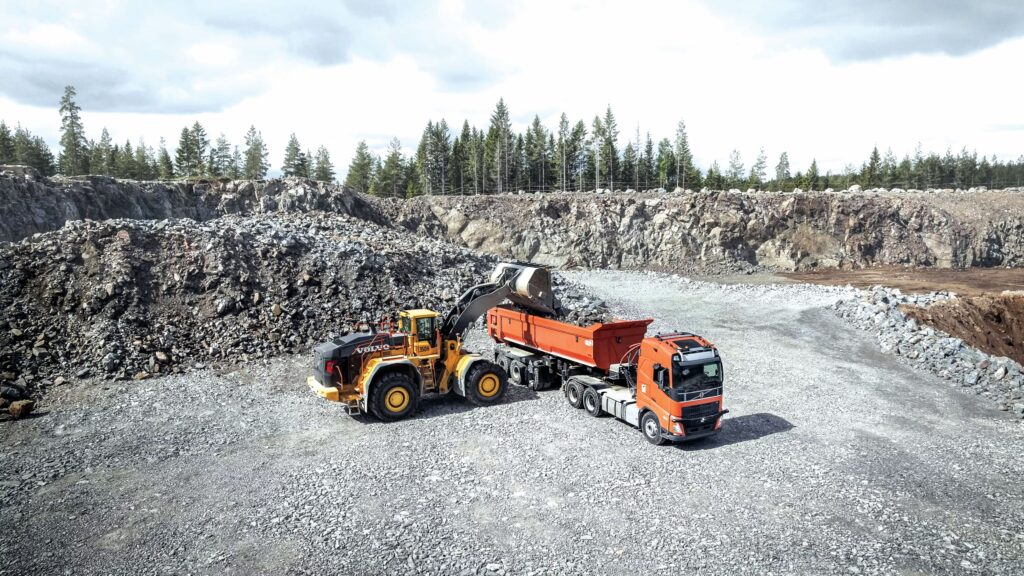
(Image: Volvo)
Integration of the autonomous software stack with vehicle dynamics is key for mining equipment, writes Nick Flaherty.
Autonomy cannot be treated as a software layer added on top of any vehicle, but it has to be built on a deep understanding of vehicle dynamics, say Cecilia Ekström, head of product Autonomy Enabled Vehicles and Machines at Volvo Autonomous Solutions (VAS) and Kristoffer Tagesson, global technology manager Vehicle Motion Management at Volvo Technology.
For heavy trucks, vehicle dynamics are especially complex. With up to 60 tonnes of material loaded on a single truck, questions about suspension, braking and steering become increasingly challenging. Heavy trucks are also fundamentally different from passenger cars, with different chassis designs, axle configurations and load distributions.
For autonomous operation, that behaviour must not only be understood in detail but also be sufficiently predictable to model so that the system can plan ahead and control the vehicle with confidence.
Combining that understanding with self-driving technology, the virtual driver can make better use of the truck’s capabilities than even a highly skilled driver could achieve consistently in demanding conditions.
To date, the autonomous transport at Brønnøy Kalk quarry in Velfjord, Norway, has covered more than 220,000 km and moved over 1 million tonnes of limestone.
Seven Volvo FH trucks equipped with proprietary virtual driver technology from VAS traverse a route of five kilometres between the mine and the crusher, which includes steep inclines and tunnels.
The vehicle itself needs to be matched to the mission starting with the route, the surface conditions, the payload, the required productivity and the steepest grades the truck must handle. In mining and quarry operations, gradeability is often a critical factor because it influences axle configuration, traction, powertrain choices and how much power the truck can deliver uphill under load.
There are also challenges when the truck is moving downhill. The truck not only has to slow down but also manage braking energy without overheating the service brakes. That is why heavy trucks often depend on auxiliary braking systems such as engine braking and retarders.
Conditions under the wheels can also vary significantly. On gravel, mud, snow or loose rock, traction will vary. In those situations, capability depends not only on torque, but also on how the truck uses functions such as differential locks and axle load distribution to make the most of available grip.
Gear strategy is another critical part of the set-up. Volvo has specifically adapted the autonomous Volvo FH’s automated gear-shifting logic to work with autonomous driving, using preview data and intended driving strategy to optimise how the truck prepares for what comes next.
Getting this right matters even more in autonomous operation, where recovery of a truck that becomes stuck can be more complex than in conventional site operation.
That requires deep knowledge of vehicle dynamics and the ability to learn quickly in the field. This becomes even more important in critical moments such as raising the bucket, where rollover risk, changing load distribution and ground conditions demand tight integration between lifting functions, vehicle control and perception.
UPCOMING EVENTS