





USVs
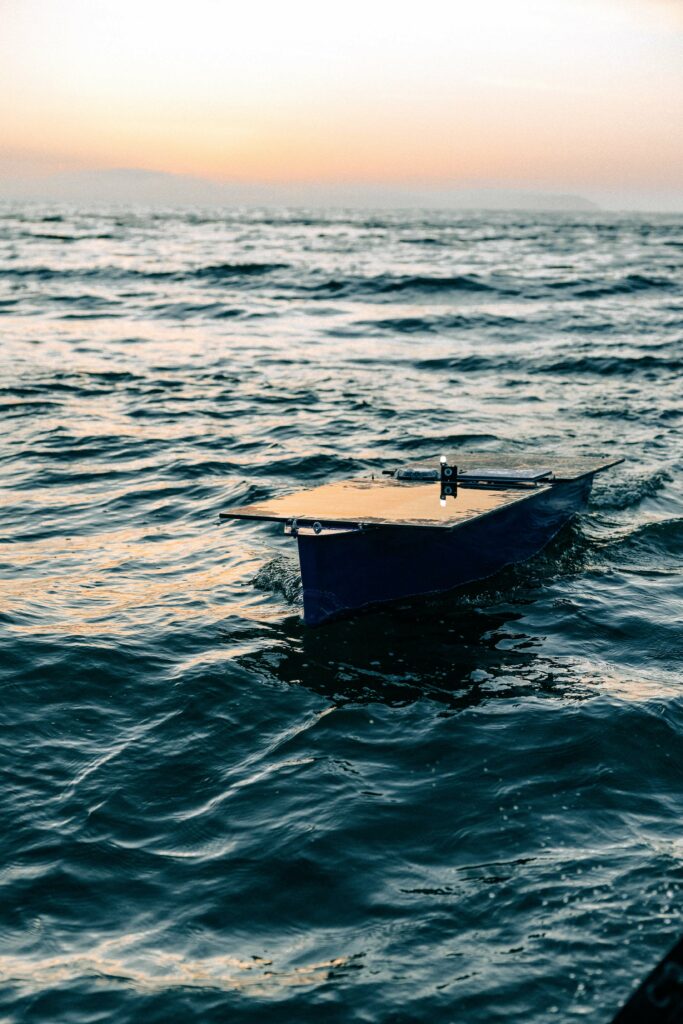
(Image: Online Oceans)
Bring me that horizon
Rory Jackson investigates a new generation of USVs that are set for niche operations beyond operators’ visual line of sight
Discussions with USV manufacturers over the past few years yielded a mild, but general frustration at the pace with which regulations around autonomous vessels were advancing. The full capabilities of self-sailing, long-endurance, oceangoing platforms had become widely known and accepted among industry, particularly in their capacity for carrying out mapping, surveying, patrol and logistics at sea with minimal cost and labour requirements – but standards introduced by maritime regulatory authorities were hindering the extent to which these could be deployed and leveraged.
Today, however, that is beginning to change, with regulatory bodies across Europe and elsewhere making particular strides in the definitions and permissions necessary for organisations looking to either begin or scale BVLOS commercial operations with USVs.
Simultaneously, the defence world has seen an explosive demand surge for far-flung uncrewed assets, and interest in USVs has particularly grown, owing not least to headlines coming out of Ukraine, where one-way USVs scored major tactical victories against some of Russia’s largest and most costly naval vessels.
Hence, whether civilian or defence in nature, one thing is clear across all maritime markets: uncrewed does not merely function as well as crewed in many applications, the former outright beats the latter in many ways. Stripping back the typical crewed ship of all life-support systems vital to keeping crews healthy and in good morale (such as quarters, kitchens and walkable corridors), and reducing it solely to those subsystems needed to get mission payloads over the necessary distances for as long as they are needed, makes for a far more efficient vessel and prevents crews from having to serve at sea for days or even months at a time.
With regulations enabling them and demand pushing them, more and more USV manufacturers are racing to fill every specialist niche- and cost-requirement, unveiling new vessel designs across trade shows, harbours and naval exercises to satisfy each type and scale of demand.
Metocean
Online Oceans is a UK-based company that has recently unveiled its Scout USV, which it both supplies to others and utilises for its own maritime data-as-a-service offerings. Although not a large vessel by any means, most USVs of Scout’s size are engineered and specified to work for days at a time, whereas Scout is very much intended (and proven) to spend months at sea, unattended and without a nearby mothership.
“We’ll also run lower-power payloads than the kinds of side-scan or multibeam sonars you see more commonly in those shorter-running kinds of USVs. There are plenty of those sorts of short-range mapping USVs serving the market already, hence why Scout has really been designed to function as a persistent sensing platform, not another mapping vessel,” explains George Morton, co-founder and CEO of Online Oceans.
The company cites comms relaying, marine mammal monitoring and maritime domain awareness as some standout missions where it views Scout as being particularly advantageous, first among them being the role of communications node from satellite to subsea.
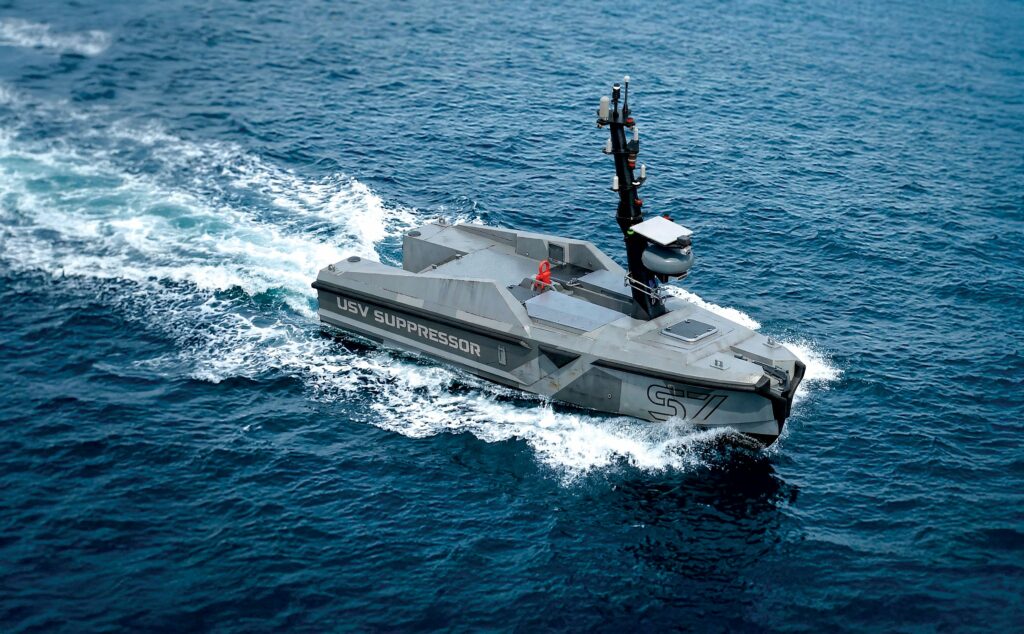
(Image: TideWise)
“But what we’ve really been doing at an increasing rate lately is meteorological–ocean [Metocean] sensing,” Morton continues.
Metocean sensing is conventionally performed using buoys, which are easy to deploy in shallow, coastal areas but comparatively hard to operate in deeper waters, meriting hiring large vessels for tens of thousands of dollars per day in order to ferry, launch and moor a buoy for the mission duration.
Certain marine protected areas will even prohibit entirely the mooring of buoys, or any other activity requiring weight to be lowered onto the seabed. Some try to circumvent such issues using drift buoys, which are designed to function without mooring – but, per their name, these can drift beyond the bounds of the area targeted for data collection. USVs, by contrast, can keep station or follow waypoints within a strict radius, without mooring, drift or crews, making them a superior alternative if engineered appropriately for the task.
“But for many organisations, it really doesn’t work financially to buy or hire a multi-million-dollar USV to take some wind measurements in a small area for a month; that’s where Scout makes particular sense,” Morton says.
“We have, for instance, one partnership with Sofar Ocean through which we essentially integrate the internals of their buoy onto Scout, allowing the USV to collect wave data on top of integrating a weather station to get wind speeds, pressures, temperatures and so on.”
Scout’s capacity for self-righting, and hence surviving lengthy operations in high sea states, comes primarily (although not exclusively) from how Online Oceans has designed the USV’s electric powertrain. The vessel’s keel is U-shaped, with two vertical members carrying cables down to a longitudinal member at the bottom, inside which the battery pack is housed (with a magnetically coupled thruster behind, thereby avoiding failure-prone seals).
“The battery is one of the heaviest components and, by putting it in the keel, we get a 1° angle of stability upside-down – the only way you can flip it over such that it stays that way is if you get it perfectly upside-down within 1° on perfectly flat water, with no inertia or wind to push it over,” Morton muses.
“Normally, boats use lead as ballast, but we saw no need to put dead weight in to increase its displacement and dry weight to no extra function. Plus, keeping the battery in the water really helps regulate its temperature in particularly hot or cold climates – water inherently being more temperature-stable than the air above it.”
Atop the USV are a plethora of solar cells for persistent energy independence at sea – hence Scout’s endurance extending up to six months at a time – plus Starlink and Iridium modems.
Much of the design and engineering has focused on finding ways to simplify the vessel architecture, both for end-users’ operations and maintenance, and for optimising Online Oceans’ own manufacturing costs and capacity.
“It’s hard to engineer simplicity, but we’ve performed a lot of iteration loops into distilling and stripping Scout down into the core elements of what makes a USV. There are just two moving parts, a motor and a rudder, and the body is a single-piece structure, meaning one person can assemble a Scout in one day,” Morton says.
“That keeps production costs down, but also means we can make a lot of them, to enable users to cover 10 times the area they usually would for a given cost investment. This is the first month we’ve been in production: we’ve made 10 boats, and we plan to be assembling 20 per month by the end of 2026 and to continue scaling from there.”
Energy
Since our in-depth discussions and investigations in 2022 (see Issue 45), Brazilian USV manufacturer and operator TideWise has continued deploying its Tupan USV in a range of missions – particularly for the country’s vast hydrocarbon and impending offshore wind industries – amassing not only nautical miles but also critical feedback on what customers needed.
“For one, they needed us to have more vessels, to cope with demand for our services, and also to be able to compete in contracts requiring persistent 24/7 operations,” says Rafael Coelho, founder and CEO of TideWise.
(Image: Exail, Gilles Martin-Raget)
“We also needed to update quite a bit of our hardware, and from our end we wanted to make our vessels easier to deploy and operate – as we don’t sell the vessels but operate them – and mobilising USVs faster means more uptime and thus less overhead cost.”
As a result of these factors, TideWise has launched two new vessels in the Tupan series – Tupans II and III – along with a Tupan IV to rapidly follow, and a few other USVs designed for other services coming in the meantime.
To ease deployability and maintenance, the new Tupans incorporate a wide range of minor modifications, including being slightly bigger than the original Tupan (specifications to be published) but still fitting into 20 ft containers, and installing mechanical features to more easily have them lifted by small cranes or towed by pickup trucks.
“We’re also now integrating a dedicated electronics rack meant solely for payload-specific installations, and we’ve made the cable routing from the payload bay to the computer section a lot easier and with ruggedisations there. So, it’s a lot easier and safer to retrieve or push cabling through when you’re exchanging sensors,” Coelho continues.
“The latter especially was a real time-sink in the field, and every hour of downtime in the field costs effectively 10 times what it costs if you’re just routing cable back in the workshop.”
(Image: Open Ocean Robotics)
The new USVs also integrate secondary, standby generators making their powertrains fully dual-redundant, enhancing not only mission reliability but also endurance thanks to the additional fuel tank volume coming with the extra generator.
“Tupan II just did a seven day mission, 159 nautical miles [294 km] offshore, without any issues – so the second generator really does make our lives easier and more stress-free,” Coelho muses.
“And having incorporated TideWise Europe in August last year, Tupan III is going to be shipped to Belgium in July 2026 to carry out bathymetry at an offshore wind farm.”
Tupan II also completed an environmental DNA (eDNA) survey for Equinor in mid-April 2026, assisting in the collection of nearly 200 samples of marine species’ genetic material in Guanbara Bay and from oil fields in the Santos Basin, with a payload developed and integrated by the Monterey Bay Aquarium Research Institute.
Tupan III and its siblings are anticipated to continue using stabilised platforms from Norway’s STABLE for the launch, recovery and stowing of UAVs, to combine aerial and underwater inspection capabilities, including the deployment of winched ROVs for deeper or closer-up subsea inspections than can be achieved with USV-mounted sensors in certain circumstances. TideWise successfully demonstrated such ROV operations last year, using an ROV built in partnership with BRS (a Brazilian ROV company) using components sourced from Blue Robotics in the US.
TideWise is, however, incorporating some proprietary changes to more securely recover the UAV during landing, and is also switching away from DJI drones to a Brazilian-made UAV, being co-developed with Speedbird Aero.
“These new USVs also incorporate feedback from classification societies, as USV regulations have improved a lot since 2024 worldwide, and here in Brazil we’ve been working with the navy to get local regulations as close as possible to what’s forming in international standards, particularly those in Europe and the UK such as MCA Workboat Code 3,” Coelho adds. “Regulations are even now being coded to standardise BVLOS operations of UAVs via USVs, which really helps us bring our combined USV–UAV–ROV operations to wider ranges of customers.”
TideWise’s work with the Brazilian navy also now extends to producing military type USVs, with two designs unveiled so far, styled as the Suppressor 7 and 11 (for their lengths in metres, and to differentiate them from the more civilian-oriented Tupans). The former is to be launched in July 2026 as a mine countermeasure USV (although reconfigurable as an ISR platform), with particular architectural and hydrodynamic design elements to optimise it for long, energy-efficient endurances in harsh conditions, such that it can cover Brazil’s enormous coastlines and river lengths (in the Amazon and elsewhere).
“Suppressor 11 meanwhile is heavily focused on surveillance and anti-submarine warfare [ASW], and to that end we’re also building it for long-endurance operations,” Coelho notes.
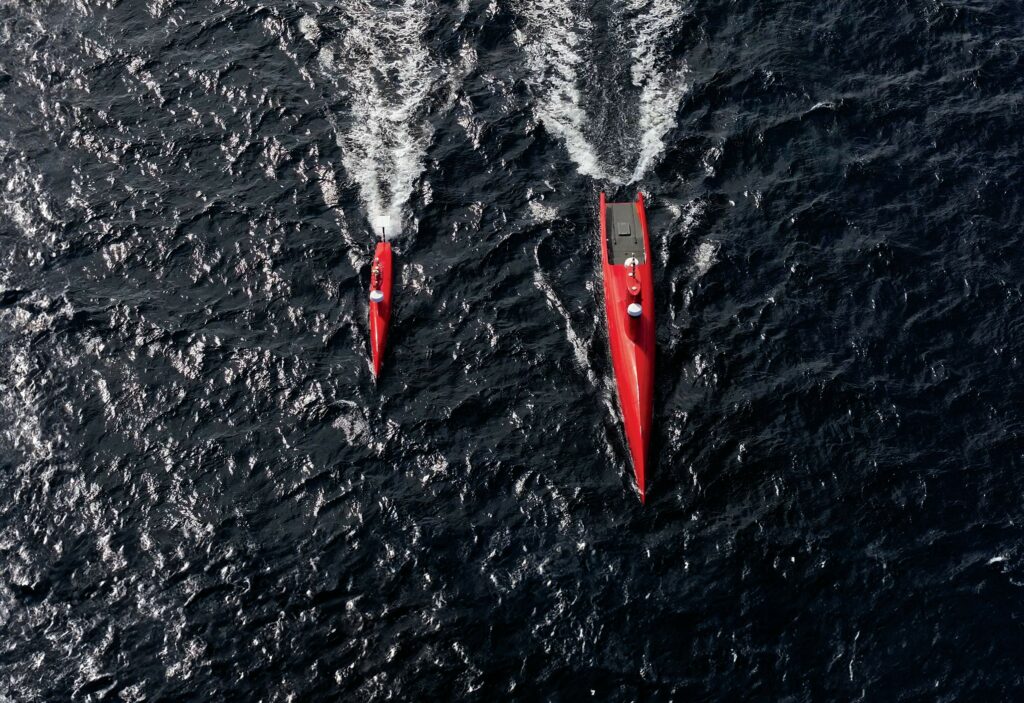
Meanwhile, French OEM Exail successfully sold the first unit of its new DriX H-9 USV for civil operations to a European client in March 2026. The 9 m long, 2.1 t displacement vessel is to integrate a multibeam echosounder, a side-scan sonar, a sub-bottom profiler and a magnetometer for performing surveys of offshore infrastructure.
“With the DriX H-9, clients can operate over the horizon with up to 20 days of endurance while deploying a complete geophysical spread,” says Olivier Cervantes, Exail’s VP for maritime autonomy solutions, referring to the H-9’s sensor complement.
Chemical spills
When aquatic chemical spills occur, the response efforts often need to be as complex, multifaceted and strategic as the response to an earthquake – despite likely occurring out at sea and far from populated areas – to prevent long-term ramifications on the ecology, marine industry and coastal communities.
(Image: Saildrone)
Study and practice of such responses is crucial to minimising the harmful impacts of spill disasters. To that end, the Maritime and Port Authority of Singapore simulated a methanol tanker collision off the city’s southern coast last year, in which Open Ocean Robotics’ DataXplorer USV participated along with several other vessels and many dozens of personnel.
The system was deployed in air quality monitoring duties, such that crewed vessels were able to stay away from potentially dangerous stretches of water – demonstrating its capacity to keep human personnel free from the risk of inhalation or other exposure to chemical vapours.
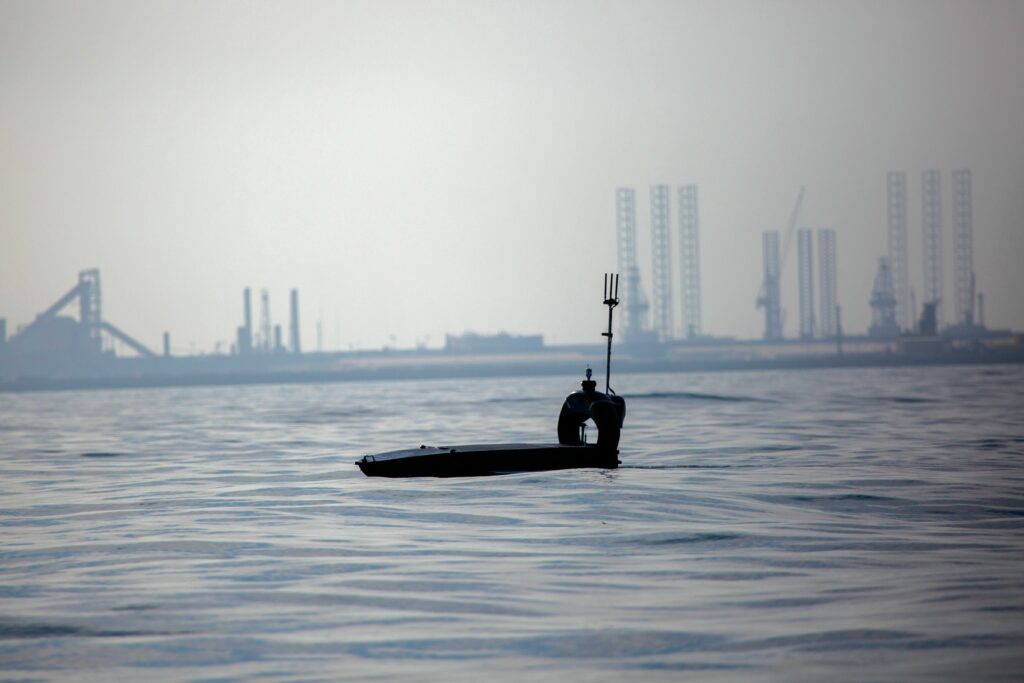
On top of being able to integrate different sensors such as those used in air quality measurements, the Canadian USV manufacturer and operator presently offers several versions of DataXplorer that come integrated with entirely different sensor packages based on the application.

As a pertinent example, the DataXplorer Enviro may come integrated with the Pro Oceanus CO2-Pro sensor for detecting partial pressure of CO2 in surface water and air, by which changes in marine carbon dioxide can be monitored, reported and assessed for removal initiatives. It can alternatively use McLane Labs’ Robotic Cartridge Sampling Instrument eDNA sampler for tracking the movements and diversity of underwater wildlife to aid in aquatic conservation efforts while maintaining distance from animals and their habitats.
This and the USV’s other configurations come with the same 3.7 m length fibreglass hull, recognisable for the rear-mounted, ring-shaped roll bar for self-righting, along with its 300 W of deck-mounted solar cells. That hull also features a 0.9 m beam and 0.5 m draft, optimised to cruise and survey at 2 knots, with a top speed of 6 knots, provided via the 3 hp electric motor. As standard, the USV comes with 3.5 kWh of battery energy enabling 100 NM of mission range, although additional, optional battery packs can be integrated to maximise onboard energy up to 17.5 kWh, which then boosts range up to 500 NM (not accounting, however, for the extra recharge and range derived from solar energy intake).
Notably, the exercise in Singapore also included the use of drones in vessel assessment, raising the potential for DataXplorer and other USVs to function as part of a networked response with multiple uncrewed assets, coordinated via a unified interface. The DataXplorers integrate 3G, 4G and LTE cellular comms, along with satcom and radio options, to facilitate such interoperability along with standard LOS and BVLOS monitoring and in-the-loop control.
Anti-submarine warfare Although Saildrone’s USVs are best known as tools for persistent, cost-efficient oceanographic mapping, the company has recently unveiled a new solution that has been optimised around ASW.
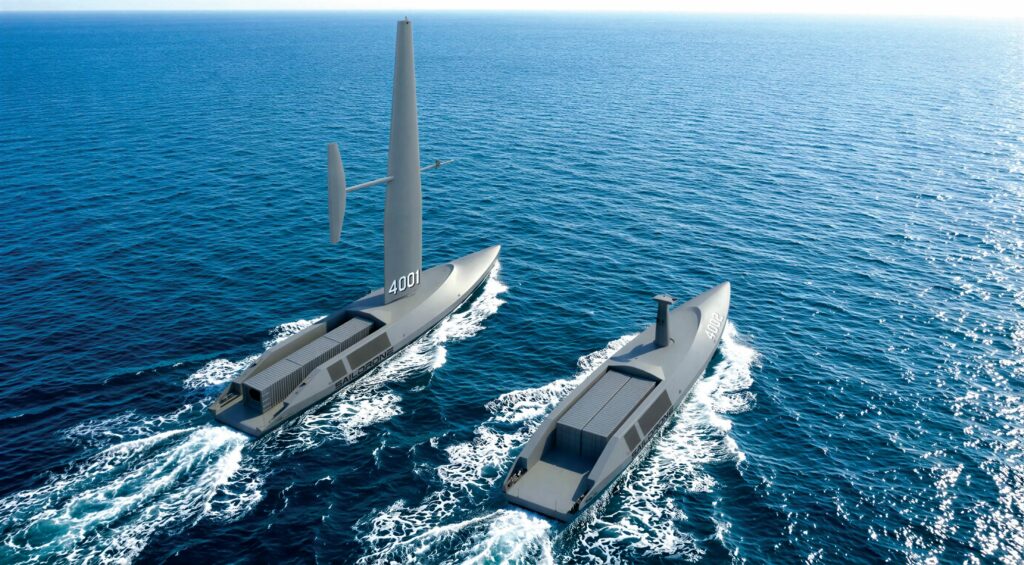
The Saildrone Spectre is capable of a maximum speed of 30 knots, making it the fastest of the Australian OEM’s vessels (as of writing). While powered by a combination of wind, solar-electric and diesel systems similar to the civilian-facing Voyager and Surveyor USVs, Spectre also integrates twin shaft-lines for dual electric and diesel propulsion.
The new USV measures 52 m in length, weighs in at 250 t, and has been designed over a two year project duration to meet ASW requirements such as very long mission endurances and a tightly minimised acoustic signature.
Construction of the high-speed USV’s aluminium hulls will take place at Fincantieri’s shipyards in Wisconsin (USA), from which the Italian-headquartered shipbuilder will be capable of delivering five units annually, with the first constructed unit planned to commence sea trials in early 2027.
Meanwhile, American Magic Services at the American Magic High Performance Center in Pensacola, Florida, will similarly produce up to five of the USV’s composite wings (each measuring
43 m tall) per year, drawing on its lengthy experience in composite design and engineering accumulated from competitive sailing series such as the America’s Cup, along with additional past work in aerospace, defence and other marine applications.
With the diesel and electric systems working together for a 25 knots standard cruise (including while carrying a 25,000 kg payload), Saildrone estimates the USV’s range at 3280 NM in calm waters, or 2790 NM if operating in a Sea State 4 head sea.
To further optimise range and endurance for the ASW use-case, the vessel’s propellers integrate pitch-controllable blades to maximise hydrodynamic efficiency at any operating speed. Naturally, blade pitch can also be adjusted to lower Spectre’s acoustic signature as needed, reducing both conspicuity during high-speed interceptions and interference with the quality of data derived during low-speed surveys with thin-line towed arrays and variable-depth sonar systems.
As of writing, the TB29 towed body and the Mk70 Vertical Launching System (the latter enabling missile deployments) from Lockheed Martin, along with the CAPTAS-4 variable-depth sonar system from Thales, are counted among those systems compatible with the USV’s design.
Alternatively, containerised payloads can be integrated, up to total counts of two 40 ft containers or five 20 ft containers, by which mission systems can be shielded against harsh sea conditions as well as outside surveillance.
Verification and testing of Spectre’s CFD and propulsion systems have been carried out at Force Technologies’ tow tank in Copenhagen, Denmark, with the American Bureau of Shipping having approved in principle of the USV’s design (a vital step towards full approval of the later, fully-matured vessel design).
C-UAS
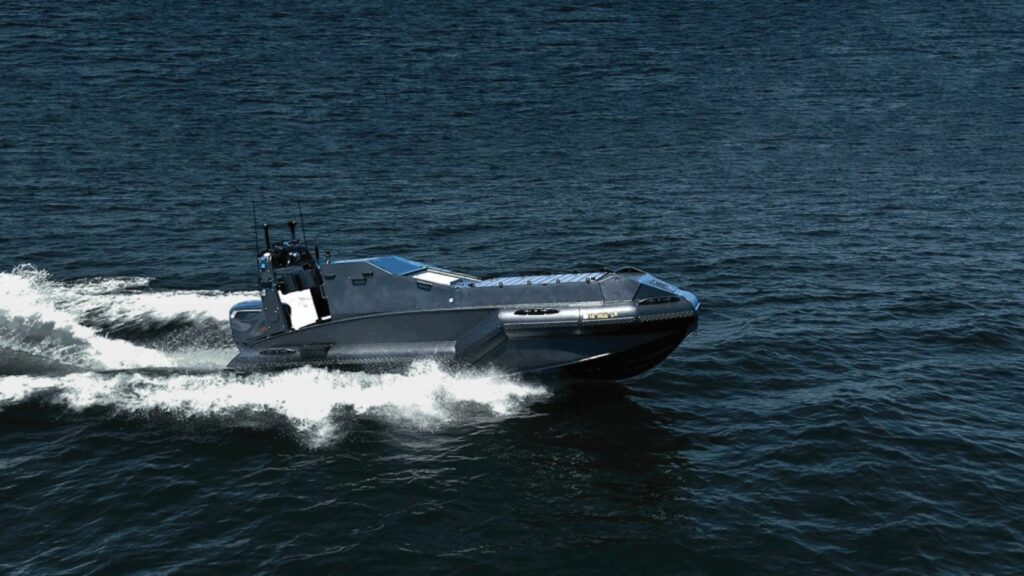
Although Sea Machines Robotics has arguably been best known for its C2 solutions for autonomous vessels, it has in more recent years become an OEM for USVs of its own design and engineering. The US company has unveiled two USVs so far: the 7 m Selkie, and the 8 m Stormrunner. In April 2026, the newer Stormrunner was announced as having been selected to integrate and demonstrate Leonardo DRS’s maritime mission equipment package (M-MEP) for C-UAS applications.
The M-MEP is an open-architecture payload ecosystem, designed to function on USVs of 14 ft (4.26 m) length and larger, while incorporating varying means of UAV detection and neutralisation.
As standard, the M-MEP’s sensors will include active and passive radar systems, as well as EO/IR gimbals, while utilising GPS, 4G and 5G electronic warfare systems to throw off detected drones’ navigation and flight control systems. Kinetic payloads can also be integrated where such non-kinetic approaches are insufficient, with Leonardo DRS emphasising the more cost-effective nature of SWaP-optimised munitions designed for integration on USVs when compared with the larger, highly-expensive kinetic C-UAS ordnance recently being used to neutralise low-cost drones and missiles in various conflicts.
The Stormrunner is designed with 450 kg of payload capacity (including an internal payload bay with dimensions of 2.0 x 1.3 x 1.0 m, and other modularly configurable mounting zones) to accommodate multi-part systems such as M-MEP, with its payload bays and hardpoints supported by a high-density polyethylene hull. The structure also integrates buoyant tubes for added stability at the craft’s speeds that can run in excess of 40 knots (with a 27 knots cruise enabling ranges exceeding 700 NM) – Stormrunner’s diesel powertrain with 300 hp of outboard propulsion enabling these speeds and distances.
Additional features safety-critical to operations in conflicted waters, such as dynamic mission editing, collision avoidance, and trail and intercept capabilities, are enabled through the SM300 Autonomous Command and Control system (also by Sea Machines).
(Image: Sea Machines Robotics)
Summary
With USVs imminently ready to perform C-UAS and ASW missions, including active weapons fire against enemy aircraft and vessels, it is only a matter of time before the first surrender of a crewed ship to an uncrewed vessel takes place (just as the first surrender of human soldiers to a UAV occurred in 1991, and the first to a UGV in July 2025). Conversely, advancements in USVs for disaster relief and casualty rescue mean that the first instances of lives being saved directly by an autonomous vessel are also very likely looming.
With autonomous navigation at sea being markedly more challenging than on land, given the absence of landmarks for GNSS-denied localisations via Lidar or vision, advances in offshore positioning, navigation and timing solutions will be crucial to supporting the expansion of USVs’ roles across these and future applications. BVLOS comms technologies will also be critical, not only for monitoring autonomous USVs’ telemetry, but also for networked and swarming systems that stand to aid USV operations through multi-domain awareness, TOF-based localisations and other means.
Further innovations in efficient wind, solar and wave power will also be key to maximising the lifespan of USVs, given their arguably greater persistence than UAVs, UUVs and UGVs in their mission environments (although new solutions to mitigate biofouling, corrosion and slamming damage will then become crucial differentiators in autonomous vessels’ long-term ROI).
The uncrewed world is, fortunately, rich in innovations ideal for supporting all these needs and more, and so the wider spread of USVs across Earth’s oceans and rivers – for the safety and good of beings on- and offshore – is likely just a matter of time.
UPCOMING EVENTS