









UGVs
(Image: Mercedes-Benz)
Introductions in order
The world stage of uncrewed systems on road and land is being walked by a new wave of all-new tech enterprises, as well as older companies entering from other industries as the value of autonomy grows clearer. Rory Jackson investigates
Once, getting hold of the kinds of sensing, computing power and digitalised control systems necessary for uncrewed mobility (both on- and off-road) was a nightmare of cost and supply-chain barriers. Today, however, much of the technology for powering autonomous land vehicles is practically commoditised, such is the relative ease with which they can be acquired.
For instance, open-source and other autonomy packages for core intelligent driving capabilities are easily accessible, and complemented by add-ons covering the majority of edge-case behaviours and AI features that a vehicle could need, no matter what niche market it might serve.
And as complex as the algorithms underneath these stacks are, AI computing products powerful enough to run them with multiple redundancies are now designed, manufactured and supplied worldwide for uncrewed mobility companies chasing both certifiability and scalability. Critical perception sensors such as automotive Lidars, radars and cameras are similarly proliferating, with significant competition in each respective industry catering for different price, performance and footprint needs.
Meanwhile, advances in the EV world have revolutionised network architectures and comprehensively digitalised drivetrain systems, not to mention making subsystems for these widely available and affordable, from small sensors down all the way to high-voltage automotive battery packs and e-axles.
This surge in accessibility has opened the doors to a wide array of UGV and AV markets, each with application-specific nuances that countless companies are discovering, from old hands across automotive and heavy industry, to new players targeting everything from defence to home use.
That, in turn, is pulling the curtains back on a very wide range of new ground vehicles and system architectures. While many UAVs are still offered as multirole systems, carrying cameras and packages with equal gusto, this will not do in the UGV or AV space: funding, contracts and headlines are being won by those who specialise, dedicating R&D to ensure their autonomous systems are deployed as efficiently and practically as possible.
Robotaxis
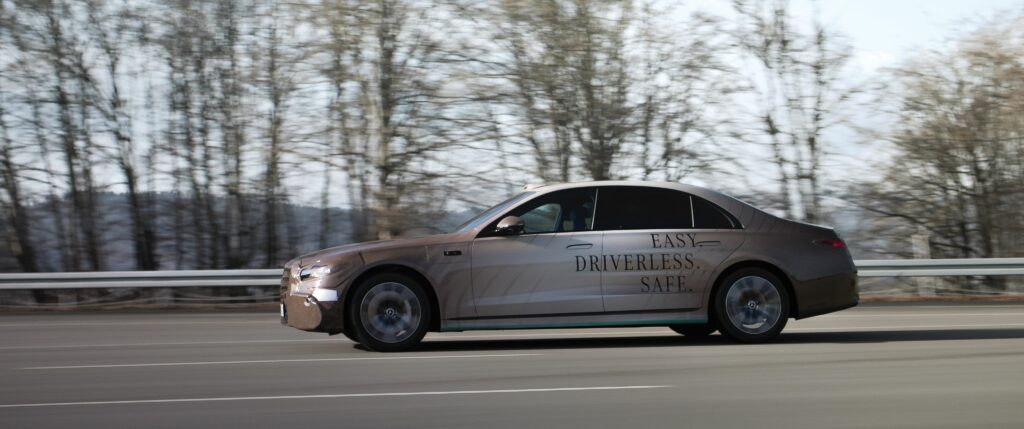
It is the policy of Mercedes-Benz, for instance, to focus heavily on developing an ecosystem around autonomous taxi platforms and services, or ‘robotaxis’, and the German automotive group is working closely with technical partners such as NVIDIA and Momenta, as well as mobility service companies like Uber and Lumo, to build that ecosystem based (at least initially) on the new S-Class.
As Alexandros Mitropoulos, Mercedes-Benz spokesperson for autonomous driving and parking tells us, “Mercedes-Benz is already a pioneer in the higher levels of automation and can present numerous innovations, some of which are being tested and some of which are already at the customer’s site.
“Advanced L2 features for urban point-to-point driving assistance, faster L3 speeds for hands-free, eyes off highway systems, and L4 for commercially and privately owned vehicles are our goals, and we have a clear roadmap for that.”
As announced in January 2026, integrations along that roadmap, in line with the OEM’s rigid standards for driving intelligence and functional safety, are to include the NVIDIA DRIVE Hyperion architecture and the full-stack AV L4 software from the same brand, along with the NVIDIA Alpamayo portfolio of open AI models, simulation tools and datasets.
Mitropoulos adds, “In line with our safety-first approach, we rely on a redundant system architecture. We use some 30 sensors with different sensor modalities in our new ADAS generation, fuse these raw data with map data [meaning, no HD maps needed] and all other available data [for example, data from the MB cloud] in a very capable supercomputer in order to enable safe automated driving. Even the algorithms for ADAS are redundant.”
Notably, around the end of 2025, Mercedes announced another L4 project with Momenta, also towards the development of a robotaxi system based on the new S‑Class, with the latter company planning to operate it initially in Abu Dhabi (the first S-class robotaxi test vehicles being slated for deployment there later in 2026), with options for other locations thereafter.
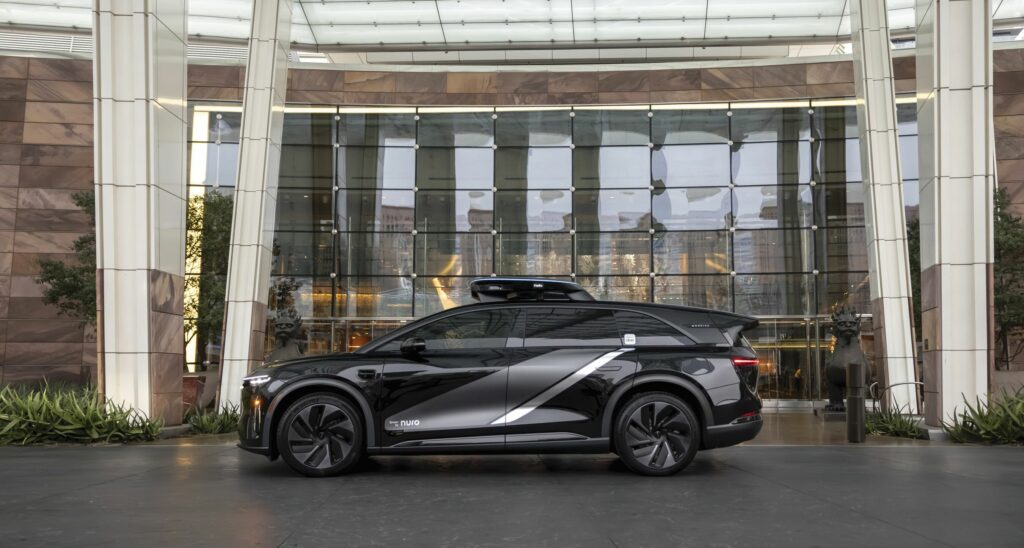
Also in early 2026, Lucid, Nuro, and Uber Technologies unveiled their production-intent vehicles designed for enabling their global robotaxi services, and announced that autonomous on-road testing began as of December 2025, with Nuro leading the test program via remotely supervised prototypes initially in the San Francisco Bay Area.
The program is evaluating several dozen capabilities across the full autonomy stack (including Nuro’s end-to-end AI foundation model), and in addition to on-road testing, closed-course testing and simulation are also being performed as part of the program objectives of validating performance across many different scenarios. Manufacturing of the robotaxi is expected to start at Lucid’s Arizona factory later in 2026, pending final validations.
Public transport
As discussed in our cover story (page 24), public transport services are a good fit for driverless autonomy because buses, shuttles and the like operate along fixed routes and schedules, making them predictable, programmable and in dire need of decoupling from the vulnerabilities of human staff, as shown through the drop-offs of such services during the COVID pandemic.
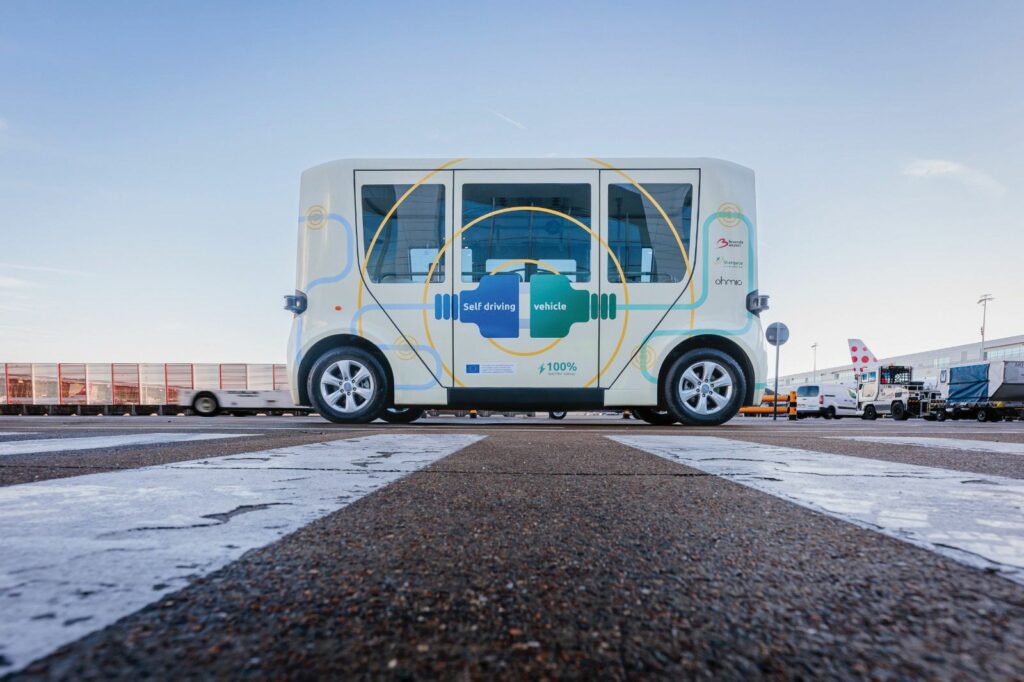
For Ohmio, the fit has proven very good. Although founded in remote New Zealand, its autonomous LIFT minibus has quickly gained partnerships and projects all over the world, with a notably recent trio of trial programmes across Europe.
Particularly high-profile among these has been the Ohmio LIFT’s work at Brussels Airport. As Kevin Denis, Ohmio’s head of operations for Europe, the Middle East & Africa (EMEA) tells us, “Our operations at Brussels are essentially split into two separate projects or phases: the first was a six month set of trials ‘air-side’, driving amid live traffic in the airport’s infrastructure, while the second was more for commercial services ‘land-side’, still in territory owned mostly by the airport but accessible to public traffic.”
The former project concluded in early 2025 and consisted largely of moving airport employees across the tarmac, while the second closed just before the end of 2025, and focused more on moving passengers and visitors from remote parking lots to terminals.
(Image: Lucid Group)
Each subjected the LIFT to substantially different conditions, thereby imparting different lessons and development data to Ohmio’s technical team. “On the air-side, you have a very controlled environment with rules to adhere to, so our top speed of 30 kph worked fine, but we also had to bear in mind that everyone in and around the vehicle was extremely busy: every member of airport personnel has strict schedules and must be on-time, the other vehicles could occasionally be emergency teams – it’s a structured jungle.”
Land-side, however, that top speed risked significant deltas versus other vehicles on the public roads, such vehicles behaving with little compassion for an autonomous shuttle running at 30 kph (even with passengers inside) as they themselves routinely surpass the 50 kph speed limit. Hence, clear lessons were implemented into Ohmio’s autonomy stack for edge cases such as busy roundabouts or intersections, where erring on the side of caution while still picking key moments to be decisive was crucial.
Joost Ortens, Ohmio’s director for EMEA and corporate development adds, “We’re going to do more and more with AI-based perception analytics, for the vehicle to inherently understand situations playing out around it, and so anticipate beforehand whether slowing down or speeding up is smart.
(Image: Ohmio)
“We’re now in a very similar second project phase with Amsterdam Schiphol – airport projects tend to open doors for other airport collaborations, and those types of customers tend to come back to us periodically, for investigating new ways to become more efficient and reduce running costs via AVs or UGVs.”
The company is also five months into a 10 month, second-phase trial focused around the University of Turin’s public roads and conducted via an on-demand rideshare app. That trial has featured use of vehicle-to-everything (V2X) systems, enabling LIFT to communicate with traffic lights, receiving advance warnings before a light turns red or green.
While exploring other applications of V2X technology through this partnership, the Ohmio team has also gained data and experience handling the crowded and occasionally unpredictable nature (as they describe to us) of Italian roads and traffic, compared with the calmer conditions of Belgium, the Netherlands and the UK.

Ohmio’s trials in the UK have focused more on city centres, business parks, new development zones and expo grounds such as the NEC Birmingham, as Ohmio’s UK director Ian Pulford tells us.
“A big share of our UK attention has been in Milton Keynes, which has 300,000 residents, growing to maybe half a million in the years ahead, which means there’s thousands of new residences under construction in the city centre,” he explains. “That brings serious questions as to how people are going to move around, commute and park cars – or if they’ll even want to own cars.
“Attitudes to car ownership are changing, especially with younger demographics who work from home more and care about the environment, and changing rules with new builds mean there may not be so many parking spaces to go around. Public transport AVs give people alternative options to owning cars, being electric and autonomous makes us as green as any scooter or e-bike system, and while we’ve become quite advanced in running LIFT in mixed British traffic, city centre traffic doesn’t move at high speeds so it’s not hard for AVs to tackle.”
Others around the world are joining the growing chorus of autonomous public transport, with Michigan-headquartered May Mobility having recently announced its partnership with Italy-based EV manufacturer Tecnobus (a subsidiary of the multinational ICAP Group).
The former’s Multi-Policy Decision Making (MPDM) software platform is being integrated onto a new minibus platform by the latter, which is built to accommodate up to 30 passengers and for top speeds of 45 mph (72.4 kph), as well as being homologated for deployment in Europe and Canada as well as key US sites.
The first autonomous minibuses are expected to be road-ready before the second half of 2026, with deployments to follow shortly thereafter that will put MPDM’s in situ AI and real-time learning capabilities to the test in various driving conditions, as well as in urban transit, corporate campus, airport and similar application environments. The buses themselves represent May Mobility’s fifth unique vehicle platform (alongside others such as the better-known
Toyota Sienna Autono-MaaS [Mobility-as-a-Service]), and are also constructed for fast swapping of their battery packs to minimise downtimes and energy wastages from overreliance on fast charging.
Personal mobility
Other companies, however, anticipate personal ownership of self-driving cars growing alongside MaaS models into the future, and are thus developing AVs intended to be purchased and driven by individuals rather than necessarily as part of a shared mobility fleet.
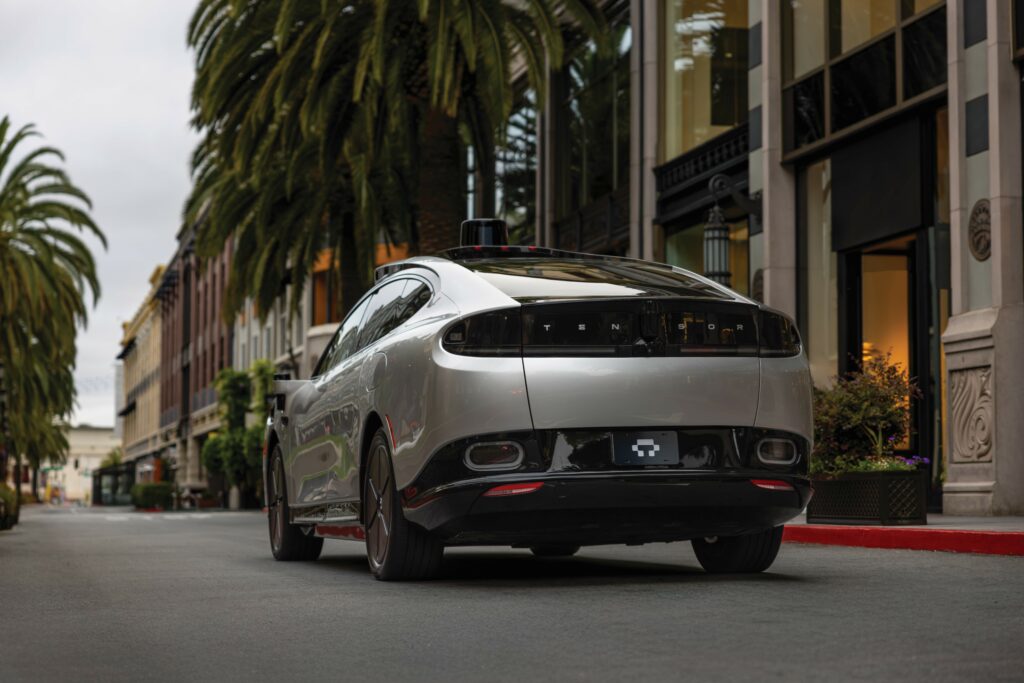
As discussed on page 6, Tensor is among the latest with such an AV, its Robocar having debuted in Dubai in late 2025. The Robocar is a 552 cm long, battery-electric, five-door hatchback, designed for a futuristic feel with a liquid metal body finish and obsidian-black highlights that conceal its perception sensors, as well as other key subsystems like lights, displays, cleaning systems and protective covers.
Most conspicuous of its sensors is the roof-mounted Tensor Halo Lidar, which emits 25.6 million beams per second and runs on AMD and Broadcom processors to track objects around the vehicle. Four shorter-range Tensor Sentinel Lidars sit at approximate corners to cover blind spots, having been designed for fields-of-view in its detections of 180° horizontally and 110° vertically.
The company claims each of its Lidar models to boast considerably higher performance and reliability in a range of metrics than COTS Lidars, including the ability for each beam to capture multiple laser returns and thus detect accurately through challenging conditions such as severe precipitation and dust.
(Image: Tensor)
It attributes such capabilities to its use of Texas Instruments’ (TI’s) advanced analogue-to-digital converters (forgoing basic time-to-digital converters it says are more typical of conventional Lidars), preserving key data signals that supposedly empower Tensor’s Lidar processing algorithms to better distinguish true signals from noise, as well as garnering reliable measurements of object reflectance.
37 cameras (17 of which are ultra- hi-res external sensors) and a unique radar solution round out the Robocar’s sensor suite, with data from these processed via an 8000 TOPS supercomputer running eight NVIDIA DRIVE AGX Thor SoCs as well as two TI TDA4VH SoCs, two NXP S32G 399A vehicle network processors, and four Renesas RH850 automotive microcontrollers.
The interior also features some novelties developed to suit the self-driving application, such as its foldable pedals and steering wheel that stow to maximise the driver’s comfort while the car runs autonomously. Tensor credits the pedals to Batz and the steering wheel (along with the by-wire components and architecture) to its suppliers Autoliv, ZF and Veoneer.
First unit availability and deliveries to the US, EU and Middle East markets are planned for later in 2026.

Domestic duties
Although autonomous mobile appliances have become commonplace in and around people’s homes, it is key that their manufacturers continue to scale and offer minor innovations that enhance the practical autonomy of such systems because reducing the need for human intervention is as important in the home as it is in the field.
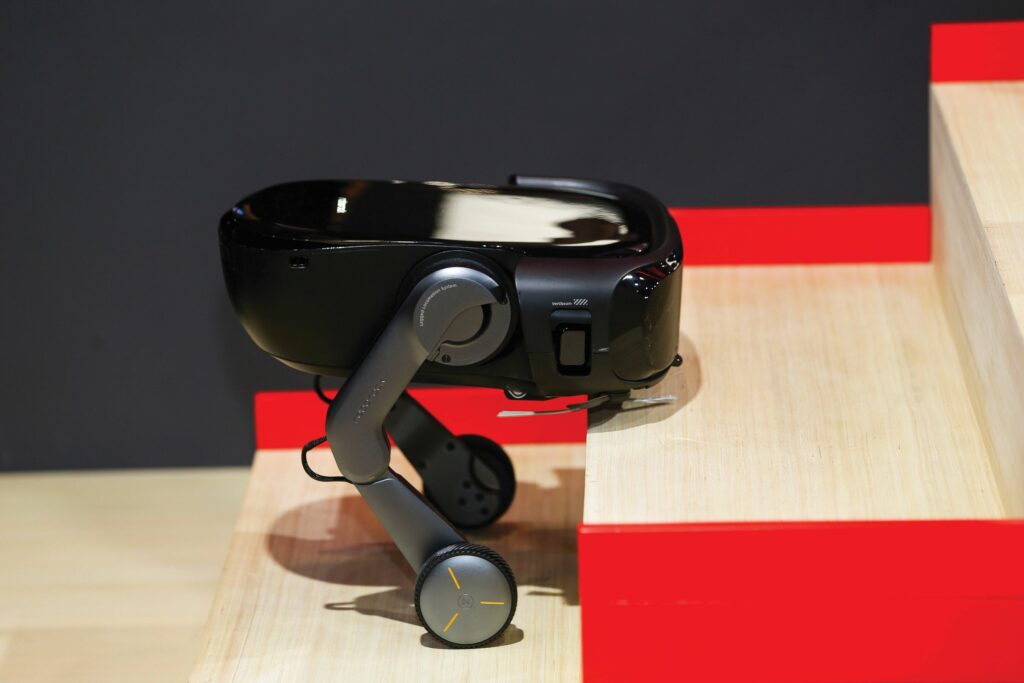
For instance, Roborock has unveiled its upcoming Saros Rover, touted as the first robotic vacuum with a wheel-leg architecture that enables it to traverse stairs and slopes intuitively, while also cleaning them. We first saw a wheel-leg system used on the quadrupedal security UGVs of Swiss-Mile (featured in Issue 57, now renamed RIVR, and pivoted into doorstep deliveries of packages and takeout), although the Saros Rover is, unusually, a bipedal system.
Either of the two wheel-legs can be actuated independently, raising and lowering as needed as it encounters differing slopes, or the need to maintain balance with one wheel-foot on the step below while cleaning an upper step. Thus, each wheel-leg supports the robot’s need for elevation and reach, including with agile turns and small jumps, while the body is kept level to prevent imbalances.
(Image: Roborock)
As with known generations, 3D laser scanning and optical sensing are used for room-specific mapping and localisation – and now, also for determining context-specific wheel-leg actuations and the necessary poses of the robot for continued balance amid narrow stairs or precarious slopes.
Similarly, Lopkin’s new E Series autonomous lawnmower comes with robotic arms to enable self-recovery (instead of calling upon its owner for salvation) in the event that it gets stuck in a ditch, divot or similar type of lawn depression.
The ‘TerraXcape’ self-recovery system triggers in response to wheel slip or immobilisation sensor signals, with the arms actuating to help the robot climb out of the depression or over an impeding obstacle, and then retracting again once the concerning signals are gone. Depressions of approximately 15 cm in depth and obstacles of around 8 cm can be handled by the solution.
These capabilities come alongside the company’s pre-existing use of RTK-GNSS, wi-fi connectivity, and AI-based evaluations of grass characteristics and environments (with analytics for terrain, sunlight, rainfall and season influencing how the robot adjusts its blades’ mowing height, speed and frequency).

Defence
While companies from across automotive, consumer electronics and heavy industry increasingly innovate autonomous vehicles and robots, it is far rarer to see aerospace-focused defence companies come forth with UGV solutions, outside of the world’s 10 largest military OEMs and contractors (although those companies have been noted to us as lacking agility when it comes to developing and maturing quality UGVs).
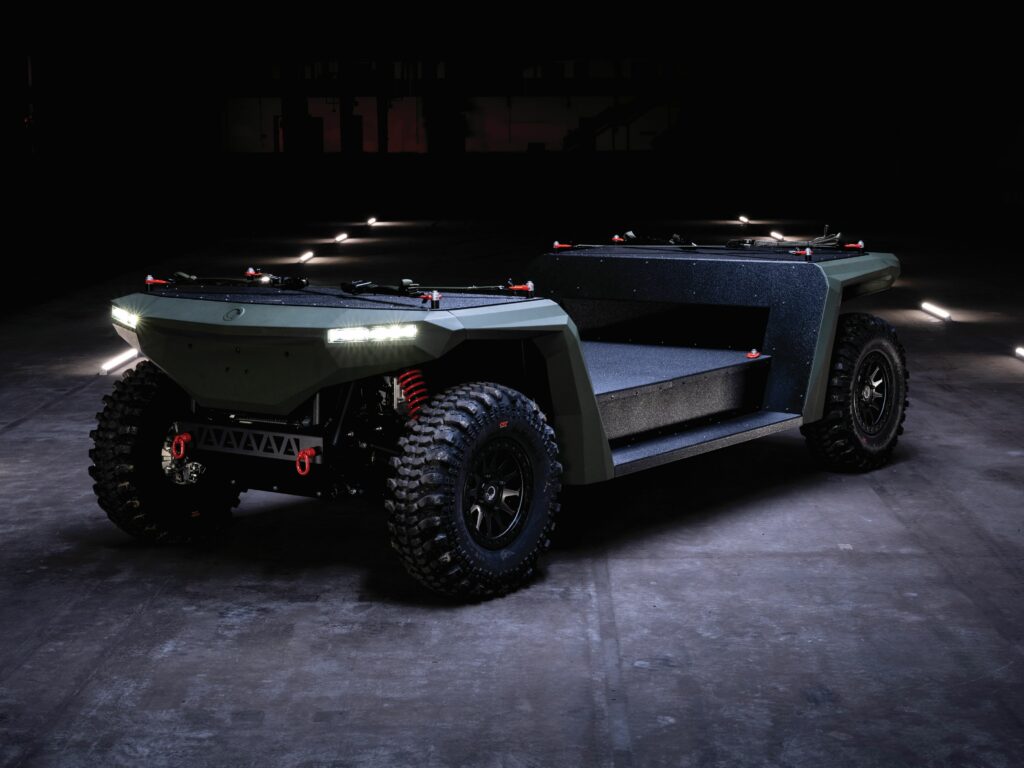
The recent unveiling of the Mandrill UGV from Quantum Systems (introduced on page 16), best known for its cost-efficient, battle-tested survey UAVs and networking solutions, is thus a peculiarity.
The German-headquartered multinational has gained weighty attention and experience through its work supporting Ukraine’s defence efforts since 2022 and, as a result, it came to understand that a crucial value-addition for modern military customers is the capacity to provide an interconnected network of cross-domain vehicles and related systems – including air, ground and maritime systems.
“We already connect vehicles of those three different domains through a common software layer that we call our MOSAIC UXS product – which can also be combined with an additional solution, the MOSAIC Ground Autonomy Kit, for retrofitting autonomy into trucks, armoured vehicles and so on – and thus Quantum felt the logical next step was to expand from its very mature aerial product portfolio into the ground space,” says Hendrik Kramer, vice president of Quantum Systems’ ground domain.
“This won’t just be one isolated platform but a family of modular vehicles to address all use-cases in the ground domain, and the Mandrill UGV is the first we’ve introduced. It’s a wheeled platform, designed as a mid-to-large sized system that is for carrying up to 750 kg of payload. That’s ideal for many missions, but especially ISR [Intelligence, Surveillance and Reconnaissance] as the overall vehicle has a very low silhouette, and is fully electric and therefore quiet, but still with a long-range capability for patrolling and monitoring perimeters.”
The Mandrill’s open, central flatbed enables mounting of other systems besides ISR sensors, with Quantum Systems continually working to integrate new systems into its in-house stack of control algorithms and APIs, those compatible payloads presently including logistics pallets, remote weapons stations, C-UAS devices and UAVs such as those Quantum’s engineering is best known for.
Naturally, however, UAV engineering does not lend itself seamlessly to UGV engineering. To bring the necessary skills for the latter in-house, Quantum Systems gradually acquired three companies: Mandrill GmbH, a specialist in developing off-road EVs (and the new UGV’s namesake), Fernride, a specialist in certified autonomous trucking (founded by Kramer) and the breakout AI software house, Spleenlab.
(Image: Quantum Systems)
“Spleenlab’s talent in computer vision was especially key to integrate and make part of our ground domain mission capabilities, so that intelligent autonomy will be possible across all our UGV sizes, including some smaller vehicles and some super heavy, tracked ones,” Kramer adds.
Eight cameras integrate inside the vehicle’s body and around its perimeter for 360° perception, with Quantum strictly avoiding Lidars and radar for this UGV because their emissions would risk revealing Mandrill’s position in the field. For road vehicles targeting certification via the MOSAIC Ground Autonomy Kit, the company gladly provides all three sensor modalities, but is confident that their absence in the Mandrill will yield largely stealth benefits and a minimum of edge case issues, thanks to Spleenlab’s AI enhancements and the occasional remote human intervention.
As the UGV drives, the electric powertrain enables speeds of up to 100 kph, with commercially available automotive components chosen across the energy, power and drivetrain systems to ensure scalability and reliability, including Mandrill’s 150 kW dual electric motor drive, battery packs and inverters.
Although using established automotive components in that way enabled significant cost savings in developing and producing Mandrill, significant ruggedisations have also been performed in-house, with options for water protection up to either IP67 or IP69 offered for the UGV. A hybrid powertrain option is also available for those who want the vehicle’s range extended from 200 to 400 km via an APU.

Summary
As much as autonomous ground vehicles for every purpose seem to be coming out of the woodwork, a slowdown should not be expected any time soon: the pace of innovation that is key to expanding UGV and AV specialisations continues to move quickly, and not simply because of new niches being requested and new computing systems being churned out.
If one scans across recent tech expos and press wires, one finds entirely new categories of products being released for autonomous and connected vehicles, from interior cabin systems like foldable steering wheels and smart airbags that react to impacts by calling paramedics or emergency medical drones, to intelligent tyre systems and solutions for autonomous refuelling and recharging that apply autonomy into the farthest corners of vehicle usage.
Moreover, new advancements in core technologies like chipsets, Lidars and cellular connectivity for automotive integration and indoor robotics keep coming, not only for vehicles but also for infrastructure as countless industries bet big on autonomy becoming part of daily life, both on and off roads.
As demand grows for autonomous systems optimised for making work and life easier, this ecosystem proliferation will likely come to encompass limbs for quadrupedal and bipedal robots, power and thermal systems suitable for off-world rovers and components designed with the curvature of ball robots.
One learned colleague had predicted definitively to us that the UGV and AV space would consolidate and noticeably shrink by 2021, rather than growing remarkably. It is, hence, likely fruitless to try and guess what the UGV and AV landscape will look like next year – other than rich in ideas and at least a little bit exciting.
UPCOMING EVENTS