




Tuco Marine Group’s ProZero USVs
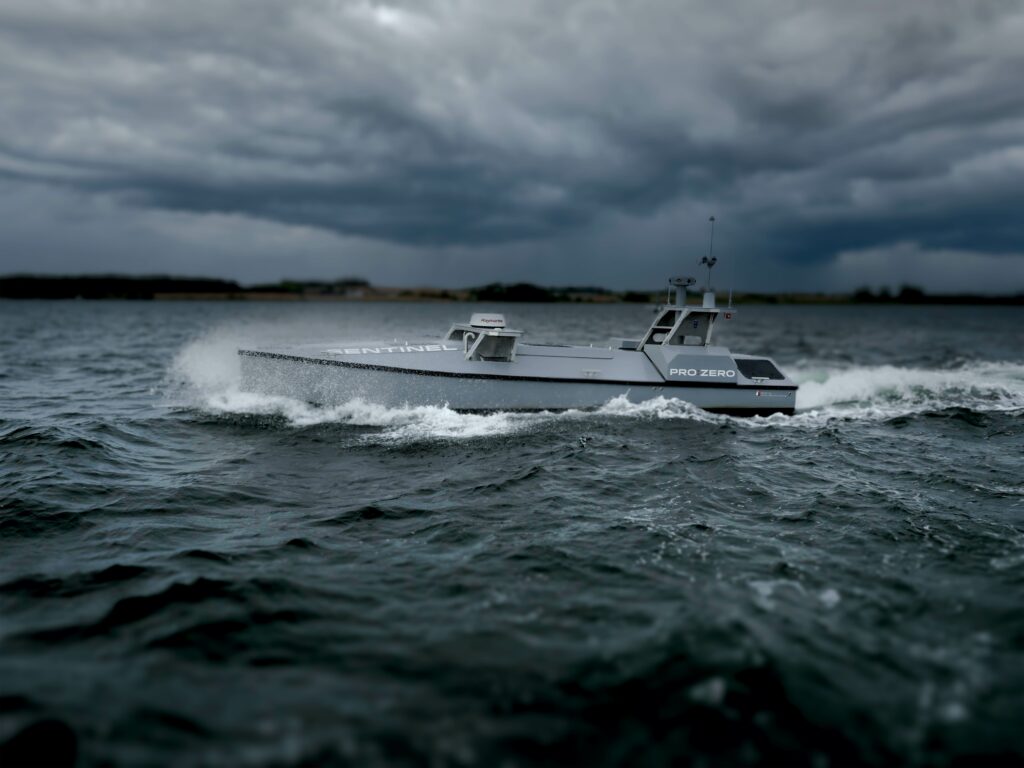
(All images: Tuco Marine Group, except when stated otherwise)
The Tuco touch
Rory Jackson looks into how this seasoned boatbuilder’s ‘one-size-fits-all’ approach makes for highly effective defence and commercial USVs worldwide
The town of Faaborg has existed on the Danish island of Funen for over 800 years, and has spent a significant portion of that history as a key shipping and naval hub for the Kingdom of Denmark. Today, among the town’s boat- and shipbuilding complexes is the Tuco Yacht Yard, which is home to one of Scandinavia’s fastest-rising stars in USV manufacturing, Tuco Marine Group.
The company’s roots lie in the production of high-end boats across both defence and civilian industries, where it has been an established name for many years. Although originally founded as JJ BådHandverk (JJ Boat Craft), the name was changed to Tuco Marine Group about a year later, both to establish a more internationally marketable masthead, and to present the company’s focus and heritage more directly as a quality, expert builder of marine vessels.
As Jonas Pedersen, CEO and founder of Tuco Marine Group tells us, “I’m an educated boatbuilder; I took my apprenticeship at a shipyard, just as we run apprenticeships today, as did my colleague and co-founder Jakob Frost.
“So, craftsmanship lies deep in our DNA, such that a lot of our original business was in subcontracting to other shipyards, eventually hitting an output of two new 12 m sailing yachts per week – one on Tuesdays and one on Thursdays – in a lengthy contract with X-Yachts, one of Denmark’s biggest yacht producers.”
In those early years, Pedersen and Frost also embarked on development of a range of fast-going aluminium boats, which was eventually commercialised as Tuco Marine’s ProZero range of fast boats for professional industry customers, following a large contract for fast passenger catamarans in northern Norway around 2010.
“Those were 35 m carbon fibre vessels, transporting around 250 passengers per journey, and in replacing aluminium ferries, they reduced fuel consumption by about 57%, pulling back NOx and CO2 emissions by roughly 62%,” Pedersen recounts.
“That was a huge awakening for us, as to what lightweight materials could do in shipbuilding. So, we almost completely forwent aluminium in favour of composites, meaning today we produce only vessels of largely fibreglass and carbon composite.”
Constructing workboats also taught the pair and their engineers about the importance of modularity. As the customer base for ProZero crewed boats expanded to cover three market segments – offshore daughtercraft for launch and recovery from a mothership, harbour workboats, and defence boats for carrying arms or armed personnel – Pedersen and Frost realised they needed to tailor boats suited to around 48 different applications.
To avoid stretching their company too thinly, a single, standardised modular system architecture (MSA) was developed. Through the MSA, a single, small set of base designs could be rapidly simulated and integrated with (in order of importance) the weight distribution, payload placements, control systems, and powertrain optimal for each application and user.
The MSA has formed the starting point for Tuco Marine’s many ProZero USVs, and is a core reason for the boatbuilder’s very wide variety of built and operating USVs having largely similar architectures and characteristics, not to mention sharing handfuls of subsystems and suppliers between them.
As a long-successful contractor, Tuco Marine has a plethora of unnamed military USV clients, and civilian customers such as offshore wind giant Ørsted and the Arctic University of Norway, who have publicly reported their purchases of ProZero USVs. While the boatbuilder is not at liberty to comment in granular depth about the design or engineering of any specific USV, Pedersen instead guides us through the wide body of shared engineering, architectural and subsystem choices across the ProZero USV range, to unpack both the boatbuilder’s successful deliveries so far, and the likely underpinnings of future USV projects to come.
Development history
The determination to closely suit each workboat to each user spurred a rising uptake of collaborative r&d projects on Tuco Marine’s part, eventually leading to its invitation into the EU-funded ENDURUNS project in 2018. This was its first foray into USVs, where it took full responsibility over designing and building an 8 m USV that could launch and recover a 4.5 m AUV from Italy’s Graal Tech SrL (both uncrewed vehicles notably running on hydrogen fuel cells).
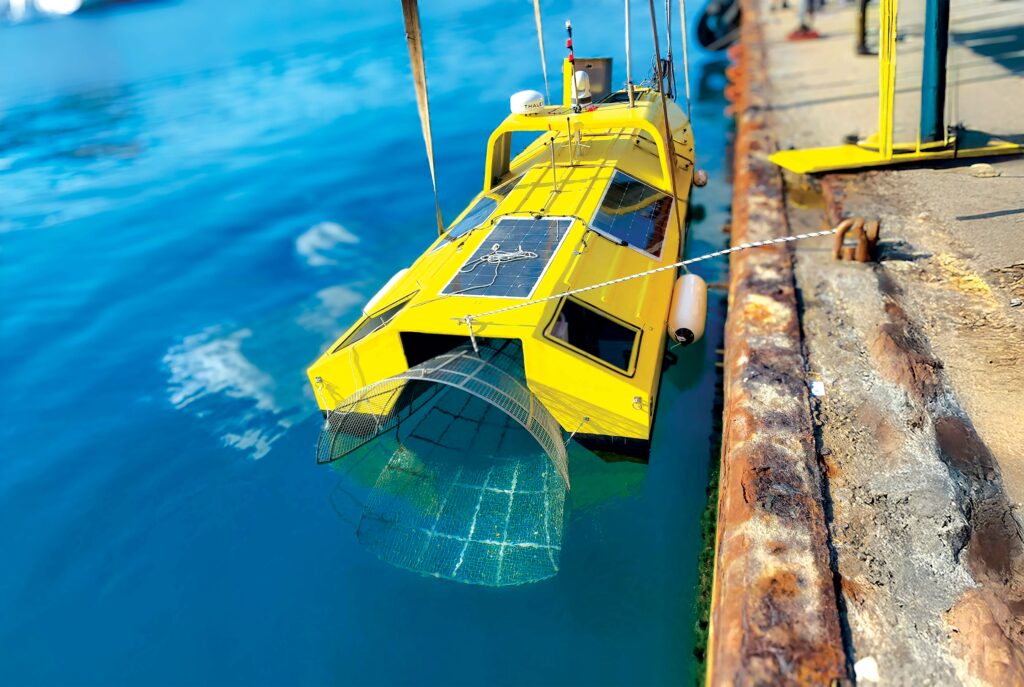
“That project taught us a lot about what it takes to integrate different subsystems for an effective, long-endurance, autonomous USV; not only obvious things like the powertrain and main computer, but also getting granular things like pumps and lights to work for months on end without the chance of human intervention,” Pedersen recounts.
“Naturally, the absence of humans on board also drove us to better understand connectivity, to maintain visibility of and data sharing from our USVs to the rest of the world.”
Soon after, Tuco Marine began receiving commercial clients interested in uncrewed maritime data collection solutions, leading to the launch of the first commercial ProZero USV for gathering hydrographic, bathymetric and meteorological ocean data.
That too was an 8 m vessel, as were subsequent delivered USVs until 2022–2023. These were followed by the development of the boatbuilder’s first 10 m length USVs, with their larger size and greater internal volume also enabling sufficient fuel and power systems for greatly lengthened endurances – up to 12 months between dockings for refuelling and maintenance for certain users.
“That was also when military customers started commissioning USVs from us; we’re not allowed to go into how many or what kinds of military USVs we’ve supplied, but I can say that our portfolio has since grown to include designs for 16 m long USVs all the way down to systems just shorter than 7 m,” Pedersen says.
“Among those were also some special powertrain technologies for operating in riverine conditions, which I’ll explain more on later. Our military projects have also included integrating kinetic effectors and other weaponry, not to mention EW [Electronic Warfare], SIGINT [Signals Intelligence] and COMINT [Communications Intelligence] payloads, onto our delivered USVs.”

Given these successful deliveries, most of Tuco Marine Group’s conversations with prospective customers today revolve around USVs, and with its present-day complement of staff, apprenticeships and facilities, the company anticipates being able to consistently deliver at a rate of up to two 12 m USVs per week, amid other overlapping vessel projects – a capability greatly assisted by how the aforementioned MSA approach shrinks down the boatbuilder’s design, prototyping and lead times.
Modular architecture
Seldom does Tuco Marine design or develop a fundamentally new hull, having boiled down dozens of application requirements into a small set of highly suitable and modular monohull designs ranging from 6 to 16 m in length.
Instead, upon receiving a customer specification, its designers will produce a detailed 3D CAD design of the potential USV within weeks, based on required physical and performance parameters, and integrating any customer-preferred subsystems along with any further subsystems from trusted suppliers that will fit the mission and budget.
“If the client approves, we’ll immediately put the design into production, and easily within a year deliver the finished USV,” Pedersen says. “More often, 6–7 months is a more likely production length, with the limitations on getting it done faster not really coming from us so much as supply chains: how fast we can receive the appropriate sensors, thrusters and so on.”
The decision to build almost entirely monohulls (rather than catamarans and other multi-hull vessels, often seen among USVs) comes from Tuco Marine’s ambition to serve vessels capable of speeds higher than typical among USVs – prioritising top speeds between 25 and over 35 knots – as well as a wish to operate in waters outside of coastal and riverine areas.

“You typically don’t see standard catamarans operating much further out than nearshore markets, and certainly not ones meant for sailing through harsh conditions – a catamaran sent out to sea will, sooner or later, get flipped over and then it’s near-impossible for it to right itself,” Pedersen says.
“We build true offshore vessels. Monohulls can very easily self-right and so endure operations through much harsher sea states than catamaran designs.”
Given that Tuco Marine’s projects start with an empty hull structure, it is agnostic to most sensors, electronics and powertrain systems. Although it has some distinct preferences and collaborative partners, it will swap in – or add as a dual- or triple-redundant backup – subsystems as needed to capture the specific mission capabilities and application nuances of each end user.
“Our MSA approach is a really crucial differentiator here in enabling us to really focus hard on the right selection and mix of subsystems for optimising each USV,” Pedersen explains. “The traditional ship designer will often use the first two-thirds of their development time in designing the very best hull for maximising a vessel’s energy efficiency at the customer’s cruise speed.
“That will yield maybe 2–4% more energy efficiency than one of our boats at that speed. Then, they’ll use the final third of development time to throw in subsystems with a general arrangement and submit it to the client.
“We work the opposite way. We’ll use the first eight out of 12 weeks to detail, simulate and integrate the best bill of subsystems for maximising our client’s value from a fixed budget of cost, internal volume, power and energy, and then tailor the hull for a good mechanical integration and weight distribution of those subsystems afterwards. USV customers don’t want a USV: they want high-value capability at sea. That’s what we aim to deliver.”
That integration stage is, in turn, eased through a set of standardised internal structures and racks that Tuco Marine leverages as a matter of course – although these, too, are changeable if one or more of the subsystems are overlarge or undersized relative to them, or have thermal management requirements meriting an additional (and large) cooling system, for instance.
Beyond these standardised subsystems, the company can incorporate a range of different requests, with some USVs incorporating electromechanical self-anchoring or -mooring solutions (Ørsted, for instance, having mentioned publicly that its Hugin USV self-anchors during its wind farm work) to enable dual-use capabilities as a marker or survey buoy.
“There are a lot of systemic considerations that come with that; if, for instance, you want to moor at 400 m water depths, you’re required to carry 1.3 km of anchor chain,” Pedersen muses.
“That’s a great deal of volume and weight to put in a small vessel, which has an impact on the remaining capacity for other subsystems, with the top deck also likely getting squeezed if the end user wants an extendable mast for marker buoy functionality. So, it pays to get weight reductions and other hull optimisations right, early on.”
Composite materials
Tuco Marine Group is a strong proponent of using composites for reducing vessels’ total weights (particularly as this, in turn, reduces powertrain size requirements, fuel consumption and emissions outputs).
Most often, the ProZero USVs utilise something around 90% fibreglass composite and 10% carbon. Variations on that ratio often favour fibreglass (with metals always used sparingly for reasons detailed below), with that and other variations coming down largely to the user, mission set and operational use-case.
“If you look at a long endurance platform, like the aforementioned anchoring platform, or ENDURUNS, or most of our other built USVs, you realise that it doesn’t create much tangible value to build such vessels a lot lighter by switching out glass for carbon fibre,” Pedersen says.
“Furthermore, you must consider the specific type of strength users need in their USVs. Carbon fibre is very, very good in terms of ‘global strength’ across a whole vessel, like the ability to weather and distribute wave-slamming loads. Combine that with its very low weight relative to its mechanical strength, and the result is that one becomes motivated to build a USV lighter with very thin carbon skins, to maximise the global-strength-to-weight benefit across the vessel.
“But that comes at the opportunity cost of impact strength, like withstanding a hit from a hammer, or being sailed into because small USVs aren’t always so conspicuous to crewed work ships or pleasure craft. You’re much better off trying to resist those with fibreglass composite.”
Hence, ProZero USVs designed for slow, surveying-type speeds over lengthy mission endurances tend to come built in fibreglass. Conversely, vessels that must be built to prioritise high speed over long endurance, and thus target weight-saving and resilience against collisions in its engineering, are the kinds of vessel where Tuco Marine uses carbon fibre favourably over fibreglass (a more likely occurrence in its crewed workboats or defence boats, than in USVs, given the differing mission requirements).
Additional strength-versus-weight optimisation is achieved through use of PVC, which Tuco Marine prizes as a highly weight-efficient filler foam in its composite sandwich layers, on top of being key to maintaining buoyancy owing to its inherent rejection of water ingress or absorption. Other core materials are sometimes used, including a range of plastics and even wooden cores, such as balsa, on occasion.
“Balsa can have even better mechanical properties than plastic foam cores; for example, its weight is very low relative to its compression strength characteristics – so one should not assume synthetic materials inherently outperform nature,” Pedersen muses. “But balsa of the highest quality is, unfortunately, very rare and hence quite expensive to obtain across the world market. So, PVC tends to be our default choice and a very good one all the same.”
Close material understandings of this nature are a key ingredient in Tuco Marine’s in-house composite working capabilities, which include a full laminating workshop for performing resin impregnations and lay-ups with its suppliers’ composite fabrics (although some composite part subcontractors occasionally fill-in production gaps during peak assembly periods).

“We even go as far as running apprenticeships for composite lamination technicians, who take their practical education in composite part manufacturing here in Faaborg, with our machines and our specialists,” Pedersen notes.
To ensure only high-quality fabrics are ordered in, the boatbuilder engages with third-party experts such as consultants and laboratories to evaluate the physical and performance characteristics of each material batch, with the objectivity and recognition of such external parties providing assurance to both clients and maritime classification institutes of such test data and reports.
“On top of that, when a project’s USV is presented to either a classification institute or its future owner – both of whom will want to know how the boat’s strength was validated – we produce what we call ‘workshop samples’ for their scrutiny: samples of the materials used both in the USV’s construction and in the prior, academic calculations of the composite lay-up,” Pedersen explains.
“That means that when we show them the numbers we used to calculate how many fibre layers would obtain the needed strength level for the product, they can appreciate that we’ve tested and understood the granular nature of the fibre material to back up those calculations, and not just made assumptions or run numbers without inspecting and validating the fabric we’re putting into that boat. It goes a really long way towards removing uncertainties with respect to mathematical and simulation work.”
Vacuum infusion
In addition to the occasional subcontracted batch of composite parts, Tuco Marine will also use pre-preg materials, if of suitable quality and useful for hitting a peak manufacturing rate.
“But pre-pregs are absolutely not our primary mode of production; vacuum forming is, both for carbon fibre and glass fibre structures,” Pedersen says.
“Vacuum infusion enables one to semi-automate a variety of processes, such as the otherwise manual task of removing air from a laminate structure. It also raises the percentage of fibre content versus resin content in your finished composite part, from maybe 35–38% fibre content in a hand lay-up depending on the workshop, to above 60% fibre content when you perform a high-quality vacuum infusion process. We’re simply building stronger and lighter components than we would with even a perfect hand lay-up.”
The first step of the vacuum forming process consists of stacking the non-impregnated matrix materials – both the composite skin and the filler core substances – onto the mould for the needed hull part or structure. The moulds themselves are cut or formed as needed in-house to suit geometric and production run requirements.
These are laid dry onto the mould at first, starting with the outer skin layer, which then undergoes a quality control inspection before being covered by the foam core material, which is carefully laid-in and fitted together to adhere tightly with the outer skin and thus also with the mould geometry.
“And while laying the core material, we will often also refine and detail the lay-up further, in the sense of removing small sections of core where we want only fibre – for instance, to make through-holes for sonars, or exchange for steel inlays or other materials,” Pedersen says.
“Alternatively, we might want to replace the PVC with other materials, like steel inlays for forming engine foundations or mounts afterwards. Obviously, the next step is to lay the inner skins of the hull part; when those are distributed, we’ll lay-in a resin transfer system.”
The resin transfer system consists of such parts as the various pipes for delivering resin, and enclosure nets for draining excess from the system. Once these are installed, a large vacuum bag can finally be placed around and atop the lay-up, and the vacuum system attached and activated.
“With that, the atmospheric pressure change draws in the bag and presses the resin into the laminates, achieving a very even, uniform distribution of resin across the whole hull part, with a minimum of manual labour needed to do it,” Pedersen concludes.
Control
Tuco Marine’s collaborations with marine autonomy supplier Sea Machines Robotics (SMR) stretch back to 2014, starting with a visit by SMR’s CEO Michael Gordon Johnson to the former’s facilities at Faaborg, shortly after his founding of SMR. The Danish boatbuilder was among the first of SMR’s European customers, starting with a project converting a crewed demonstrator into an automated vessel through integration of a Sea Machines product.
Among Tuco Marine’s most frequently implemented control systems is the SM300, which comes today as either the smaller SM300-SP or the larger SM300-NG. The former presents physically as a 40 x 40 x 20 cm cabinet, enclosing electronics for control and autonomy processing inside an IP65-rated box built of industrial grade stainless steel, with an 18.6 kg overall weight.
The latter carries more powerful computers to ensure safe, precise autonomous navigation of bigger vessels from navy offshore patrol vessels and upwards. As a result, its cabinet is 50.8 x 50.8 x 22.35 cm in size, and 29.48 kg in weight, with the same protection rating, materials, and 0–60 C temperature range as the smaller system.
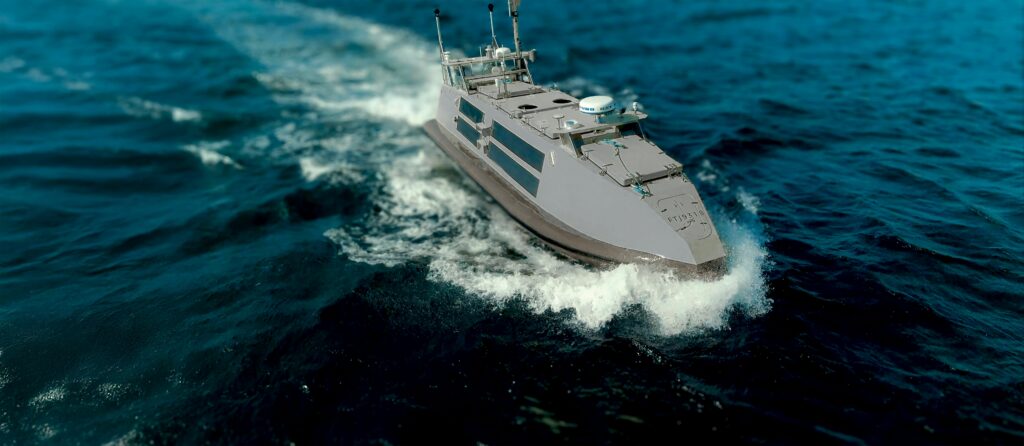
Both systems are also designed to integrate seamlessly with other critical maritime subsystems such as Automatic Identification Systems (AISs), radar, computer vision and electronic navigational charts, as well as human–machine interfaces including tablet Ground Control Stations (GCSs), joystick-based hand controllers, industrial-standard remote helms and desktop computers (with Beyond Visual Line of Sight, as long as satellite signals are available).
“Sea Machines doesn’t get involved in our USV developments, as much as they have experience in doing so, as the client still needs to hold us fully responsible for product engineering and delivery. And furthermore, we don’t use Sea Machines’ products every time,” Pedersen says.
“But we do work closely with them in aligning our vessels’ configuration carefully to ensure we have the best use of sensor data inputs and, by extension, the best use of the control system to make for an effective USV. That means focusing on tight payload installations, optimising powertrain rpm sensing and executing well on other, similar fine details.”
It also means ensuring a comprehensive power and signal integration of steering mechanisms. Tuco Marine voices no preference and great agnosticism to these, and has installed standard rudder systems and shaft drives, bow thrusters and azimuthing pod drives (or z-drives) successfully.
Electronics ecosystem
The range of Global Navigation Satellite System (GNSS), AISs, radars and cameras used on the ProZero USVs (and some crewed vessels) for safe marine navigation are largely provided by Raymarine and FURUNO Danmark.
“And since Raymarine is owned by Teledyne FLIR, we’re also able to obtain thermal imagers and UV cameras through them, whether for mission-related object detections, or safe navigation through poor- or low-visibility conditions including fog and night operations,” Pedersen says.
“We tend to listen to what our customers and our other suppliers need. If, for instance, a control system supplier voices a strong preference for one company’s GNSS receiver and antenna package in particular, just for ease or knowledge of integration requirements, then we’ll likely go with their pick – they’ll always know their subsystems better than a USV manufacturer can – but if the end-client’s mission scenario makes another GNSS receiver or antenna choice imperative, then we’d have to prioritise that.”
A variety of other products and suppliers, on top of Raymarine and FURUNO, are leveraged for GNSS redundancies and protections against spoofing and jamming. In general, use of overlapping and redundant sensors enables either elimination of false readings or fallbacks onto lower-precision navigation technologies, without relying on costlier technologies such as controlled reception pattern antennas (CRPAs) or 3D SLAM.
Thus, unless a customer requests that their ProZero USV can continue navigating with sub-metre accuracy amid GNSS attacks, Tuco Marine will opt for simple, low-precision workarounds, rather than adding-in a subsystem that threatens to blow-up the project costs. As Pedersen says: “A simple system can still bring you home or within radio control range with a much lower price than a complex system, and a better likelihood of meeting budget and value creation targets.”
C2 systems are provided by Systematic AS, including for high-end defence users such as special forces customers. Meanwhile, systems for secure, remote communications links are provided by Northcom, which owns and distributes several brands for maritime broadband radio, software-defined radios, antennas, interfacing software, headsets, Bluetooth devices and even tethered UAVs for comms bridging, primarily across Northern Europe.
Pedersen also makes special mention of CubedIn as a key enabler of the ProZero range’s sensor agnosticism, modularity and quick reconfigurability. “They provide an integration management platform which, for instance, can facilitate a detailed overview of the power generation and distribution across one of our USVs and, in turn, lets us model and understand the impact of integrating a new sensor package, like an additional camera or an EW, SIGINT or COMINT device.

“CubedIn’s software directly reads system-wide data to show how energy consumption would increase, and evaluate whether overloading might occur in certain operational scenarios, and thus if something like an ancillary generator is needed to ensure sufficient power supply. It can also then check how that added subsystem might impact mission endurance. It enables the creation of a very balanced, well-matched generic model for every platform.”
Powertrain
While a variety of internal combustion and hybrid powertrains have been used in ProZero USVs, Tuco Marine points towards Hyundai engines supplied by MD Power Train in Sweden as having been used in certain riverine projects.
“The background for sourcing engines from them originated especially from projects engineering swamp shaft drives: drives specially designed for missions in shallow waters, like riverine and mangrove swamp operations, some of which for instance we’re building for the Kenyan navy right now,” Pedersen says.
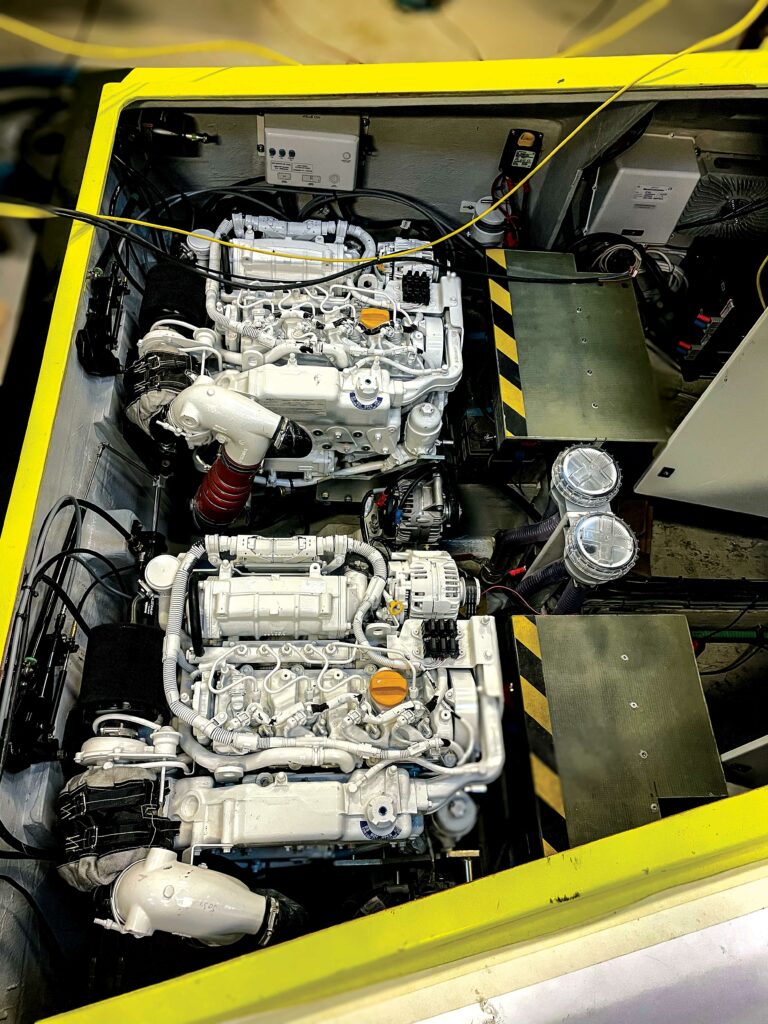
“Swamp drives look very much like a surface drive and use similar technology, but combined with surface-skimming drive design qualities and a hydraulic release system that enables the drive to lift out from the water, if for example you’re about to sail over a thick wooden log, branch or root. The drive just flaps up and then falls back down into the water.”
Such drives require a light engine with high rpm – those requirements being best satisfied by a Hyundai model from MD Power Train’s dealership. Since then, Tuco Marine has branched out with powertrain requirements, and cites the 270PS as the most commonly used sterndrive in ProZero riverine USVs (along with its core engine working as the range extender for hybrid configurations also).
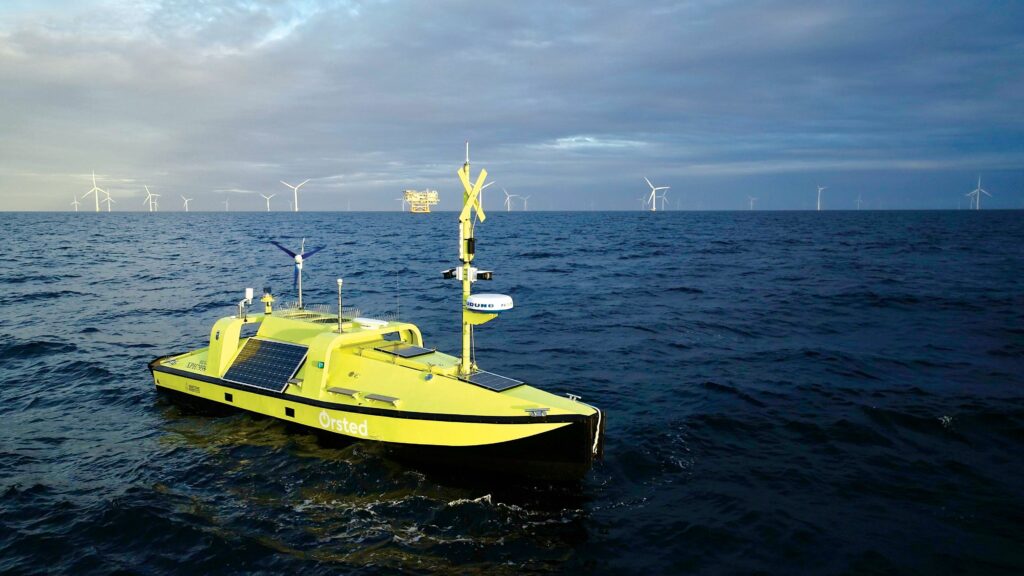
(Image: Ørsted)
The Hyundai 270PS is a four-stroke turbo-V6 diesel displacing 2959 cc and producing 199 kW at 3800 rpm. The system runs with double overhead cams, four valves per cylinder (two intake, two exhaust), an electronic variable geometry turbocharger, common rail direct injection and a maximum specific fuel consumption of 53.8 L/hr. As standard, it also comes with a 12 V alternator providing up to 150 A of electric current and glow plugs for cold starting.
Where Hyundai thrusters are not used, a variety of drive systems from Volvo Penta have been deployed across the ProZero USVs, including z-drives, shaft drives, and water jet thrusters. The boatbuilder’s projects have also run the gamut of drivetrain sizes, from 75 hp systems up to outputs measuring several hundreds of horsepower.
“We were actually a very early adopter of Volvo Penta’s products, since years back, even before they had opened up their drive portfolio for integration with third-party external control systems. To do that, they gave us early, direct access into their control IP, alongside Sea Machines in some of our very early pilot projects on automated demonstrator vessels,” Pedersen says.
Per its modular, capability-focused approach, Tuco Marine selects drives best benefitting the mission profile. Many of our readers will know, for instance, that azimuthing drives enable flexible changes of direction for both vessels and their thrust, making them advantageous for water taxis, maritime logistics boats and anything operating in narrow or crowded waterways.
“Water jets, by contrast, have novel advantages such as minimising the pressure put upon their gearboxes; by exposing the gearbox to less pressure than z-drives or shaft drives, you can add some endurance and reliability in long-term operations by using water jet propulsion,” Pedersen explains.
“The downside is that water jets consume quite a bit of energy in operation – especially in tight manoeuvring, braking and reversing – owing to using a bucket to curb thrust output, rather than by adjusting crankshaft rpm as a speed lever. That means quite a bit of energy gets wasted in operations, as some continuing thrust output winds up not getting used to generate motion in the water.
“So, a slow-going vessel, or one engaging in lots of manoeuvring, is often best placed with using something other than a water jet. But if a USV is to operate at continuously high speeds, over long periods, then water jets can be a really great solution for us to go with.”
While the engine and thruster are generally specified by mission requirements, the company’s gearboxes are not directly so; instead, these are designed to fit the former two subsystems and the required load case between them to enable their best performance, with Tuco Marine not caring so much who supplies the transmission system as long as the physical and performance dimensions match the requested specification.
Batteries tend to form little more than a voltage regulator and a small source of backup energy in the ProZero USVs because Tuco Marine finds the present-day gravimetric and volumetric energy densities of batteries to still fall far short of those obtainable from fuel (whether hydrogen for USVs like ENDURUNS, or diesel in the boatbuilder’s other USVs). In cases where vessel reliability is especially paramount, such as USVs for military ISR applications, Tuco Marine avoids even hybrid powertrains, with diesel engines posing the more trusted and far longer-proven maritime technology.
“Frankly, we find better reliability and value from other sources of electricity than conventional hybridisation strategies; solar cells, for instance, provide good value for very long-endurance vessels,” Pedersen says.
“For example, a USV on a 12 month outing, spending most of its time moored or surveying in one place, can utilise solar panels as a very good range extender because it’s hard to estimate efficiently how much fuel you should carry or how often you should start-up your engines to recharge your battery pack.
“Adding solar panels, and windmills too – the latter of which we’ve done on a few different successful USVs out in the world right now – can really help cut down on fuel consumption and overcome mid-mission fuel insecurity. If you’re running a bunch of different sensors 24/7, 7–10% of your energy needs can be obtained from solar cells, with another 15% maybe from one or two small deck-side wind turbines, and the rest coming from your diesel or hydrogen machine.”
Tuco Marine has also engineered a variety of fire extinguishing systems, suited to internal engine rooms as well as outboard engines, including pressurised retardant containers and integration of delivery hoses, along with flame-destructible hose covers to burn up and passively release extinguishing media in the event of a fire breaking out.
Comms
A variety of different antenna selections and placements are possible with the ProZero range, with these generally defined by how visible the end user wants their USV to be on the open water.
“That’s not something you can predict by tagging customers as either ‘military’ or ‘civilian’; some defence and security operators will want to make their presence known, both in their USVs’ visibilities and radar signatures, and some commercial users need to shrink down their USV’s profile so as not to stick out to locals or wildlife too much,” Pedersen says.
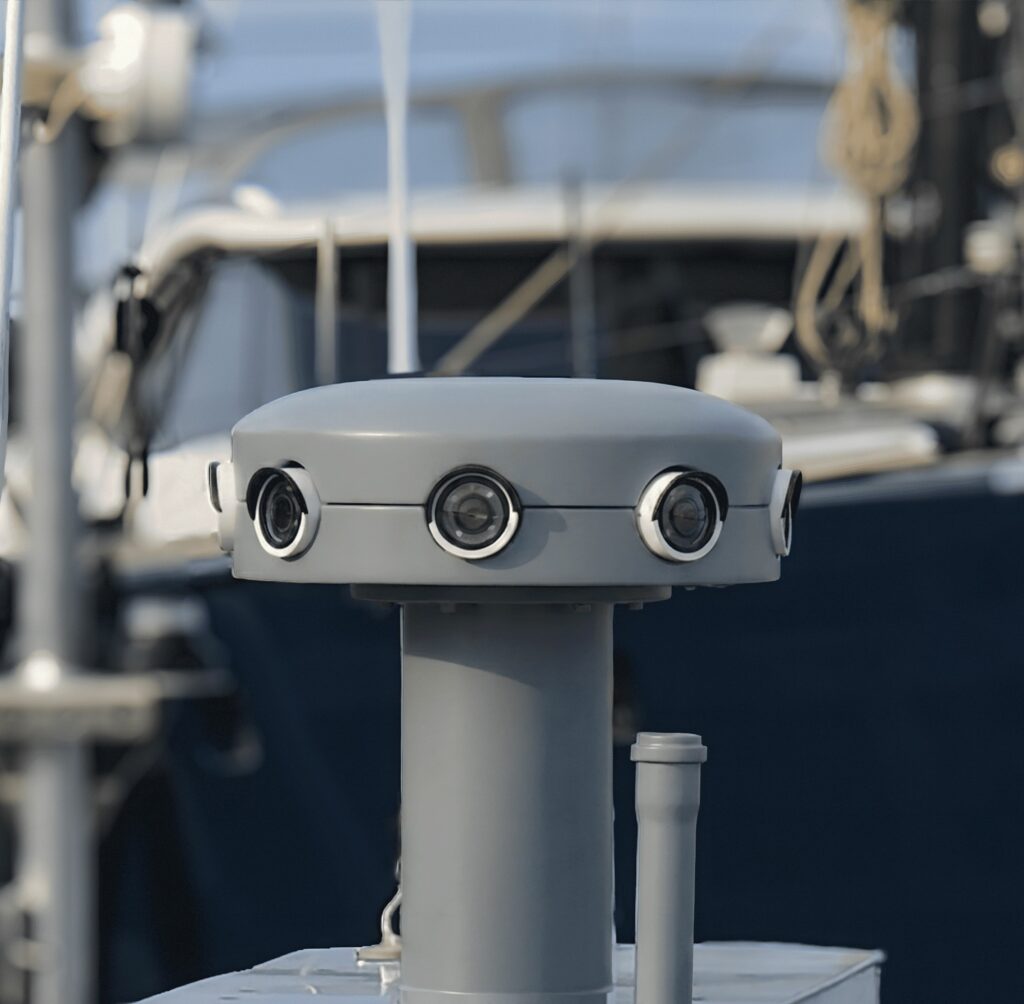
If conspicuity is a threat, then Tuco Marine engages in a strategy of picking smaller, flatter antennas such as domes or patch designs, and hiding them beneath the USV hull, thereby keeping the hull as sleek as possible. The converse approach, when conspicuity is acceptable or desirable, is to build a conventional mast structure atop the USV, where antennas, radios, radars, cameras and other electronics can be mounted and spaced apart. In such cases, taller, larger antennas like blades, dishes and monopoles can be selected.
“The latter route is somewhat easier from an engineering point of view. Antenna height is always an issue, as there’s no antenna that doesn’t benefit from being set higher – we can even build retractable or foldable antennas onto our vessels to enable reduced height and visibility while also maximising antenna altitude and so connectivity,” Pedersen adds.
“But antenna placement is never easy, and the more complex the USV, the more complicated it is to achieve optimal antenna placement. Add to that a technology or application which really depends on a sensitive, high-end antenna, like COMINT, SIGINT, or direction-finding antenna systems, and you wind up with a lot of complexity in getting antenna placement optimal across a USV.”
As well as performing its own studies, Tuco Marine routinely engages in close collaboration with its communications system suppliers such as Northcom and Germany’s PLATH, in order to leverage their technical expertise and consultation in getting antenna choices and placements correct for persistent comms and connectivity (a rare initiative among uncrewed systems manufacturers, as antenna suppliers have told us over the years).
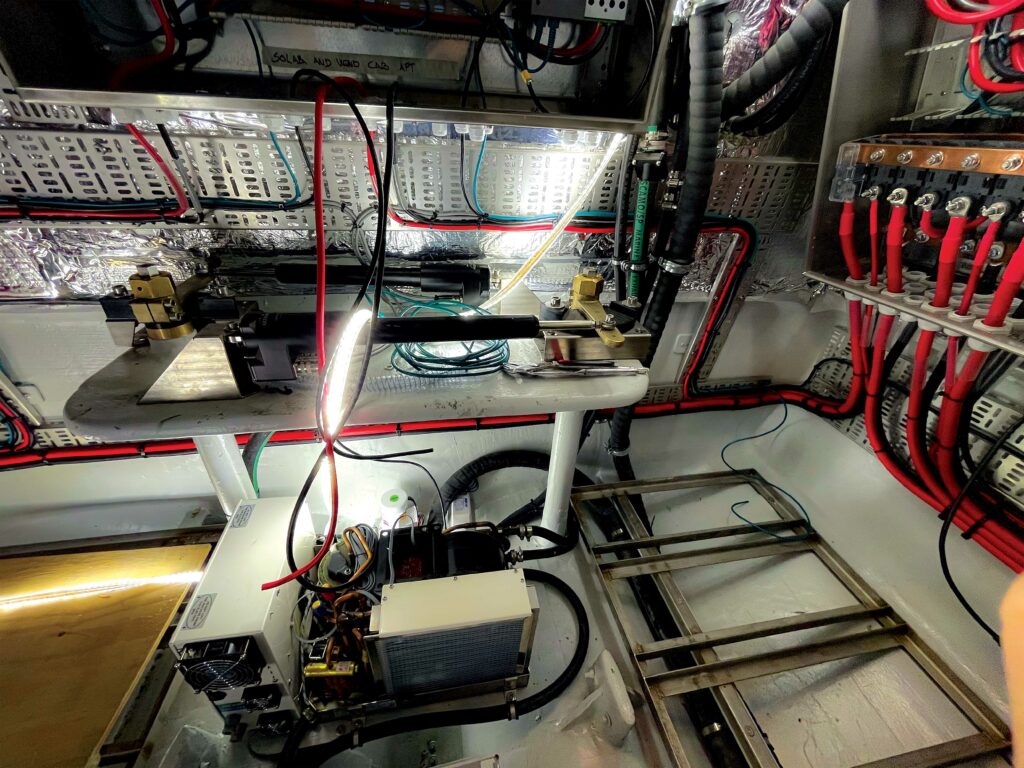
“Honestly, with PLATH, we generally don’t even consider antenna placement ourselves as an in-house responsibility: we’ve come to expect it as part of PLATH’s delivery, and together with them, we run analyses of each vessel’s total antenna placement and RF patterns, including SIGINT, COMINT, and all of the less mission-critical antennas for the autonomous operations,” Pedersen notes.
Future
While some have commented to us over the years of the hindrances posed by USV-focused regulations, and the lack of effective progress made by those writing them, Tuco Marine finds that end users are, on balance, less hindered in their uptake and usage of USVs today than they were 5–10 years ago.
“While end users aren’t always allowed to use full autonomous operations and capabilities with their USVs, we can observe our customers pushing forwards with remote-controlled, semi-autonomous and combined operations to an extent we’ve never seen before,” Pedersen notes.
The boatbuilder attributes such growth to an increasing understanding and aptitude from maritime markets, not only of what they can achieve with USVs, but also of how much more hydrography, maritime ISR and more mission coverage can be achieved if they opt for an uncrewed vessel instead of a ship that requires onboard staff and dedicated personnel facilities (even if they are still monitoring operations from close by, for instance, in a containerised GCS room shoreside).
“There are plenty of people who put energy into complaining to the regulators or collaborating with them to form better rules, but for our part, we find there’s still quite a lot of unused room for USV operators to move around in, whether civilian or military,” Pedersen says.
“So, we prefer putting our energies into building and selling USVs that will just comply with the regulatory frameworks. We have to live with and within those frameworks, whether USV manufacturers like it or not; and for our part, we’re finding the USV world to be a better and better place to live in.”
ENDURUNS USV
Monohull
Hydrogen- and solar-electric
Length: 8.35 m hull, 9 m total
Beam: 2 m
Total weight: 4.5 t
The ProZero 8 m ENDURUNS USV was developed through the EU-funded ENDURUNS r&d project, bringing together a consortium of experts and organisations to develop a hybrid-powered USV.
The system is powered by hydrogen fuel cells (exploring a high energy density approach to zero-emissions propulsion), and capable of launching and recovering an AUV, for extended survey missions along with the ability to execute multiple different tasks within a single outing. The USV also serves as a communications and navigational geotagging node between the AUV and remote command centre, enabling real-time updates and mission adjustments.
ProZero Sentinel USV
Length: 8.2 m
Beam: 2.3 m
Shallow draft: 0.8 m
Maximum speed: 12 knots
Survey speed: 5 knots
Maximum range: Estimated greater than 500 nmi
Maximum payload: 2000 kg
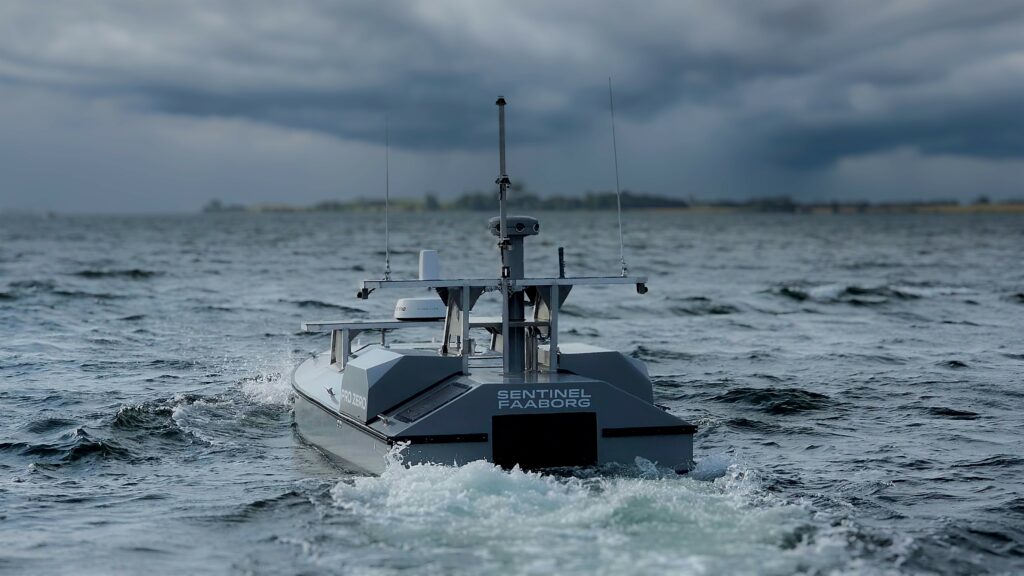
The Sentinel is an 8 m platform offered by Tuco Marine Group since 2023, principally for ISR operations, as well as monitoring of physical assets, coasts, maritime borders and so on.
The USV’s topside features a rearward-mounted twin mast system for mounting sensors, cameras, antennas and more as needed for the client’s mission. Lower down, one finds a D-fender encircling the hull for added impact protection above the glass- and carbon-fibre hull (sandwiching PVC, as conventional for the boatbuilder), with two diesel-electric inboard engines handling propulsion and steering.
Key suppliers to Tuco Marine Group’s USVs
Autonomy subsystems: Sea Machines Robotics
Powertrain systems: MD Power Train
Drivetrain systems: Volvo Penta
GNSS: Raymarine
GNSS: FURUNO Danmark
AIS: Raymarine
AIS: FURUNO Danmark
Radars: Raymarine
Radars: FURUNO Danmark
EO cameras: Raymarine
EO cameras: FURUNO Danmark
IR cameras: Raymarine/Teledyne FLIR
C2 systems: Systematic
System modelling: CubedIn
Communications systems: Northcom A/S
Antennas: PLATH Signal Products
UPCOMING EVENTS