










Testing the Transwing
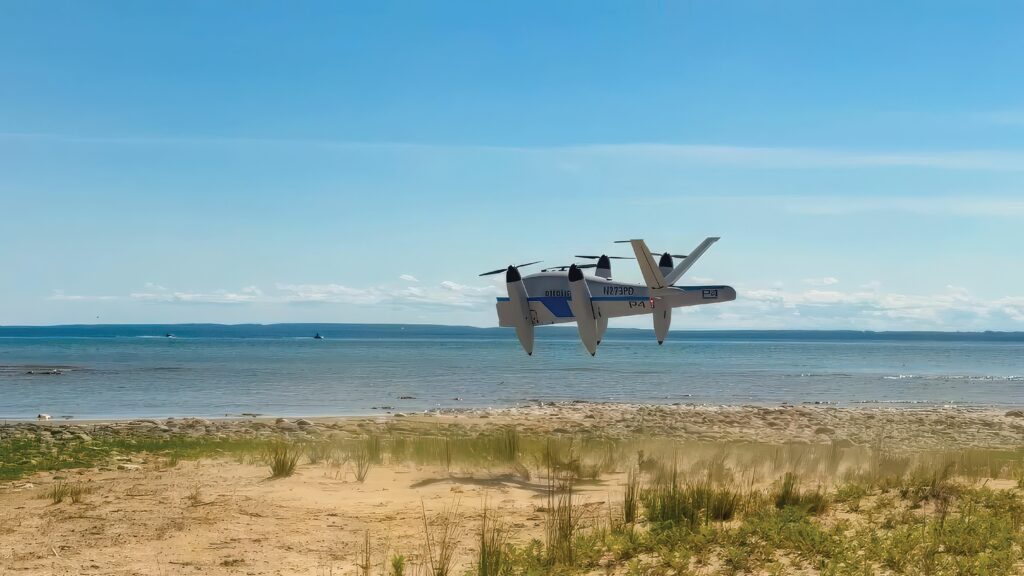
(Image: PteroDynamics)
PteroDynamics has integrated a series of electronic warfare (EW) sensors in the first US trials of its P4 Transwing autonomous VTOL UAS, writes Nick Flaherty.
The modular sensors from AeroVironment enabled three scenarios in operationally relevant, multidomain environments – observing, detecting and effecting various representative threats. This uses an open-architecture EW chassis and sensors to support mission planning and awareness.
PteroDynamics’ Group 3 Transwing unfolds its wings to transition smoothly and quickly between vertical and horizontal flight. It provides superior VTOL stability and gust tolerance, requires no launch and recovery infrastructure, and occupies a ground footprint that is one-third or less than that of other VTOL aircraft with comparable wingspan.
The company received a Special Airworthiness Certificate–Experimental Category (SAC-EC) from the FAA for its P4 Transwing UAS to conduct research and development flights in national airspace near Alpena, Michigan. Prior US Navy demonstrations were at sea.
The SAC-EC allowed PteroDynamics, for the first time, to fly the 40 kg Transwing in US airspace. The certification review and approval process took over seven months and demonstrated to regulators the maturity and safety of the UAS.
The Transwing flew from confined launch and recovery zones along the tree line on the shore of Lake Huron, showcasing its inherent expeditionary capabilities and operating envelope, which are unconstrained by wind direction. The team also took advantage of Transwing’s modular architecture to integrate and flight-test the AV EW payload in a single day.
UPCOMING EVENTS