



Safety framework for driverless cars
(Image: University of Wisconsin–Madison)
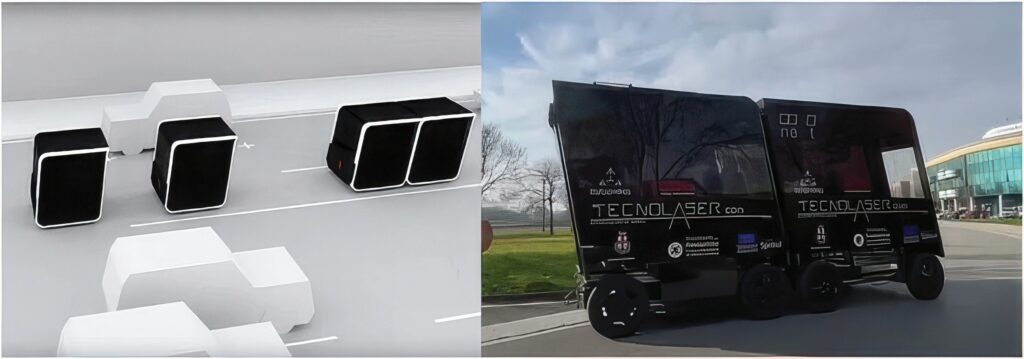
Researchers in the US have developed a framework to make Modular Autonomous Vehicles (MAVs) more practical, writes Nick Flaherty.
These modular vehicles can link or separate while on the road, offering flexible transport for passengers and freight. However, safety during docking and undocking is challenging because of close interaction, sensor noise and system uncertainty.
The team at the University of Wisconsin–Madison has developed a Safety Assurance Adaptive Model Predictive Control (SAAMPC) framework to address the lack of dedicated control strategies for MAV docking and undocking.
The framework integrates a model predictive control (MPC) controller for trajectory optimisation, an adaptive module for dynamic adjustment of control parameters with disturbance, and an adaptive safety assurance module with longitudinal and lateral control barrier functions (CBFs) to ensure safe operation during risky and uncertain conditions.
The combination of adaptive control and safety barrier functions allows MAVs to handle real-time disturbances and ensure robust operation. The adaptive model predictive control (AMPC) framework is established to optimise trajectory planning and enhance docking efficiency and precision. Within this model, the longitudinal and lateral CBFs ensure safety during operations, even in the presence of perception noise and control uncertainty. Additionally, an adaptive method is designed to dynamically adjust the parameters of the MPC model and the barrier function components in response to real-time environmental conditions, ensuring robustness and reliability.
The effectiveness of the approach was validated through both simulations and reduced-scale physical experiments using cars.
“Our work is to move beyond theoretical modelling and simulation to implement and verify MAV docking control in a physical testbed,” said Chengyuan Ma, a researcher on the team at the University of Wisconsin–Madison. “We developed a SAAMPC framework that combines model predictive control with adaptive parameter tuning and safety assurance using control barrier functions. This allows the MAVs to maintain safe operation despite perception noise, control uncertainty and external disturbances.
“One of the key features of our framework is the use of adaptive control barrier functions. Instead of setting fixed safety limits, our method dynamically adjusts the CBF constraints in real time based on perception reliability and control stability. This ensures the following vehicle does not over-accelerate during docking, even under disturbances or sensor noise.
“To ensure practical applicability, we validated our method in both simulation and real-world conditions,” said Ma. “We used Simulink to test the SAAMPC framework under various disturbances, and conducted physical experiments with robot vehicles on a circular track. The experimental results confirmed that our method works reliably, even in the presence of real-world noise, uncertainty and limited sensing.”
The SAAMPC framework enables smooth, safe and robust docking/undocking operations and lays a technical foundation for future deployment of modular vehicle systems in real-world transportation networks.
UPCOMING EVENTS