




Rivian develops its own silicon for self-driving
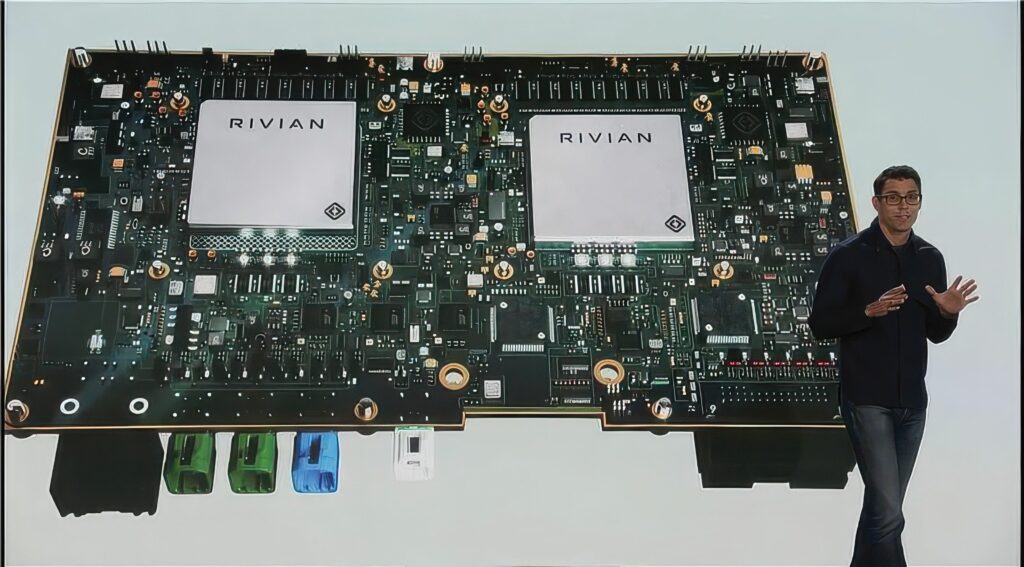
(Image: Rivian)
US truck maker Rivian has designed its own AI processor for self-driving, writes Nick Flaherty.
The Rivian Autonomy Processor (RAP1) is based on 14 ARM Cortex A720AE cores and eight ARM Cortex-R52 real-time processors alongside a custom neural network processing core that has a performance of 800 TOPS of 8-bit integer (INT8) data.
Two of the RAP1 chips are used on the ACM3 compute module, linked by a low latency interconnect called RivLink. The ACM3 can handle up to 5 billion pixels per second for image processing, and Rivian plans to integrate Lidar into future R2 trucks. The Lidar will augment the company’s multimodal sensor strategy, providing detailed, three-dimensional spatial data and redundant sensing, and improving real-time detection for the edge cases of driving.
In the autonomy platform, safety runs throughout the compute pipeline, with Rivian incorporating ARM processors dedicated to real-time safety functions that keep autonomous systems operating consistently and reliably. This safety-capable compute design is essential for any autonomous machine to make decisions on the road or in other dynamic environments.
The company introduced its Large Driving Model (LDM), a foundational autonomous model trained like a large language model. Utilising group–relative policy optimisation, the LDM will distil driving strategies from massive datasets into the vehicle.
The Autonomy software will be available via an additional subscription soon, while the third-generation autonomy hardware, including the ACM3 and Lidar, is currently undergoing validation and expected to ship on R2 models starting at the end of 2026.
UPCOMING EVENTS