









Power management
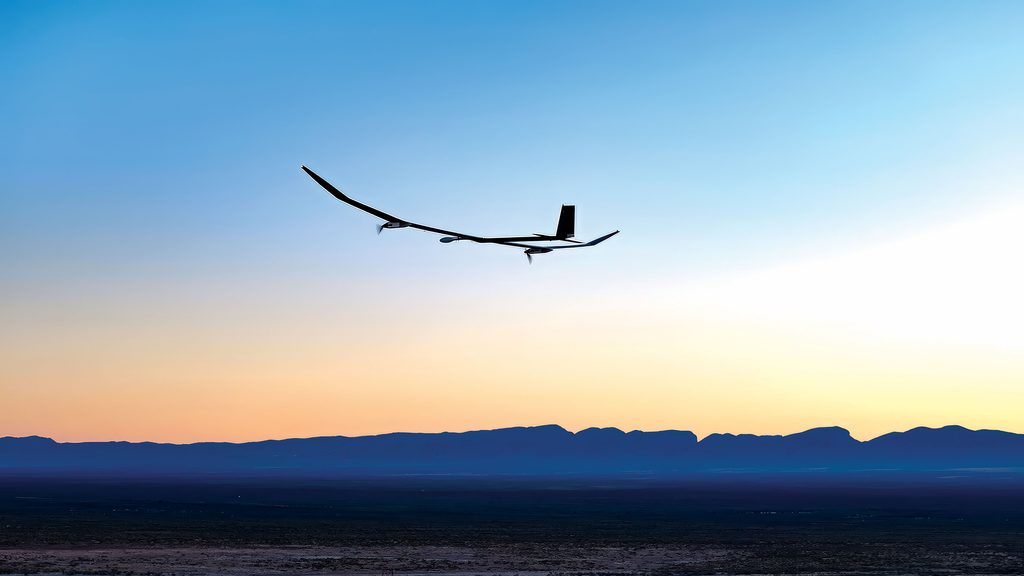
(Image: BAE Systems)
Smart meters
Nick Flaherty reveals AI’s increasing involvement in efficient power management for autonomous systems
AI and machine learning algorithms are becoming increasingly important for energy management in autonomous systems. For solar-powered high-altitude, long-endurance (HALE) UAVs, the algorithms can significantly boost mission time, while swarms of UAVs can also use power management techniques to extend their operation. On the ground, the increasing use of sensors on driverless vehicles means managing the power of the central processing is becoming more important than ever.
However, there is a wide range of options for algorithms to manage power efficiency both in the air and on the ground.
Platforms such as a solar-powered UAV and a high-altitude pseudo-satellite offer significant potential for persistent intelligence, surveillance and reconnaissance operations, but their endurance remains constrained by variable solar irradiance, atmospheric turbulence, battery limitations and payload power demand.
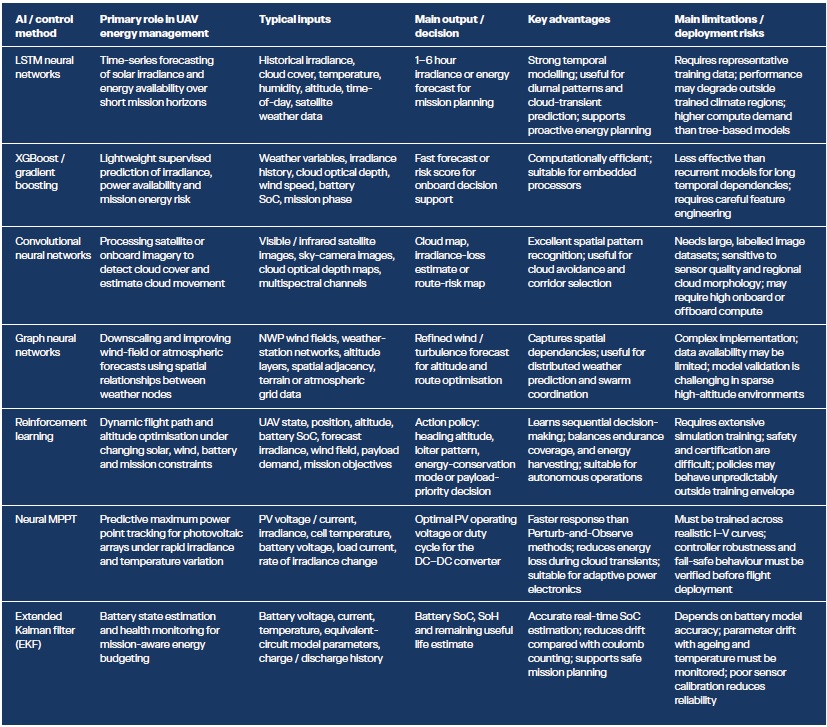
AI and machine learning algorithms are improving UAV energy management through predictive solar forecasting, reinforcement learning (RL)-based flight path optimisation, adaptive Maximum Power Point Tracking (MPPT), battery state estimation and intelligent payload balancing.
Current approaches use long short-term memory (LSTM) networks, gradient-boosting models, convolutional neural networks (CNNs), graph neural networks (GNNs) and RL architectures for autonomous energy-aware flight.
Simulations suggest that AI-assisted control can improve energy utilisation by 15–25% and extend mission time by as much as 30–40%, particularly under variable conditions of irradiance and wind.
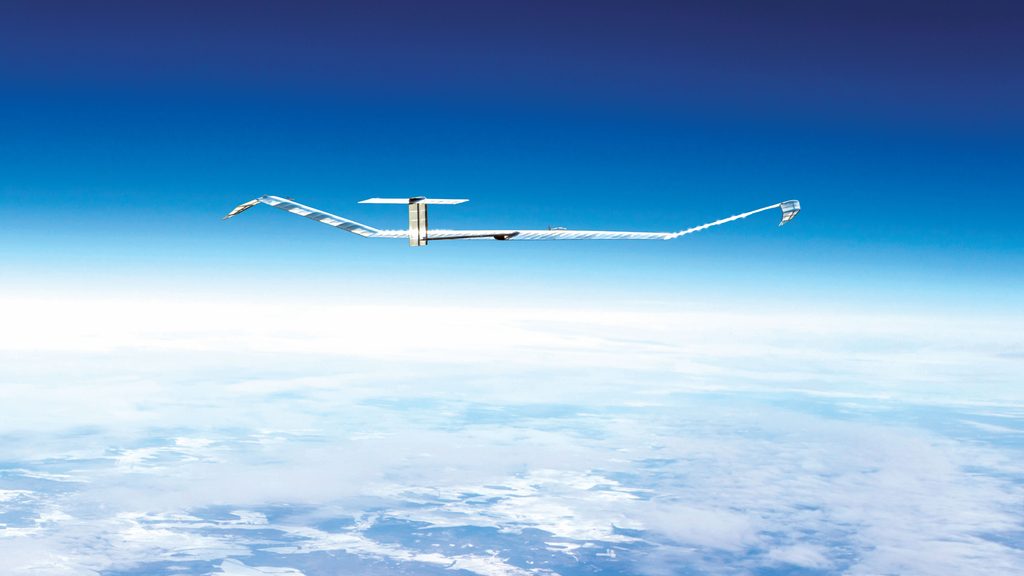
(Image: Airbus AALTO)
However, practical deployment requires robust validation, certifiable AI architectures, adversarial resilience and reliable edge-computing implementation.
AI-driven predictive algorithms can forecast solar irradiance based on satellite weather data, dynamically adjust flight altitude to maximise photon flux and optimise power distribution across multiple payloads. RL frameworks allow UAVs to learn energy-efficient flight strategies through simulated training, adapting to mission-specific conditions without human intervention.
Neural network-based MPPT controllers achieve faster convergence and superior tracking accuracy compared to conventional Perturb-and-Observe or Incremental Conductance algorithms, particularly under rapidly changing illumination conditions caused by cloud transients.
Accurate prediction of incoming solar irradiance is the foundational requirement for AI-driven UAV energy management. Supervised learning models train on historical solar irradiance data paired with atmospheric variables (cloud optical depth, aerosol concentration, relative humidity, temperature and pressure altitude) to build predictive relationships. The most effective architectures for stratospheric applications are LSTM neural networks and Gradient Boosting Machines (XGBoost).
LSTM networks are particularly well suited for time-series solar irradiance prediction because they capture temporal dependencies across multiple time scales. These are typically trained on two to three years of hourly irradiance data from satellite sensors and ground-based pyranometers, which detect solar irradiance.

LSTM models achieve prediction accuracy of 91–94% for a one hour forecast and 87% for a six hour forecast. For stratospheric HALE UAVs, six hour predictability is operationally critical because it allows the flight controller to preplan altitude and heading adjustments before solar conditions degrade.
XGBoost models offer complementary advantages because they are computationally lightweight – and so are suitable for onboard execution on UAV autopilot processors – and can help mission planners understand which atmospheric variables most strongly influence the energy availability.
Beyond predicting available solar energy, the UAV must dynamically optimise its flight path to maximise cumulative energy harvesting over a long mission. This is inherently a sequential decision-making problem suited to RL.
Deep Q-Networks (DQNs) and Proximal Policy Optimisation (PPO) are the most mature RL algorithms available for this application. A DQN uses a neural network to estimate the Q-value (expected cumulative reward) for each action, enabling the UAV to select the most appropriate action. PPO directly learns a policy from the probability distribution over actions and is more efficient than DQN, requiring fewer simulation episodes during training.
Training is conducted in high-fidelity physics simulators such as AirSim or custom MATLAB/Simulink environments using 6–12 months of historical meteorological data. The simulator replicates atmospheric conditions at hourly resolution, including cloud cover, wind profiles and temperature gradients. After 1–2 million training episodes (equivalent to 500–1000 simulated years of operations), RL policies converge to near-optimal behaviour.
In the field, the trained RL policy runs onboard the UAV at five minute decision intervals, consuming ~50–100 mW of compute power, which is well within UAV autopilot budgets. Real-time irradiance observations update the policy’s state estimate, allowing continuous adaptation to unforeseen cloud transients or wind shifts.
Neural network-based adaptive MPPT controllers
Traditional MPPT algorithms use a Perturb-and-Observe approach to operate reactively, measuring voltage and current at discrete intervals and making small adjustments based on the observed change in power. Under rapidly changing irradiance conditions, such as cloud transients or high-altitude wind-driven cloud motion, these algorithms lag the true maximum power point by 1–5 seconds, causing power loss of 10–20% during transients. Neural network-based MPPT controllers directly predict the optimal operating voltage from inputs that include instantaneous irradiance, cell temperature, battery voltage and load current.
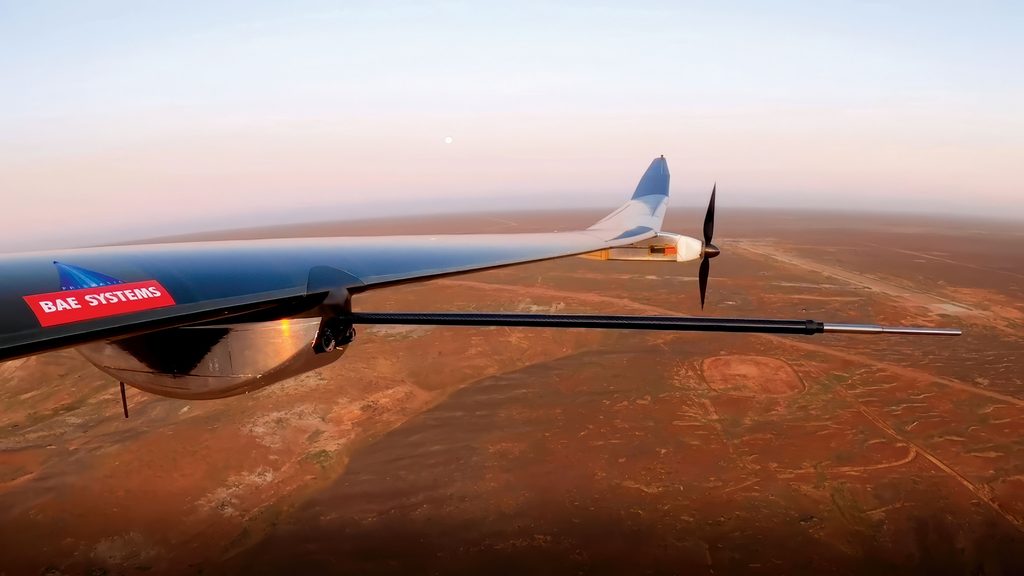
(Image: BAE Systems)
Instead, neural network-based MPPT controllers operate predictively. A trained feedforward network receives various real-time inputs – photovoltaic array current, voltage, solar irradiance measured by an onboard pyranometer, cell temperature, rate of change of irradiance, battery voltage and load current – and the network outputs the optimal operating voltage that maximises power output.
For this, a feedforward neural network with two to three hidden layers (each with 64–128 neurons) is trained offline and the training data is generated by simulating thousands of I-V curves under varying irradiance (100–1000 W/m²), temperature (-40 to +80 C) and spectral conditions with approximately 4500 parameters.
The inference time is 15–50 ms on a typical UAV autopilot processor, such as an ARM Cortex-A53 running at 1.2 GHz, enabling update rates of 20–60 Hz. This rapid response allows the controller to track the moving maximum power point during cloud transients, maintaining efficiency greater than 95%, even when irradiance change rates reach 500 W/m²/s.
Crucially, neural MPPT controllers anticipate drops in cloud-induced irradiance by observing the rate of change of irradiance (dI/dt). When the dI/dt value becomes negative, such as with an approaching cloud, the controller pre-emptively reduces voltage to avoid operating on the steep, inefficient portion of the I-V curve during the transient. This anticipation reduces energy loss during cloud passage by 15–30% compared to reactive Perturb-and-Observe algorithms.
The neural MPPT controller is implemented as a small firmware module on the UAV’s power management electronics, typically a Texas Instruments TMS320 DSP or ARM Cortex processor running at 100–200 MHz. Power consumption is ~50–100 mW and the computational overhead is negligible compared to total onboard processing.
(Source: BAE Systems)
Field testing and simulation studies demonstrate quantifiable advantages of AI-driven energy management over conventional systems. During a mission scenario over a period of 24 hours in an environment with variable cloud, traditional static MPPT combined with preprogrammed flight paths achieved an average energy efficiency of 68%. AI-enhanced power management systems combining LSTM irradiance forecasting, RL-optimised flight paths and neural MPPT achieved 82–87% efficiency – an improvement of 15–25% percentage points. Over a mission duration of 5000 hours, this efficiency gain translates into 750–1250 additional kWh of harvested energy, directly extending mission endurance by 30–40% without any increase in photovoltaic panel area or battery capacity.
Stratospheric solar-powered UAVs operate above most weather systems but still experience significant irradiance variability caused by high-altitude cirrus clouds, which transmit 40–70% of incident solar radiation. Therefore, accurate forecasts of cloud cover over periods of one to six hours are essential for energy planning.
The UAV’s mission planner downloads the latest satellite imagery (via satellite data link or pre-mission briefing), ingests it into the onboard CNN model and generates a six hour forecast of cloud optical depth. The RL-based flight path optimiser then uses this forecast to route the UAV through predicted clear-sky corridors, maximising cumulative energy harvesting.
Turbulence and wind speed forecasting
Wind shear and atmospheric turbulence affect both solar irradiance (cloud motion) and aerodynamic drag (increasing power consumption). Numerical weather prediction (NWP) models such as the High-Resolution Rapid Refresh or Global Forecast System provide wind profiles at 15 minute intervals and 13 km horizontal resolution. For UAVs, this resolution is often too coarse, meaning that the aircraft may encounter localised wind shear not captured by the NWP model.

GNNs enhance NWP forecasts by learning fine-scale wind patterns from historical high-resolution observations. A GNN takes NWP wind fields and adds high-frequency wind variability corrections, producing wind forecasts with 1 km resolution. These GNN-enhanced wind predictions improve six hour forecast accuracy by 20–30% and enable dynamic cruise altitude selection. The aircraft computes the altitude that maximises the ratio of the solar power available to the aerodynamic drag power required. Strong headwinds at low altitude may require the aircraft to climb to higher altitudes where winds are weaker, even if solar irradiance is slightly lower. GNN-based wind forecasting makes this trade-off calculable up to four to six hours in advance.
The complete atmospheric modelling pipeline integrates satellite imagery, NWP forecasts, GNN-enhanced wind predictions and ground station observations into a unified state-space model running on the UAV’s onboard computer. At five minute intervals, the system takes the latest satellite cloud imagery and updates forecasts using CNN predictions. It then retrieves the latest NWP wind profiles and enhances them using GNN corrections. RL-based flight path optimisation computes the optimal heading and altitude for the next five minute interval. The MPPT controller voltage setpoint is then updated based on predicted irradiance, and all the forecasts and actual observations are logged for continuous model retraining.
This architecture ensures that the UAV responds to atmospheric conditions in real time while maintaining predictive foresight. When unexpected weather (sudden cloud formation, wind shear) occurs, the system detects it within minutes and adjusts operations accordingly.
Field testing demonstrates that real-time data fusion reduces energy prediction error by 30–40% compared to using satellite data alone. Over a 24 hour mission, this accuracy improvement translates into 50–100 kWh of additional energy harvested – equivalent to four to eight additional hours of operations.
An onboard NVIDIA Jetson Xavier NX processor consumed 12–18 W during active RL and LSTM inference. For extended missions (48+ hours), this computational overhead becomes significant because it is 1–2% of the total energy budget. So, optimisation of neural networks for onboard use is critical.
Kalman filters
Accurate SoC estimation is critical for energy-aware mission planning. While simple coulomb counting (integrating current over time) is computationally cheap, it accumulates drift due to sensor noise and leakage currents. An extended Kalman filter (EKF) fuses multiple measurements (terminal voltage, current, temperature) with a battery state-space model to produce robust SoC estimates.

The battery model represents the battery as a series of RC circuits modelling diffusion resistance and double-layer capacitance. The state vector includes SoC and the voltage across each RC element. Measurements include terminal voltage and current. The EKF prediction step uses the battery model to predict the next state; the update step corrects predictions using new measurements.
For lithium-polymer or solid-state batteries, the EKF achieves SoC estimation accuracy of ±2–3%, far superior to that of coulomb counting alone (±5–10% drift over a 24 hour mission). The filter runs continuously at a 1 Hz update rate, consuming less than 50 mW.
The EKF also estimates the battery’s remaining useful life by tracking degradation in the RC circuit parameters. As the battery ages, the diffusion resistance increases, which the EKF detects. When the remaining useful life drops below a safety threshold (80% of original capacity), the mission planner reduces power draw or curtails mission duration proactively.
Load balancing
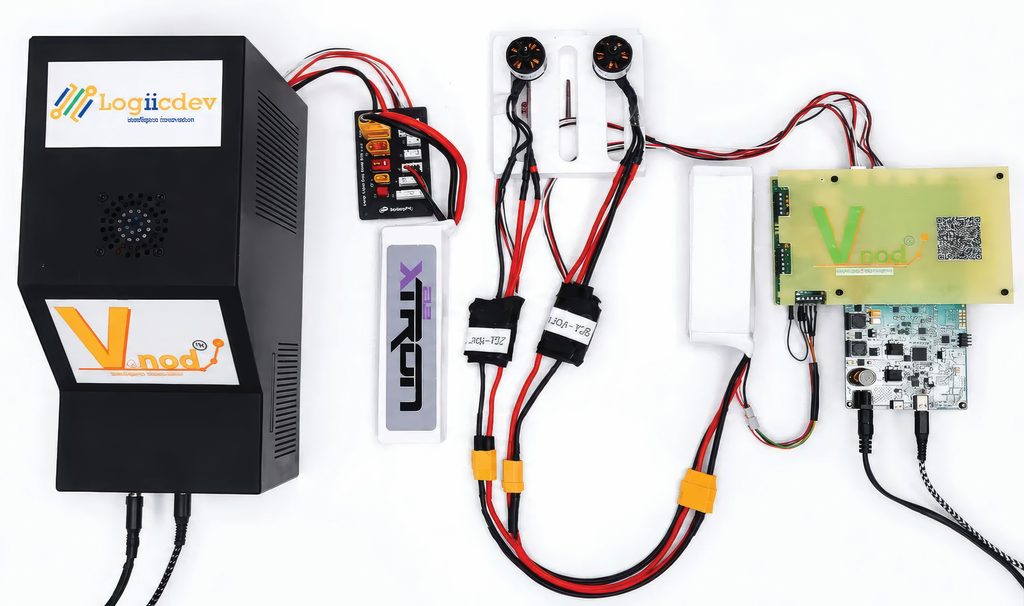
Modern UAVs can carry multiple power-hungry payloads, with electro-optical sensors, infrared cameras, synthetic aperture radar and radio receivers. Total power demand often exceeds available solar power plus battery discharge rate, requiring intelligent load prioritisation.
(Image: Logiicdev)
An AI-based load balancing system uses multi-objective optimisation to allocate available power among competing payloads based on mission priority and forecast energy availability. The optimisation problem maximises the weighted sum of payload power allocations subject to constraints: total power must not exceed available power, each payload has minimum and maximum power bounds and battery SoC must remain above safety thresholds. This is solved every five minutes using dynamic programming or genetic algorithms, taking 100–500 ms on the onboard computer. The result is a power budget for each payload over the next hour, allowing operators to adjust sensor parameters (image resolution, coherence time) to fit the available power envelope.
In field operations, this adaptive load balancing extends mission duration by 15–25% compared to that realised using static, equal-power allocation schemes. For a 24 hour surveillance mission, this translates into three to six additional hours of continuous operations.

The AI power management also improves the lifetime of the battery pack. Traditional reactive MPPT and altitude control require rapid power adjustments, causing high-amplitude battery current variations that can be as high as 20 A/s, putting strain on the battery cells. Predictive AI control smooths power demand, thereby reducing current ripple.
A traditional controller cycles the battery cells 8.5 million times, equivalent to a service life of over 5000 hours. An AI-enabled controller reduced this stress to 6.8 million cycles, a 20% reduction in battery degradation that extends the useful service life from seven to eight and a half years.
Swarm coordination
Three aircraft on a coordinated surveillance mission in the Mojave Desert (USA) in June 2026 maintained continuous surveillance of a 100 km² target area over 18 hours. Independent operation saw a total flight time of 42 hours (3 aircraft x 14 hours each) with two mission gaps when the aircraft landed to recharge. The coordinated swarm saw a total flight time of 51 hours with each aircraft mission lasting 17 hours with no gaps, giving an improvement in endurance of 21.4% and increasing the coverage to 100%.
Future standardisation of energy-aware flight controllers is also needed. Integration of the signal from the pyranometer solar irradiance detector into the autopilot’s control loop required custom firmware, and commercial autopilots (Pixhawk, APM) lack direct irradiance-based control. The drift and calibration uncertainty of the pyranometer of ±3–5% introduced prediction errors, while the dual redundancy and frequent recalibration improved reliability but added complexity.
Mission planners also requested simplified interfaces for AI control. So, rather than exposing RL policies and hyperparameters, a simple ‘energy conservation mode’ button proved more practical, allowing operators to toggle between maximum endurance and maximum coverage strategies.
Automotive
As the technology behind autonomous driving continues to progress, the function of power electronics and management will become increasingly important. The technologies that enable autonomous driving have their own set of issues when it comes to power management, which differentiates them from conventional vehicle systems.
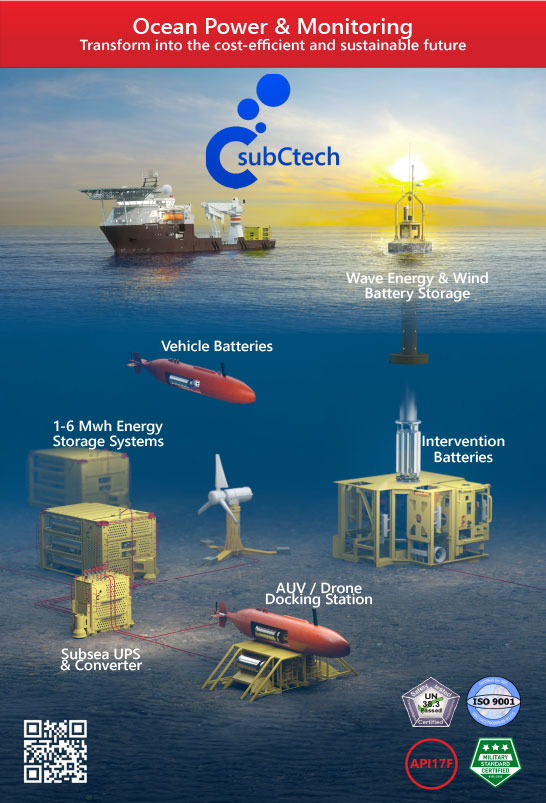
Autonomous vehicles rely on a wide variety of sensors, ranging from Lidar technologies to ultrasonic systems. Every single sensor requires power, and when the power demand of each sensor is multiplied by the number of sensors on a single vehicle, the entire power consumption can be significant.
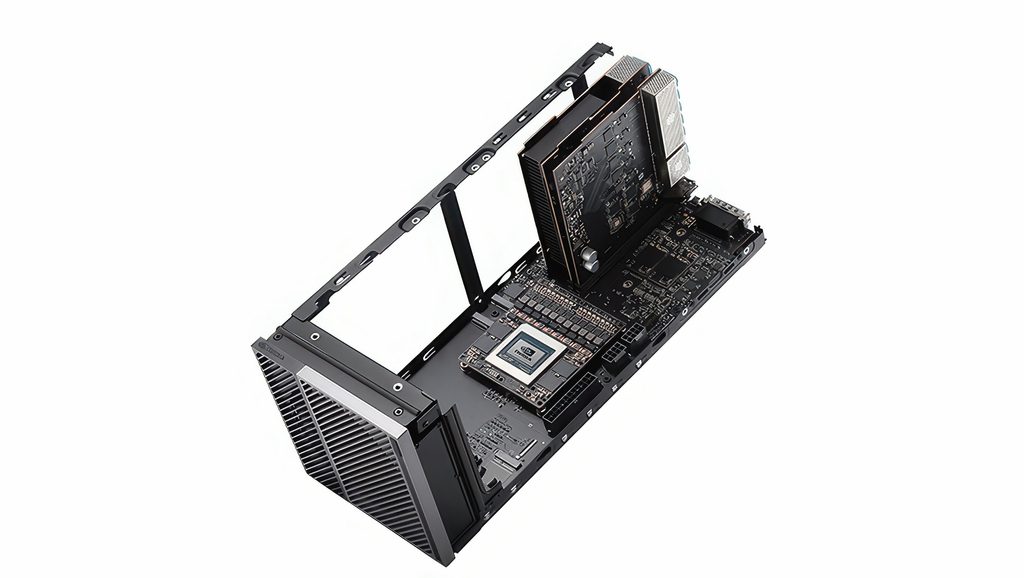
In addition, the data that these sensors collect is processed in real time by the onboard computing systems. Even though such systems are efficient in terms of their processing ability, these processors require a large amount of power.
The continual running of these systems even when the vehicle is stationary, for example, at a traffic signal, contributes further to the overall power consumption of the vehicle. Numerous autonomous systems continue to be active, continuously scanning and processing information, in contrast to traditional vehicles that have a tendency to let many of their systems lie dormant when the vehicle is not in use.
The power systems also need to be extremely dependable in order to function properly. Any interruption to power could result in a malfunction of a sensor or processor, which could put the safety of the people within the car as well as other people on the road in jeopardy.
Additionally, safety standards necessitate that power systems are able to withstand abrupt high-load demands without experiencing any disruptions. In the event of an emergency, for instance, the vehicle might require access to additional computational power in order to make decisions or activate multiple systems at the same time. For instance, when an autonomous vehicle detects an impending collision, it might need to immediately activate braking systems, steering adjustments and various sensors in order to avoid the obstacle. This demands a fast increase in computational power in order to process the Lidar, radar and camera data while simultaneously engaging mechanical systems such as brakes and steering actuators. This must be done without any delay or power shortage.
(Image: NVIDIA)
The power electronics must also be resistant to external variables such as variations in temperature, vibrations and electromagnetic interference. This can be a particularly difficult task to accomplish considering the limited space and weight constraints.

Some vehicle operators have created processing systems specifically for their autonomous vehicles with the purpose of maximising power efficiency. Because the system is able to interpret sensor data and make judgements regarding driving with very low latency, it ensures that it is responsive in real time. Given that the system dynamically adjusts its consumption in response to the needs of computation, adaptive power regulation is clearly visible.
Driverless vehicle operators are currently working to develop energy optimisation algorithms that intelligently balance performance and power consumption to ensure that the processes that require the most energy are only activated when they are absolutely required to do so.
Investments in more energy-efficient next-generation hardware reduces the overall energy footprint, but this involves the creation of specialised hardware components designed to perform particular functions more effectively than general-purpose components, thereby reducing the amount of power wasted on unnecessary operations.
Acknowledgements
With thanks to Sulaman Rafiq of BAE Systems and Deepak V Katkoria of Logiicdev.
UPCOMING EVENTS