








Photon-tracking of UAVs in flight
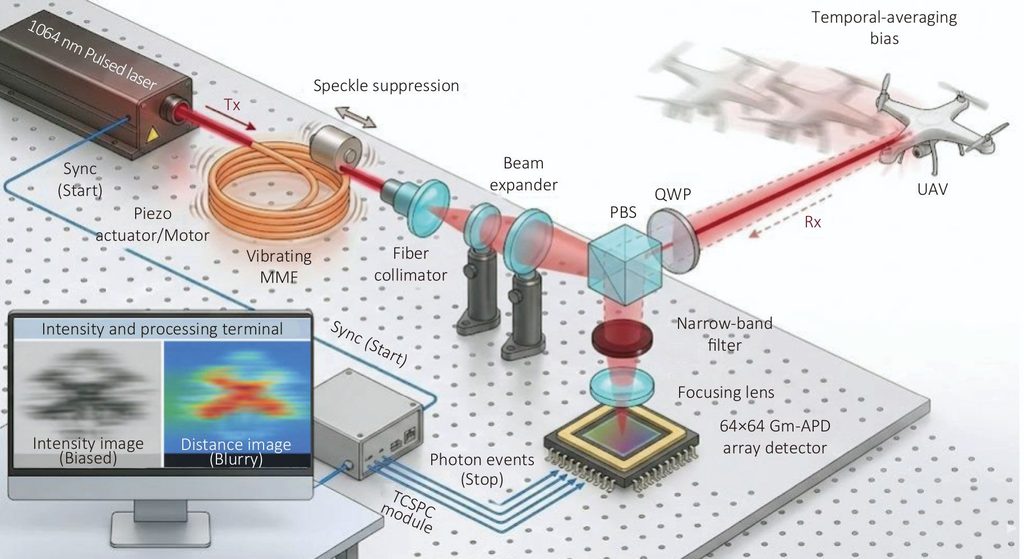
(Image: Harwin Institute of Technology)
A significantly more accurate dynamic Lidar sensor that can operate with single photons has been developed by researchers in China, writes Nick Flaherty.
Single-photon Lidar combines single-photon-level sensitivity with nanosecond-scale temporal resolution. It has substantial potential in precision imaging and long-range static sensing.
The technique developed at the Harwin Institute of Technology in northeastern China accumulates photon events over multiple laser-emission cycles to extract sparse target returns from strong background noise. For stationary targets, this accumulation improves statistical significance. For moving targets, however, spatial displacement during the sampling interval causes photons returned from different positions to be compressed into the same integration window. The result is spatial spreading of photon energy, meaning that conventional methods can recover only a weighted-average position along the target trajectory rather than its instantaneous location.
Reconciling this photon-statistical gain with instantaneous dynamic measurement is a central challenge in advancing single-photon Lidar from static imaging to dynamic sensing. The team analysed the photon-triggering model and the mechanism of motion-induced photon dispersion, defining a ‘motion-induced temporal-averaging effect’ in single-photon dynamic detection. This highlights the fundamental conflict between the accumulation required to enhance weak echoes and the instantaneous measurement demanded by high-speed motion.
To overcome the motion-induced averaging, the team developed a photon-event-driven three-dimensional dynamic target-tracking (P3DTT) method. The P3DTT method addresses the photon-limited bottleneck in which a moving target can be detected but its instantaneous position remains difficult to determine. This breaks the conventional trade-off between photon-statistical gain and instantaneous measurement accuracy, thereby providing a new technical route for advancing single-photon Lidar from static integration imaging toward practical long-range dynamic sensing.
P3DTT identifies target-generated photon events against strong background noise by exploiting the dynamic consistency of photons scattered from the target across spatial location, arrival time and inter-frame displacement.
It then rearranges and refocuses these events in space and time, reconstructing the instantaneous target position throughout the sampling window and enabling continuous 3D tracking. This suppresses the impact of temporal averaging on dynamic imaging and localisation accuracy.
Monte Carlo simulations showed that with an average of only 0.2184 signal photons per pixel and a signal-to-noise ratio as low as −8.37 dB, the P3DTT method could recover the instantaneous position of a dynamic target moving at a 3D velocity of up to 188.8 m/s and perform continuous 3D tracking.
The method also reduced the instantaneous time-of-flight localisation error from 4.71 to 0.33 ns, corresponding approximately to a 14-fold improvement over other systems.
The algorithm was implemented on the team’s independently developed single-photon Lidar system. Under intense stray illumination of 12,500 lux and with an average of only 0.2731 signal photons per pixel, the system achieved instantaneous position estimation and continuous 3D tracking of a moving UAV at a range of 2.5 km, with a 3D tracking error of below 0.4375 m. The results demonstrate that photon dispersion generated by a moving target within the sampling window is not merely an imaging artifact. Instead, it is an evolving photon-event process that encodes the target’s motion state. The P3DTT method can identify and use photon events, which conventional accumulation methods merge together, to recover the target’s instantaneous 3D position.
UPCOMING EVENTS