





Octopus inspires underwater drive
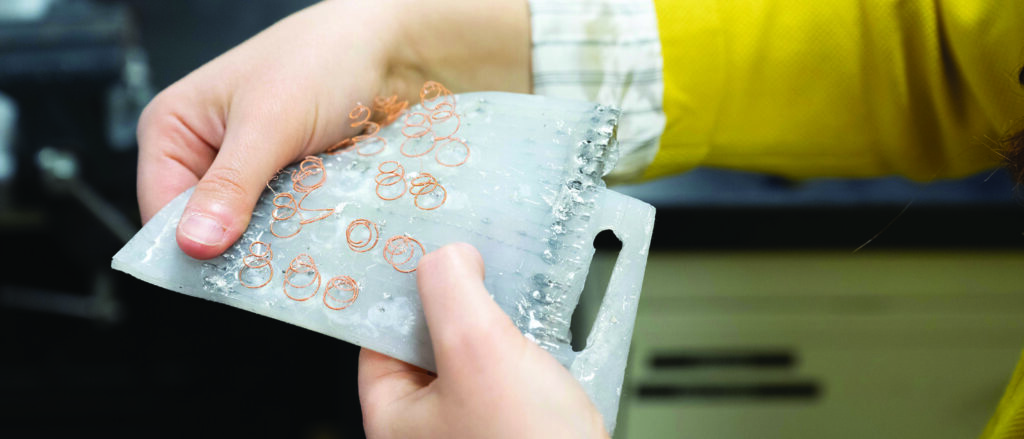
(Image: University of Iowa)
Researchers in the US have developed an underwater propulsion system based on the way an octopus moves, writes Nick Flaherty.
The research team at the University of Iowa outfitted the wings of an underwater hydrofoil with a series of coiled spires that, when activated, unspool, thereby reducing drag and creating more lift for the craft as water current is moved around it.
The researchers demonstrated a proof of concept for the coiled spires, which they call twisted spiral artificial muscles. These synthetic coils are designed to mimic an octopus’ papillae muscles, which are located on the animal’s skin and can be uncoiled on a moment’s notice for camouflage and to aid movement when flow conditions change in the water.
The team modified a hydrofoil’s wings with two rows of four twisted spiral artificial muscles, each one powered by two tiny electrical actuators. In experiments with water moving at different speeds, the researchers report that the hydrofoil generated lift up to 30% and reduced drag by up to 10% during certain manoeuvres.
This device can deploy vortex generators (VGs) on demand in response to changes in flow conditions, thanks to the embedded twisted spiral artificial muscles. The device was tested on a hydrofoil in a rectangular water channel at NASA’s Langley Research Center at a Reynolds number of 100,000 and 120,000, while lift and drag were measured.
Results demonstrated that the VGs produced an increase in the lift coefficient (CL) of 25–30% and reduction in drag by 8–10% at high angles of attack (α), compared with a clean hydrofoil. The active flow control device ensures timely VG deployment, closely matching the peak performance of static devices across the range of α tested (0°–24°). The on-demand deployment of the active flow control device was facilitated by an adaptive controller, while flow visualisation studies were conducted to observe flow separation on the hydrofoil.
With the increased lift and reduced drag, the hydrofoil displaced the water more easily during different flow conditions, even when the craft was tilted steeply against the direction of water flow.
“This study can help make uncrewed underwater vehicles more efficient, using low-cost artificial muscles that are bioinspired by the motion of octopus papillae muscles. It can help save energy and improve the portability and manoeuvrability of seafaring vehicles,” said Rabiu Mamman, a doctoral student in mechanical engineering at the College of Engineering and a graduate research assistant at IIHR Hydroscience & Engineering (University of Iowa).
UPCOMING EVENTS