




New materials for boosting communications in vehicles
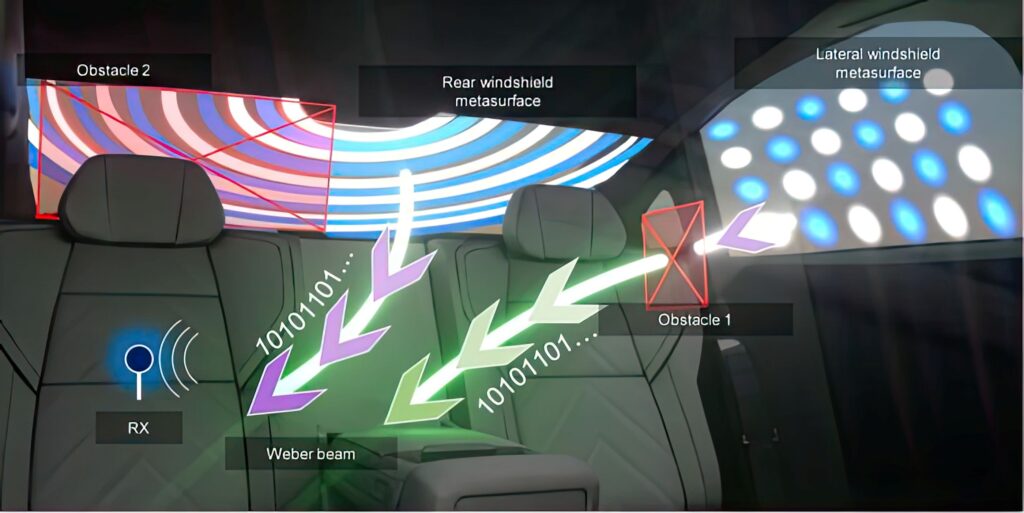
(Image: Nanjing University of Aeronautics and Astronautics)
Researchers in China have developed a transparent metamaterial that can boost the transmission of data from a vehicle, writes Nick Flaherty.
Vehicles are a complex electromagnetic environment with occlusion from metal body frames, seats, headrests and other interior components that often leads to severe attenuation of wireless signals, which has become a limiting factor for communication quality.
The team from the State Key Laboratory of Millimeter Waves at Southeast University and National Key Laboratory of Microwave Photonics at Nanjing University of Aeronautics and Astronautics demonstrated a functionally adaptive transparent metasurface integrated into a car’s windows, which can enable obstacle-avoiding and self-recovering signal transmissions using a Weber beam technique.
Weber beams use a non-diffracting wavefront with unique self-accelerating properties that allow them to propagate along curved paths and so bypass obstacles in their way. They also exhibit self-healing capabilities so that even when blocked, the beam can be reconverged behind the obstacle and restored to its original waveform and energy.
The smart window developed by the team uses low-cost, easily processable flexible PET substrate and precise PCB fabrication techniques. The core advantage lies in combining excellent electromagnetic control capability with high optical transparency. Experimental data show that the metasurface sample achieves a visible light transmittance of 73.5%, which meets industry standards for modern automotive windshields without interfering with passenger visibility.
UPCOMING EVENTS