


Multi-scenario tracking antennas
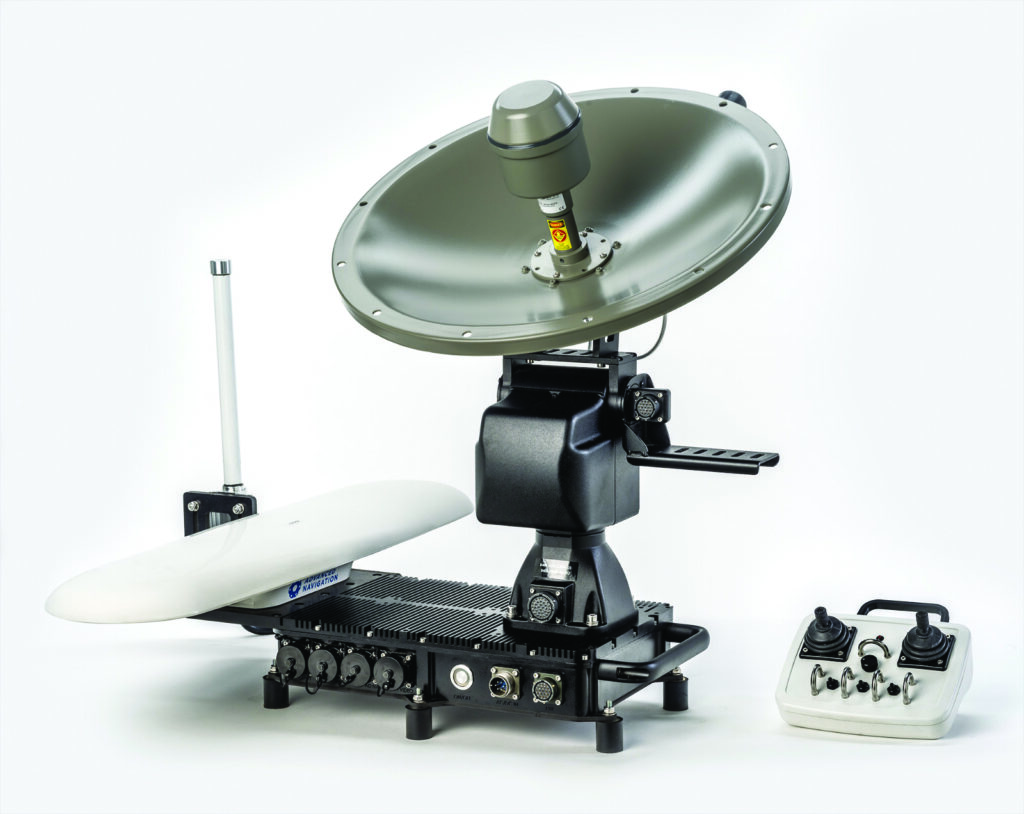
(Image: Alpha Unmanned Systems)
Alpha Unmanned Systems in Spain is manufacturing integrated tracking antennas and GCSs for enabling UAV operations from a range of different locations. The systems have been matured over the past 15 years, even prior to the company’s official founding in 2014, leveraging key lessons from its operations, including integrations onboard naval vessels, writes Rory Jackson.
“We can customise our tracking antennas based on how much data clients want to transmit, the ranges they want to achieve, and how much weight and power their UAV can dedicate to a strong data link – we’ll also help clients with integrations, and do full calculations to simulate the potential ranges they could have,” said Álvaro Escarpenter, CTO and co-founder of Alpha Unmanned Systems.
“There’re many trade-offs: for instance, a stronger radio will consume more power, or a dual-bandwidth system will be more jamming-resilient but rely on lower-gain antennas with suboptimal ranges. There’re a lot of levers to pull, so it takes a lot of engineering and consulting to customise an ideal system.”
A few standard-issue tracking antennas are available, such as the company’s Vessel-based Control Station (VCS), offered principally for ships, but also suitable for road and off-road vehicles, as a remote UAV post or main C2 station.
The VCS is offered in various sizes and grades, and comes with extensive Ethernet connections for integrating computers and control peripherals, and an optional radome for protection. The dish antenna at the heart of the VCS is, unusually for a tracking antenna, gyrostabilised, enabling it to maintain continuous connection with a UAV amid high sea states and harsh weather.
Key to the tracking antenna’s gyrostabilisation is a pan-tilt unit, also offered as a standalone product to system manufacturers and integrators. It also functions via Alpha’s power and communications module, which tightly integrates power distribution, telemetry and data links as 300 or 1200 W solutions.
Meanwhile, the operator can interface with their UAV via the G-Case GCS, which is designed as a rugged case-type station, but with an open ‘payload bay’, born of Alpha’s many exhausting years of hurriedly switching radios in and out of G-Case to suit different clients’ preferences.
This bay comes with an accessible mounting frame, along with power and RF connections, so that any customer’s technician can bolt-in their choice of radio, or an additional computer or peripherals.
UPCOMING EVENTS