







Morphing wings adapt to flight conditions
(Image: DLR)
DLR in Germany has developed new aircraft wings capable of changing shape during flight, writes Nick Flaherty.
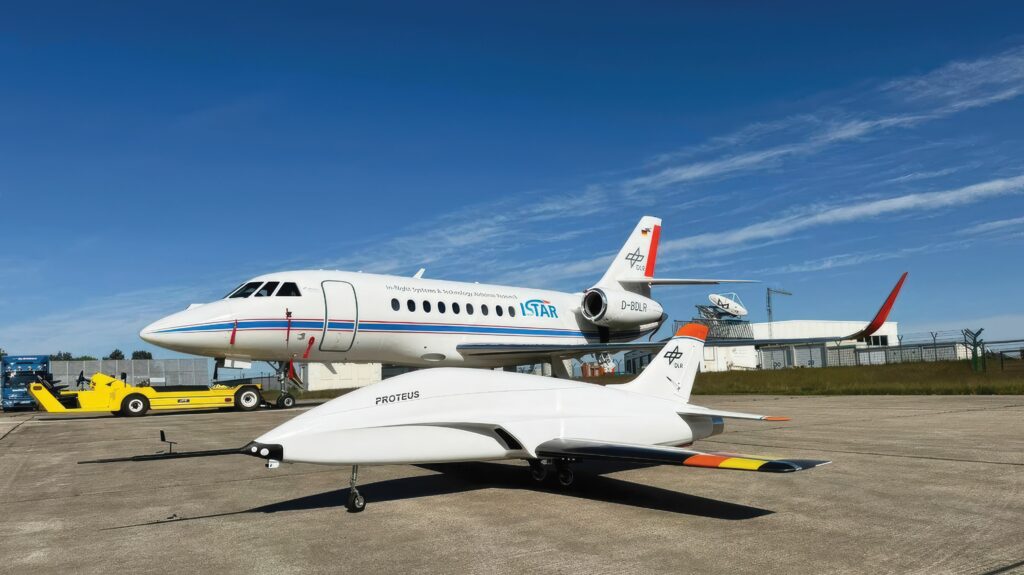
An AI model controls the wings and automatically adjusts them, even in the event of disturbances. The system has been flight-tested on a 70 kg experimental uncrewed aircraft called Proteus as part of the morphAIR project from the German Aerospace Center (Deutsches Zentrum für Luft- und Raumfahrt, DLR).
Proteus has both a conventional and a morphing set of wings. “The morphing wing can change its shape during flight, allowing it to adapt optimally to different flight conditions,” said project leader Martin Radestock from the DLR Institute of Lightweight Systems.
Both sets of wings are made entirely of fibre-reinforced composites. The morphing wing pair uses a form-variable trailing edge section, made possible by a Hyperelastic Trailing Edge Morphing (HyTEM) system. This enables the wing to deform seamlessly and without steps.
“The HyTEM concept replaces conventional flaps and ailerons with an intelligent system comprising several small actuators distributed across the wingspan,” said Radestock. “These can precisely adjust the wing profiles at 10 points without creating gaps between sections. The continuous shape reduces profile drag. In addition, lift, induced drag and aircraft control can all be influenced in a targeted manner.”
This technology also promises improved safety because control functions can be distributed across the entire wing.
A central element of the project is an AI-assisted flight control system developed by the DLR Institute of Flight Systems, designed specifically to make full use of the unique movement capabilities of the morphing wing.
During flight, the adaptive algorithm detects when the aircraft’s actual behaviour deviates from its previously trained model and continuously adjusts its internal models. During training, specific damage scenarios and failures of individual control surfaces are also deliberately simulated. This allows the algorithm to learn to recognise such changes in flight and control the remaining actuators in a way that keeps flight behaviour as stable as possible.
Unlike conventional flight control systems, this adaptive approach can optimally coordinate the many distributed actuators, making the most of the aerodynamic potential of the morphing structure while also improving fault tolerance.
A key element in this is the reliable method for reconstructing the surface pressure distribution from just a small amount of measurement data. This gives the system an immediate ‘sense’ of its current flow field. The experimental aircraft can thus compare the reconstructed pressure field with the expected state, automatically detect local deviations and interpret them as relevant disturbances.
In initial trials, DLR researchers successfully tested both wing concepts in flight. They integrated both the reference wings and the morphing wings into the aircraft and tested them. The trials demonstrated the basic airworthiness and system integration.
Although the researchers collected data during scaled flight tests, the aerodynamic and structural design support a maximum speed of 300 kph and a wing loading of 70 kg/m2.
UPCOMING EVENTS