







Miniature pump with a big heart
(Image: University of Bristol)
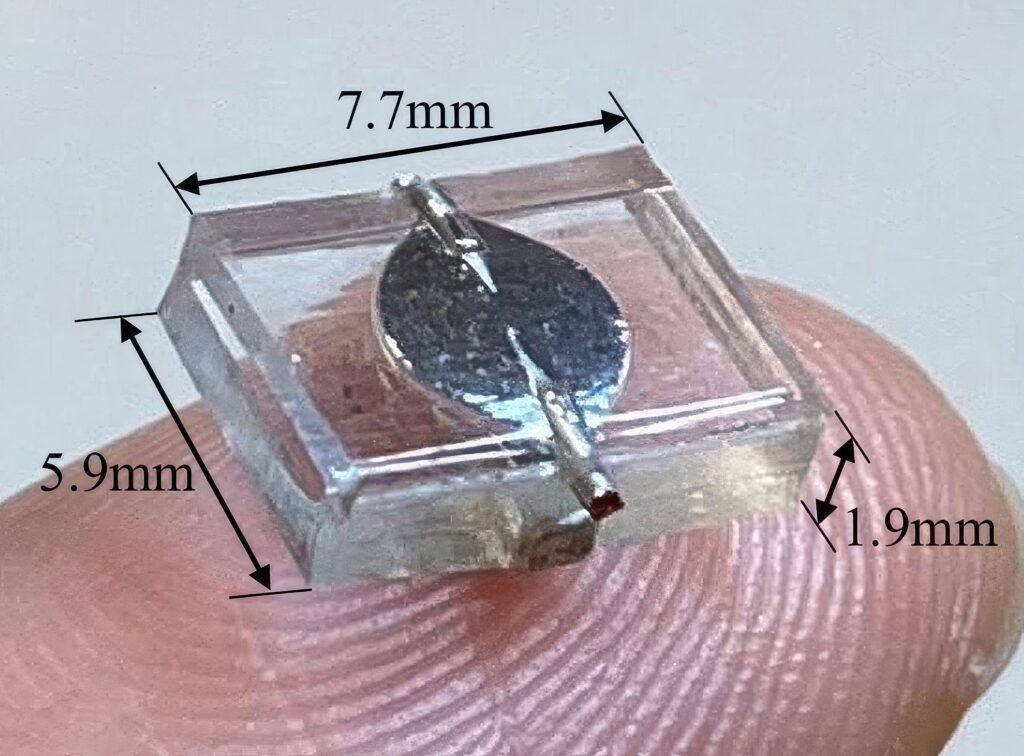
A tiny pump capable of powering a tiny robot butterfly has been developed by researchers in the UK, writes Nick Flaherty.
The liquid-metal magnetohydrodynamic (LIMA) pump weighs just 0.2 g and runs at less than 0.1 V, yet has the potential to outperform existing soft pumps and even some commercial pumps used for fluid transport and hydraulics.
Electrical energy is converted into fluid motion through the principle of magnetohydrodynamics, which harnesses the Lorentz electromagnetic force through the liquid metal. This moves the droplets back and forth, displacing surrounding fluid and creating a pumping action.
It delivers a specific pressure of 18.6–34.88 GPa/m³ and a specific flow rate of 38.4–49.29 kL/min/m³, and the pump’s light weight has enabled its use in robotic butterfly wings.
“This is a really exciting development, which overcomes the existing barriers of stiff bulkiness and offers something miniature, portable and more adaptable,” said lead researcher Saba Firouznia, research associate at the University of Bristol Soft Robotics Lab.
“Unlike conventional soft pumps, which often rely on bulky, rigid or high-voltage components, LIMA uses the intrinsic properties of liquid metal: high electrical conductivity, high surface tension, deformability and low resistance to motion. These properties allow the pump to operate at millivolt-to-sub-volt levels while still generating useful pressures and flow rates for soft robotic movement.”
The pump can transfer not only hydraulic energy but also chemical energy and information signals through soft fluidic networks, and so it offers a route toward more portable, autonomous and multifunctional soft robots.
“Crucially, the LIMA pump acts as a soft, compact heart for robotic systems, combining pumping, signalling and energy transfer in a single low-voltage platform,” said Jonathan Rossiter, professor of robotics at the University of Bristol and head of the Soft Robotics Research Group.
UPCOMING EVENTS