






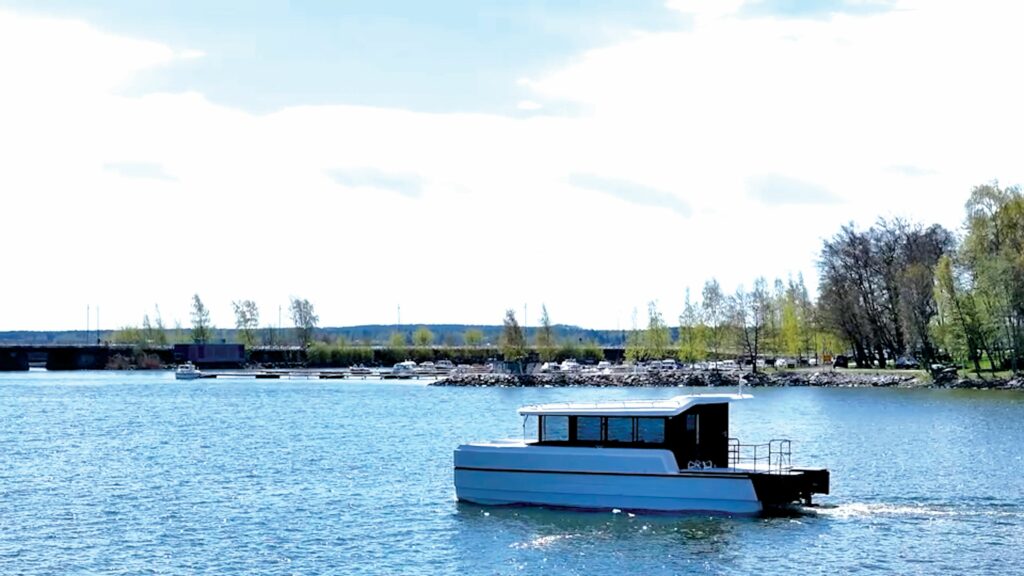
Mente Marine Callboats CAT 10 L
(All images: Mente Marine)
All aboard
Water passenger transport is beset with severe overheads and labour shortage problems, but this company’s autonomous water taxis are fixing them. Rory Jackson investigates
The maritime passenger transport industry has been a hotbed for autonomy pilot projects for several years now, with legitimate causes beyond the mere profit motive of uncrewed systems manufacturers.
For one, while many industries are currently enduring labour shortages, the majority of ferry and water taxi captains worldwide are dangerously close to retirement, and it is especially difficult to find replacements. This has been a mounting issue for the past couple of decades, with captaining water transports being a job that requires exhaustive training, high sustained skill levels, and tolerance of seasonal lulls and occasional lack of career advancement.
The industry’s captains aren’t the only ageing asset; most ferries and water taxis are painfully old vessels running on maintenance-intensive diesel powertrains, with maintenance costs leaving little financial headroom for attracting new generations of trainee staff, let alone upgrading old systems.
Hence, new mobility tech suppliers see golden opportunities in rejuvenating maritime mobility and resolving its problems; city planners and governments meanwhile view revamped water commuting networks as much-needed relief for their congested, cracking roads, and thus many are eager to fund or otherwise encourage such initiatives. Electrification is a natural solution to prohibitive maintenance costs; autonomy, meanwhile, is the obvious answer to labour shortages, with the former enabling the latter through replacement of manual, analogue systems with electronically governable digital networks and devices.
And in addition to taking dull work off the captain’s hands by outsourcing vessel piloting to a marine autopilot, and yielding key benefits in collision avoidance and casualty rescue by entrusting advanced sensors with situational awareness, autonomy may pose even greater appeal to industry in cost-reduction terms than does electrification, as Finland-based Mente Marine tells us.
“Whether you’re running diesel or electric boats, your crew costs are more or less the same, as are your OpEx [operating expenditures] and CapEx [capital expenditures] by extension. So, if you can take away the majority of the OpEx, everyone would electrify, and you’d easily facilitate a hundredfold use of public transport, from how cheap you could make it and how you could decouple it from seasonal peaks and troughs,” says Peter Ostberg, CEO and managing director of Mente Marine (and its Callboats product line of autonomous water taxis).
Ostberg’s insights are founded in experience, having been managing director of marine electronics supplier Mente Marine, before spinning out Callboats in 2017. Although originally formed to electrify pleasure boats, Ostberg and his team realised this would do little good for Europe because such vessels spend less than 1% of their time actively using their propulsion systems.
“There’s a far more serious environmental imperative in electrifying marine commuter transportation; tens of thousands of Finns populate islands unconnected by roads to the mainland, meaning tens of thousands of unnecessary, small, carbon-spewing boats where a small fleet of electric water taxis would empower the same degree of commuting,” Ostberg muses.
Mente Marine started small, launching its six-passenger CAT 6 in 2020 (staunchly claiming this as the first autonomous passenger boat in the world), before moving onto its 10 m CAT 10 prototype in 2022. It has also operated seasonal transport services in Helsinki in recent years.
At the time of writing, the company’s flagship product is the 10 m CAT 10 L – the third-generation version of the CAT 10 line – and its first product sold to another company, having been delivered to its Norwegian customer the day after our interview.

“Norway was a deliberate choice because we believe Norway is in the forefront of maritime autonomy advancements, which makes it easier to collaborate with authorities and build a regulatory framework for autonomous water transport that other countries can then adapt towards,” Ostberg says.
“RINA [Registro Italiano Navale], being much like Bureau Veritas, has been of vital help in supervising all of our production, watching even as we lay-up our GRP [glass-reinforced plastic or fibreglass composite] and everything; we also send test samples of our metals and GRP to labs for every boat, not just for one boat for type certification.
“We’re based in Vaasa, in Finland’s boatbuilding region, meaning we have great access to experienced engineering talent; we’re now moving to a bigger construction hall not far from our previous one, as we’re getting more demand than our current production space can fulfil.”
The water taxi
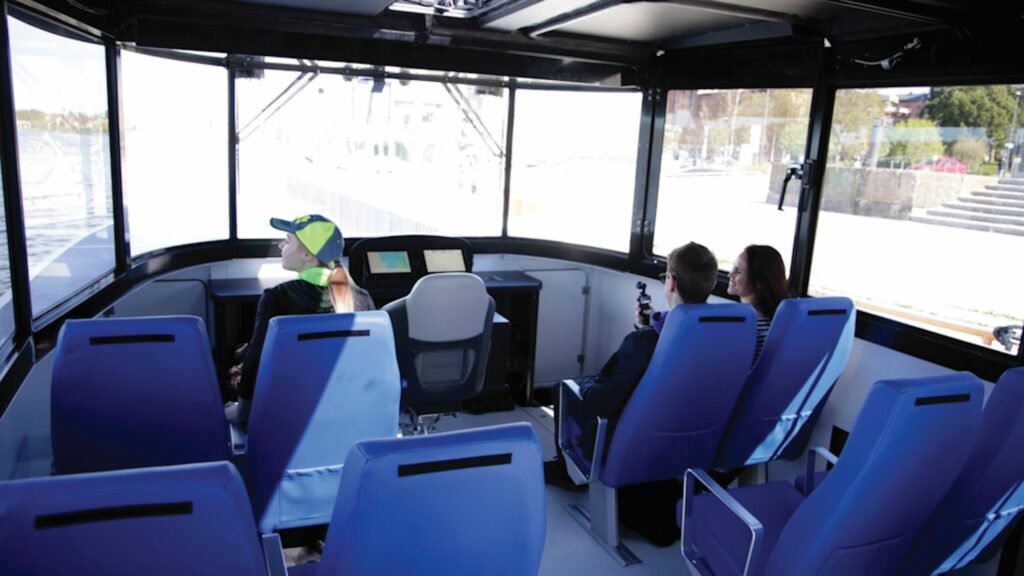
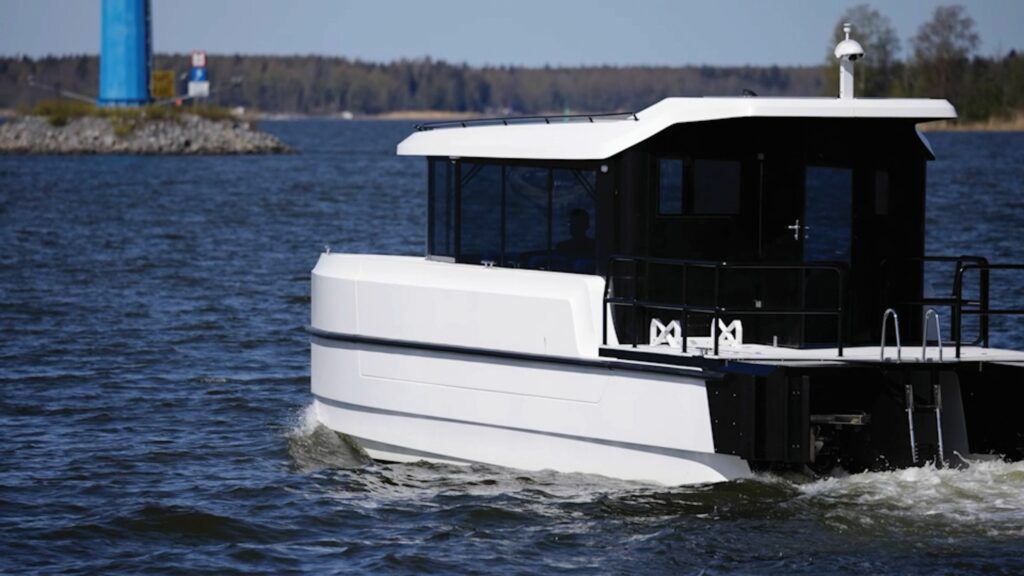
The CAT 10 L measures 9.9 m in overall length, 3.5 m at beam and has a 0.6 m draft – its name (and that of its predecessors) coming from its catamaran architecture. Its hulls are predominantly GRP, while its cabin is largely aluminium, within which up to 30 passengers may be seated.
The vessel’s displacement is either 6000 or 6600 kg, depending on which of its two configurations it is ordered in: one with a 60 kW powertrain and the other with a 160 kW powertrain. The former is equipped with a pair of 30 kW thrusters and is capable of speeds up to 9 knots, while the latter’s two 80 kW thrusters give speeds up to 14 knots.
The latter also integrates a 240 kWh battery pack – twice the size of that of the lighter vessel – enabling its 34 hour continuous endurance if adhering to a cruising speed of 6 knots. It also fast charges at 120 kW DC, and ‘slow charges’ at 22 kW AC compared with the slower vessel’s 60 kW DC and 11 kW AC charging (meaning matching C-rates).
Both watercraft also integrate 1500 W of solar panels atop their cabins, a 30 kW backup thruster, and an unusual single-PCB approach to its control and navigation electronics.
All inter-system processing and signal communications takes place on a single, large PCB. In addition to keeping the electronics architecture simple and accessible, the board also integrates redundant backups for every subsystem.
In essence, the company has built a boat around its electronics, with the board carrying OEM versions of all subsystem computers, rather than the traditional boatbuilding approach in which every subsystem is housed in a separate box. Ostberg notes that the latter causes painful added costs in projects retrofitting crewed, conventionally powered boats into autonomous, electrified vessels, covering mounting plates, thermal management and excessive labour hours.
“And each of the catamaran’s two hulls contains a powertrain, with everything connected between them via CAN bus and HV cables, and everything made redundant wherever possible, including each thruster being driven by two motors, so we’re never left dead in the water,” he adds.
The “self-driving computer” system (as Callboats’ personnel refer to it) and its network have been designed entirely in-house. A central ARM-based electronic control unit (ECU) serves as a centralised processing core for all low-level electronic subsystems, such as sensors and actuators.
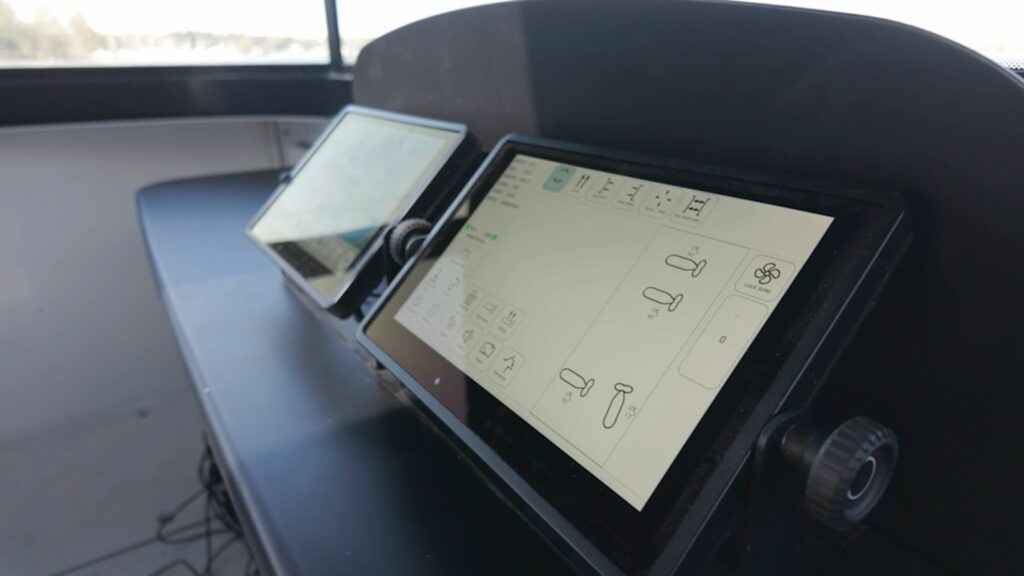
A higher-level computer monitors the ECU and its lower systems, and governs all data and comms for human-machine interfacing. It is, hence, responsible for the CAT 10 L’s onboard 4G modems, its SIM cards (with two from different network providers typically installed), as well as an offboard user interface typically displayed over two touchscreens – this architecture ensuring redundancy and eliminating physical interfaces such as buttons and flippers.
“The higher computer is a Linux-programmed system built around a very standard x86-type architecture, and then we have a third layer with an architecture built around a Hailo computer, which integrates our GPUs for camera, radar and Lidar data analytics,” Ostberg says.
These computers are soldered onto a board printed and layered in-house because circuit boards have been a key part of Mente Marine’s electronics business for many years; the CPUs, GPUs and other ICs are ordered in, naturally.

“By and large, making the computer system was easier than the structure; a colleague of mine with experience in both aviation and automotive industries has told me that structural regulations for passenger boats are even stricter than those other two,” Ostberg muses. “We had to adhere to enormous pressure, scrutiny and collective certification requirements from classification societies on structural integrity, quality, materials, loads and so on.”
GRPs are used in the hulls primarily because of the relative ease in forming hydrodynamic geometries and sweeps with fibreglass, with Poland-based Schneider & Dalecki chosen as a high-quality GRP supplier. The GRP additionally yields safety benefits over aluminium and other metals when used as housing material in close proximity with high-voltage, high-current machinery and salt water.
“Aluminium, high-voltage electrics and seawater are really not a safe combo; it’s very easy to get sudden, high-energy events, and it might not even be the USV’s fault. Poorly controlled crewed vessels or harbourside machinery neighbouring the USV could impact it and cause a high-power discharge if we don’t take care to use less electrically active GRP over aluminium where appropriate,” Ostberg notes.
Meanwhile, the easily tailored flexibility of aluminium (particularly through laser cutting) drove its use in the bridge deck, cabin and elsewhere – the metals coming from a few suppliers local to Callboats around Finland’s west coast.
Setting sail
Given the highly digitalised control and comms system inside the CAT 10 L, all pre-departure checks can be run remotely and analysed remotely. Accordingly, Mente Marine has a remote control centre, with consoles such as the aforementioned two touchscreen interface enabling initiation of key safety tests and monitoring for any sort of anomaly.
Such tests include checking all minimum and maximum voltage levels across the low- and high-voltage buses, along with initial ping and response checks for all motive parts in the thrusters – meaning propulsion motors and servo actuators.
“Those are all triggered and evaluated remotely, and we can even go so far as to remotely test for signs of anything stuck in the propellers like rope or seaweed,” Ostberg says.
“That involves measuring the electrical energy usage, propulsion force and position feedback, and seeing how they play out in contrast to requested loads to see if there’s something impeding the thruster.
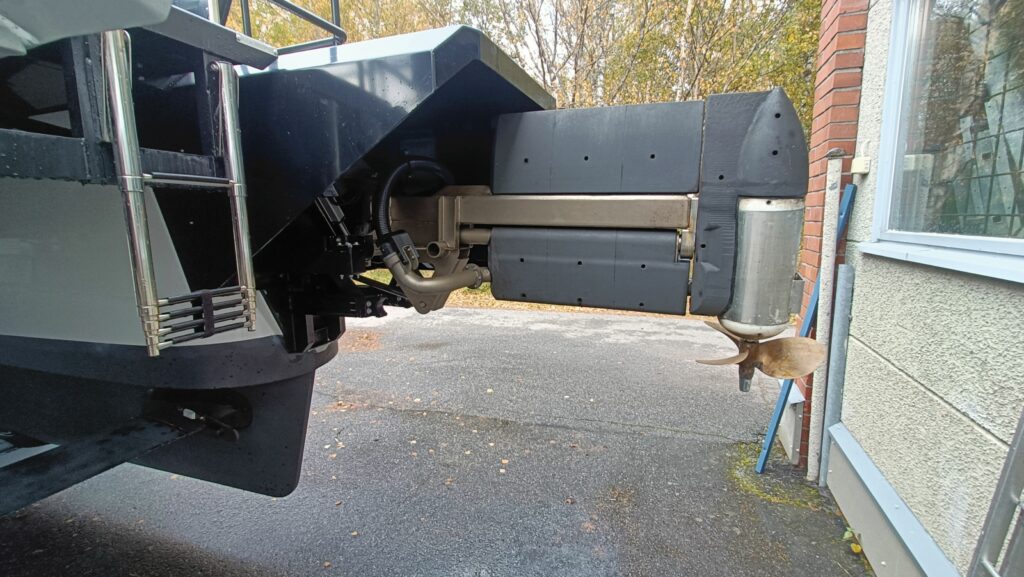
“That’s a real concern when working in city environments because all kinds of trash can be floating in urban waterways. So, to assist with situations where the data show signs of something stuck in the props, we design our pod motors so they can be tilted up for humans to inspect and possibly clean them.”
Low-cost propulsion
Naturally, the remote monitoring centre also tracks live telemetry during taxiing operations for these sorts of anomalies, and its routes thus far are organised such that a crewed boat on standby can come to attend to it at short notice, typically within 10–15 minutes of an issue being detected.
Many of the engineering choices that have gone into the water taxi were aimed at reducing maintenance costs, which is in line with the original cost-saving motivation behind Mente Marine’s decision to produce autonomous vessels rather than crewed electric boats.
The thrusters are perhaps the best example of this: each of the two submerged pod thrusters has been designed and assembled in-house, with subcomponents such as the motor windings, shafts and housing parts arriving from elsewhere.
To minimise the number of moving parts and regular maintenance tasks, the thruster was designed as a direct drive system, forgoing gearboxes or reduction belts, and also omitting oil, meaning no scheduled oil replacements.
In fact, Ostberg tells us there is no oil anywhere in the boat (aside from sealed oil inside actuators), nor is saltwater required anywhere inside the boat, be it for lubrication of the long-lifespan plastic bearings used, or direct water cooling of heatsinks or similar subsystems. The latter omission notably prevents the need to periodically flush saltwater-lubricated or -cooled machinery with sweetwater to dial back corrosion and biofouling rates.
Owing to the electrified powertrain’s omission of mechanical, hydraulic, lubricated or actively cooled parts, he notes, there is technically no need for scheduled maintenance at all, aside from replacement of individual parts when they reach their respective end-of-life, such as changing the pod thrusters’ bearings at 20,000 hours. The little maintenance performed after a day’s operations consists largely of minor cleaning duties and mooring the boat (or hauling it ashore), rather than oiling engines or cleaning props.
“Going backwards from the propellers: the motors we use are from Fischer Panda in Germany, while the very nice motor controllers we use are from Piktronik,” Ostberg says.
“Forward from the motor controllers are our batteries. We don’t have any single or couple of sources we’re committed to because battery selection differs a lot depending on customer requirements. Some, for instance, specifically require DNV [Det Norske Veritas] approvals, which entails use of DNV-approved cells and other subcomponents going into our packs.”
Wherever possible, the Finnish company opts for cells built with lithium iron phosphate (LFP) cathodes, owing to their safety in terms of thermal and chemical stability, as well as their longevity, efficiency and voltage stability. Ostberg also notes here that the weight advantages of other cell cathode chemistries such as lithium nickel manganese cobalt oxide are somewhat mooted given the reduced need for weight optimisation in the maritime sphere, compared with aviation and automotive engineering.
“And by choosing LFP cells, we’ve found we have no need to cool them with water, internally or externally sourced,” Ostberg adds. “That’s also a massive and important safeguard for the passengers: the few fires at sea I’ve personally heard about within my region were caused by coolant leaks triggering short circuits onboard the vessels in question.
“That’s not to say there aren’t bilge pumps for flushing seawater – we’re required to have two for every enclosed and otherwise watertight space, and we have four enclosed, watertight areas sections per hull, so 16 bilge pumps – no matter how much you want to eliminate all moving parts, and even though they never see seawater, or active use outside of routine tests, you can’t get rid of those; they’re regulation.”
Hence, so long as the batteries are never recharged nor discharged at a C-rate higher than 1 – a constraint made realistically achievable by the CAT 10 L not being marketed as a high-speed or 24-hour taxi – they never need active cooling. With such hard limits enacted in the vessel’s BMS and charging software, the packs can be built without the cost, volume, weight or maintenance of liquid cooling plates, immersion cooling systems and the like.
“It’s just passive air exchange; we don’t need anything else to cool the batteries. But we do integrate some special kinds of filters to keep excessively salty air and similar sources of particles from passing into and collecting throughout the hulls; clean air is always preferred for the powertrain and vehicle’s lifespans,” Ostberg says.
To account for when differing electrical and electronic battery requirements arise, the company has developed an interfacing module as an effective adapter for new systems to integrate with its CAN bus; through that software approach, at least three different types of packs have been designed and assembled into the autonomous vessels as of writing.
“But overall, we’ve made a very tightly integrated system across both the powertrains and the very centralised control PCB, really optimised for power, weight and internal volume, rather than making it too modular and providing excess space and power over what we really need,” Ostberg adds.
Sea view
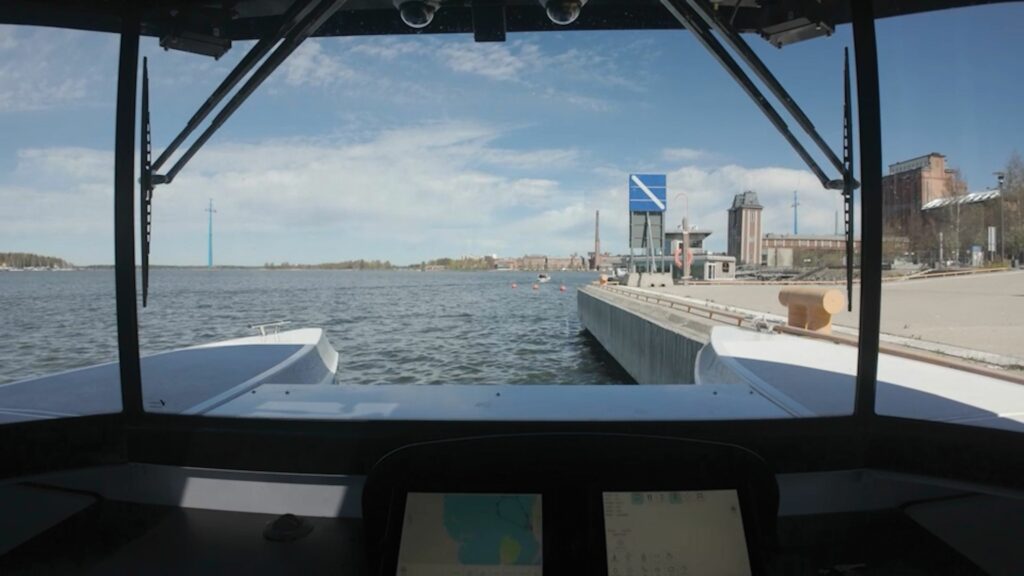
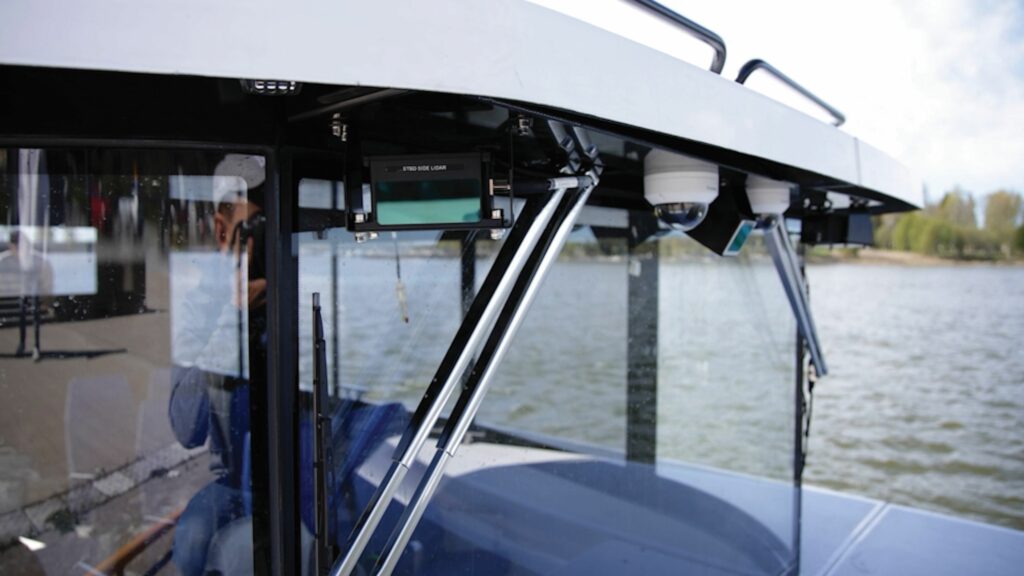
The CAT 10 L features three Lidars, five cameras and one rotating radar, each providing its respective, typical advantage: the cameras excel for object classification during daytime, with the Lidars and radar providing night detection (the radar also enables continued situational awareness in the event that the Lidars are blinded by sunlight).
“The radar we use has also proven very good and consistent for ascertaining our location with SLAM algorithms. That might sound odd for a sea vessel, but as we’re a water taxi with regular stops, we’re always operating within line-of-sight of land in at least a couple of directions from wherever our position is, so landmarks for triangulating our position are always available,” Ostberg adds.
While the radar rotates to enable 360° coverage, the Lidars are solid-state devices chosen for their great cost-saving and long life over conventional spinning mirror Lidars, as well as their strong accuracy and precision at long ranges. The Finnish company declines to reveal its solid-state Lidar of choice, but notes that it needs its vessels to be able to identify small objects like surfers or swimming children at a range of 100–150 m, as well as identifying large objects like boats at distances of 300-400 m.
“The Lidars and their point clouds are also very important for precise localisation over short distances, for instance when we’re doing autonomous docking. We get centimetre-level precision scanning, for adjusting the motors such that we approach the dockside very safely, and we can also electromechanically adjust the gangway height to match the dock height,” Ostberg continues.
“We’re also using u-blox’s GNSS, with four antennas spaced around the boat, firstly for redundancy but also very precise heading data. But our systems are not dependent on GNSS: these days, it can be very unreliable at sea or in congested or built-up harbours, or at risk from cyberattacks. I really believe it’s going to become a requirement from regulators that USVs and other autonomous vessels have to be engineered without reliance on GNSS.”
Safeguarding lives
As of writing, actual regulations for autonomy in marine passenger transport are still wanting. However, Mente Marine maintains ongoing dialogues with regulatory bodies as needed for its customers, such as the Norwegian Maritime Authority (NMA, or Sjøfartsdirektoratet). It has also implemented some features and systems based specifically on their feedback.
“That’s included expected things like subsystem redundancy, and we’ve actively worked to go beyond the NMA’s requests in that regard, particularly with regard to sensors and related electronics; for the world to accept autonomous transport, we have to be better than a human – plain and simple,” Ostberg says.
Some unexpected requests have also come forth. The most significant example of this is an autonomous ‘person overboard’ or ‘person in water’ detection capability. Both terms are applicable here, because the company has implemented this feature for detecting not only individuals in the water within range of its sensors, but also for detecting persons part-way through falling overboard from other vessels.
“As a function of that, we even have a limb-detection feature built into our cameras and Lidars. That detects the limbs on a body and analyses for where they are relative to their bodies or the upright position; our annotations go as far as recognising when someone is climbing down or back up the grabrails of a boat or dock,” Ostberg explains.
“If we detect one or more souls in the water or falling overboard, the water taxi stops its thrusters and rings an alarm to the remote control centre, so that an approach can either be plotted or manually controlled for manoeuvring over and picking those persons up.”
Naturally, this feature raises questions as to whether water taxis such as the CAT 10 L should really be completely uncrewed, despite what it would save on operating costs. Mente Marine anticipates that and – at the very least – such vessels can go from two to one crewperson onboard to reduce costs and labour issues while still offering a strong lifesaving capability.
“Most countries require two crewmembers: one captain and one deckhand, but a deckhand can recover souls from the water and alert the appropriate emergency services by themselves – removing the captain takes a water taxi’s labour costs down by 70%,” Ostberg comments.
“And without any staff at all, the CAT 10 L is still better than a human because our cameras up on the roof get a very wide and clear FoV – much more so than people do – and react very quickly upon someone falling overboard. Humans’ eyes can make mistakes, they can get tired or blurred – machines are frankly more consistent.”
Callboats also specifically integrates low lux cameras concentrically around the boat for dealing with low-light conditions. Therefore, even when close to nighttime, the cameras maintain effectiveness in spotting people in (or about to enter) the water – conditions in which human eyes become far less effective, particularly when the water taxi fills with light from its ceiling lamps or passengers’ smartphones, polluting deckhands’ visual capacities.

“Developing most of these features was honestly very easy; these are now off-the-shelf algorithms anyone can find, so we didn’t need to reinvent the wheel,” Ostberg says.
“Harder, was swimmer detection. If people are falling overboard or are in water and waving to you, there’re clear lengths of limb and body to see, but swimmers are more occluded by waves and reflections from the sun, and if they’re covered in all-black swimwear and swimming where they really shouldn’t be, it’s a nightmare. But we’ve trained our algorithms as hard as we could for that, and we can change routes to avoid direct sunlight or other collision risk factors, so I’m still very confident we’re better than a crewed vessel.”
No cameras point inside of the cabin as of writing, but individual operators may request such features as they or regulators deem necessary, for instance in terms of passenger security or safety. An emergency stop button and radio are, however, installed in the cabin, enabling passengers to forcibly halt the vessel and talk to the remote control centre as a last resort measure in case an incident unlike any anticipated should arise (or in the event of a personal emergency, such as a passenger dropping their smartphone overboard).
Future
With the CAT 10 L now at full technical readiness, its design locked-in for commercial production and sale, Callboats’ r&d efforts are now focused on its next major product, the CAT 16. Like the CAT 10 L, the CAT 16 comes in two versions, although these differ in width, displacement and capacity: one is 5.5 m wide, displaces 25 t and can seat 60 passengers; the other is 7.5 m wide, displaces 30 t and can fit 100 people.
“We have signed sales orders for three of those, to be fulfilled within the next year: two are bound for Italy and one for Finland. So we’re working hard towards building our first production units of those vessels,” Ostberg tells us.
“And we’re looking beyond Europe’s markets too via ongoing talks with prospective customers in the US and India, among other countries, including potential for final assembly within those continents to save transport costs. The new production hall should be enough to produce the CAT 10 Ls and CAT 16s we expect to sell for the years ahead, so long as we utilise the space as efficiently as possible and maintain a highly effective workforce.
“Recruiting for that has been pretty easy, honestly; we have a very interesting product and Vaasa’s a nice place to live, so it seems quite a few people want to work here.”
Key specifications
Callboats CAT 10 L
Autonomous water taxi
Catamaran
Fully electric
Pod thrusters
LFP battery pack
Dimensions: 9.9 x 3.5 x 0.6 m
Maximum passenger capacity: 30
Maximum power output: 60 or 160 kW
Displacement (60 kW powertrain): 6000 kg
Displacement (160 kW powertrain): 6600 kg
Maximum speed (60 kW powertrain): 9 knots
Maximum speed (160 kW powertrain): 14 knots
Recharging options: 1500 W solar, 11–22 kW plug-in AC, 60–120 kW plug-in DC
Some key suppliers
Fibreglass composites: Schneider & Dalecki
Electric motors: Fischer Panda
Motor controllers/inverters: Piktronik
GNSS: u-blox
AI computers: Hailo
UPCOMING EVENTS