





Low-cost wind-powered robot
(Image: Cranfield University)
In the UK, researchers have developed a robot for hostile environments that is powered by wind energy, writes Nick Flaherty.
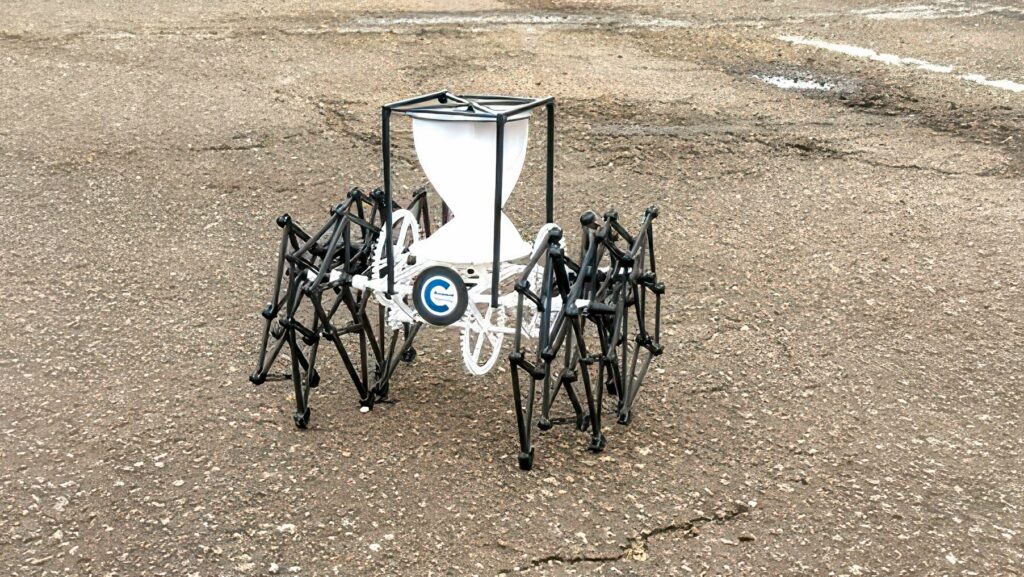
WANDER-bot is a low-cost, 3D-printed robot that is designed for deployment in hostile, windy environments such as certain deserts, polar regions or even other planets. Movement accounts for around 20% of battery use in most robots, so running on wind energy means that WANDER-bot doesn’t need a battery to power movement, enabling longer operations without having to pause and recharge.
Any electronic elements added to future versions for data collection or transmission purposes could have their own smaller, lighter power source. Using natural energy also counters the issue of performance degradation over time in traditional power sources, such as solar cells and radioisotope thermoelectric generators.
The 3D-printed parts are deliberately simple to allow for quick repair and replacement. This means that, in theory, the system could be printed and constructed anywhere and replacement parts manufactured in situ as needed, removing the need for time-consuming and costly resupply missions.
Inspiration for the robot’s design came from Dutch artist Theo Jansen. WANDER-bot uses the Jansen linkage mechanism in combination with a Savonius wind turbine to power its movement.
Invented in 1922, the Savonius turbine is a simple, drag-based vertical axis wind turbine with two or three scoops that are often S-shaped. It is known for high starting torque, low-speed operation and omnidirectional capability,
The Jensen link is a planar leg mechanism that generates a smooth walking motion using a simple rotary input. The central crank moves in circles because it is actuated by a rotary actuator such as an electric motor. All other links and joints are unactuated and move because of the motion imparted by the crank. Their positions and orientations are uniquely defined by specifying the crank angle and hence the mechanism has only one degree of freedom.

“There are many challenges when it comes to robotic exploration,” said Dr Saurabh Upadhyay, lecturer in space engineering at Cranfield University who developed the robot. “Battery capacity limits things like range, and technological complexity limits the ability to repair in an environment where human occupation would be minimal and the capability for manufacturing or maintenance is limited owing to the harsh conditions.
“WANDER-bot is a first step towards low-cost, repairable, self-sufficient robots that can explore environments that are currently difficult for humans to reach and work in, such as other planets, or places on Earth where it’s impractical for people to spend long periods of time.”
The next step will be to increase the manoeuvrability, giving WANDER-bot the ability to change directions and tackle more challenging terrain.
UPCOMING EVENTS