





In-line architecture transforms fuel flow measurement
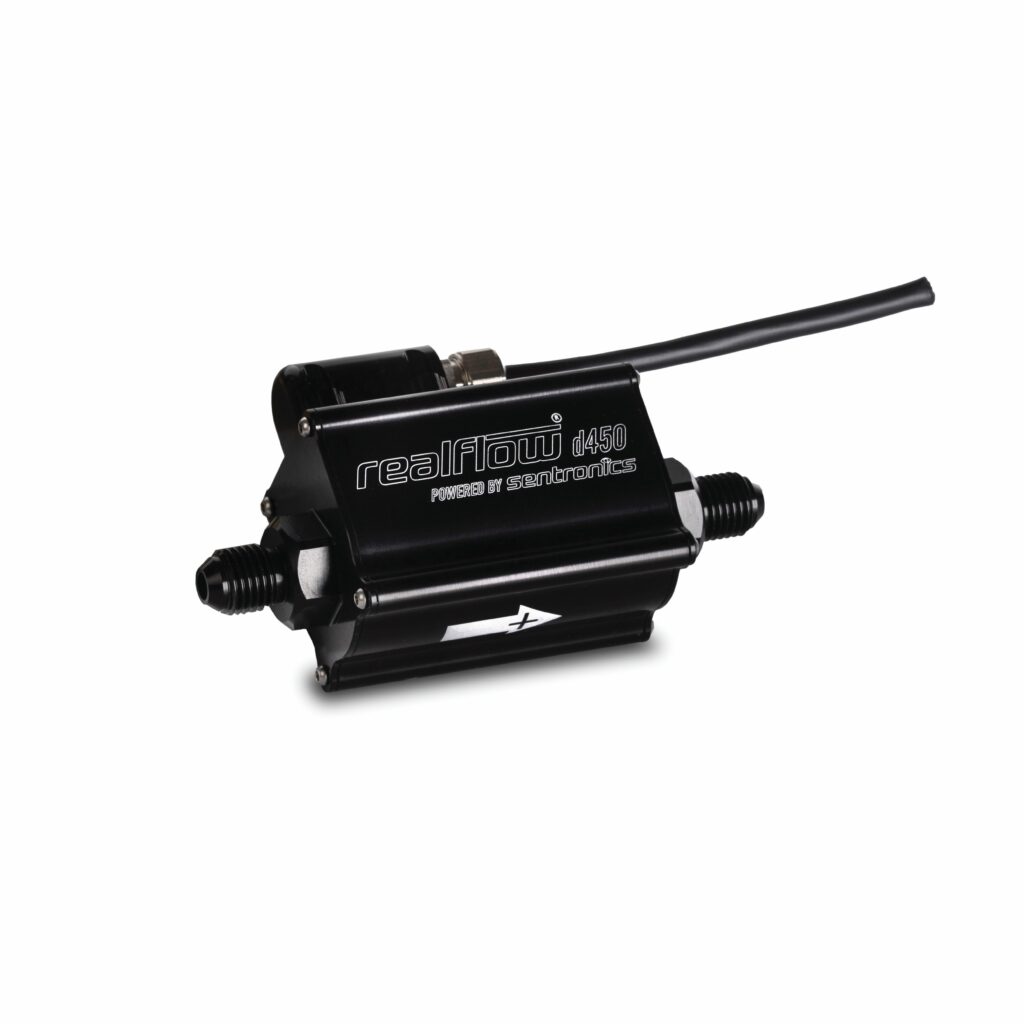
(Image: Sentronics)
Sentronics has launched its range of next-generation fluid flow sensors, the RealFlow D‑Series, incorporating several innovations previously unseen in flow sensor products and of particular benefit to precise fuel monitoring.
Like previous Sentronics product designs, the RealFlow D‑Series uses ultrasonic time‑of‑flight flow measurement, which works by emitting ultrasonic pulses upstream and downstream within a fluid channel. The time‑of‑flight differences measured in each direction are directly proportional to fluid velocity.
However, the new design features a smooth‑bore, or ‘in‑line’, internal flow path – a considerable improvement over the complex or convoluted internal flow paths typical of flow meters.
“From a fluid dynamics standpoint, the RealFlow D‑Series presents virtually the same pressure drop as a straight pipe. By contrast, most other flow meters – particularly fuel flow meters, whether ultrasonic, turbine, positive displacement or Coriolis – rely on very small internal bores to achieve measurable accuracy, which inherently restricts flow and increases pressure loss,” explained Jamie Jones, senior systems engineer at Sentronics.
“The in‑line flow path also makes the sensor highly tolerant of contamination, allowing debris to pass straight through the fuel channel rather than becoming trapped. In conventional mechanical flow meters, such contaminants can clog turbine wheels or sensing elements, halting measurement and, in extreme cases, restricting fuel delivery or overloading the fuel pump.”
Achieving the in‑line internal flow path required Sentronics to develop a fundamentally new ultrasonic transducer architecture that operates without direct contact with the fluid. This marks a departure from the disc‑type transducers typically used in ultrasonic flow meters, enabling a simpler internal geometry with significantly reduced flow disturbance.
“Conventional transducers must be mounted in the fluid path to measure flow, resulting in convoluted flow paths that generate turbulence – and that’s the last thing you want when you’re trying to measure flow accurately,” Jones added.
“The result is a much simpler flow meter architecture, which helps lower production cost while delivering a marked improvement in measurement consistency. By eliminating common sources of inaccuracy and failure associated with conventional flow sensors, performance is maintained even under challenging operating conditions.”
The simple, in‑line channel also helps reduce the RealFlow D‑Series’ form factor to 99.2 x 56 x 33 mm (maximum dimensions for the standard configuration) and brings its dry weight down to just under 150 g, which Sentronics cites as “three times lighter” than its lightest motorsport product to date, whilst delivering high performance.
Sentronics managing director Neville Meech said: “With native CANopen support, the D‑Series is designed to integrate cleanly into modern control architectures. Engineers can install the sensor anywhere in the fuel line, connect it directly to the CAN bus, supply power and immediately stream fuel flow data to their ECU or data logger.”
The company can scale the product for a wide range of applications, from flow rates of just a few drops per minute up to around 20 L/minute – comparable to that of a fully open garden hose.
But, arguably, the most important target for Sentronics was the D‑Series’ multi‑fuel operating capability. This contrasts with most fuel flow sensors that are fuel‑dependent and require either recalibration or a complete redesign when switching between fuels.
The D‑Series is engineered to deliver consistent, accurate fuel flow data across different fuels without modification, reflecting the realities of today’s UAV propulsion systems,” Meech noted.
Development also prioritised the selection of practical, proven components capable of supporting certification to military standards including Mil-Std‑461G and RTCA‑DO‑160G.
UPCOMING EVENTS