









In conversation: Erin Roesler
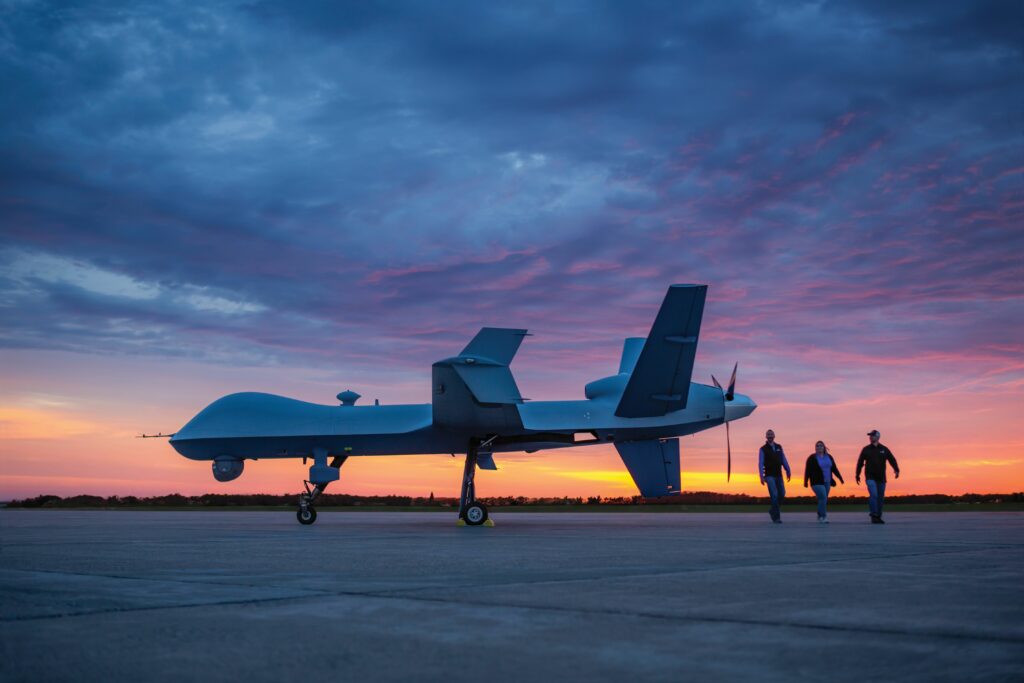
(All images: NPUASTS)
Sky pioneer
Erin Roesler, deputy executive director of NPUASTS, talks to Peter Donaldson about her years of experience as a recognised trailblazer in the UAS industry
Based in the spacious and sparsely populated US state of North Dakota, the Northern Plains UAS Test Site (NPUASTS) is perhaps best known for Vantis, the programme that supports beyond visual line of sight (BVLOS) flight for UAS statewide. It also helps UAS operators make the most of BVLOS infrastructure, and integrate their machines and missions safely into the National Airspace System (NAS). The organisation’s long-term mission is perhaps best expressed by deputy executive director Erin Roesler, who anticipates “a future where there’s no distinction between a UAS and a crewed aircraft in the sky – just aircraft, all sharing the same airspace safely and efficiently.”
Total aviation person
Roesler can be described as a ‘total aviation person’ having been involved with aircraft since childhood, starting with voluntary work for the Experimental Aircraft Association (EAA), where she still serves as co-chairman. She credits the EAA with providing hands-on exposure, mentorship and community at a formative age. “I’m forever grateful for that because it truly set the trajectory for everything that followed in my career.”
The University of North Dakota provided what she considers a comprehensive foundation in aviation. While her focus was on commercial flight training, the curriculum was broader, covering air traffic control, weather and atmospheric science, and aviation law, and the blend of technical and regulatory knowledge proved invaluable early preparation for the complexities of UAS integration.
“When you graduate, you know the rulebook; you understand the Federal Aviation Regulations inside and out. But in the world of uncrewed aircraft, much of what we do operates outside that rulebook. The key is understanding the intent behind those rules so you can safely and thoughtfully push the boundaries,” she emphasises.
For Roesler, the steepest learning curve here was in working out how to ‘navigate’ where no written guidance exists. This involves suggesting many solutions to find one that’s acceptable to the regulators. “Over time, I learned that this isn’t a guessing game; it’s a process built on collaboration and trust. Building relationships with regulators, understanding their priorities and finding shared solutions is how meaningful progress happens. That mindset has become the cornerstone of how NPUASTS approaches integration today.”
Leading through uncertainty
Before her promotion to deputy executive director, Roesler was director of operations at the test site – a hands-on role from which she drew lessons that shaped her leadership philosophy, the first being how to lead teams through uncertainty.
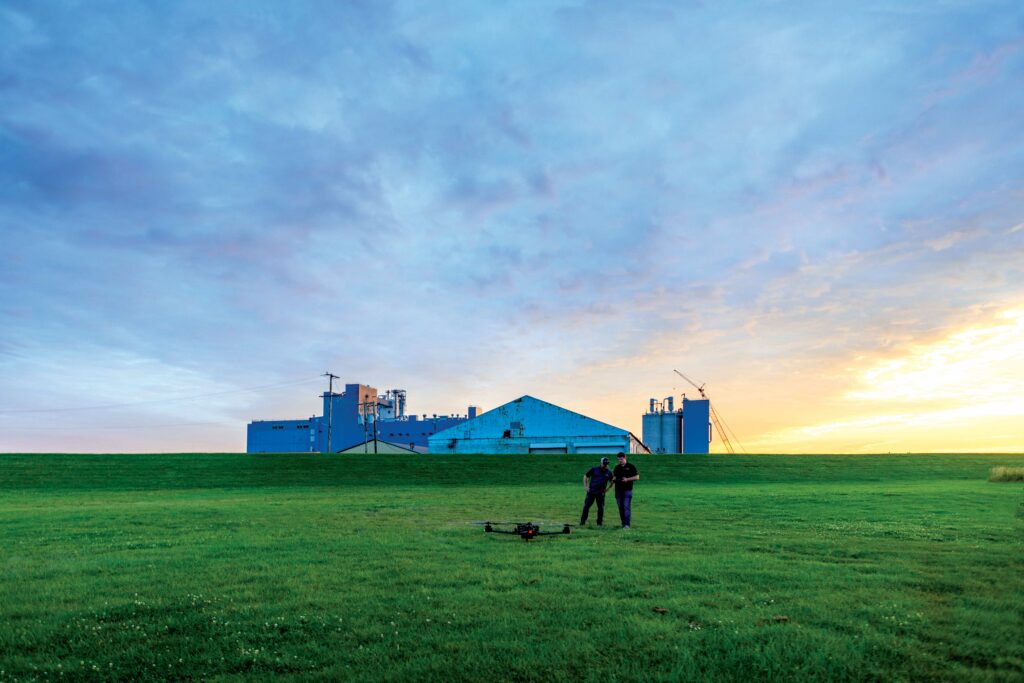
“In UAS operations, so much of what we do has never been done before – whether it’s developing new test plans, pursuing regulatory approvals or evaluating emerging technologies. That level of unknown can be uncomfortable, even unsettling, for highly capable people who take safety seriously,” she emphasises. “My role was to create an environment where that unease could exist without eroding confidence – to build a culture where people felt heard, understood and supported, even when every answer wasn’t yet known.”
The second lesson learned was in recognising the value of one-on-one conversations in helping her to understand what each team member needed to succeed. “I’m surrounded by brilliant, passionate people with ideas that far exceed what any single person can produce alone. My job as a leader is to give those ideas structure, direction and the freedom to thrive.”
NPUASTS benefits from North Dakota’s good weather and uncrowded airspace. However, Roesler argues that the organisation’s “secret sauce” is an emergent effect of the state’s small population (around 800,000), which makes collaboration a matter of survival. “We have to work together, across government, industry, academia and the private sector because success simply isn’t possible any other way. That necessity has created a culture of partnership and trust,” she emphasises. “It’s that spirit of collaboration that’s propelled the Northern Plains UAS Test Site and the Vantis network to national prominence.”
While the lack of a playbook for setting up a statewide BVLOS network made almost every aspect of the Vantis project a challenge, the single biggest hurdle has been the absence of a formal regulatory framework for such infrastructure and services. Without that framework, every new operator who wants to use the network must go through an extensive, case-by-case approval process with the Federal Aviation Administration (FAA), she explains. Encouragingly, however, the FAA’s proposed Part 146 regulations offer a validation pathway. “Once that framework is in place, it will be transformative – not just for Vantis, but for every service provider working to make scalable BVLOS operations a reality across the country.”

In the process of standing Vantis up, NPUASTS has evolved from a pure r&d facility to a service provider maintaining real-world systems on which others depend. Roesler explains that rather than just testing concepts in controlled environments, the organisation now has to manage network uptime, bring users onboard, ensure service reliability and support commercial operations. These responsibilities demand a new mindset and business model routed in service-level discipline, performance metrics and long-term operational stability, she notes.
NPUASTS is a state entity, and its transformation also redefined its role in government from pure economic enabler to critical infrastructure provider. “It’s been a challenging process; establishing frameworks, processes and accountability structures that didn’t exist before, but it’s positioned us uniquely as both a test site and a trusted operational partner.”
Learning from setbacks
Achieving this state has meant overcoming and learning lessons from setbacks. For Roesler, two that reshaped how the organisation operates and engages with industry come to mind. The first arrived early in the construction of the Vantis network and stemmed from what she terms their “if you build it, they will come” mindset. “What we discovered, however, was that the UAS market wasn’t yet mature enough – economically, operationally or organisationally – to adopt it at scale. That realisation was humbling and transformative. It shifted our entire strategy,” she recalls. “Today, we provide not just access to the network but also guidance on the processes, procedures and operational maturity required to succeed.”
The second setback was a series of incidents that revealed weaknesses in quality control, software management and change processes at an aircraft manufacturer whose platform had previously had a strong flight record but lacked the internal rigour needed to sustain safe, scalable operations. “Those experiences taught us that safety isn’t just about the aircraft – it’s about organisational maturity, operator discipline and system integration.”
Having ‘test site’ as part of its name can lead to some minor initial confusion among customers, Roesler admits, elaborating that people often expect a confined test environment where operations are isolated from the national airspace, which is not the case. “Our expertise lies in achieving regulatory approvals that allow UAS operations to truly integrate into the NAS. We intentionally avoid segregation wherever possible because our goal is to enable real-world, scalable operations – not limited experiments.”
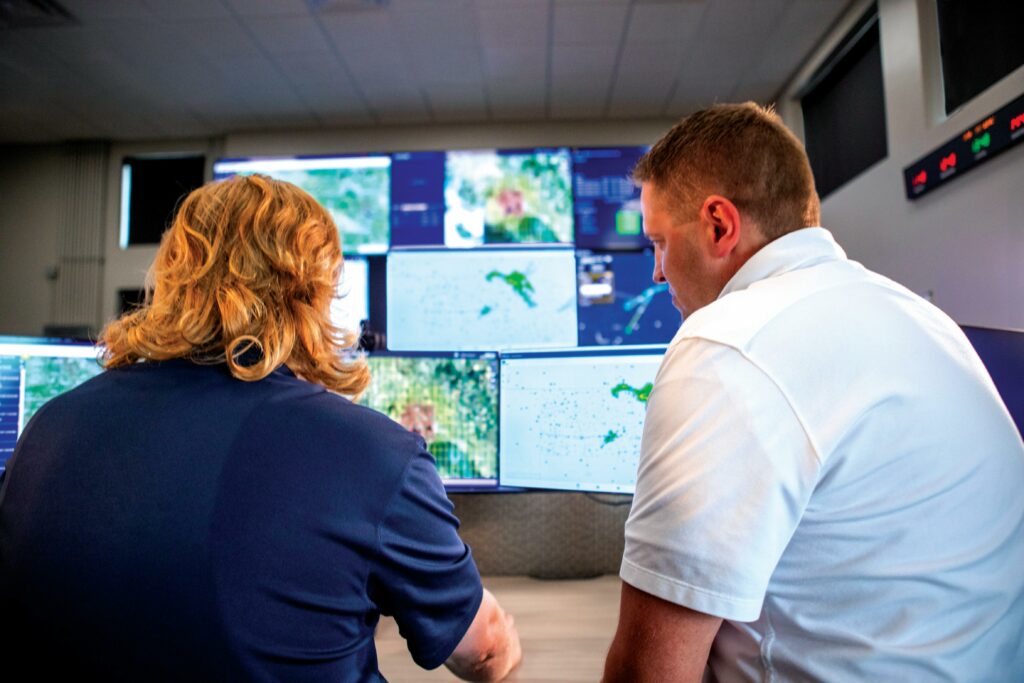
She argues that this approach ultimately gives operators a much stronger foundation because, instead of testing in a vacuum, they are developing systems, procedures and safety cases that can transition directly into commercial markets. “It’s about helping them move from research and development into viable, repeatable business operations, and doing so in a way that aligns with FAA expectations from the very beginning.”
Choosing partners
As a state of North Dakota entity, NPUASTS still pursues research projects and industry partnerships. It favours those that move policy and regulation forward while having practical application, such as improving public safety, enhancing infrastructure or creating scalable solutions that can serve the broader US market. Its most successful collaborations are with companies who are ready to engage transparently, share data and help shape the regulatory landscape.
Looking ahead, Roesler sees true airspace interoperability as the biggest technical frontier. “The next leap will be when drones operate seamlessly alongside crewed aircraft; when a controller looking at a radar scope can’t tell whether they’re talking to a pilot in a cockpit or one sitting in a control centre on the ground.”
While the digital flight rules and other aspects of a fully modernised airspace ecosystem are being implemented, UAS operators must be ready to plug in to that ecosystem, she argues. This will require the industry to mature rapidly in cyber security, autonomy assurance, system certification and data resilience because they apply to aircraft and to supporting infrastructure such as C2 networks and automated data service providers. However, she emphasises that interoperability also requires readiness to operate to the same standards as every other aircraft in the NAS.
Inflection point
Scalable commercial return on investment for BVLOS operations will not come while they depend on waivers and investments because growth will be incremental and costly. “The real inflection point will come once we have operations by rule – through frameworks like the proposed Part 108 for operators and Part 146 for certificating automated data service providers.”
Regulators move slowly and cautiously because their main responsibility is to protect lives and maintain public trust in the NAS. Even though industry-wide standards from bodies such as ASTM and RTCA (for detect and avoid systems, for example), can be developed more quickly, they require formal FAA recognition before their true value can be realised. However, they can help bridge the gap between innovation and regulation in the meantime, which the FAA itself has recognised. “Standards give both the FAA and operators a shared technical language, allowing us to tackle complex challenges like interoperability, testability and assurance levels with common understanding.”
Perhaps the most critical aspect of the job is fostering innovation safely in an area such as airspace integration where the consequences of mistakes are potentially so serious. Here, she emphasises the importance of a structured risk framework as the basis of data-driven decision making. “When risk is evaluated through data and process rather than opinion, conversations become safer, more objective and more productive. People feel empowered to question assumptions, explore ideas and debate decisions without fear that their judgement – or someone else’s – is on trial.”
Confidence and role models
She admits to late recognition that the industry is male-dominated, naïveté that she puts down to her father being a nurse. “I grew up seeing that dynamic in reverse. Because of that, I didn’t initially recognise career fields as male-dominated or female-dominated. It wasn’t until I was well into my professional training that I realised how male-dominated the field really was. But by then, I had already built confidence in my own abilities,” she says. “Women, statistically, are more likely to underestimate their skills, so sometimes you have to act as if you already belong in the room – because you do. The confidence catches up.”
For Roesler, Sally Ride, the United States’ first female astronaut, and star aerobatic pilot Julie Clark provided proof that women could achieve greatness in aerospace, while legendary pilot Bob Hoover – famous for, among many other exploits, pouring a glass of iced tea without spilling while performing a 1G barrel roll – embodied mastery with humility.

Looking a decade ahead, she is optimistic that UAS operations will be indistinguishable from manned aviation, with drones filing flight plans and using instrument procedures. Achieving this requires modernised air traffic management systems that are scalable and inclusive for all airspace users. “That’s how we’ll achieve true integration, where uncrewed aircraft are simply ‘aircraft’, and the sky becomes one shared, digital ecosystem.”
Erin Roesler
Erin Roesler is steeped in the theory, practice and culture of flying – both crewed and uncrewed. Born in 1988 in New London, Wisconsin (USA), Roesler spent her childhood and teenage years there, attending high school in nearby Appleton. Imbued with both ambition and fascination for aerospace as a child, she recalls wanting (aged 8 or 9) to be either the President of the United States or the first astronaut to land on Mars when she grew up. Her first flight came courtesy of the Experimental Aircraft Association (EAA) and its Young Eagles programme for children aged between 8 and 17.
She graduated from the University of North Dakota (UND) with a Bachelor of Science degree in aeronautics, commercial aviation and flight education in 2011, and as a Master of Science in instructional design and technology in 2019. She also holds a commercial pilot’s licence.
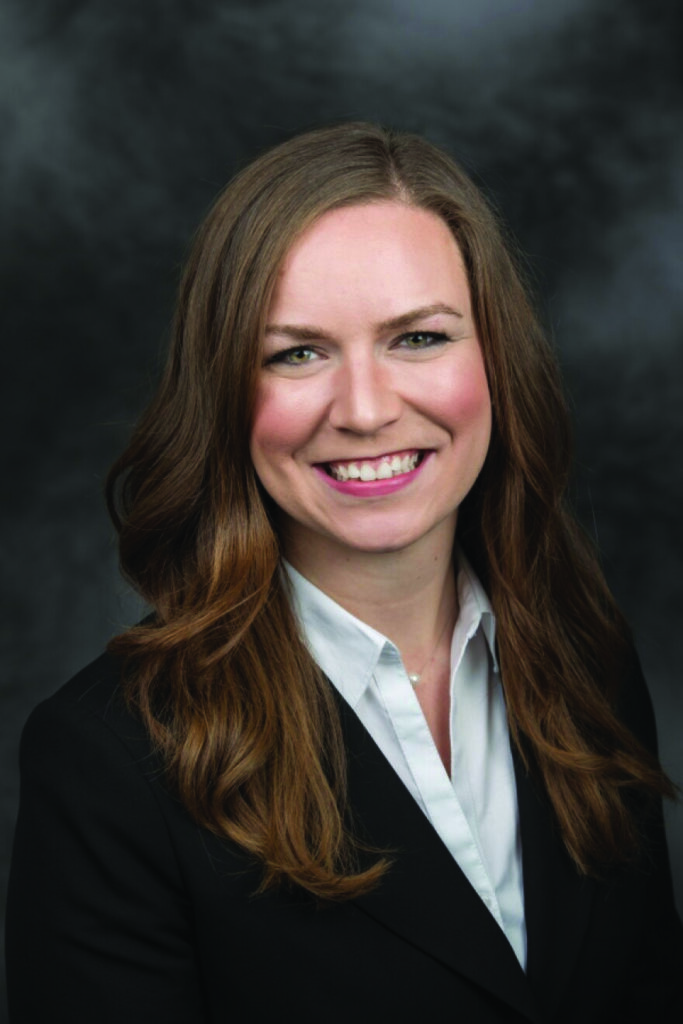
Starting as a UAS student assistant at UND in 2009, she remained with the university after graduation – the airlines weren’t hiring – progressing though marketing and flight instruction roles including lead flight instructor on crewed aircraft, then UAS lead flight instructor before becoming assistant chief pilot for UAS. The move to NPUASTS came in early 2019 when she was appointed UAS standards and policy manager, becoming director of operations in November 2021 and deputy executive director in December 2023. Roesler received the UAS Sky Pioneer Award at the 19th Annual UAS Summit & Expo Grand Forks, North Dakota, on October 15, 2025.
UPCOMING EVENTS