








In conversation: Dr Steve Bullock
(Image: University of Bristol)
Multi-path engineering
Dr Steve Bullock, programme director of aerospace engineering at the University of Bristol, discusses his varied career with Peter Donaldson
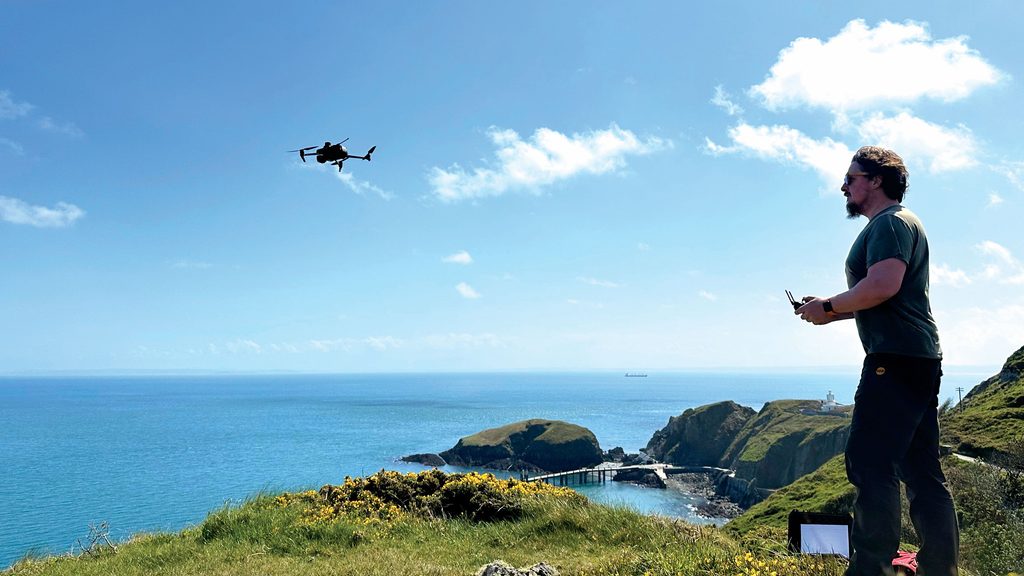
He calls himself “a drone guy who doesn’t like drones sometimes.” This apparently contradicts everything about Dr Steve Bullock’s career. He built his first UAV in 2004, spent seven years on a PhD in autonomous air-to-air refuelling and leads training for a pan-European drone ecology research network. Yet, he’s aware that the technology can be intrusive – a source of noise and disruption rather than progress.
Tension between what technology can do and what it should do runs through Bullock’s work. His interest is less in tech for its own sake and more in its impact, whether used for volcano monitoring in Guatemala, wildlife conservation in Kenya or climate-optimal transatlantic flight routing. Increasingly, he’s concerned with ensuring that the people in the places where this technology operates – rangers, ecologists, local researchers – ultimately own and benefit from it.
Path into uncrewed systems
Born in Gloucester (UK) in 1982, Bullock grew up in Buckinghamshire and Devon, with early leanings towards science and maths. The aerospace spark came through the Air Cadets where, as a cadet himself, he taught the fundamentals of aerodynamics to others aged 13 to 16 years old and led radio courses at RAF Northolt. “The stuff I really liked was the human interaction, the developing people side,” he recalls.
His first proper UAV experience came in 2004, during his master’s project at Bristol. He and a coursemate designed a blended-wing micro-air vehicle from scratch – aerodynamics, wind tunnel testing, flight controller coding and all. The climax? A self-proclaimed ‘best pilot’ from a local model aircraft club hand-launched it – and it nose-dived. “It ploughed into the ground and exploded in a shower of fibreglass and foam.” They never got a flight test but the tunnel- and ground-test data earned them a first-class mark.
But the bigger crisis came during his undergraduate design project with Rolls-Royce. The Bristol site was defence-focused, and the work coincided with Gulf War II. “We started getting grainy footage of explosions and then finding out what we’d blown up by mistake.” He had a crisis of ethics, was diagnosed with depression, took medication and repeated his third year. “It drove me into a tricky place.”
He took a break working outdoors with young people – “the change was the best thing ever” – and that led him into one of the early cohorts of Teach First’s two-year training route. Teaching in northwest London and later at a small academy, he became head of physics in his third year. But academia called back. His master’s supervisor, Prof Tom Richardson, offered a return to Bristol and “a PhD making giant robots pretend to be aeroplanes.”
He accepted. Seven calendar years later – a period he notes that was “three and a half PhD pro-rata years to the hour” of actual work due to other commitments – he submitted his thesis on cooperative control for automated air-to-air refuelling.
PhD & cooperative control
The PhD, Bullock explains, was an industry-linked project with Cobham, a British-based aerospace and defence manufacturing business. Cobham, a major company behind probe-drogue refuelling, was interested in autonomy for air-to-air refuelling, where safety was a primary driver, particularly with the rise of military unmanned aircraft. But Bullock found his motivation elsewhere.
His early reading led him to work by Ilan Kroo from Stanford and others, who had modelled operational changes for airliners using aerial refuelling. “You can knock maybe a third off the fuel burn for a long-haul flight,” Bullock says. Cobham gave him the freedom to shape the work in that direction.
The lab used two ABB industrial robotic arms in a hardware-in-the-loop simulation. One arm, at the end of the lab, carried an actual flight drogue. The other, on a track, represented the receiving aircraft. They simulated the final 10 m of approach and capture at full scale in real time.
(Image: University of Bristol)
One key task was getting the simulation set up – a complex model of a tanker, a flexible hose and a receiver. “The first time we simulated that was really interesting because you don’t normally see robots moving in an organic way,” he recalls. They modelled hose whip – the dangerous phenomenon where the hose goes slack and starts flapping if the receiving aircraft engages too fast.
But the insight he’s proudest of was subtler. Making robots pretend to be aircraft required compensating for the robots’ natural dynamics – “What if you tune this to behave like this?” This led to the insight that instead of holding the drogue straight and level, or having it actively track the receiver, what if you made the drogue react to gusts in the way an F-16 would? “They’ll move in sync.” This reduced the need for constant communication between systems and, as Bullock notes, “There was this lovely parallel between our robotic work and the actual aircraft implementation” that he wishes he’d made more of in his thesis.
The PhD took seven calendar years – still a source of gentle ribbing from his supervisor. But Bullock’s defence is precise: “Three and a half PhD pro-rata years at the exact hour I submitted my thesis.” This was a consequence of the fact that he was building other things along the way.

From defence to conservation
The Rolls-Royce experience during his undergraduate years shaped Bullock’s career trajectory. It wasn’t that he abandoned defence-adjacent work – his PhD with Cobham was in air-to-air refuelling for military applications – but it made him deliberate about choosing projects with what he calls “higher purpose.”
Two things convinced him. First, aerial refuelling was about safety – making it easier and safer for pilots. Second, the environmental angle was real. “The thing that really got me was the climate side.”

Today, his portfolio spans applications that may seem disjointed: volcano monitoring in Guatemala, zebra tracking in Kenya, plant sensing on a remote island off the Devon coast in the UK and non-CO2 emissions modelling for transatlantic aviation. But there’s a connecting thread. “There’s a core of control systems and collaboration, and utility to the broader world that I think sit nicely together.”
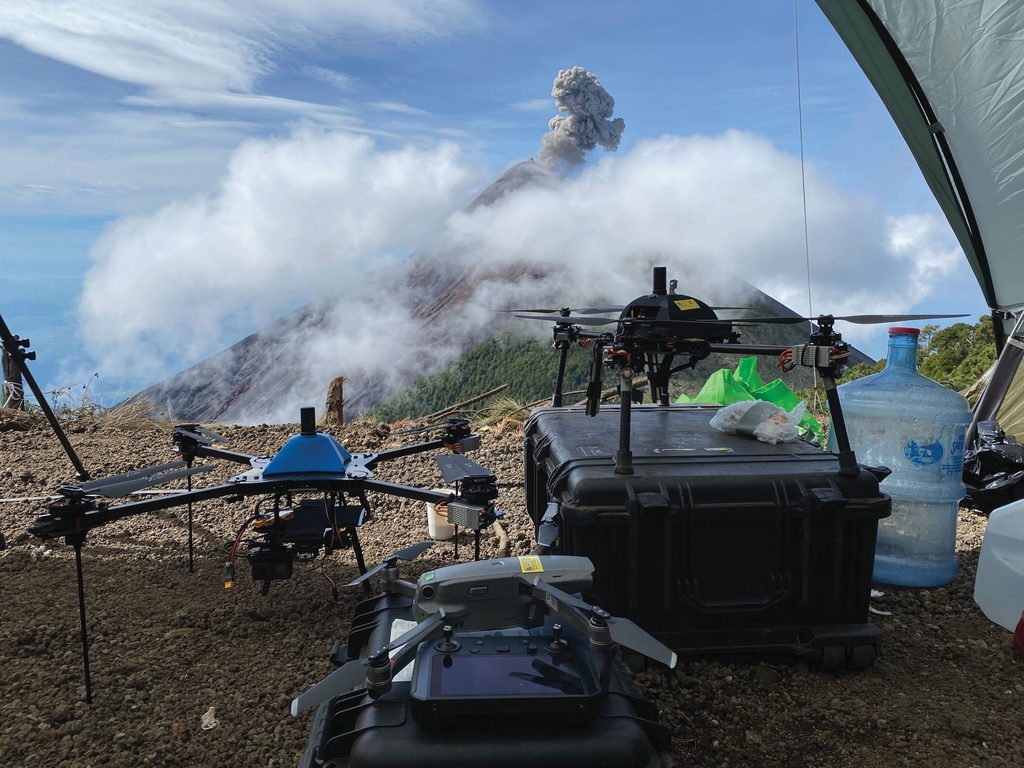
The volcano work, led by Prof Matt Watson in Bristol’s Earth Sciences School, drew Bullock in as “an extra pair of hands.” INSIVUMEH’s Fuego Volcano Observatory in Guatemala, he notes wryly, “sounds pretty high-tech but on the ground it’s a concrete shed with someone sitting in it watching the volcano.” The project combined technical data capture with the human side. The research group engages with disaster relief organisations, volcano monitoring bodies and local communities to augment what they do.
WildDrone, the European training network, took that further. Bullock was about to take a career break – “I just wanted to go and ride bikes” – when the Danish lead, Ulrich Lundquist, called him back. The network needed a people-focused person to lead the training side. Bullock agreed, working an average of one day a week during his supposed break before absorbing the role into his main job at Bristol.
He’s clear about his position in these collaborations. “I’m definitely a minor player in many of those – the volcanology stuff, the WildDrone stuff.” The credit, he insists, belongs to “excellent collaborators, really eminent academics and the PhD students.” But his role – bridging the technical and the human, the local and the global – is essential.
Swarms in Kenya
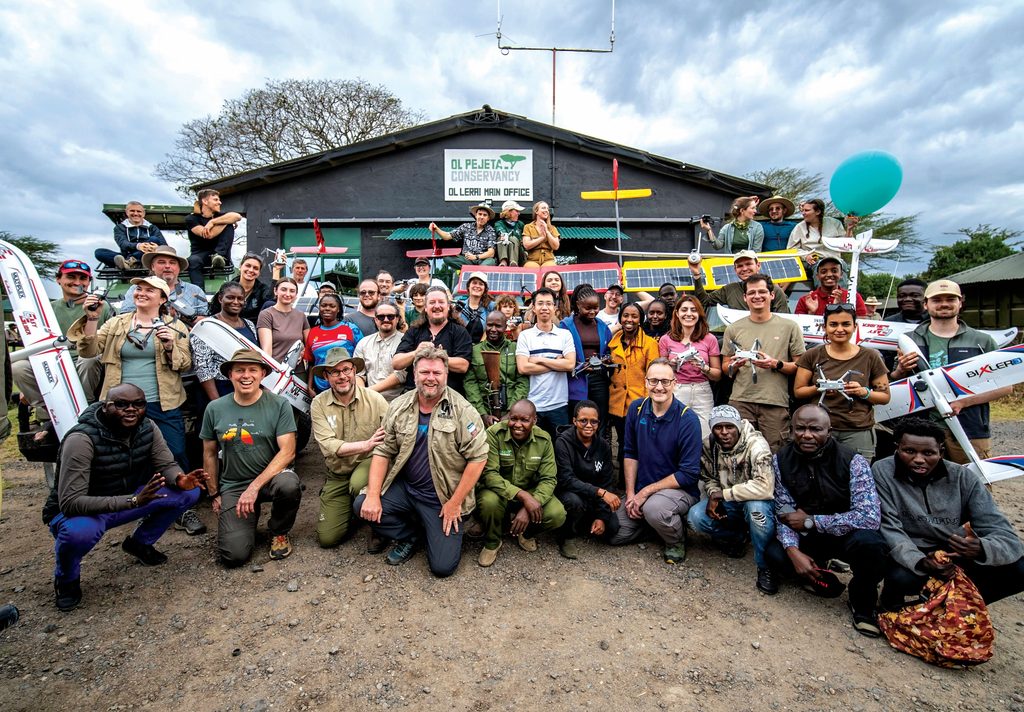
WildDrone is a European doctoral training network spanning multiple universities and conservancies using uncrewed systems for wildlife conservation. Bullock’s role as training coordinator has put him at the heart of one of the most ambitious deployments yet – a field campaign in Kenya monitoring zebras with swarms of off-the-shelf and bespoke drones.
WildDrone’s technical achievements are significant. PhD students Kilian Meier and Edouard Rolland, together with other collaborators, developed WildBridge, which is an interface connecting with DJI’s API, enabling custom control of commercial platforms. Separately, WildDrone associate Christoph Praschl at the University of Applied Sciences Upper Austria created BAMBI, a plug-in for QGIS that integrates drone location data, imagery and AI pipelines for identifying and geolocating animals. “He’s taken something that you used to need a computer science degree to use and made it a plug-in to a piece of software that any ecologist can upskill on really quickly,” Bullock says. Both technologies were showcased at a training course delivered by the team at Kenya’s Wildlife Research and Training Institute, intended to be the start of a collaboration that will endure beyond WildDrone’s funding, which ends in 2026.
The operational lessons were equally valuable. For proof-of-concept work, they needed one pilot per drone. The cognitive load of managing multiple pilots emerged as a significant challenge, prompting PhD student Guy Maalouf to dedicate his thesis to operational considerations: permissions, risk assessments, workload, pilot and observer checklists for swarming and BVLOS operations, and encouraging Rolland to focus on swarming technologies.
Then came the inevitable friction: hardware overheating and network reliability issues, Kenya’s strict drone import regulations and the critical challenge of airspace safety – “bush plane pilots have until now had the airspace mostly to themselves.” The team responded with rigorous procedures, air and ground observers and an assistant pilot for unfamiliar operations.
Bullock is careful about what he claims. “There’s still a gap between academic proof of concept and application and impact at scale.” But the transferability is real. And for Bullock, the most important takeaway is the people. “Seeing that there are people passionate about filling that gap is the biggest takeaway.”
Purpose, ethics & direction
Bullock’s perspective on the future of uncrewed systems starts not with technology but with safety. “The only real missing part there is safety assurance,” he says of truly autonomous BVLOS operations. “A lot of broader regulation is hard-won and it’s written in lives lost.”
(Image: University of Bristol)
He adds that the CAA has a “really unenviable job” of balancing innovation against public safety. The SORA approach – assessing kinetic energy, population densities and operational context – feels proportionate to him.

On AI, Bullock strikes a balanced note. Much of what’s now branded as AI – computer vision, reinforcement learning – has been in use for decades. But he worries about uncritical adoption, particularly in education.
And then there’s the bigger picture. “We know that these problems exist and we’ve known for a long time,” he says of climate change. Technology alone won’t solve it. For Bullock, uncrewed systems have a role, but it’s a supporting one. The real challenge is political, social and deeply human.
The human element
Bullock is an anomaly in his field. A teaching-focused academic who maintains active research involvement. An accomplished engineer who measures success not in publications or patents, but in whether the people he works with – students, rangers, local researchers – are better off for having collaborated with him.
“I was Prof Richardson’s worst PhD student ever,” he says with a laugh. “I got very distracted with other things around the university.” But those distractions – supporting non-traditional entry students, building support programmes, developing people – became the foundation of his career. When students come to him struggling, he shares his own story. “They’re like, ‘Oh, you struggled as well’.”
Mentorship has also been critical – Bullock credits Profs Richardson and Watson for offering opportunities in the field, as well as WildDrone lead Prof Lundquist at the University of Southern Denmark for (gently) twisting his arm into taking the training role. He also emphasises the value of collegiality – Bullock was programme director for Bristol’s Aerospace programmes through COVID, but successes in student support and in staff morale were a huge team effort.

Outside work, Bullock lives on a 117-year-old Dutch barge that he’s retrofitted with solar panels and an electric drive. He’s cycled from Bristol to Stockholm over two months. He co-hosts the Cosmic Shed podcast, talking “science fact, science fiction and everything in between” – an excuse, he admits, to meet interesting people and geek out about nerdy movies.
His advice to young engineers is characteristic. “Think about the dent you want to make in the world.” Not every step needs to be obvious. Taking time to reflect is itself a decision. “What would you want to spend your time on? What do you think is useful? Then, grasp opportunities.”
Dr Steve Bullock
Dr Steve Bullock, 43, is associate professor of aerospace engineering at the University of Bristol, leads the institution’s MSc programme in aerial robotics, and teaches control systems and group design projects. He is on the committee of the Royal Aeronautical Society’s Remotely Piloted and Autonomous Aerial Systems Specialist Group. Having directed the aerospace engineering undergraduate programme at the University of Bristol, Bullock now serves as an external examiner in the subject for Manchester University. Furthermore, he is training coordinator and management board member for the WildDrone and WildBotics EU MSCA doctoral networks. He does outreach and public engagement, advises student rocketry groups, and has undertaken pastoral roles including warden and senior resident in student residences, supporting student wellbeing and transition to university.
UPCOMING EVENTS