









Improving the urban canyon
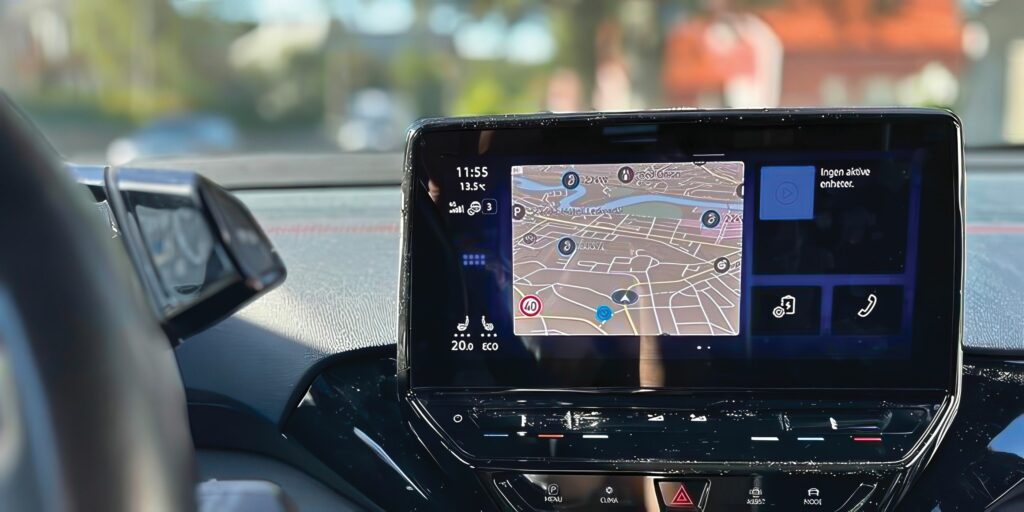
(Image: Anne Sliper Midling)
Researchers in Norway have combined three techniques to improve the accuracy of GNSS signals for driverless cars in cities.
Phase-only positioning can overcome the issues of the urban canyon that make data from GNSSs such as GPS or Galileo less useful.
“Cities are brutal for satellite navigation,” said researcher Ardeshir Mohamadi, a doctoral fellow at the Norwegian University of Science and Technology. “In cities, glass and concrete make satellite signals bounce back and forth, tall buildings block the view, and what works perfectly on an open motorway is not so good when you enter a built-up area.”
The problem is that signals are reflected between buildings and take longer to reach the receiver. As a result, the calculation of the distance to the satellites is incorrect and the position becomes inaccurate.
“For autonomous vehicles, this makes the difference between confident, safe behaviour and hesitant, unreliable driving. That is why we developed SmartNav; a type of positioning technology designed for urban canyons,” said Mohamadi.
Phase-Only Positioning uses measurements of the phase of the carrier signals from multiple GNSS satellites to reduce code-multipath and achieve centimetre-level accuracy. Traditionally, its use has been limited to open-sky conditions or high-end receivers, but the researchers showed this can be used with mass-market receivers to achieve centimetre-level accuracy, increasing the availability to 78% for high-end and 58% for low-cost receivers.
“Using only the carrier phase can provide very high accuracy, but it takes time, which is not very practical when the receiver is moving,” said Mohamadi.
This is combined with Precise Point Positioning–Real-Time Kinematic (PPP-RTK) processing, which combines precise corrections with satellite signals. The European Galileo system now supports this by broadcasting its corrections free of charge to further increase accuracy.
Finally, the system adds a new service launched by Google for its Android phone customers.
Google now has 3D models of buildings in almost 4000 cities around the world, and is using these models to predict how satellite signals will be reflected between the buildings. This is how they solve the problem of it appearing as if you are walking on the wrong side of the road when using the map app, for example, when trying to find your way back to your hotel.
“They combine data from sensors, wi-fi, mobile networks and 3D building models to produce smooth position estimates that can withstand errors caused by reflections,” Mohamadi said.
The researchers were able to combine all these different correction systems with algorithms they had developed themselves. When they tested it in the streets of Trondheim, they achieved accuracy that was better than 10 cm for 90% of the time.
The use of PPP-RTK will also make the technology accessible to the general public because it is a relatively affordable service.
“PPP-RTK reduces the need for dense networks of local base stations and expensive subscriptions, enabling cheap, large-scale implementation on mass-market receivers,” said Mohamadi.
UPCOMING EVENTS