


First personal robocar
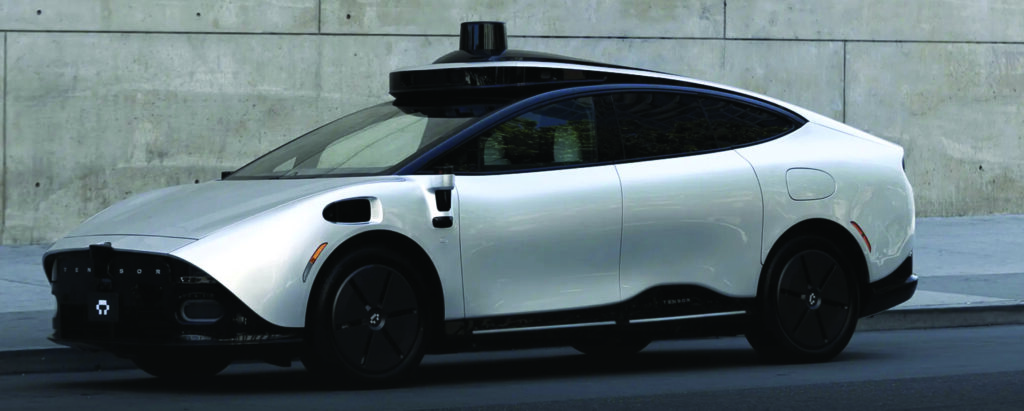
(Image: Tensor Auto)
Tensor Auto in the US has developed the first driverless car for personal use with over 400 distributed ARM cores and eight NVIDIA GPUs for the self-driving systems, writes Nick Flaherty.
The ‘Robocar’ has a vertically integrated Level 4 autonomy stack, and a comprehensive sensor suite of 37 cameras, 5 Lidars, 11 radars, 22 microphones, 10 ultrasonic sensors, 3 IMUs, GNSS, 16 collision detectors, 8 water-level detectors, 4 tyre-pressure sensors, a smoke detector and triple-channel 5G connectivity.
Robocar has a retractable steering column that stows away in autonomous L4 mode and four RGB Mini-LED interactive displays that can interact with other pedestrians and vehicles.
Processing involves a mix of Neoverse AE cores for high-throughput AI processing, Cortex-X for agentic AI cabin and peak performance system control, Cortex-A for drive-by-wire, Lidars, redundancy and general compute, Cortex-R for real-time safety-critical systems and Cortex-M for low-power subsystem management. This enables Tensor to deploy AI workloads across diverse compute domains while meeting stringent automotive safety, thermal and power requirements.
Central processing is handled by eight NVIDIA Drive Thor AGX processors that run on a proprietary autonomy stack based on NVIDIA’s safety-certified DriveOS operating system.
There are also layers of diverse, specialised automotive processors from Texas Instruments, NXP Semiconductors and Renesas Electronics with ARM cores, ensuring critical system operation in the rare event of a primary hardware fault.
“We have to think forward. The nature of hardware is that you can’t iterate like software,” said Dr Jewel Li, chief operating officer of Tensor Auto in San Jose, California. “So, we have to build for a few years forward. Because we have such a large platform, we’re not only able to have the most frontier, cutting-edge models running in our vehicle for self-driving; we’re also having agentic AI running on board in real time, and we can merge the two so that they work together and collaborate together.”
Tensor is also working with Autoliv, ZF, Continental, AMD, Qualcomm, Samsung and Oracle on the vehicle, which will be offered in the US, EU and Middle East markets in 2026 for around $200,000.
The vehicle has the first fully redundant brake-by-wire + steer-by-wire system with fully electronic four-wheel steering developed with ZF. The front-wheel and rear-wheel steering, providing mutual redundancy, are integrated with the Bosch electronic stability program and a redundant EPB, offering triple-redundant architecture.
An AI-powered collision detection system fuses data from Lidars, IMUs and 16 mechanical-wave sensors around the vehicle, to accurately detect impacts and help prevent secondary injuries. Further Robocar details are investigated on page 84.
UPCOMING EVENTS