








Edge Performance ThrustVik X3 & X5
(All images: Edge Performance, except when stated otherwise)
Go beyond
Although already a worldwide name in upgrading and supplying Rotax engines for commercial aircraft, this Norway-based company has now spun out a new pair of engines for makers of defence UAVs. Rory Jackson investigates
BRP-Rotax is a trusted name in engines, not only across UAVs but also motorsport and general aviation (GA), but a variety of companies have long offered improved versions of (or performance upgrade kits for) Rotax engines to give a competitive edge in sport driving or flying.
Most updates have historically offered little appeal to UAV manufacturers, having focused more on optimising engines for racing conditions or simply pilots’ enjoyment.
Edge Performance, however, has come to stand out for its unique focus on the specific needs of the UAV space, and its prowess in addressing those needs via safety-critical and efficiency-optimising modifications across Rotax engines’ mechanical, electrical, electronic and software components.
The Norway-headquartered company’s CEO Thomas Hauklien previously specialised in mechanical engineering, working in both motorsport and oil & gas industries around the world. He founded Edge Performance in 2006, initially to produce EFI kits for GA Rotax engines (which were all carburetted at the time – something he and his colleagues felt needed improving upon).
“We bought a 20,500 m2 grounds about five years ago; that was really when we started to really shift our focus towards UAVs, after seeing a big increase in the number of small, medium and large UAVs at the trade shows we were going to,” Hauklien recounts.
Although perfectly capable of designing its own clean-sheet engines and sourcing many of its own metal parts (both in-house and via a large international network of trusted, specialist suppliers), Edge has long opted to modify and resell Rotax engines for a few key reasons.
One is that Rotax’s name and reputation do inspire a good baseline starting point, particularly because vast numbers of existing high-end UAVs are already designed around Rotax engines, and anyone can access parts, maintenance and understanding of such engines worldwide.
“But, with all respect to Rotax, its engines are designed for mass-manufacturing and thus earnings, not so much for the weight, efficiency or safety optimisations – especially relative to power output – that professional UAVs need,” Hauklien says.
“People sometimes look at our 200–240 hp max power outputs, realise we’re getting that out of what used to be a Rotax-badged engine, and assume we’ve built a bomb. But UAVs have a different power regime to GA and motorsport, in that they need really high power to be able to get airborne from a relatively short runway, and once they’re flying, they don’t need peak power anymore.”
Hence, combining high power output with prudent thermal management and weight optimisation has occupied most of Edge’s work since 2020. And while most of its deliveries thereafter went to civilian users such as agricultural, cargo, and search and rescue drone manufacturers, requests for engines for defence applications surged following 2022.
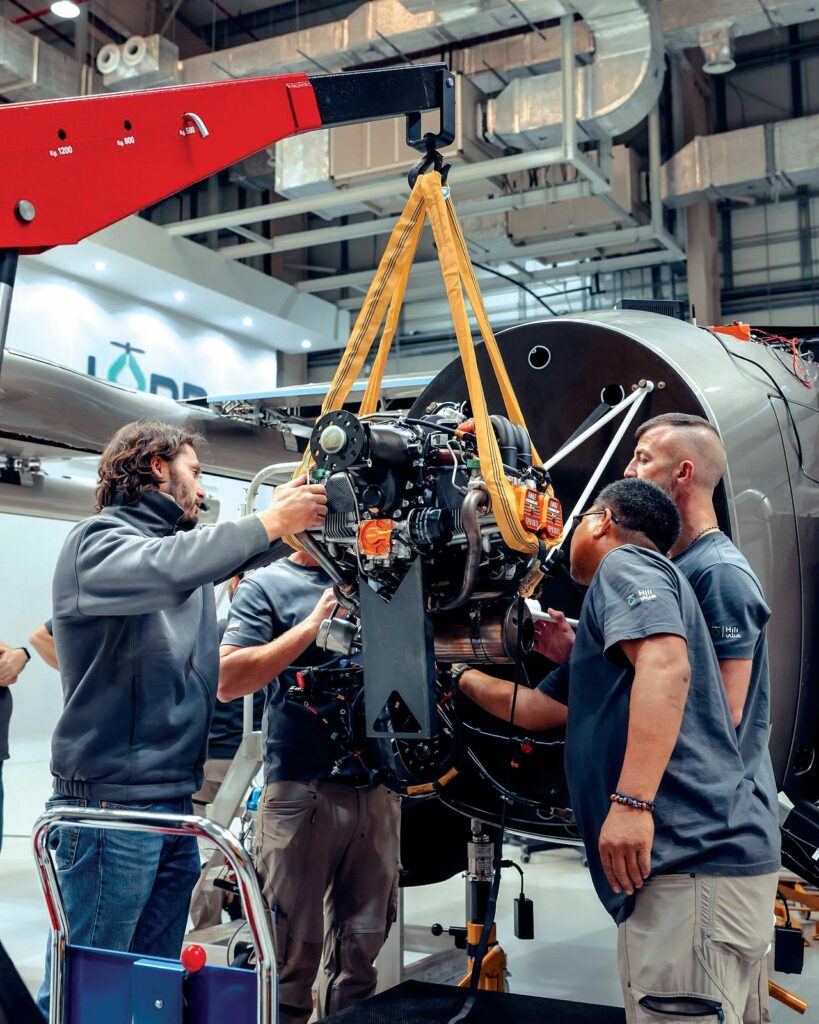
“That, combined with BRP-Rotax’s somewhat recent decision to stop actively engaging with military applications, encouraged us to start producing our new ThrustVik range of engines, as a dedicated series of powertrains badged for delivery to those prospective customers in the defence space,” Hauklien says.
(Image: LODD)
“With major names like Bayraktar and others no longer able to access their original Rotax engines, there’s a huge demand for a drop-in replacement engine, particularly one that can be supplied in good numbers, and give better performance and improved safety at high altitudes, as ThrustVik does. And given that the core engine is ASTM-certified, we can get that same certification with very little effort.”
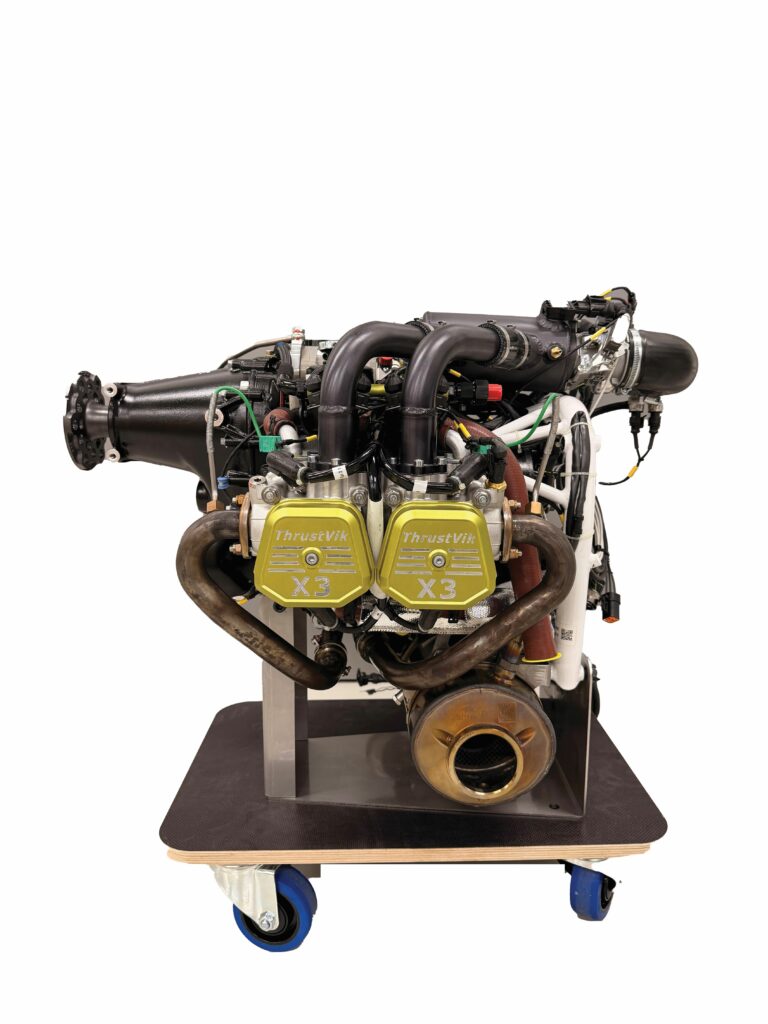
ThrustVik X3 & X5
The ThrustVik series is based closely on Edge Performance’s EP918Ti engine, which in turn is built upon the BRP-Rotax 916iS, being a flat, horizontally-opposed, four-cylinder four stroke. Both engines are spark ignited and turbocharged, with the Rotax engine outputting 137 hp (102 kW) maximum continuous power as standard, while Edge’s engines improve on this (as detailed just below) on top of integrating electric throttles, electro-hydraulic propeller governors and CANaerospace compatibility to enable UAV integrations.
Two ThrustVik engines are offered: a ThrustVik X3, practically identical to the EP918Ti, and a ThrustVik X5, which incorporates new, larger-bore cylinders, with new pistons and rings to match.
Both engines also incorporate new ECUs, EFI, turbochargers and camshafts over the original Rotax, with detailed explorations into their designs and reasons presented in this article.

The X3 is commercially available as an 83.5 kg system with peak power output of 185 hp (and consuming 60.3 L/hr of fuel) at 5800 rpm or 160 hp maximum continuous power at 5500 rpm (compared with the 916iS’s 137 hp), with nominal cruise power from 125–155 hp at 4600–5500 rpm approximately. It is currently validated to a TBO of 1200 hours, although Edge Performance plans to steadily revise this figure upwards, towards the predecessor EP918Ti’s 2000 hr TBO, as the X3 racks up testing hours.
“We started development of the X3 around December 2024, and we had the first 3D CAD renderings done in May 2025 – with dyno tests starting in October that year – although because most of the engineering is the same as the EP918Ti, a lot of the period from December to March was made up of gathering feedback on desired features from customers,” Hauklien says.
“Much else of it was designing how best to integrate electrical and communications links between different subsystems, and adapting outsourced components to provide a complete, turnkey system that customers could receive and use immediately.”
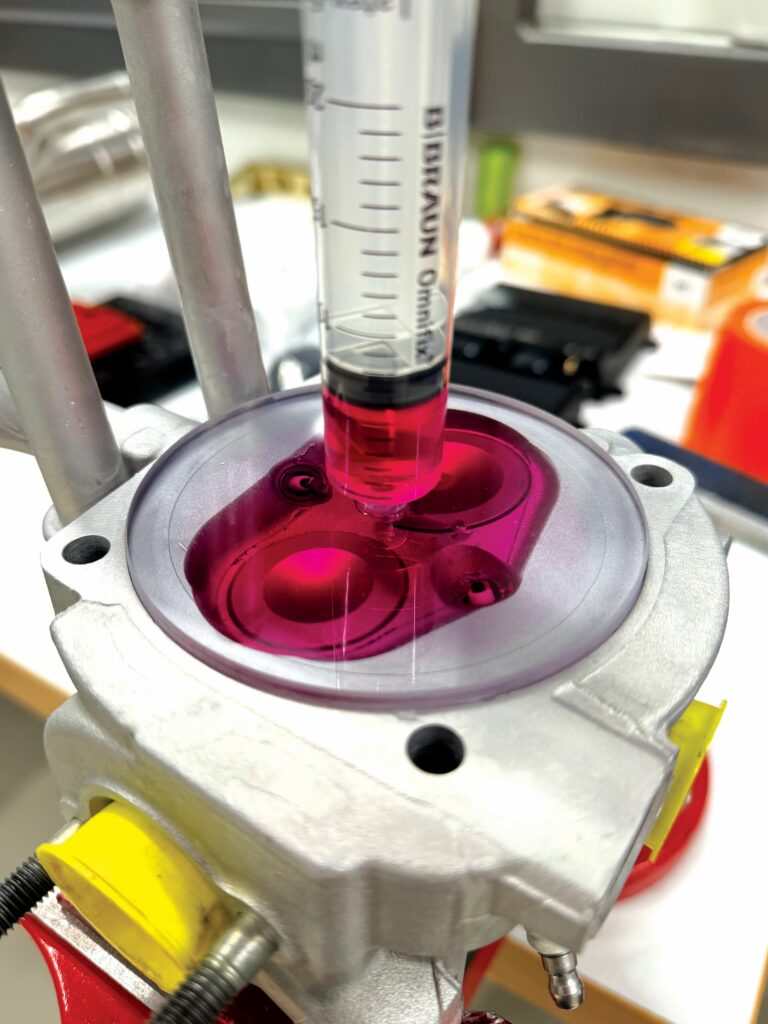
As of writing, the X5 is nearing completion, with exact performance specifications to be published soon, although a higher power output is to be expected. Both engines’ components are validated to run on RON 98 gasoline, as well as avgases AKI 93, 100LL, G100UL, and biofuels or mixtures ranging from E5 to E100.
Today, Edge is one of the biggest OEM customers of engines from Rotax and its distributor Franz Aircraft, and Edge confirms to us that its working relationship with BRP-Rotax has been friendly, functional and stable, particularly following an agreement in 2016 to re-badge all Rotax engines it purchases, modifies and sells as either Edge Performance or ThrustVik engines.
“At our current size and staff, we could probably produce another 50 engines per year, which if we focused on ThrustVik would mean delivering 200–250 ThrustVik engines annually, but we’re in the planning phase of further expansion and recruitment,” Hauklien adds.
Engine management
Among the biggest changes in the ThrustVik engines versus their Rotax predecessor is the replacement of the engine management system, including the ECU hardware, software, wiring harnesses and much of the sensor architecture.
“We’ve chosen a completely dual-redundant ECU; the original Rotax ECU by Rockwell Collins has redundancy too, being two sets of ECU hardware mounted on one circuit board, housed in a single casing, but that makes it a bit more prone to failures from, say, short-circuiting, lightning strikes and other hazards,” Hauklien says.
Instead, the Edge Performance ECU consists of two separate units, individually housed and stacked atop one another, each with its own generator supplying power. Each ECU is based originally on automotive and racing designs from MaxxECU, but customised for use in engines for UAVs and small aircraft (which the Swedish supplier has prior experience in and customers for).

“A key challenge there was that most aftermarket ECUs are running Bosch’s automotive CAN protocol, but in UAVs and aerospace, you really need CANaerospace. So, we made a converter for translating the automotive CAN data into CANaerospace, which makes integration a lot easier,” Hauklien adds.
That converter – the ‘EP-CC’, or Edge Performance CAN bus Converter – was developed in close partnership with RS Flight Systems, with the latter helping greatly speed development time and incorporating the EP-CC into their own System Control Unit (SCU) product, meaning that customers can buy the SCU if they prefer that over the EP-CC. RS also worked with Edge to enable end users to remotely toggle fuel pumps, fans and other ancillaries for tasks such as remote checks, diagnostics or troubleshooting of the ECU and other subsystems.
Being able to toggle software and hardware in this way has been key for end users changing engine ancillaries to suit very hot or cold climates, or the use of poor-quality or badly-stored fuels, as Rotax’s standard engine management builds-in extensive safety margins, catering for these edge cases by pulling back on power and optimisations.
“Instead, we’ll design our engines based on customer-submitted parameters, and once they have ground and initial flight test data, we do final adjustments and tuning into the engine management to get the powertrain performing as highly as possible in their application and environment,” Hauklien says.
“It helps that we both control our ECU design, and also keep it very open for customisation; whereas trying to get Rockwell to tune their software for specific features like playing it less safe with the restrictive safety margins, even for me who has strong connections with their upper management, is practically impossible.”
ECU redundancy & safety
On the matter of safety, however, the original Rockwell engine management hardware functioned on the basis of two ECU ‘lanes’: an A- and a B-lane. If something failed on lane A, such as a coolant or air temperature sensor, lane A would be completely shut down until the issue could be rectified. The UAV would then be entirely reliant on lane B, meaning a total loss of engine management (and very likely the aircraft) if something similar happened to lane B.
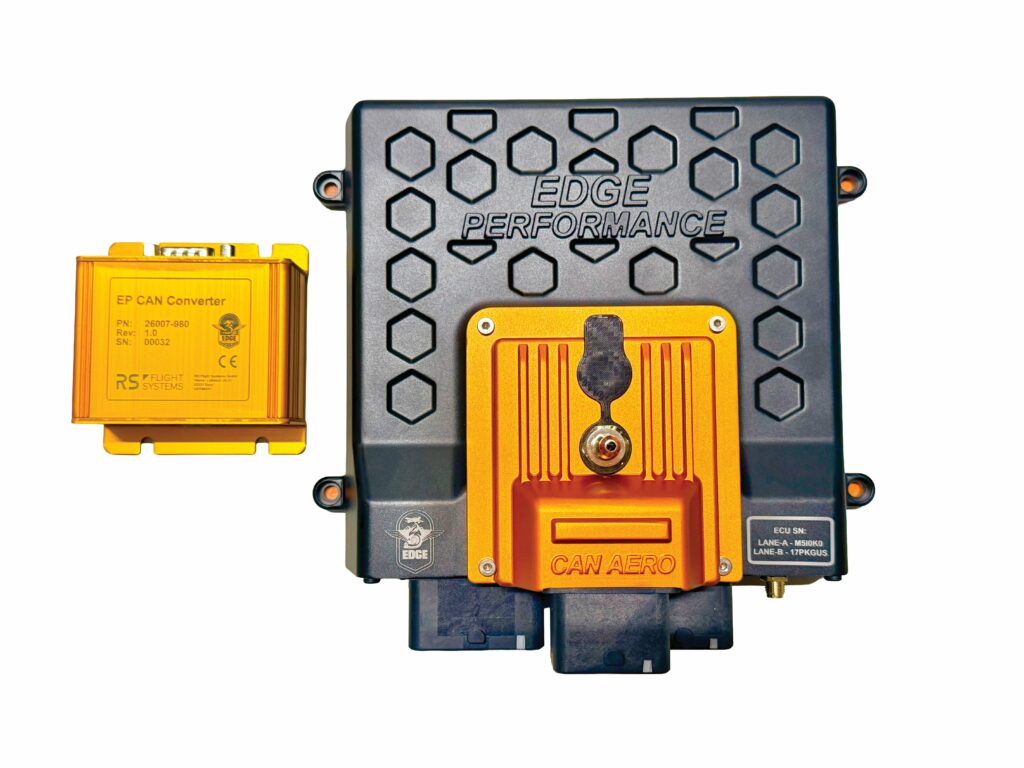
“If that happens in ours – which is less likely in the first place due to the fully separate housings, boards and dedicated generators – there’s an added function where the engine switches back to lane A to run in a limp mode,” Hauklien explains.
“That’s possible because we’ve put hundreds of hours into mapping every single sensor and trying to provoke the engine into stopping. So, we can disconnect our MAP sensor, the crank sensor, any temp or pressure sensors, and the engine management system will keep running at 85% efficiency regardless. It’ll also autonomously switch back-and-forth between the two ECUs, depending on which one is mapped or calculated to have the greater remaining functionality; even the two generators can switch power delivery from their main ECU to the other if needed.”
Additionally, Rotax’s original wiring harnesses contained many wires, spliced throughout a single harness, resulting in some cases with four-to-five grounds per singular pin at the ECU. Edge, by contrast, extensively calculated for optimal wire gauges, opting for thin, 28- or 30-gauge wires wherever possible; these are then run individually throughout the wiring looms to prevent single points of failure anywhere in the harnesses.
“It’s the same for both power and signal lengths. All are individually run, which means a lot more wires, but they’ve all been calculated for size so we don’t end up with a huge, bulky harness,” Hauklien notes.
Careful selection also went into ensuring suppression of interference from electromagnetic or radio waves via shielded, twisted cable pairs with concentric copper winding. Raychem DR-25 heat shrink tubing from TE Connectivity has been fitted and epoxy applied for sealing, to protect not only against heat, but also splashing from chemicals such as diesel or gasoline.
Significant proprietary work has gone into the software, particularly to enable continuous CAN communication and sharing of sensor data between the ECUs, as well as seamless engine running if the master or primary role is swapped from one unit to the other.
“We’ve also some specific features for high-altitude operations. For example, barometric pressure compensation on the Rotax system was originally only designed for up to 50 kPa, which only corresponds to about 18,000 ft,” Hauklien observes.
“So, we had to install different sensors in the PCBs and rewrite the software with a lot of altitude compensation mathematics – that we conducted – along with reporting systems for engine health, status and so on. Some hardware and firmware modding was also done to fully integrate and account for the fact that we’re running dual fuel and spark systems for extra safety and certifiability in flight. And since we have full authority over all that, there’s endless opportunity to add more features in case any customers want more.”
An Alpha-N strategy is run for managing the engine, using TPS and rpm as core mapping inputs, with MAP also used for further throttle regulation. No MAF sensor is installed, but significant calculations went into accounting for ambient air pressure and temperature, as well as barometric pressure, to keep the engine running optimally at high altitudes.
“We’ve found that a lot of Alpha-N-with-MAP strategies really start to fall off at greater heights, just out of lacking sensor data or workarounds for things like changes in exhaust back pressure – so our tables and software compensate for sensor issues like the offset in the O2 sensor’s voltage range, for instance,” Hauklien says.

Key sensors added by Edge include Bosch systems for MAP, fuel gauging, intake temperatures, and crank and cam speed, along with pressure transducers by Honeywell, and rotary speed sensors (for TPS) by Variohm. Oil temperature and EGT sensors from Therma Thermofühler GmbH in Germany have also been installed.
“Variohm’s sensors are especially interesting, as they have a dual Hall sensor in a single unit, with six wires across two tracks, enabling two TPS outputs per ECU; maybe it’s not safety-critical for flight, but it’s been very useful throughout programming and mapping,” Hauklien muses.
“And Therma make all their own sensors in-house, not just for aerospace but also industry and motorsport, including Formula One. So, they’ll produce ours to spec, with the suitable wire type, wire gauge and wire length pre-terminated with thermocouple connectors and so on, machining their stainless and other bodies with the appropriate threads and lengths.”
Turbocharged intake
While the starter-motor is unchanged from the original Rotax engine, being a 75 A, 1 kW device connected to the crankshaft via an idler gear and sprag clutch, the throttle body has been modified to better suit safety-critical aviation requirements.
“Back in GA, there was a requirement that, in case a throttle cable disconnected for whatever reason, the engine should go to wide-open throttle [WOT] so the pilot could continue flying towards an airfield before shutting off the engine and gliding down to land, instead of defaulting to idle and forcing the plane to descend immediately,” Hauklien says.
“But, while looking into fault tolerances and redundancies, we discovered that the pre-existing throttles would just get stuck in whatever position they were in at the time of cable failure. That’s not good for crewed GA planes or for UAVs potentially worth millions of dollars. So, we developed a couple of alternative throttle options, depending on customer preference.”
Two throttle bodies are available depending on customer preference. One is supplied by S-Can (previously AT Power Throttle), custom-designed based on one of its existing e-throttles to incorporate a spring, which passively returns the valve position to WOT in the event of failure.
The throttle’s drive mechanism also integrates a magnetic clutch, such that even amid a gear or motor failure in the servo, power to the servo can be shut off and isolated to enable the spring’s corrective action.
“S-Can also has a patented shaftless butterfly valve design, which increases air flow through that throttle and reduces turbulence,” Hauklien adds. “The valve plate has two small, square knobs – one at either end – each of which presses into an external aluminium shaft with two vertical machined grooves running down into the body. So, you insert the valve vertically and it naturally rotates into place before you seal it off with some plugs. If you look into the bore of the throttle body, you get the impression that it’s just floating on pins.”
The other is a modified version of the original Rotax throttle, which replaces the original throttle servo with a Volz DA 15-N servo – notably, a CAN bus-capable servo enabling detailed monitoring, diagnostics and fault tolerances via the ECU and autopilot.
“The Volz servo isn’t cheap, but our UAV customers are all already using Volz servos for flight control; it’s a known name for quality and reliability, so the price of that throttle body doesn’t bother any of them in the slightest,” Hauklien muses.
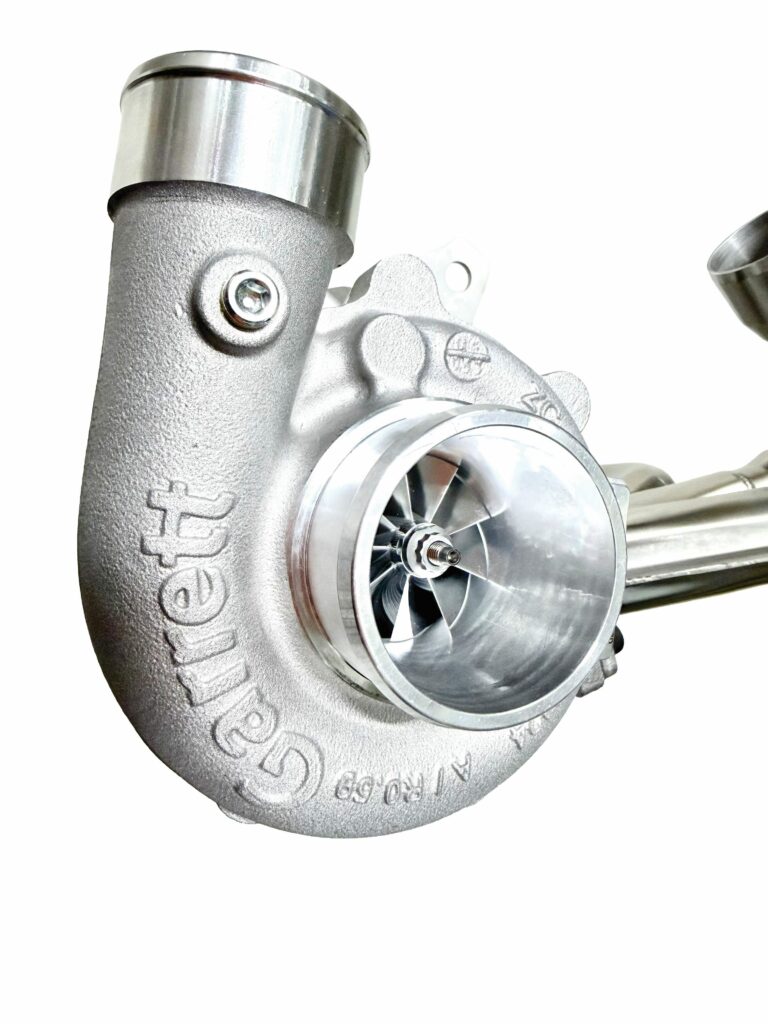
For forced induction purposes, he and his team also offer a larger Garrett turbocharger alongside the standard Rotax turbocharger. While the latter is proven to perform well, Edge notes that it starts to lose power above 18,000 ft (5486.4 m) and lacks a speed sensor for closed-loop engine management. Significant customer demand has also been made for continued engine performance at 38,000 ft (11,582.4 m).
“At those altitudes, you’re at the limit of what’s possible with a single turbo and without running compound turbo set-ups,” Hauklien says.
Hence, Edge Performance looked for turbochargers with the right air-flow capacity and high-pressure ratio to prevent the turbo from overspooling and overspeeding at altitude, or running out of control with intake temperatures. Additional emphasis was placed on minimal, controlled exhaust back pressure performance, as befitting a UAV engine intended for continuously running high power outputs.
“We’ve also sought the best possible mass-produced turbo, as turbo customisations cost an absolute fortune in development, with still a much heftier price per unit than something already manufactured in the tens of thousands. And thereafter, you still wind up needing extensive testing to check whether the design achieved what you were hoping for.”
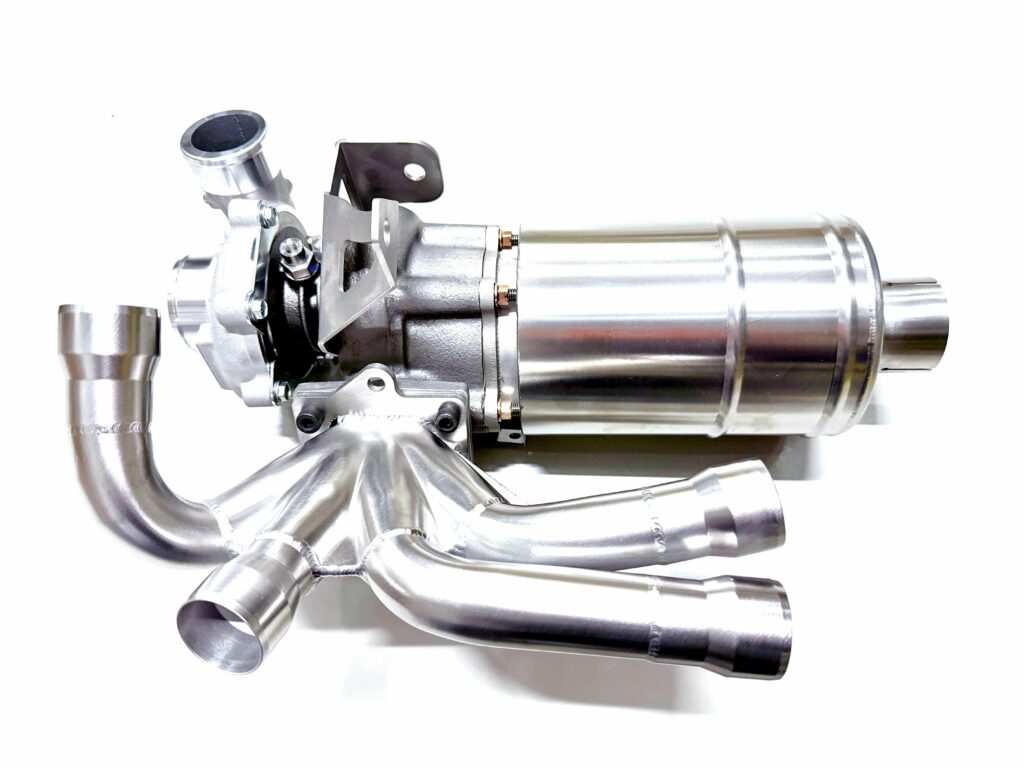
Edge Performance also manufactures its own custom housing for the turbocharger, principally to save weight versus the standard, heavy, bulky aftermarket turbo housings, which are typically cast iron (the Norwegian company strongly preferring 316 or 321 stainless steel cast alloys, to enable thinner walls for weight and size optimisation).
“Titanium is also interesting, if you can get the right alloy for taking heat and oxygen exposure over time, without oxidising and breaking down like regular, commercial-grade titanium does,” Hauklien muses. “But that search has proven challenging. You even see in Formula One, they’re all sticking to Inconels; if they could run titanium headers, they absolutely would because you can save so much weight. But when you go past 650–700 C, a lot of titaniums really start to deteriorate.”
Furthermore, the Rotax intake manifolds are designed as 2-into-1 systems, which is the optimal choice for low-cost, high-volume production, but Edge runs an equal-length, 4-into-1 to equalise air flow into all four cylinders. That gives an improved balancing of mass air and fuel flow across the engine, enabling far smoother running and lowered vibration (particularly at low rpm), as validated via Edge’s vibration analyses.
“Also, we couldn’t find a turbocharger with a large enough compressor housing that wasn’t also fitted with an external wastegate,” Hauklien adds. “So, we built ours with an internal wastegate to keep weight, complexity and the number of components and exhaust systems to a bare minimum.”
Most CFD work focused less on the turbo housing and testing and more on the ThrustVik intake manifold to slightly improve parameters such as plenum volume, runner diameter length and velocity stack positioning. Some simulation and testing work was done with injector placements – including mounting them outboard and inboard – although barely any difference in combustion, power efficiency or output of CO2 or oxygen was found.
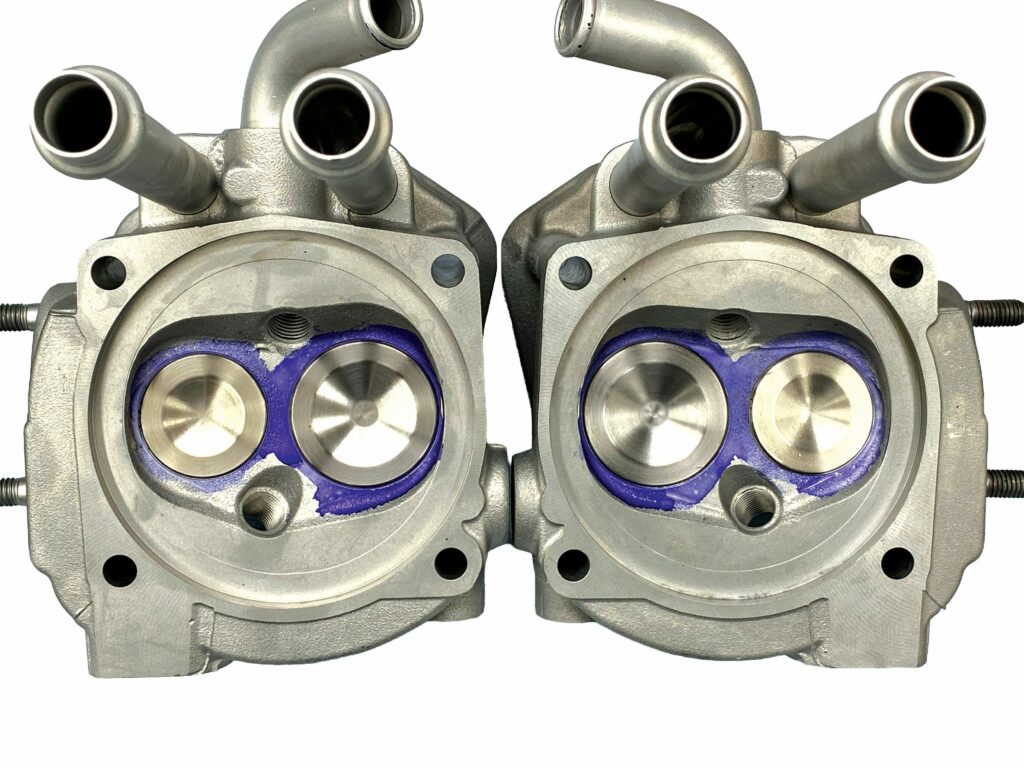
As it stands, an intake flange bolts directly onto each cylinder head, with intake runners welded onto these, and two fuel injectors mounted roughly 10 mm from the flanges, with fuel–air mixing starting just prior to cylinder entry and the piston then providing a final squish to the mixture.
Sequential fuel injection
In addition to changing the entire induction and engine management systems from the original 916iS, Edge has also converted its EFI system into a sequential fuel injection (SFI) system.
This replaces the standard wasted spark and batch fire EFI arrangement, in which spark plugs are fired in pairs – one for combustion and one for exhaust (the latter thus being ‘wasted’) – and fuel is sprayed in batches rather than in individual injections per cylinder. Such an approach enables simplified wiring and programming, and thus easier and quicker production, but forgoes useful optimisations such as precise valve timing or more efficient deployment of input power or fuel.
Key to enabling SFI is integrating a feed for camshaft speed data; therefore, Edge has added the aforementioned Bosch sensor to that purpose onto the camshaft. Through those readings, the ThrustVik ECU can precisely determine the positions of the pistons relative to the crankshaft, enabling it to time the injector pulses and spark plug firings at specific, optimised intervals for each cylinder, enabling better fuel efficiency and economy than in batch firing where all injectors are simply opened simultaneously once per revolution.
“And although Rotax runs a knock sensor, whenever the ECU detects a knock level, it’d opt for retarding the ignition timing on all four cylinders, so the power would very noticeably get pulled back,” Hauklien says.
“By running SFI instead, our ECU knows exactly which cylinder is knocking, and it can undertake corrective measures specific to that cylinder alone; for instance, pulling back ignition timing, adding fuel or a combination of both.
“There’s also future potential for us to run dyno tests with CO2 and O2 sensors for each cylinder to see what opening angle is ideal for the injector to maximise combustion efficiency without sacrificing performance.”
Camshafts
The valvetrain is conventional and largely unchanged from Rotax’s original sequence of hydraulic flat tappets, push rods, rocker arms and valves, with cotters, retainers, valve springs, valve spring shims, valve stem seals and valve guides for stable and consistent valve operation. Edge also discloses that its intake valves are stainless steel, while the exhaust valves are sodium-filled Inconel; the push rods are EN4340 steel.
However, a replacement camshaft has also been installed for both the X3 and the X5 ThrustVik engines in pursuit of a widened power band over the Rotax 916iS, and for a narrower mid-band torque range (roughly between 4000 and 5000 rpm) than the very linear torque curve on the original engine. The latter modification enables the engine to be slowed from its top speeds with greater efficiency and less frictional losses.
“We’ve been able to do so, and have some quite interesting dyno data on the camshafts, showing a very flattened torque curve throughout the power band of the engine,” Hauklien says.
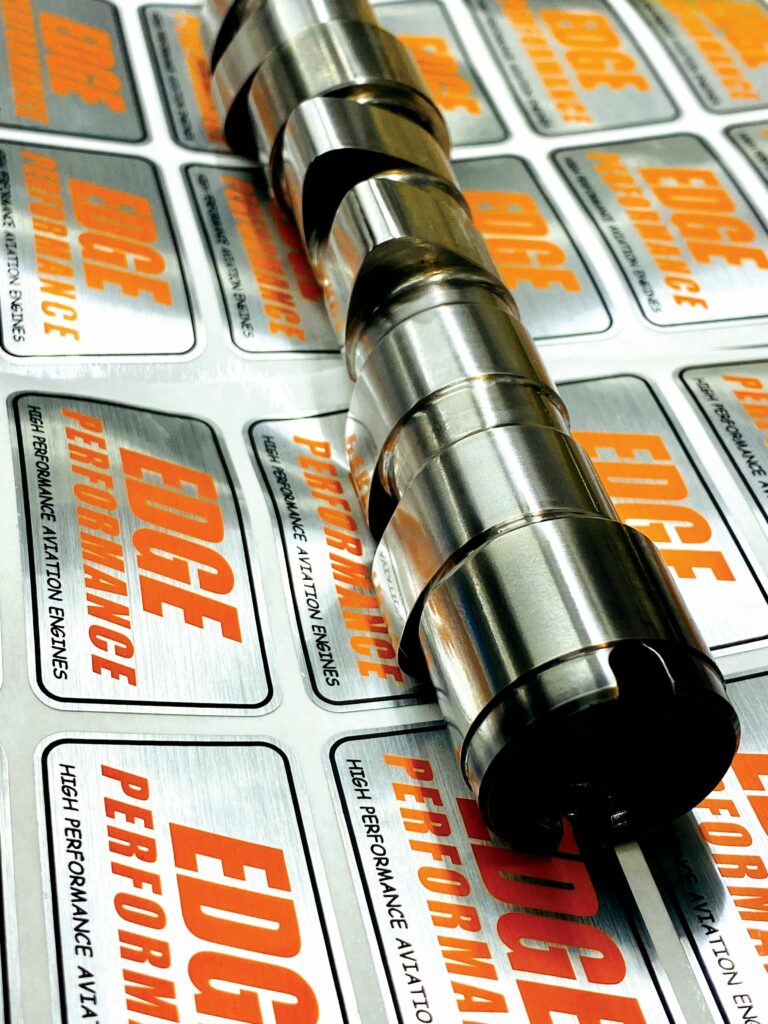
Belgium-based Cat Camshafts was exclusively responsible for design and prototyping of the new camshaft, Edge feeding them power and torque curves from testing for the former company to put into its simulation programs to refine its cam profiles. Per the two valves for each of the four cylinders, the shaft has eight cam lobes and three bearings, running by gear off the crankshaft.
“Camshafts are a bit of a black magic area, and many still debate over turbo camshafts versus natural aspiration camshafts, even though it’s been debunked a million times – as we’ve seen throughout our dyno testing,” Hauklien says.
“The simple truth is, spark-ignited engines are air pumps. If you push a 100 hp naturally aspirated engine to 150 hp via a better camshaft, the 200 hp turbo version of the engine with 100 kPa of boost will also reach 250 hp; it’ll benefit 1:1, almost every time.”
Lubrication
The ThrustVik engines are oiled using fully synthetic 5W-50 with lead-scavenging properties, the lubricant running from an external dry sump (typically at 3.5–4.8 bar of pressure). Around 3 L circulates between the tank and the engine when operations commence, although losses of just below 300 mL per 50 hours (hence, below 6 mL/hr) occur, as the oil feeds outwards to the engine’s accessory gearbox for gear oiling, and to Edge Performance’s proprietary propeller governor for forced lubrication of the shaft and splines, on top of providing lubrication of the turbocharger and direct cooling of the alternators.
Oil enters the engine from a Rotax OEM oil pump (with a custom, pressurised, high-flow oil cooler sandwich adapter) to feed through two main galleries in the crankcase halves, providing oil to the main bearings, rod bearings, valve lifters and piston oil squirters.
“Years back, we saw a lack of piston oil thermal management in the 916iS and some other engines, so we increased the size of some oil bores, designed our own high-flow oil pumps, and designed and installed our own piston oil squirters and associated parts,” Hauklien recounts.
“But, luckily for us, with the new Rotax turbo engines, they’ve incorporated those modifications that we’d already invented years ago anyway, so that saves us having to drill into the crankcases ever again.”
Edge’s oil cooler adapter integrates on the oil filter side of the oil pump, and along with bleed air from the turbocharger’s compressor (controlled by the ECU via a boost-controller solenoid valve and a pressure transducer in the sump) is vital to ensuring that the oil tank constantly targets 100 kPa of pressure, regardless of whether the UAV and the oil pump are at sea level or 38,000 ft.
Without these two workarounds, the original arrangement causes the oil pump’s suction from the sump to increase excessively at altitude as atmospheric pressure drops below 50 kPa, potentially causing oil pressure drop.
“The adapter is nothing revolutionary; mechanically it’s just a machined lump of aluminium, but it has an intake and an output, so we can run pressurised lubrication through the oil cooler, and don’t need to run that on the suction-side of the pump,” Hauklien says.
Custom coolers
As per the stock Rotax 916iS, the ThrustVik crankcases are split lengthways into two case halves, bolted together first with six M8 studs (with dowel pins) over the three main journals, and then with five additional M8 bolts, an M10 and nine M6 case bolts.
Other unchanged components include those for thermal management, with the original heat sinks, radiators and oil coolers also present as standard, although Edge can design and supply air guide baffles to forcibly air-cool the cylinders at high altitudes, along with custom heat sinks for edge cases, thereby preventing overheating, blow-by and losses.
“Some users assume higher altitudes automatically mean colder temperatures, and so, easier thermal management, forgetting that there’s really poor mass density up there,” Hauklien notes.
Hence, Edge Performance cooperates with Pro Alloy and other suppliers on custom, oversized radiators and intercoolers, for applications such as larger, slower, low-drag UAVs with a higher organic cooling need, as well as its customers in hotter climates such as the Middle East or Africa.
As a result, its engines are never at significant risk of overheating, even if idling in a pusher configuration on a runway for extended periods. All pumps are, additionally, mechanically gear-driven, which prevents failures from power cuts or overdrives, even when operating at maximum continuous power levels.
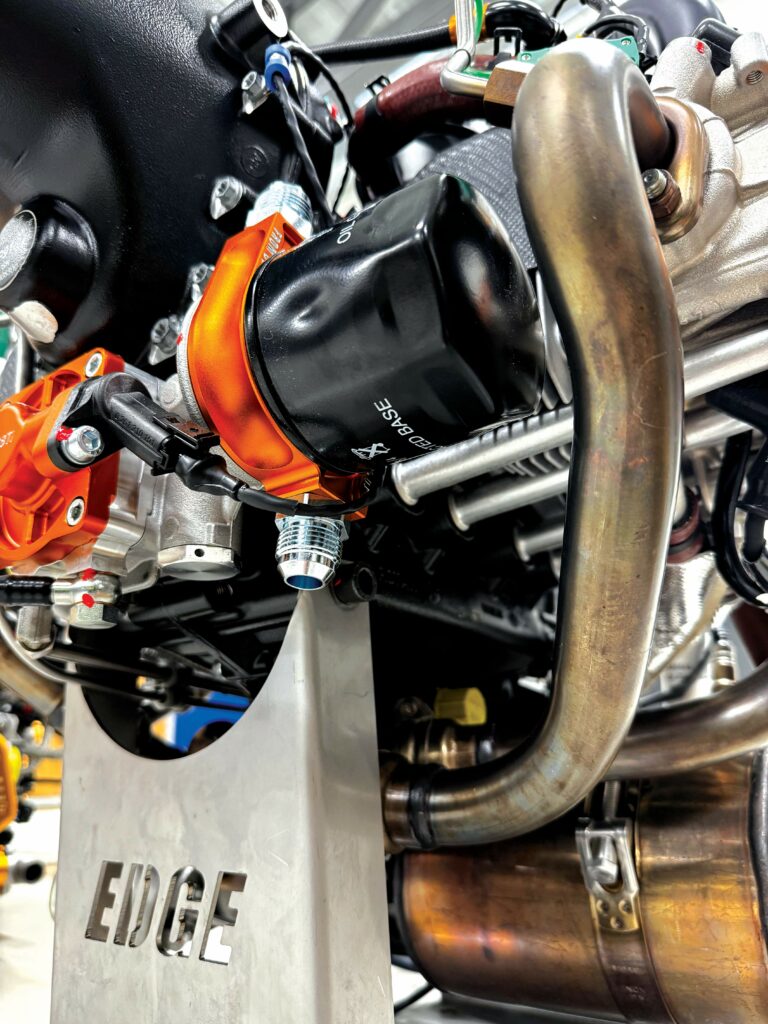
“We’ve had past collaborations with Pro Alloy in motorsport; and even today as they’ve transitioned into aerospace, their engineers have proven incredibly easy to get hold of by phone or e-mail, and they already know us and our requirements very closely, which puts us on the same page immediately when we’re trying to get some new custom heat sink or intercooler work done,” Hauklien says.
“It’s not easy to get custom coolers done quickly or easily, but we often need radiused cores, tapered cores, angled cores and the like, and Pro Alloy do custom stuff all the time, they’re really good in that field.”
A bigger bore
More significantly, however, the ThrustVik X5 as indicated comes with a 2 mm larger cylinder bore design than the ThrustVik X3 and original Rotax 916iS, to increase displacement and reduce weight, without increasing the engine width or manifold air pressure.
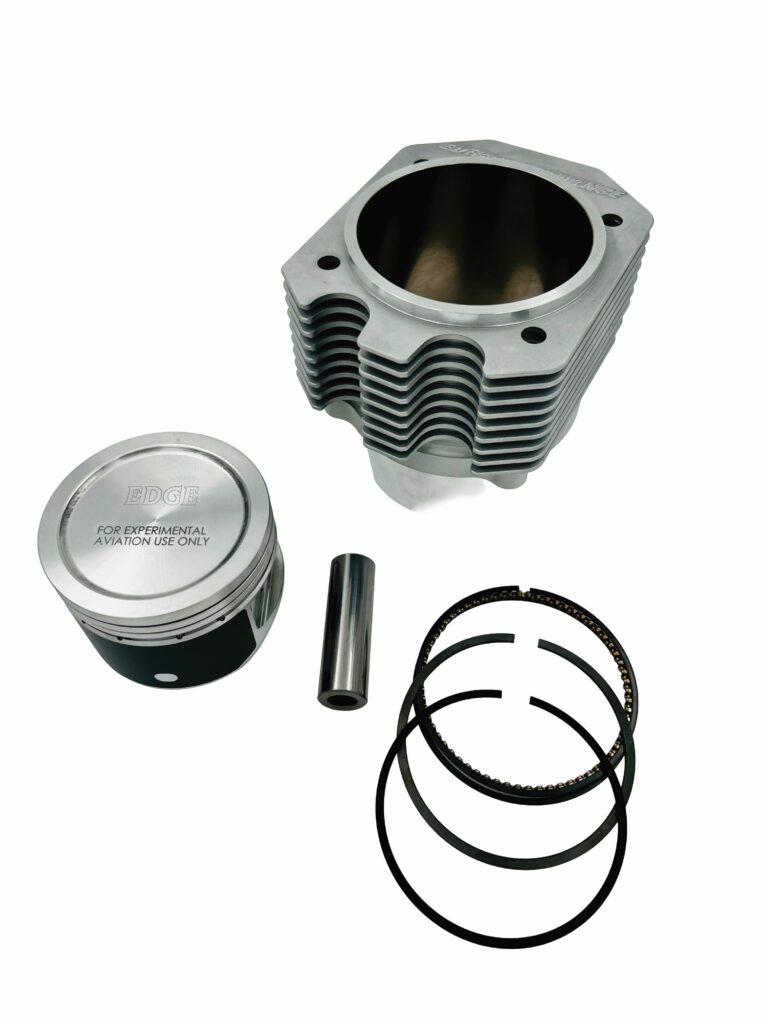
“We’ve been developing what are essentially ‘big bore kits’ for Rotax engines since 2006, and worked with Millennium Technologies since that date, as they’re a very high-end and recognised name in nickel silicon carbide cylinder coatings across the aftermarket space, including
for MotoGP, snowmobiles and Harleys. And we’ve just had an exceptional track record and relationship with them these last 20 years,” Hauklien says.
The X5 cylinders are machine-cut in-house from 6061-T6 aluminium billet, which Edge plates and hones to its own specification before surface finishing them. After being coated by Millennium, they are bolted as individual barrels onto the crankcase with no gaskets, including mating and sealing directly with their heads.
“As a funny side-note: Rotax is supposedly working on a similar big bore update to two of its engines now,” Hauklien adds.
Also key to the success of the X5’s new bore design are new pistons from United Engine & Machine Co (UEM), as Rotax is not yet supplying pistons with an 86 mm diameter, and Edge Performance has found other piston manufacturers to miss shipment deadlines all too frequently.
“That was a persistent headache for us, but luckily Millennium recommended UEM, as they’d worked with them on their Harley-Davidson high-displacement cylinder kits for many years with great success, and UEM have long roots – maybe 120 years of piston-making experience at this point,” Hauklien says.
“Plus, a lot of motorsport-born suppliers will focus first on frictional losses and then on maximising efficiency and horsepower. That’s all good stuff, but aerospace pistons have to put reliability front and centre; you can’t have narrow-skirt designs, piston rocking or other potential long-term problems threatening your aircraft.
“But UEM has a long tradition of working with OEMs, including all the major American V8 brands, to prioritise reliability over performance if needed. So, not only did they immediately understand our requirements, but they continue to offer really competitive pricing and lead times today, as well as keeping pistons on-stock if we need a bunch of them at short notice. We’ve been really impressed with the quality, consistency and reliability of their pistons. Not a single failure from any of their pistons compared with lots from other brands.”
The X5 pistons are forged to be better able of withstanding high loads and stress over long durations than cast pistons. While forging means increased metal density and thus greater thermal expansions over cast pistons, Edge typically chooses to mitigate this by requesting UEM’s M42 skirt coating (which UEM has described publicly as ‘a mixture of graphite, Teflon and molybdenum’).
The piston rings have been chosen from Total Seal, particularly out of a drive for tight oil control. Gas sealing is less desirable in the ThrustVik engines because the lack of a scavenge pump is overcome by deliberate use of blow-by gases to force oil back to the sump; hence, picking gapless rings could result in oil pooling in the engine and running out at the sump over operations.
“But oil consumption is a significant issue in these engines, and while Rotax has good control of that in the base 916iS design, getting it under control in an all-new set of cylinders and pistons was of prime importance,” Hauklien says.
“Luckily, Total Seal’s huge range of experience in aviation and different engines was really helpful, especially with the second ring; that’s a napier-cut steel ring with a hook-like shape on its lower face, which does a great job scraping the oil off the cylinder and getting it through the oil ring below, which is composed of non-chrome oil rails and a three-piece oil scraper.
“Overall, Total Seal, UEM and Millennium all collaborated really well with us and each other, resulting in some unique features like how we design and machine the pistons for passage clearance between the napier ring and oil ring, to get oil back into the crankcase. Keeping oil losses from getting out of control is crucial to ThrustVik’s longevity; with the price of our engines, we can’t have a measly TBO of 500–600 hours, that’s just not going to cut it in this industry.”
Propeller governor
As a final point, MT Propeller in Germany and Jihostroj in Czechia are credited with the supply of the aforementioned electro-hydraulic propeller governors on the ThrustVik series, these being off-the-shelf parts that the two Central European companies design, develop and manufacture.
Edge has, however, created a specific mapping by which the governor can be commanded to put certain amounts of oil pressure towards target blade pitches, against TPS, MAP and crankshaft rpm.
“It’s a lot like mapping an engine, in that you have to predefine in a mapping table what rpm you’d allow the prop to run the engine at, at specific loads and throttle settings,” Hauklien says. “We did that mapping together with RS Flight Systems, since they do the electronics side of it.”
Future
Going forwards, Edge Performance anticipates focusing its r&d into optimisations for a few key areas of customer interest.
“Alternative fuels are something we’re always interested in, like ethanol – which the ThrustVik can already run on – but others like hydrogen hold big potential for improving power and energy densities,” Hauklien says.
“And of course, hybrid and heavy fuel powertrain arrangements are something that’ll definitely proliferate in the not-too-distant future; we have some projects in their early phases with European UAV manufacturers, particularly concentrated on VTOL-capable platforms much like our known customers at LODD Autonomous.
“We’re also working as hard as we can to recruit new engineers to come and work with us here in Norway. Hiring locally is pretty difficult because the Norwegian military and hydrocarbon companies surrounding us are snapping up every skilled hire they can, but we’ll need all hands on deck to satisfy the levels of customer demand we’re faced with now.”
Key specifications
ThrustVik X3
Four-stroke
Flat opposed four-cylinder
Turbocharged
Air cooled
EFI
Weight: 83.5 kg
Dimensions: 73 x 57 x 55 cm
Maximum power (peak): 185 hp at 5800 rpm (3 min maximum recommended duration)
Maximum power (continuous): 160 hp at 5500 rpm
Operating power output: 125–155 hp @ 4600–5500rpm
Maximum torque: 266 Nm (675 Nm at PTO)
Operating torque: 200–220 Nm
Redline speed: 5800 rpm
Operating speed: 4000–5500 rpm
Maximum SFC: 60.3 L/hr
Operating SFC: 44 L/hr
Displacement (per cylinder): 338 cc, 8.4 x 6.1 cm
Displacement (total): 1352 cc
Compression ratio: 9:1
TBO: 1200 hours as of writing
ThrustVik X5
Displacement (per cylinder): (354 cc, 8.6 x 6.1 cm)
Displacement (total): 1417 cc (Additional specifications to be confirmed)
Some key suppliers
Base engine and spare parts: Rotax
Base engine and spare parts: Franz Aircraft
Wiring harnesses: Silec Auto Electrical
Integration electronics: RS Flight Systems
Actuators: Volz Servos
Piston rings: Total Seal
Pistons: United Engine & Machine Co
Turbochargers: Garrett
Metal fabrications: Premanex
Sensors and additional electronics: Mouser Electronics
Sensors and additional electronics: RS Components
Sensors: Bosch
Pressure transducers: Honeywell
Speed sensors: Variohm
Temperature sensors: Therma Thermofühler GmbH
ECU software: MaxxECU
Throttle bodies: S-Can (previously AT Power Throttle)
Heat exchangers: Pro Alloy
Cylinder lining: Millennium Technologies
Camshafts: CAT CAMS
Propeller governors: MT Propeller
Propeller governors: Jihostroj
UPCOMING EVENTS