










Cyber protection for UAVs
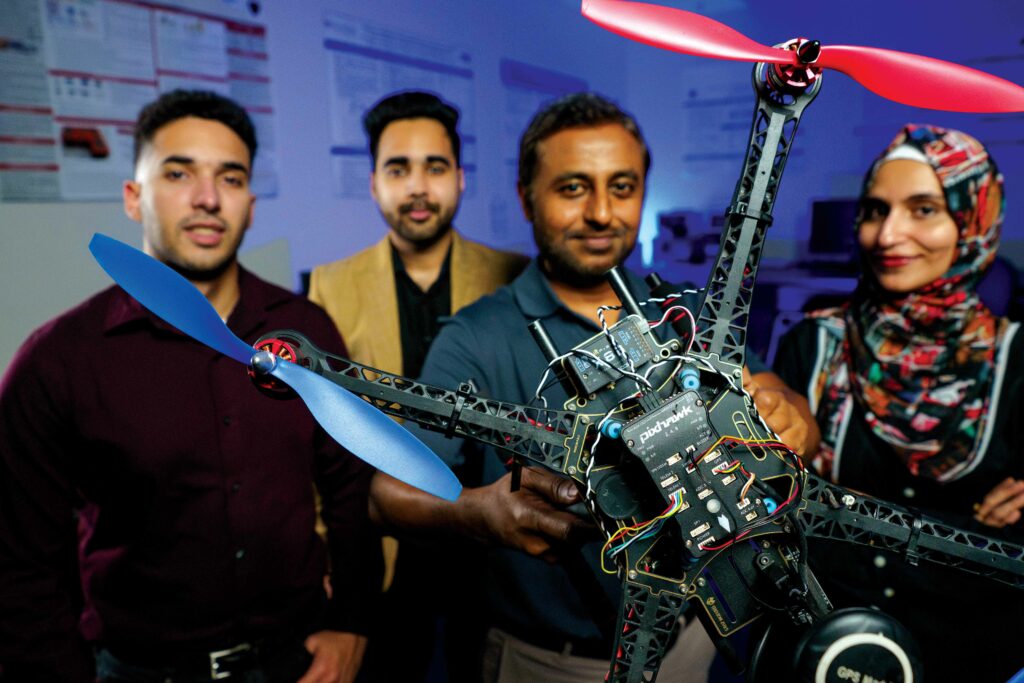
(Image: Chris Necuze/Florida International University)
A Florida-based team has developed technology that can detect and neutralise cyberattacks on UAVs in real time and, crucially, allow the craft to finish its mission, writes Nick Flaherty.
The Side-channel analysis-based multimodal Holistic Intrusion Evaluation with Layered Defense (SHIELD) system, developed at Florida International University (FIU), uses machine learning to diagnose the type of assault. Each attack leaves behind a unique signature, and SHIELD responds with a tailored recovery protocol.
Traditionally, attack detection has revolved around sensors that help the drone to perceive its surroundings and fly safely but which can be easily manipulated.
Sophisticated cyberattacks, though, bypass the sensors and go straight for the control or actuation system, sneaking malware into the drone’s hardware.
“This is why a detection and recovery system that only takes into account the sensors misses the bigger picture,” said Muneeba Asif of the FIU research group. “It will be blind to other attacks that happen across the system and at different levels.”
SHIELD goes further, monitoring the drone’s entire control system. It detects abnormalities not just in sensors but also in hardware, where hackers often try to hide their tracks. A sudden battery surge or overheating processor, for instance, may signal an attack underway.
SHIELD is a comprehensive security framework that uses side-channel data for robust detection, precise attack categorisation and tailored recovery processes across the entire UAV system. Side channels provide critical, hard-to-manipulate information that enhances the detection of sophisticated stealthy attacks. By categorising the specific nature of an attack, SHIELD selects the most appropriate recovery strategy, focusing on the integrity of pulse width modulation signals to ensure effective recovery and mission continuity. This makes SHIELD a holistic approach across the sensor–control–actuation spectrum.
Through multiple hardware-in-the-loop simulations in the lab, researchers learned that every attack leaves behind a unique signature and impacts the drone’s system differently. So, the team trained AI machine learning models to spot abnormalities in the data, use the data to classify the attack and roll out the prescribed recovery protocol.
In lab simulations, the FIU team’s approach identified attacks in an average of 0.21 seconds and restored normal flight in 0.36 seconds.
“Without robust recovery mechanisms, a drone cannot complete its mission under attacks because, even if it is possible to detect the attacks, the mission often gets terminated as a fail-safe move,” said Mohammad Ashiqur Rahman, lead researcher and associate professor in the Knight Foundation School of Computing and Information Sciences at FIU. “What’s important about our framework is that it helps the system recover, so the mission can be completed.”
Rahman’s research group at FIU plans to scale up testing to prepare SHIELD for real-world deployment.
UPCOMING EVENTS