






CUAV 2026
(Images: CUAV)
Making powerful connections
With the opportunity to get hands-on with proven tech, gain insights from industry leaders and connect with expert innovators, small wonder that the Commercial UAV Expo 2026 was the most popular to date. Ania Burgess reports
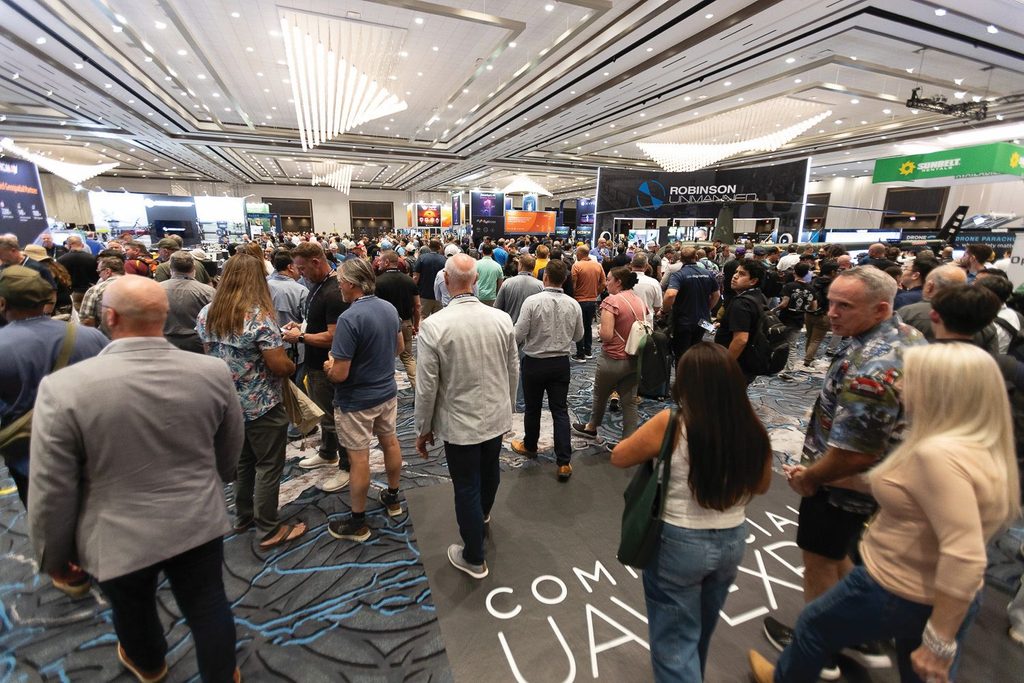
The drone industry made its annual pilgrimage to Las Vegas for the Commercial UAV Expo, drawing the largest turnout in the show’s 12 year history and spotlighting a host of new products spanning airframes, propulsion, sensors, materials and ground control systems. In all, 3800 attendees and more than 250 exhibitors represented 65 countries and packed the show floor and presentation stages with new solutions and improvements on existing technologies.
The presentation stages were dominated by discussion of the FCC’s covered list and the exhibition floor told a parallel story: NDAA compliance surfaced in nearly every conversation, from battery chemistries and structural materials to navigation systems and full airframes, as exhibitors positioned their latest products around this constraint. A selection of these solutions, along with other new products, are presented within.
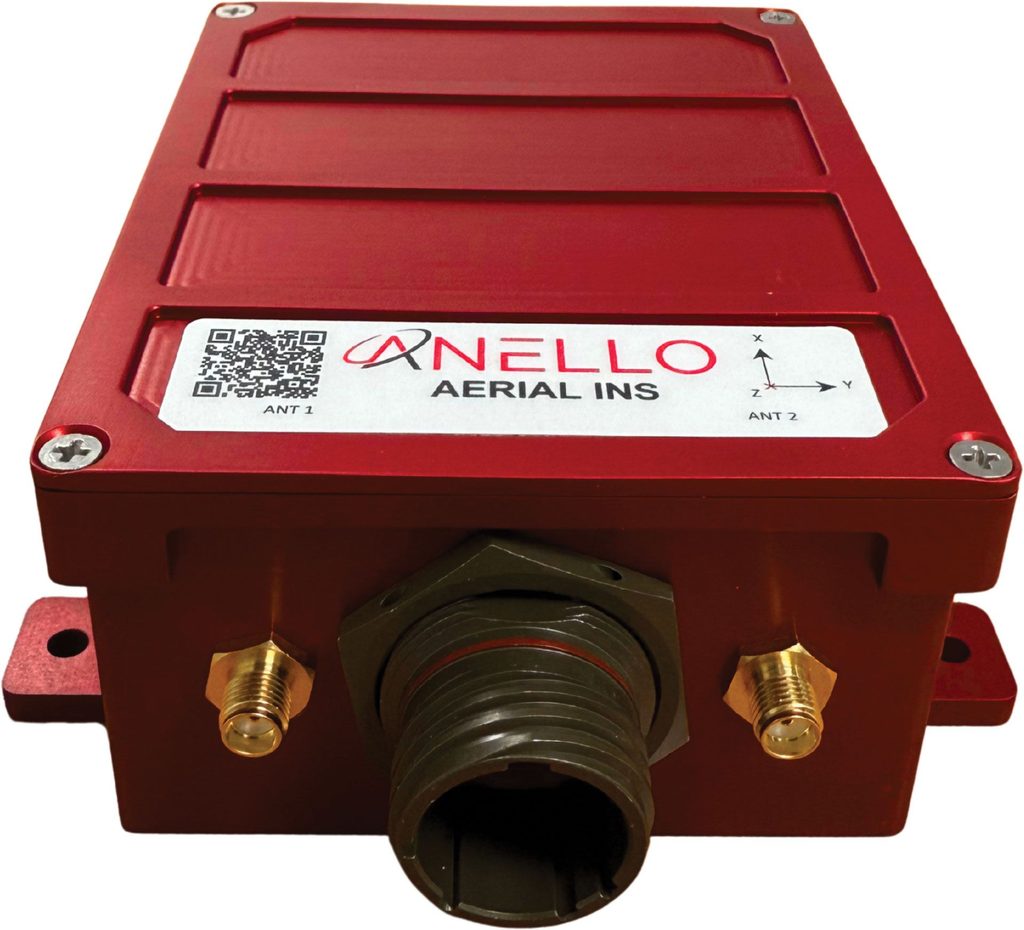
ANELLO Photonics is targeting the gap between MEMS-based inertial sensors and fibre-optic gyroscopes (FOGs), as more autonomous platforms need to sustain navigation-grade accuracy through extended GPS-denied intervals. The company’s core innovation, the SiPhOG (Silicon Photonics Optical Gyroscope), replicates FOG-level sensing by moving the interferometric components of a traditional fibre-coil gyroscope onto a photonic chip, rather than relying on the physical fibre windings that make conventional FOGs bulky and expensive.
The rationale traces to the physical limitations of MEMS. “Many times, a MEMS IMU is not going to cut it – the alternative is to buy a very expensive fibre-optic gyroscope. They’re great, but they’re big, they’re heavy and they’re really expensive,” said Gerhard Boiciuc at ANELLO, adding that conventional FOG suppliers can carry lead times of 12–16 months.
Earlier this year, ANELLO brought the SiPhOG technology to market in a new ANELLO Aerial INS: a lightweight unit built around three ANELLO SiPhOGs, dual triple-frequency all-constellation GNSS receivers and an advanced EKF-based sensor fusion engine with flight-profile-tuned algorithms. Standard Ethernet, RS-232, RS-422 and CAN interfaces, along with PX4 and ArduPilot drivers, enable straightforward integration with existing autopilot and flight-control stacks. The aerial unit joins ANELLO’s existing land and maritime products, including an IP68-rated Maritime INS shipping since 2025. ANELLO, which recently closed its Series B2 round, is also developing a man-portable, handheld positioning device for dismounted personnel operating without GPS, set to be released in early 2027.
Arcsky, based in Austin (Texas), is a manufacturer spanning heavy-lift and small UAV platforms, and introduced its Xplorer – a compact NDAA-compliant airframe for inspection and imaging missions that don’t warrant the company’s larger, lift-focused systems.
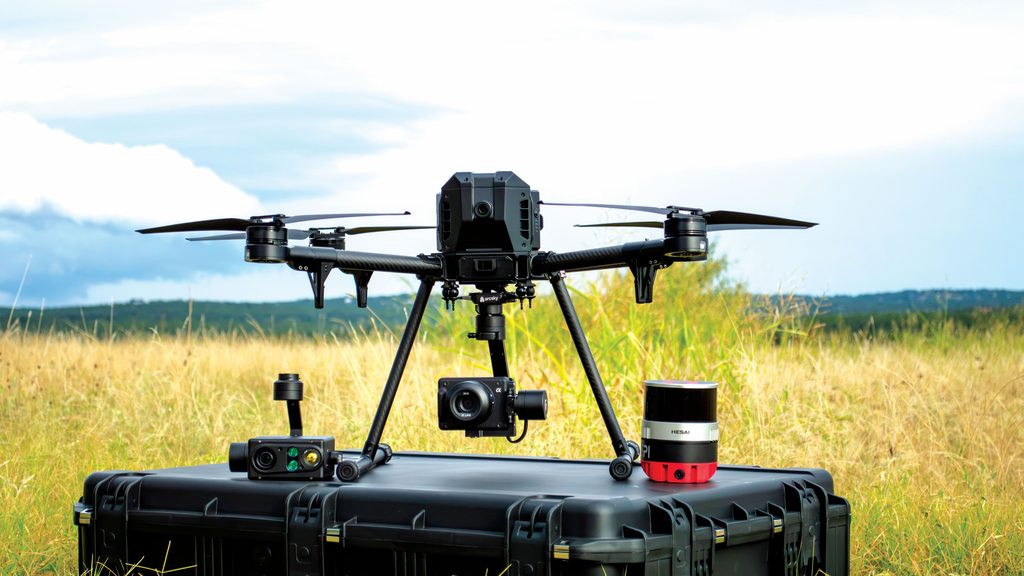
Xplorer carries up to 4.5 lbs across a 45 minute flight envelope at a flight speed of up to 20 m/s. With forward-facing obstacle avoidance of up to 50 m and downward-facing obstacle avoidance of up to 90 m, Xplorer is capable of real-time terrain following and features hot-swappable batteries. “We target all companies and sectors in the drone industry,” said Jayden Pettigrew at Arcsky. “We have multiple payloads for Lidar inspection and thermal imaging.”
Xplorer is now moving into ramped production as Arcsky works through its initial sales pipeline.
Vigilant Sky Technologies has spent recent months hardening a fully in-house hardware and software stack, built from the ground up to serve custom mission requirements – historically for US Department of War and Homeland Security customers, and increasingly for commercial sectors like oil and gas.
Rather than a single flagship product, Vigilant Sky’s offering is customisation itself: modular 7 and 15 in airframe platforms built to NDAA-compliant standards, designed to accept whatever sensor payload a mission calls for. “What we do here is we provide custom solutions,” said Tim Goodwin of Vigilant Sky Technologies. “Whoever comes to us and needs something done, we do it for them.” The company doesn’t manufacture Lidar in-house but integrates third-party sensors onto its platforms as required.
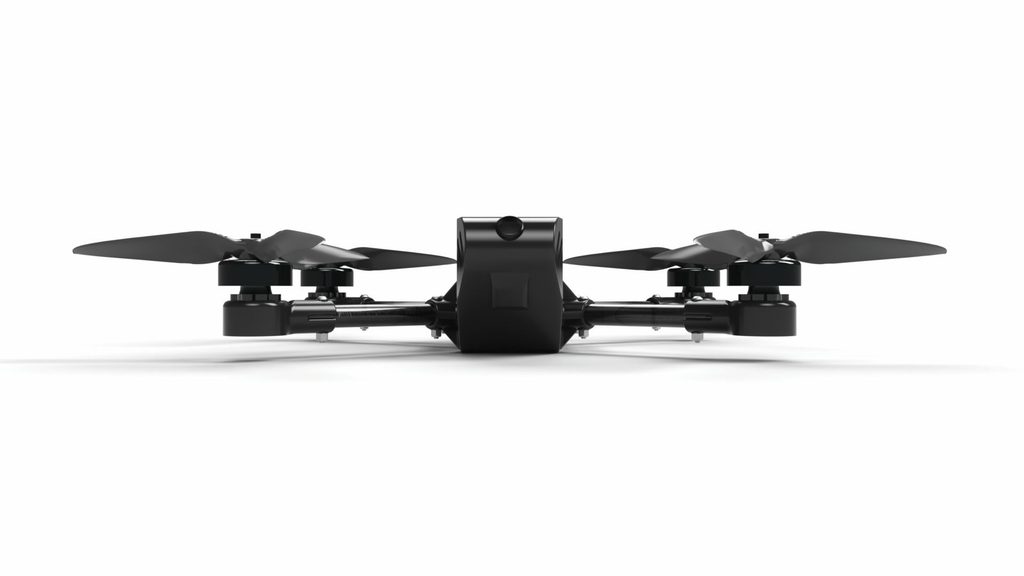
Looking ahead, Vigilant Sky is expanding into sub-249 g platforms as the company works to build a footprint beyond its traditional defence base.
Hextronics, who has built its reputation in the industry around battery-swapping drone dock stations, used the show to unveil its Eclipse system with the launch of Luna, the company’s new automated dock, and Helios, their new aircraft, into a single vertically integrated drone-and-dock solution.
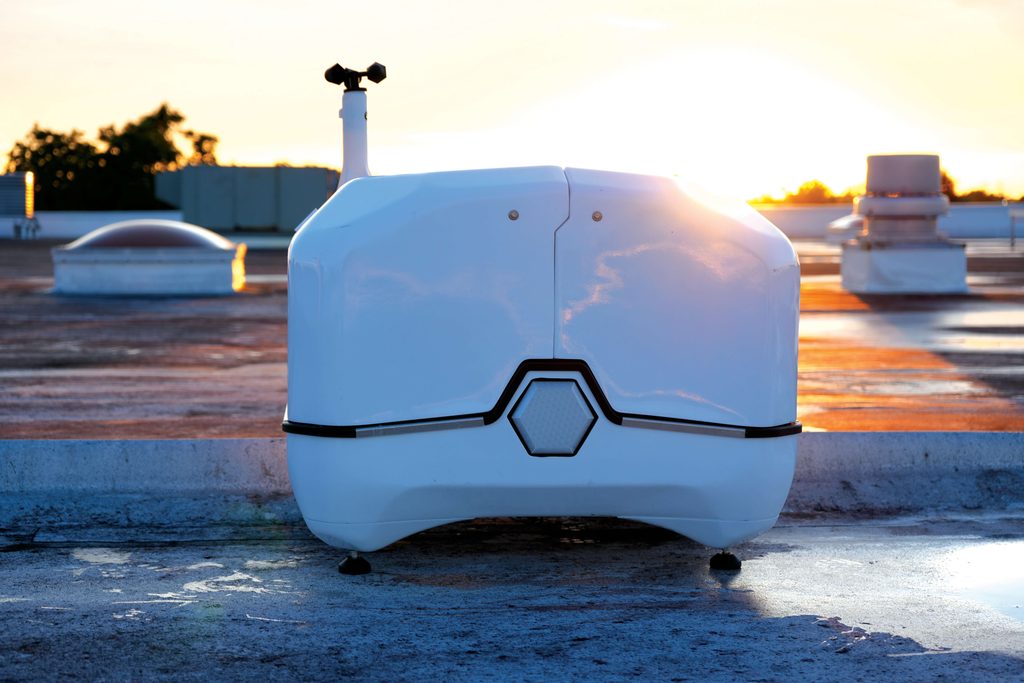
Luna is the centrepiece of the announcement: roughly the size of a checked airline bag, it recharges a depleted battery in 35 minutes, launches an aircraft in 20 seconds and tolerates landing in winds up to 12 m/s, all while operating across a wide ambient range of 14–114 F (-10 to 46 C). At 100 lbs and

31 x 27 x 23 in, the dock is compact enough for rooftop or remote-site deployment, and pairs a 400 W active cooling system with a backup UPS battery to keep operating through grid power loss, plus onboard edge compute for on-prem AI inference rather than cloud-dependent processing. “When the Luna and Helios come together, you get the Eclipse,” said Curtis Lary of Hextronics.
Helios flies for 50 minutes, covering up to 6.2 miles of range at speeds up to 60 mph, with a multi-band RTK GNSS receiver delivering centimetre-class positioning and a 3090 g maximum take-off weight. The aircraft carries either the standard Hadron 640 (a radiometric 640 thermal sensor paired with a 64-megapixel visible camera) or Hextronics’ own Trinity payload, adding a narrow, telephoto lens reaching up to 88x zoom. Both aircraft and dock are NDAA compliant.
The company is initially targeting solar and infrastructure customers. Across its installed fleet, Hextronics reports having completed roughly half a million total battery-swap cycles to date, with its systems collectively flying more than 500 missions per day.
Texas-based Nolvis released its M1 at the show, in a direct answer to full-size survey and inspection platforms like DJI’s Matrice 400. Built around an interchangeable payload architecture and a 45 minute flight time with payload attached, the M1 weighs under 8 lbs and folds into a single, ‘carry-on style’ case. The M1 lifts payloads up to 5.5 lbs, is NDAA compliant, and is built for field use, with RTK GNSS accuracy down to 1 cm, transmission range of up to 15 km with a directional antenna, wind resistance to 34 mph and an operating range of -10 to 50 C.
The payload architecture features the LR1, a 61 MP full-frame camera; the NV1, a 25x optical zoom with thermal imaging to 550 C and a 2.2 mile laser rangefinder; and the NL1, a Lidar with ±5 cm system accuracy and a scan rate of 2 million points per second, each swappable in seconds without tools or recalibration.
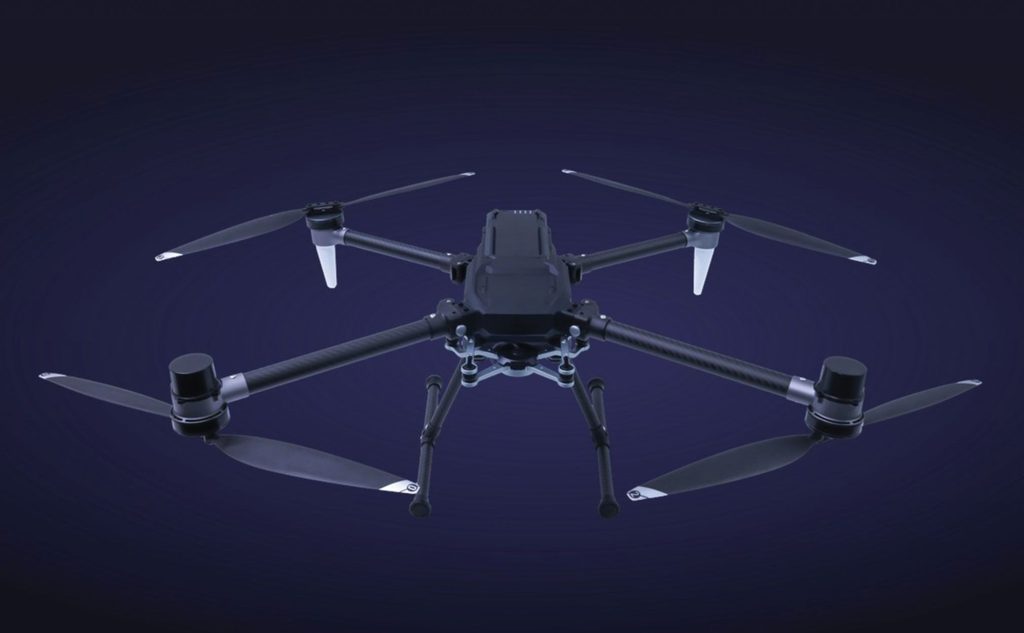
The standout achievement is packaging that lift capacity into a meaningfully smaller footprint than the class it’s competing against, at a lighter overall weight than comparable platforms. “The size is significantly smaller than other drones in its class,” said Bob Overton at Nolvis, “So it’s more portable.”
The M1 supports workflows with software such as Pix4D and DroneDeploy, alongside Nolvis’s own proprietary software stack, and the company expects to begin deliveries within about a month.
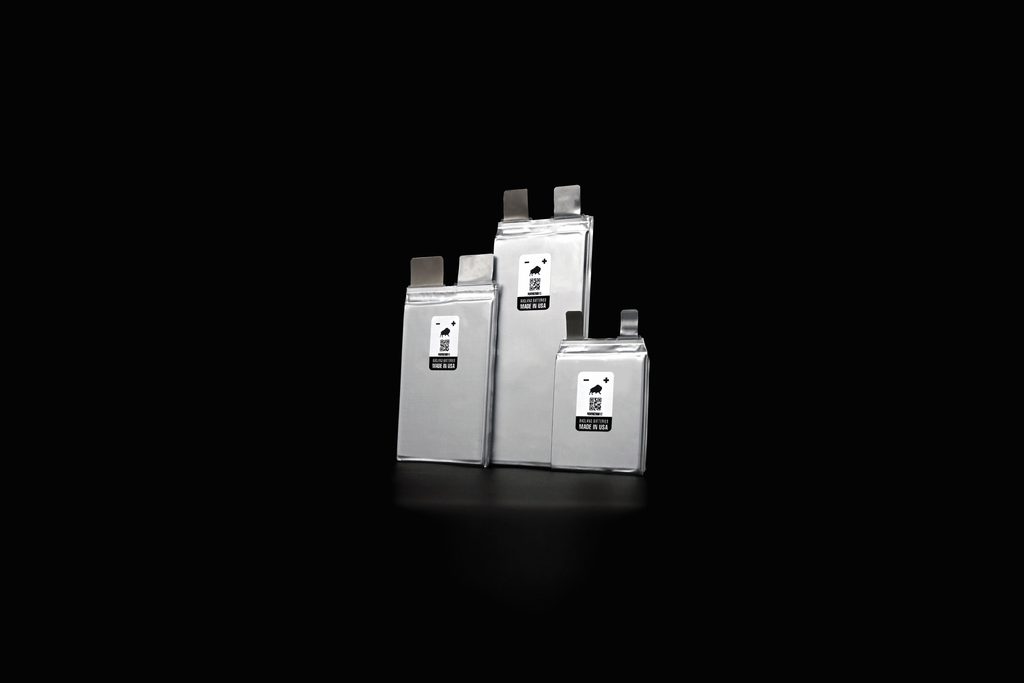

Badland Batteries is leveraging 20+ years of parent company Packet Digital’s experience building custom battery projects into an OTS product line, marking the company’s first appearance on the show floor with US-made cell and pack products that it can sell directly to end users.
Badland has a fully realised, primarily domestic-sourced supply chain of raw materials used for battery cell manufacturing. With the completion of its battery cell plant in Fargo (USA), the company will be able to take raw materials and manufacture battery cells at scale for its own OTS packs or supply cells for customers. The battery cell plant is set to come online this fall, with pilot runs beginning in October.
“We are a true end-to-end battery manufacturer,” Matt Sather at Badland Batteries said. “Where most companies do one piece of the battery puzzle, we are starting at the very beginning with non-FEOC materials to build these cells. Then, we can run them six blocks to our battery pack assembly facility where our team completes the assembly and pack testing prior to shipping to customers.”
Badland Batteries is offering a range of battery cells focusing on high discharge rates, high energy density and a combination of the two with its initial cell offerings. At the pack level, options from 17–30 Ah 6S and 12S packs are available now with more options coming soon.
Vulcan Metals Specialty Products is making the case for magnesium alloys as a direct replacement for aluminium and carbon fibre in structural drone components. Its primary alloys, AZ31B and Elektron 43, are strong alternatives for applications like gimbal housings, where mass reduction translates directly into usable payload capacity.
The density numbers make the case plainly: AZ31B comes in at 1.78 g/cm³ and Elektron 43 at 1.83 g/cm³, against 2.72 g/cm³ for 6061 aluminium – roughly a third lighter, consistent with magnesium’s overall density advantage over aluminium (and a 60% reduction versus titanium).
That weight saving does come with a stiffness trade-off worth noting for structural designers: the modulus of elasticity for both magnesium alloys is
44 GPa versus 68.9 GPa for 6061 – meaning lower absolute stiffness, although normalising for density narrows the gap considerably. Elektron 43, alloyed with 3.7–4.3% yttrium and 2.5–3.5% rare earths rather than AZ31B’s aluminium-zinc-manganese composition, trades a small amount of weight advantage for superior strength and improved heat resistance in demanding environments.
Magnesium’s ductility is the other differentiator: components tend to deform rather than shatter under stress, and cracked parts can be welded and repaired rather than discarded – an option carbon fibre composites don’t offer once damaged. “It’s very ductile, so it’s not easy to crack. If you do have a crack, it can be welded so it can be repaired,” said Max Lutes of Vulcan.
New York-based Modovolo is putting Lyten’s graphene-enhanced PA12 filament to perhaps its most demanding test yet: printing the primary structural components of an entire drone airframe – truss, folds and all – out of a single material, relying on the filament’s improved interlayer adhesion to survive loads that would delaminate conventional FDM nylon.
Modovolo’s current airframe, the Lift, splits the fuselage truss into printable quarters rather than a single continuous piece, so a damaged quarter can be replaced individually, and sections can be mirrored to double print throughput without wasting filament. The airframe also folds in half for compact storage. “The inner layer adhesion on this is amazing,” said Arion Mangio, who noted Modovolo was among Lyten’s first customers after a cold email to the company. Modovolo’s packs run unusually low discharge rates for a multi-rotor – as low as 1.1C–1.5C – owing to the aircraft’s lightweight structure and efficient propulsion system, and the company estimates two-hour-plus endurance could be achievable with a modest gimbal payload using newer battery chemistries shown at the event.
The team is now scaling up. A taller-format printer is in development to eventually produce individual airframe components as large as 36 in (0.9 m), and Modovolo recently competed in the DARPA heavy-lift challenge with a
30 motor, 12 ft (3.6 m) airframe built around domestically produced motors. The aircraft is built around a removable, bolt-in payload bay that decouples payload design from airframe design, allowing interchangeable payload modules to support different missions without redesigning the aircraft. Modovolo is also working on 3D-printed folding propellers – although printed geometry deviates slightly from design geometry under load, requiring compensation built into the print as the propellers progress through testing and qualification.
San Jose-based advanced materials company Lyten is aiming its decade-old 3D graphene platform at one of the drone industry’s more overlooked vulnerabilities: a battery supply chain that’s roughly 80% concentrated in China.
Lyten’s graphene substrate underpins a lithium-sulphur cell chemistry built from domestically available inputs – lithium, sulphur and natural gas – offering higher energy density and lower mass than conventional lithium-ion cells. “Lyten wants to help move the US over to a more domesticated supply chain,” Bryce Anzelmo of Lyten explained. The cells have already flown in a prototype aboard a Titan Dynamics drone roughly 17 months ago, and Lyten is scaling up production of its high-energy-density lithium-sulphur drone cells at multiple facilities in the US.
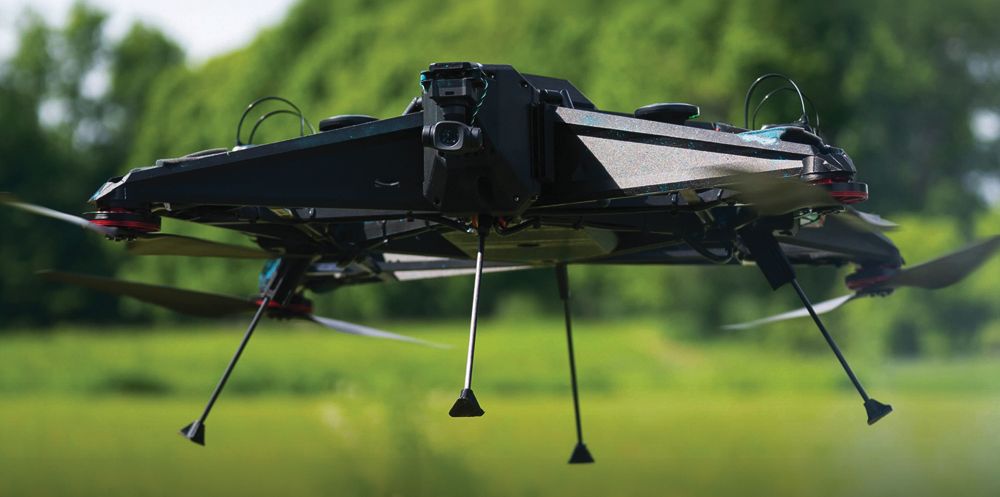

On the materials side, Lyten’s 3D-graphene-reinforced composite filament – a carbon-fibre-reinforced nylon-12 – was engineered to counter the Z-axis delamination that limits most fused deposition modelling (FDM)-printed structures, improving interlayer adhesion enough to make full structural airframes printable in one material. That filament is already in full production and forms the entire structure of the fully 3D-printed Modovolo drone. The company’s related high-temperature composite adhesive, reportedly among the highest-temperature-rated epoxies on the market, is also actively shipping.
U.S. battery manufacturer Upgrade Energy will launch its V5 battery packs this October, built on a new generation of higher-energy-density lithium-ion cells delivering approximately 20% more stored energy than the equivalent V4 configuration. The gains extend beyond the cells themselves: Upgrade Energy has redesigned the pack’s electrical architecture, increasing the main power leads from 12 to 10 AWG and roughly doubling the copper used in the conductive structure, reducing resistive losses and heating under high current draw.
For uncrewed aircraft, lower resistance means less stored energy lost as heat and less voltage sag during high-power manoeuvres, letting more of the cell’s power reach the propulsion system. On platforms where the battery represents roughly half the total take-off weight, Upgrade Energy expects around a 10% improvement in practical flight time over its previous generation of batteries, although actual gains will vary with aircraft configuration, propulsion efficiency and mission profile.
The company has also introduced a DC internal resistance test to evaluate each finished pack’s resistance under load before shipment to verify performance beyond component-level specs. V5 packs are assembled in Torrance, California, on a new production line built for tighter tolerances and higher-volume fleet deployments.
Phoenix LiDAR Systems’ focus this year centred on sensor bundling, pairing its miniRANGER-3 Lite, RANGER-Flex and RANGERU120 payloads – all NDAA compliant and included on the DIU’s Blue List – with similarly compliant aircraft.
Of the three, RANGER-Flex is the most operationally flexible. The payload can be flown on a UAV or mounted to a ground vehicle and driven at highway speeds. Phoenix combines the resulting datasets in its own processing software; in one example, the team flew over a bridge and separately drove on the bridge – because the aerial pass alone couldn’t capture the top support sections – then merged the two datasets into a single model. “The RANGER-Flex [has] become a staple for departments of transportation because of its multi-use capability and high pulse repetition rate,” said Raymond Akol. This year’s featured NDAA-compliant bundle pairs the miniRANGER-3 Lite and RANGER-Flex with the Harris Aerial H6E UAV.
Hitec used the show to demonstrate just how far its servo technology can be pushed into demanding, safety-critical applications – including a scale mock-up of the jet engine exhaust module from an F-35B stealth fighter, built around three servos capable of continuous, programmable rotation with full closed-loop feedback (position, temperature, rotation count and current draw) reported back to the flight controller.
Alongside it, the company showed a redundant servo architecture built around two fully independent motor/gearbox/signal/power paths on separate boards to a single output shaft, so that a failure in one motor or its CAN bus signal triggers an automatic failover to the second path. “It would automatically switch over to the other one,” Shawn Spiker of Hitec explained.
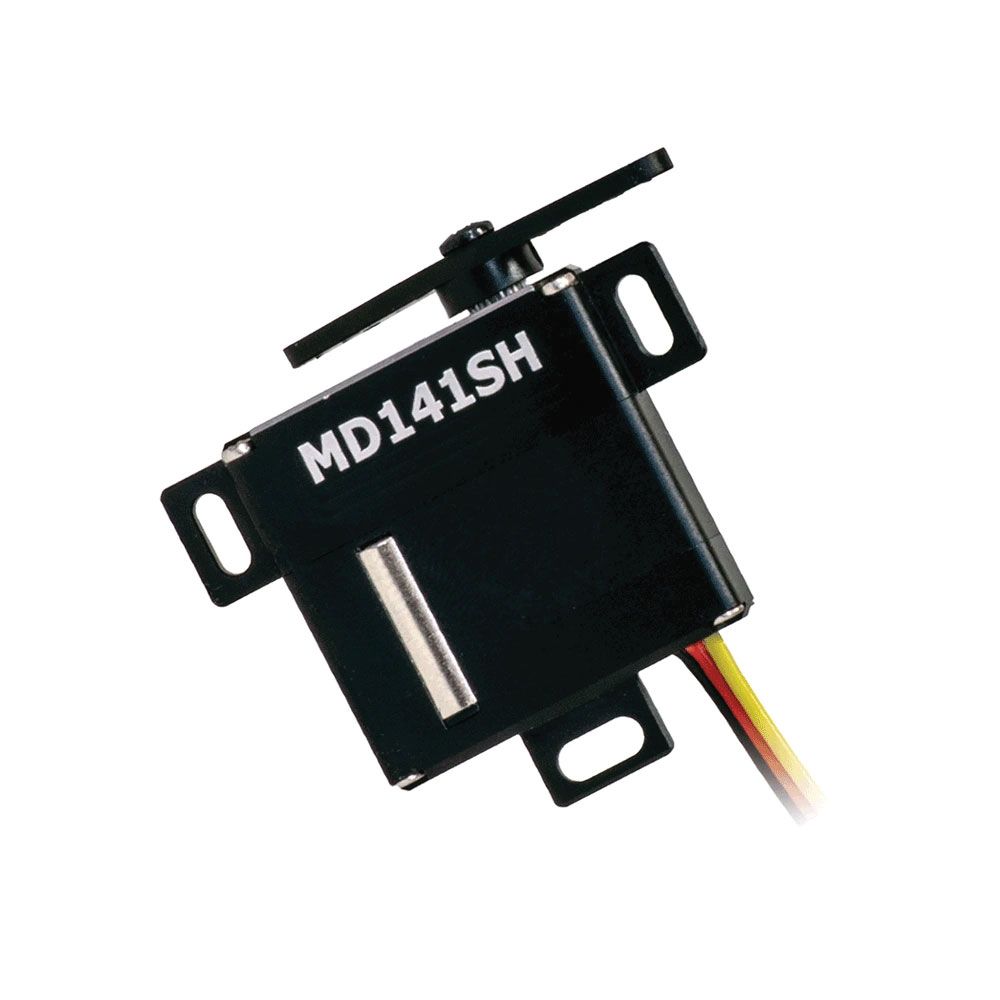
New to the lineup is the MD141SH CAN, a CAN-protocol version of one of Hitec’s smaller-form-factor servos that just began shipping, already selling at a run rate of roughly 50,000 units a year into one-way drone applications.

Ground control systems specialist NTI Systems offers COTS products alongside extensive platform customisation – every controller at its booth this year was configured differently for a different customer and mission.
“If you ask me: ‘Do you have a controller for me?’ I first need to know what specific task you need to accomplish,” said Alexy Mukadem of NTI Systems.

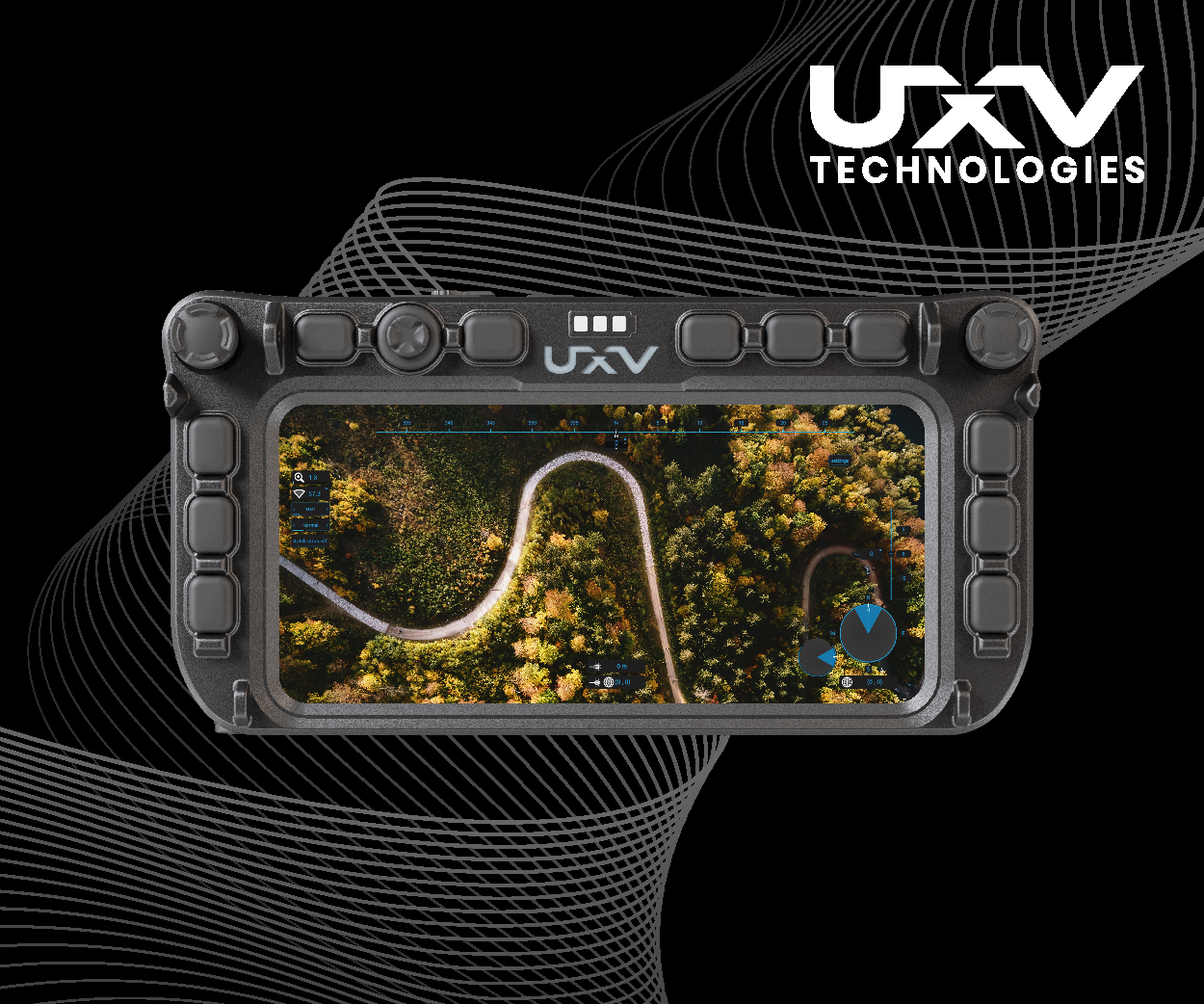
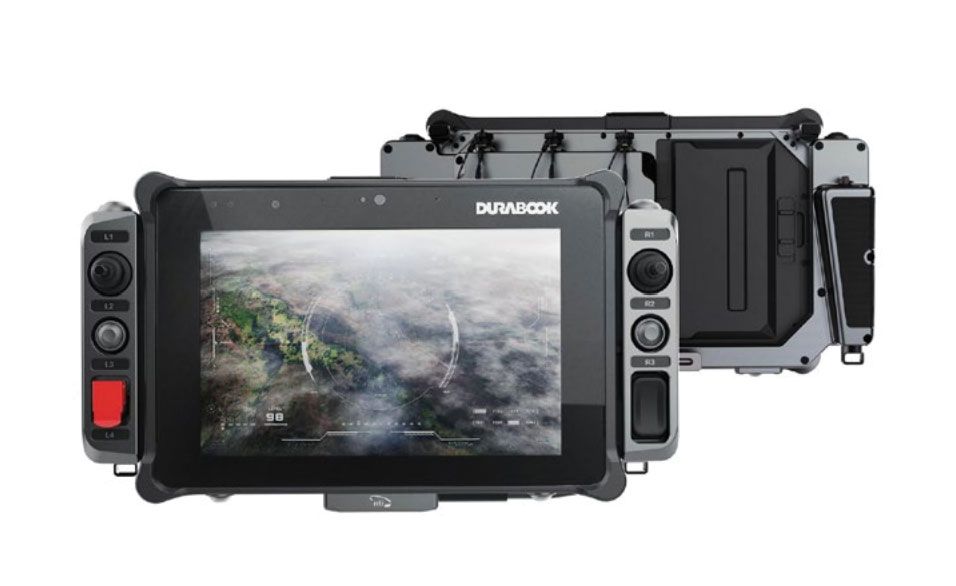
The standout new product is the Dragonfly ND-8 Flex, a rugged touchscreen GCS built around a Durabook R8 tablet running Windows OS, with an 8 in, 1280 x 800 capacitive multi-touch display rated to 800 nits for direct-sunlight readability. The control system offers a versatile interface: alongside the fully on-screen touch controls, dedicated hardware flanks the display, including dual 2-axis Hall-effect joysticks (offered in either spring-centred or friction-damped configurations), programmable push buttons and a 3-way mode switch. It sits alongside two newer, Android-based siblings in NTI’s compact lineup: the NS-8, built on the Samsung Galaxy Tab Active5, and the compact NX-7, based on the 6.6 in Galaxy XCover7 smartphone.
Ruggedisation meets MIL-STD-810/461 standards and IP66 ingress protection, while hardware security is handled through Intel vPro, a secured-core PC architecture, TPM 2.0 and NIST BIOS compliance – positioning the ND-8 platform for critical infrastructure and government use as much as high-demand commercial projects.
For third-party RF and datalink integration, NTI relies on its proprietary Enclosed Integration Kits. A purpose-built power architecture rounds out the system, with hot-swappable batteries and on-the-go charging designed to keep the unit running without a full reboot during prolonged field operations.
This was NTI’s first year exhibiting at the show.
Drone Rescue Systems has developed a plug-and-play parachute recovery system for Freefly’s Astro and Astro Max platforms, designed to integrate with minimal airframe modification: the unit mounts directly to the aircraft and connects to the flight controller via a single connector. The system is already MOC certified, with ASTM certification currently underway.

The recovery mechanism avoids pyrotechnic deployment in favour of a slingshot-based ejection system, which allows the parachute to be repacked and redeployed after use rather than requiring a full cartridge replacement. “It’s without pyrotechnics, it’s reusable – you can repack the chute after it’s been deployed, put it in again and you’re good to go,” Thomas Uberriegler at Drone Rescue Systems told us. A quick-lock mount lets operators dismount and stow the unit quickly for transport, and the system requires no external power cabling.
Drone Rescue Systems offers the same architecture, scaled up with a larger canopy, for Freefly’s Alta X, and will take on custom parachute development work for other platforms, order quantities permitting. Standard systems are available to order now, with a typical 25-business-day shipping window.
Network orchestration company TEAL Communications is tackling a connectivity problem that spans well beyond drones: keeping distributed autonomous devices reliably online no matter which mobile network operator covers their operating area. Its programmable SIM implements over-the-air carrier switching across roughly 3500 networks in 195 countries, letting a single hardware SKU serve customers globally rather than requiring region-specific carrier provisioning at manufacturing time.
This year’s newest addition is a bring-your-own-carrier option, letting customers fold an existing carrier relationship into TEAL’s orchestration layer. “If someone has their own carrier, they can just come with it and add on more to that,” said Willem Debray of TEAL, adding that the feature is already documented on the company’s website. TEAL already offers satellite connectivity today through MNO partners, and TEAL’s 6–12 month roadmap includes onboarding first-party satellite networks directly into the platform, thereby extending the same orchestration model to devices operating entirely outside terrestrial network coverage.
UPCOMING EVENTS