







Correcting underwater navigation
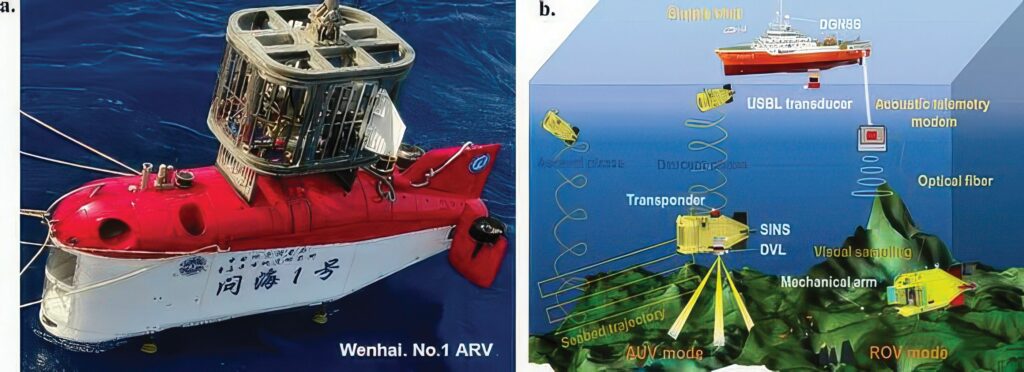
(Image: Qingdao Institute of Marine Geology)
Marine geologists have developed a real-time correction scheme that can improve the navigation of UUVs, writes Nick Flaherty.
Variations in the speed of sound in seawater often introduce systematic acoustic positioning errors, making underwater navigation difficult.
Navigation precision decreases with depth and distance owing to this non-uniform sound speed, which changes with temperature, salinity and pressure across time and depth. Pre-measured sound speed profiles serve as initial references, but long-endurance UUV missions experience temporal sound speed profile (SSP) drift, causing refraction-induced travel-time and angle errors that accumulate in navigational results.
Traditional correction relies on static conductivity–temperature–depth (CTD) profiler measurements or empirical models that fail to adapt to real-time conditions. Therefore, dynamic estimation of the acoustic speed variation is needed to compensate for the acoustic positioning distortion during deep-sea UUV missions.
So, the team at the Qingdao Institute of Marine Geology developed an SSP correction scheme to improve Strap-down Inertial Navigation System (SINS) and Ultra-Short Baseline (USBL) systems. The SSP uses acoustic ray-tracing theory to link sound speed disturbances to positioning deviations, and incorporates an adaptive two-stage information filter to estimate SSP variations while detecting USBL outliers in real time.
The work begins by analysing how a time-varying SSP affects USBL acoustic propagation, altering ray incident angles and travel time. Based on Snell’s law, the team derived partial differential relationships between sound-speed disturbance and horizontal/ vertical displacements.

The resulting model enables estimation of SSP perturbation through differences between SINS-derived and USBL-measured travel times. A two-order SSP disturbance representation separates the shallow-water mixed layer, the thermocline transition zone and the deep isothermal layer, reflecting realistic sound-speed distribution with depth.
To fuse the corrections with the navigation data, the Adaptive Two-stage Information filter combines SINS, Doppler velocity log, pressure gauge and USBL observations. The filter updates position, velocity and attitude errors while simultaneously detecting USBL anomalies through a generalised likelihood ratio test and refining the SSP estimation via recursive least squares.
Simulations using Moving Vessel Profiler-collected CTD datasets showed that, without SSP correction, USBL horizontal positioning errors reached several meters. With the proposed algorithm, the RMS error dropped markedly. Sea trials showed that the RMS position improved from 0.45 to 0.08 m northward and from 0.23 to 0.07 m eastward, boosting precision by over 80% under real mission conditions.
The real-time SSP reconstruction is crucial for addressing navigational drift in deep-sea acoustic systems. “Traditional navigation often depends on static sound speed profiles, which quickly become outdated during long missions. Our model integrates physical ray-tracing with adaptive filtering, enabling ARVs to sense and correct sound-speed changes rather than rely on fixed inputs,” said the researchers. This SSP correction framework provides a practical path toward self-adaptive deep-sea navigation systems. By reducing dependence on external CTD surveys and improving resilience to acoustic distortion, it enhances navigation
UPCOMING EVENTS