Bonded fasteners enhance aerostructure integrity
(Image: Click Bond)
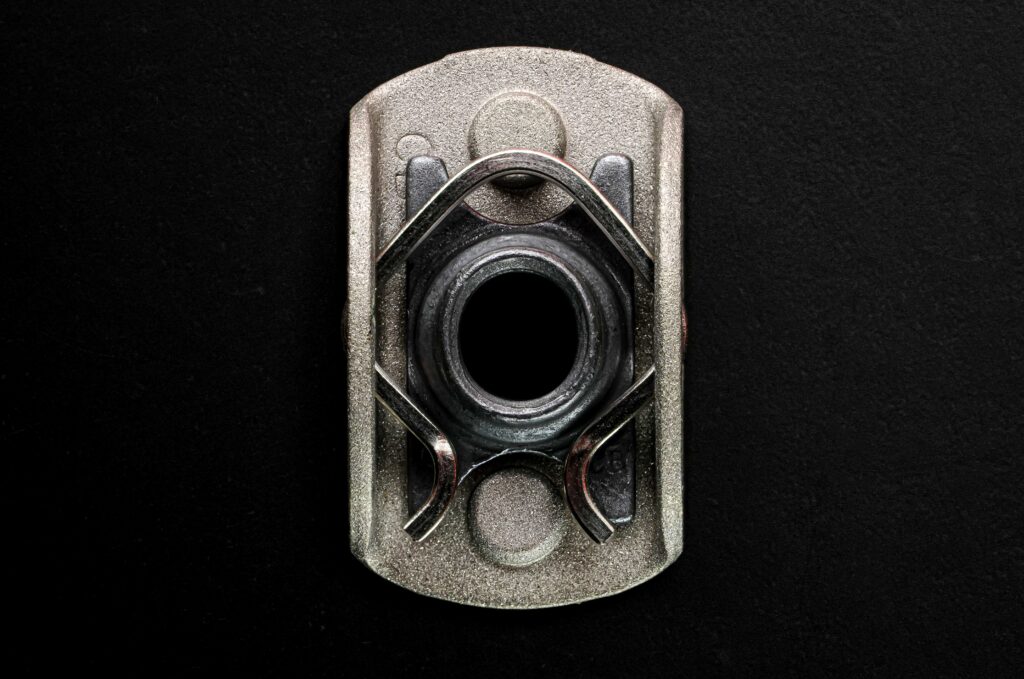
Click Bond is supplying a range of adhesive-bonded fasteners and fixtures to uncrewed and eVTOL customers, which yield a wide variety of advantages over traditional methods for panel attachment and harness routing in aerostructures.
Prominent examples of these atypical fastener solutions include bonded nutplates for enabling through-holes without needing rivets or similar mechanical retention, bonded studs for clamped attachments of wiring and tubing in place of through-bolt and nut combinations, and bonded standoffs for holding apart at specific distances two or more components (whether structural, electrical or electronic).
By saving considerably on engineers’ need for riveting or drilling into aerostructures (particularly internal ones like bulkheads, spars and ribs) to create fittings, adhesive-bonded fasteners preserve structural integrity as cable harnesses and fluid lines are added and routed. Additionally, by eliminating the onerous planning required for mechanically bonded fasteners (because holes cannot be undrilled), aircraft designs and subsystem architectures can change and evolve organically, be removed or replaced when needed, and keep bulkheads intact all the while.
“As adhesive-bonded fasteners spread the load over the entire panel, they don’t significantly interact with structures’ load-bearing, vibrational or other properties. Engineers can use them to route lines wherever it makes the most sense for volume efficiency and serviceability,” says Bill Perez, senior product application & strategy manager and mechanical engineer at Click Bond. “They can attach to bulkheads that cannot be put at risk due to structural concerns, as we’ve seen with one eVTOL customer, who used a bulkhead behind the pilot to mount control systems and harnesses.
“And by making that switch, aircraft constructors can consequently switch to thinner, higher-performance materials because they no longer have to account for any holes they’ll be drilling into their aerostructures.”
These adhesive-bonded fasteners have also been validated through 30-day hot-wet tests, in which they survived simulations of 30 years of performance, and the company notes that they exhibit better long-term corrosion resistance than conventional cadmium-treated (or otherwise coated) carbon steel fasteners – the latter often corroding five to 15 years after first deployment. To address the potential errors engineers may face when switching from traditional construction components to these newer bonded systems, it has developed a wide range of tools for bond line verification, to ensure proper surface preparation for optimal bonding and XR-guided installation, so that engineers can close the loop in ensuring proper application of adhesive-bonded fasteners. Additionally, a broad global network of technical consultants shares a mandate to guide customers’ product selections and installations correctly.
“Our products are distributed by partners all across the Americas, Europe, Asia, Africa and Oceania, whether for a prototype UAS or something manufactured at scale for fleets, and these specialists provide guidance throughout the entire product life cycle,” Perez notes.
UPCOMING EVENTS