









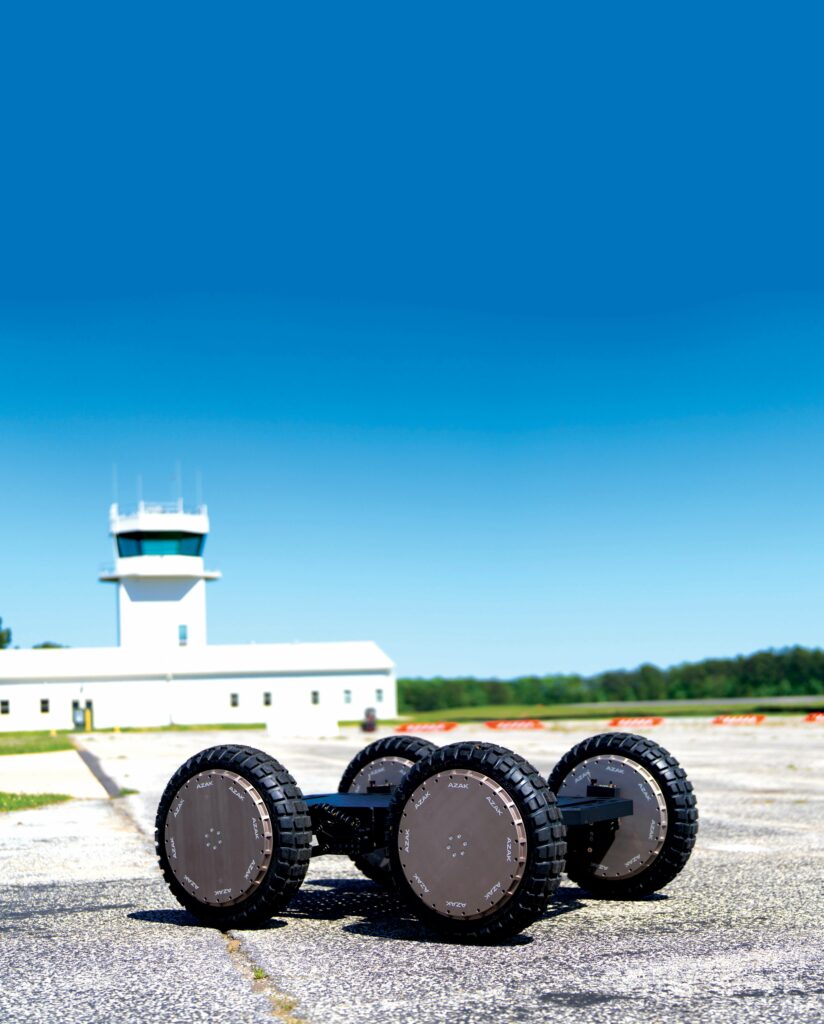
AZAK S26
(All images: AZAK)
Team torque
Rory Jackson learns about how UGV operations may be revolutionised through one company’s self-propelling wheel technology
As long as ground vehicles have existed, a very particular issue of engineering and physics has posed a conundrum to numerous off-road mobility applications, affecting designers of defence, mining and construction vehicles (as well as those across a few categories of logistics and motorsport).
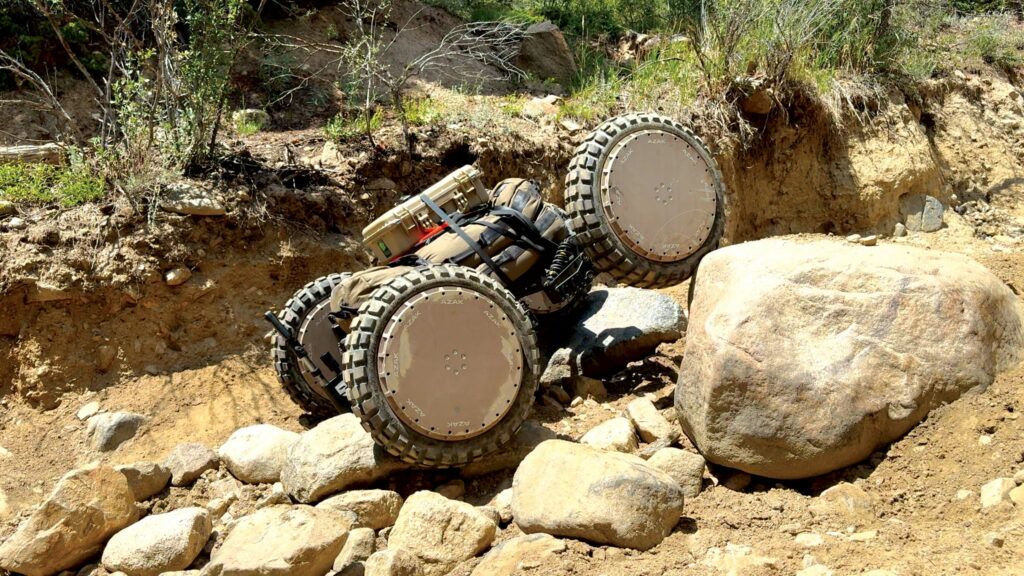
Specifically: the ability to clamber over ground obstacles like rocks, debris or bumps requires a vehicle with high ground clearance, but conversely, to have any sort of agility (for manoeuvres such as moderately sharp turns), that vehicle must instead be built for a low centre-of-gravity (CoG) and hence, have a body lying low and close to the ground.
Consequently, it is borderline impossible to find a vehicle with both excellent climbing and cornering capabilities. To illustrate this, Ben Meager, CEO at AZAK, Inc. posits to us: “Picture how a Formula One car moves, and you have a great example of an incredible cornering ability, thanks in particular to its low CoG – but it can’t climb over anything.
“Contrast that with, say, a monster truck, as the opposite example. It has an incredible climbing capability, but as soon as you turn a corner even somewhat tightly, that whole vehicle is on its side.”
Meager was determined in the 2010s to design a vehicle that could corner and climb with equally high proficiency. Although a long-time inventor, he confesses to us that his initial attempt at a solution was by no means an original invention.
“It was a ball vehicle, or a pendulum vehicle as some call it; much like the BB-8 robot from the newer Star Wars films. It’s an established type of hollow vehicle design, in which a heavy pendulum hangs in the bottom of a ball or wheel,” he explains.
“As you attempt to propel that pendulum forwards, gravity takes over to hold that pendulum toward the ground and, in turn, the wheel spins around that pendulum. I designed such a pendulum vehicle, went to my patent team, and they gave me a very large stack of prior art indicating that I was very far from the first to invent this thing.
“But that perplexed me. Why weren’t pendulum vehicles out there being used for industry or defence?”
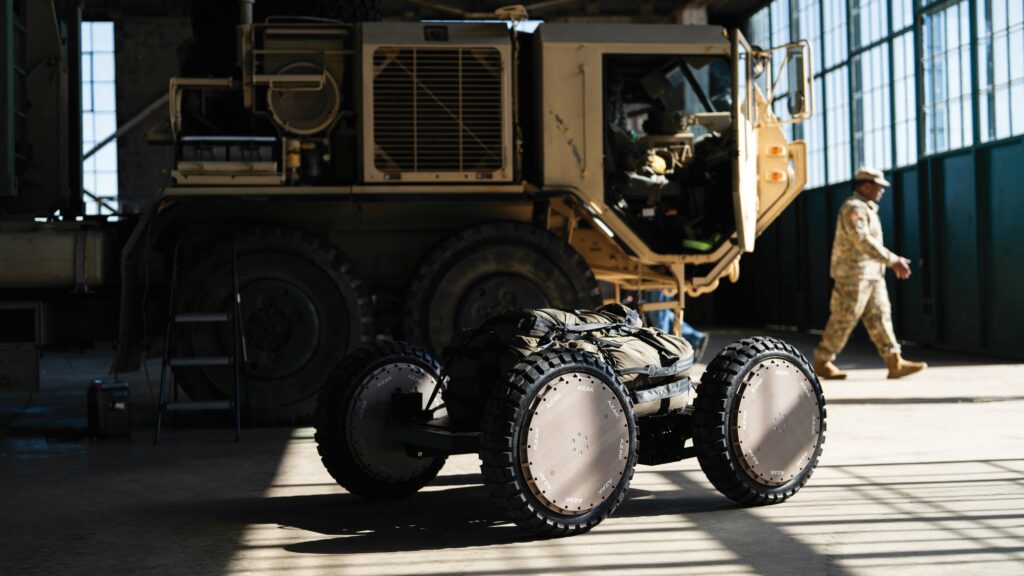
A core physics barrier is that Earth’s gravity is only so strong: if a ball robot accelerates or climbs a large object (or otherwise manoeuvres) too quickly, the interior pendulum will inevitably rotate, rendering the vehicle ineffective.
“Our solution to that problem is built into our AZAK wheels: a proprietary mechanism grabs hold of our pendulum, locks it to a frame, and thus locks the pendulum into the ideal orientation for maintaining a very low CoG inside each wheel, preventing the need for a low floor to achieve a low CoG,” Meager explains.
As a result, the company offers its eponymous wheels as quickly installable devices around quite literally any sort of frame – including metal mounting frames, trays or even tree logs (as the company has proven in trials) – to whip up a highly agile and capable UGV out of nowhere.
“You can throw as much power to the ground as each wheel is capable of, and all the pendulums stay in their proper orientation, whether you have a vehicle with four, six, eight or more wheels,” Meager says.
As of writing, AZAK has unveiled its first product, the S26, so-named for its 26 in (66 cm) diameter, while being 20.3 cm wide and 39 kg in weight, and able to produce up to 147 lb-ft (199.3 Nm) of torque.
With the high torque and low CoG of each wheel, AZAK vehicles are capable of hauling considerable weight; the S26 is rated such that 1500 lb (680.39 kg) of payload can be carried on a four-wheeled AZAK UGV.

Each wheel integrates a motor for traction, as well as a gearbox, motor-inverter and battery, along with other components to enable its propulsion and its use as a turnkey system. While each individual wheel is not yet equipped with an autonomy stack or computer to enable its own self-driven operation, AZAK wheels have repeatedly been quickly cobbled together into fully functional UGVs in varying scenarios – and each wheel does carry a wireless communications receiver for remote operation, both for hands-on use as an independent ball robot, or for group operations as an autonomous or automated UGV, depending on which is paramount to the end user.
Holding sway
Following the development and unveiling of a prototype wheel, described by Meager as being far skinnier than the present-day S26, numerous groups and individuals approached Meager to buy his patents (of which 16 currently protect the AZAK technology).
After presenting a newer, larger wheel prototype, around 30 in (76.2 cm) in diameter, AZAK was connected to a US Special Forces group. That spurred significant military interest, the consequence being that that market is the present-day focus of AZAK’s business and demonstration activities (although defence does not represent the only or majority use-case the company is passionate about).
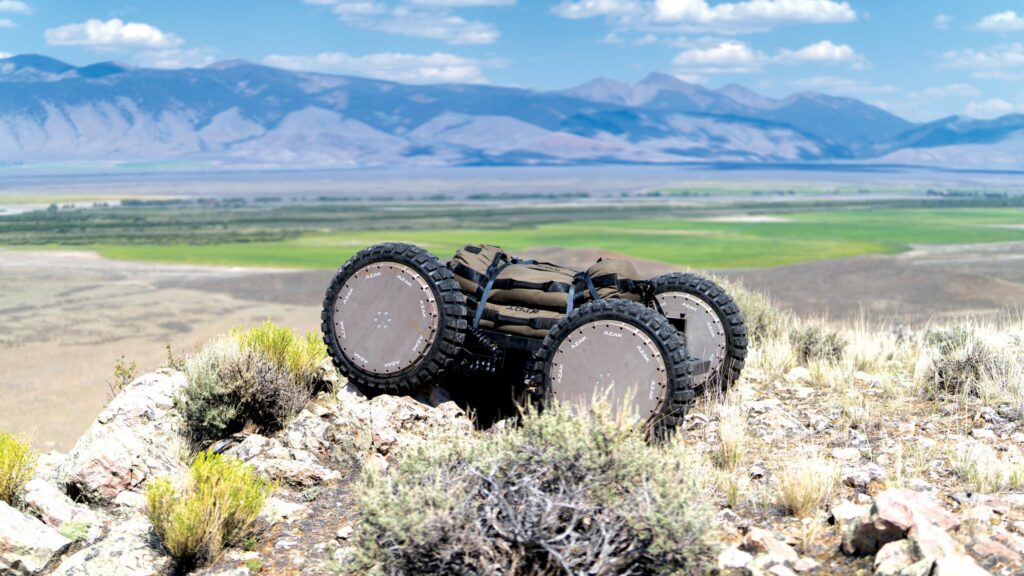
“Around the same time, we brought in former SpaceX engineer Evan Mucasey, a really brilliant individual who is now our CTO. We were working to upgrade the motors and powertrains in our then-S30 wheel and, long story short, we had a failure in our newly selected motor we’d been specifying for the next-generation S30,” Meager recounts.
“Evan pushed for a ground-up redesign: keeping the base structure the same, but looking at a new motor, gearbox, motor controller and battery.”
Three-and-a-half months later, the revamped S26 wheel showed torque figures over 10 times that of its predecessor (along with improved durability) in real-world tests in the mountains near AZAK’s Colorado headquarters.
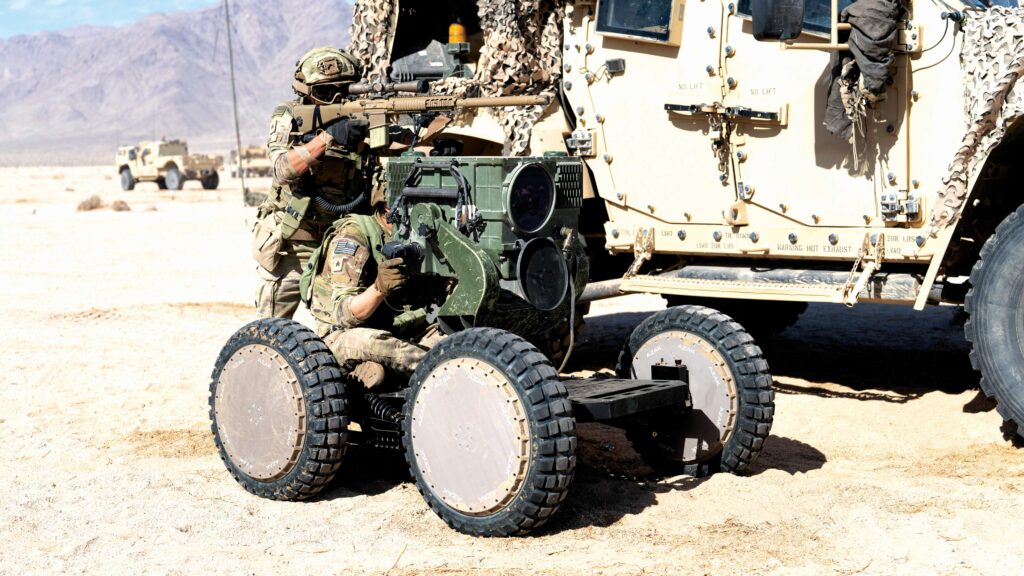
While the wheels could be used on any vehicle, crewed or uncrewed, the company’s primary focus to date has been catering to the needs of the US DoW (particularly since it anticipates AZAK vehicles’ performance and logistical capabilities enabling many of the department’s ambitions, without the traditional drawbacks associated with electrification), a major proponent of uncrewed systems, much like other defence ministries.
“Our combined climbing, cornering and payload capacity means we can get vehicles and equipment to places that other ground vehicles can’t, and in quantities and turnaround times that air vehicles struggle to match – particularly if we operate in an uncrewed way or function uncrewed to serve as a force multiplier,” Meager says.
Wheels on tight
An example of an obvious scenario for AZAK’s use could be a team of soldiers amidst difficult terrain, in sudden need of a mule UGV for carrying their packs or other cargo. Alternatively, they might already have a large, heavy mule UGV, and need to take parts off of it to create a second, rudimentary vehicle for transporting a casualty back to their frontline base. And as a further example, such a base might need to transport a medkit, generator or specialised weapon at short notice to a remotely operating team via similarly difficult terrain.
In either case, four or more wheels would need to be quickly assembled into a UGV. To facilitate this, AZAK, Inc. has patented what it calls ‘QuickConnect’ technology, which the company favours over standard mounting brackets, particularly as a means of enabling fast assembly of UGVs without the use of screws, bolts or tools being absolutely necessary (given the propensity of these items to be dropped, lost or broken if handled in a hurried fashion).
“It takes literally a couple of seconds to put on a wheel, all by hand, no tools required: the QuickConnect is composed of two simple latch halves, one side of which has a large geometric feature that allows it to hook into the wheel very easily,” Meager says.
“Even if it’s not perfectly aligned, it’ll essentially line itself up. Each latch half fits together, one with a positive shape and the other with a matching negative form, resembling in some ways an upside-down pyramid.”
As the positive and negative forms fit together, they tighten and form an interference fit, ensuring correct alignment by their geometries, and then two latches (one on either end of the wheel-side half of the QuickConnect) click over hooks on the frame-side half, enabling the wheel to be snap-fitted into place. The whole process as mentioned takes 2–3 seconds, and so four wheels can be attached to a frame in under a minute.
Dogs to a sled
The next step in setting up an AZAK vehicle naturally consists of enabling some form of unified, synchronised control (not of charging because, operationally, the batteries inside each wheel ought to be precharged before deployment). Without provision for this, none of the wheels would be capable of knowing their position about the frame (such as front-left, rear-right and so on) and hence, their optimal speed, acceleration, power and torque targets for a given vehicle manoeuvre would be a mystery to them.
“But all the vehicles shown in our demonstrations and videos throughout 2025 don’t actually communicate between the wheels as one might think,” Meager notes.
“What’s actually happening is that each wheel has its own integrated, wireless device – which comes mounted in a box on top of the QuickConnect hardware we just talked about – and each of those receives a separate signal from a wireless transmitter. Those signals are converted into CAN messages and those simple messages tell each individual wheel what to do.”
Through this top-down arrangement, the wheels do not transmit and receive telemetry or commands among each other and, as of yet, there is no need for such a swarm-like network among the wheels. The company’s preferred in-house analogy is that of a sled pulled by dogs: through the transmitter, individual signals are sent to all four wheels, corresponding to speeds, accelerations and turning angles.
In the upcoming 2.0 generation AZAK wheels, all wheels will operate on the same CAN bus and those messages will all be handled by a central controller on the frame.
“We want to make it really easy to achieve whatever level of autonomous control the end user wants, in whatever way they like, regardless of whether the end user is DoW, MoD or a commercial entity,” Meager says.
“To that end, our QuickConnects will take in wireless telemetry, from any kind of military or other radio they need to be configured to work with. And that radio can connect to and take signals from our own handheld controller or a similar one, or from a system running ATAK [Android Team Awareness Kit], or an autonomy computer. The QuickConnect will then translate this into a CAN bus signal for the wheels, providing precise commands.”
Earlier trials and demonstrations of AZAK vehicles have utilised wireless remote control more than autonomy, but Meager notes that the system is logistically easiest to operate from a central brain with physical CAN interfaces, as well as enough processing power to enable precise monitoring of telemetry from each wheel and compensate accordingly for smooth traction control.

“If you can put real-time feedback from all wheels into a single computer, it’ll be able to do things like detecting slippage in a given quadrant, and responding with increased power into that corner, or pulling more power at the front in response to detected understeer,” he explains.
“So, most of the demonstration frames with our Gen 2.0 wheels will likely integrate a central controller that wires directly into the wheels, and is configured for running ATAK, as well as interfacing with any military radio and autonomy kit. We’ve demonstrated strong traction control so far, but it’ll only get better when we have independent, intelligent control of each wheel, being formulated inside a central controller.”
Interoperability
The company’s aforementioned controller is referred to as SHUI (Single-Handed User Interface), and is designed to fit into one hand and thus maximise ease of use over extended durations.
Originally, the AZAK team configured its embedded software for compatibility with ATAK and thus any GCS running that standard. However, the early special forces users observed that the AZAK wheels could be operated continuously for up to 30 hours at a time.
“No-one wants to be stuck with a carry-case, tablet or chest-strapped GCS in rugged terrain for 30 hours at a time; they knew that would be very uncomfortable and impractical,” Meager says. “What they needed, in those initial trials, was something small, lightweight and simple for delivering manual commands.”
Hence, SHUI fits into one hand, and is designed to be intuitive and easy to use. It features a trigger that toggles either forwards or backwards for simplified continuous motion, with an additional joystick for steering in the instances where that matters, as well as a deadman lever toggled via the lower fingers such that no accidental vehicle command can be triggered if, for instance, the controller is dropped onto the ground.
As crucial as autonomy is to getting the most out of the AZAK wheels and vehicles, the company plans to offer SHUI with every delivered unit, to cover myriad edge cases where remote manual control will be necessary (such as clusters of trees and rocks oriented in such a way that whichever autonomy system is integrated is unable to compute the best way out). To make such extrications easier, an additional device, tethered to SHUI and worn on the body, features a button for flipping the vehicle’s sense of direction (as defined in the QuickConnects) by 180°. SHUI also integrates a connector for tethering to the end user’s choice of battery, radio and control interface.
“And we’re now going into SHUI 2.0, which is still going to fit in a single hand, but it’ll integrate its own radio, and even a screen on top for displaying the operator’s choice of telemetry, like the battery capacity per wheel, distance travelled, speed, temperature data or error codes if something like that occurs,” Meager says.
“It’ll still need tethering to a battery, but it can flexibly take power from any number of different batteries, for instance a tiny or large battery depending on the duration of your use-case. You can alternatively plug it into the vehicle’s batteries, which also switches off the radio. This will allow the vehicle to be driven tethered in order to avoid detection.”
AZAK’s ATAK app is also near completion, which will enable compatibility for SHUI and any other ATAK-compliant GCS to monitor, program and control AZAK vehicles. The company plans to integrate any and all successful third-party GCSs, and has already worked with multiple autonomy computer suppliers to self-drive AZAK vehicles using their systems (and continues to work with additional such companies).
“We will also be incorporating our own cameras and other sensors on certain frames to demonstrate and trial key forms of autonomous operation, and port the results through to ATAK – given that our central ‘body’ is in most instances just an empty metal frame, with no main battery or drivetrain taking up space, mounting and positioning is really easy for us,” Meager adds.
Maintenance
While the present-day versions of the AZAK wheels are largely closed systems, meaning units must be sent back to AZAK when needing checks or repairs, upcoming versions will be distinctly more open to enable in-field maintenance and fixing.
“We have plans to design and offer that capability; we’re just still a small company, so we need the production infrastructure first,” Meager says.
“It won’t be difficult because all of our internal components already mount and integrate inside the S26 wheel in a very plug-and-play way. Even the motor can currently get swapped in and out without much confusion or training on the part of our technicians; we just need to create the infrastructure to allow this for our end users as well.”
The battery packs, in particular, are anticipated as the most likely subsystem to need replacement for reaching the end of their lifespan, and AZAK has already created simple connections and features to simplify this process.
“We really don’t want to limit who can repair our systems,” he comments. “We feel repairing AZAK wheels in the field is an absolutely essential capability to provide our customers; it’s not reasonable to tell customers that a wheel has to come back to us to be repaired.”
In a broader view over vehicle maintenance, the company sees considerable advantages of AZAK vehicles over industrial vehicles with traditional powertrains, particularly for mining and construction. Large trucks will take considerable time to refuel or recharge, but as each AZAK wheel is a self-propelled, self-powered system, AZAK has designed a unique approach to solving this.
“Especially in an electrified world, our approach avoids the need for rapid charging and degradation of battery lifespans; a heavy frame can be easily lifted off a set of AZAK wheels, and those wheels can drive themselves into charging bays and be replaced by fully charged AZAK wheels in seconds.” Meager says.
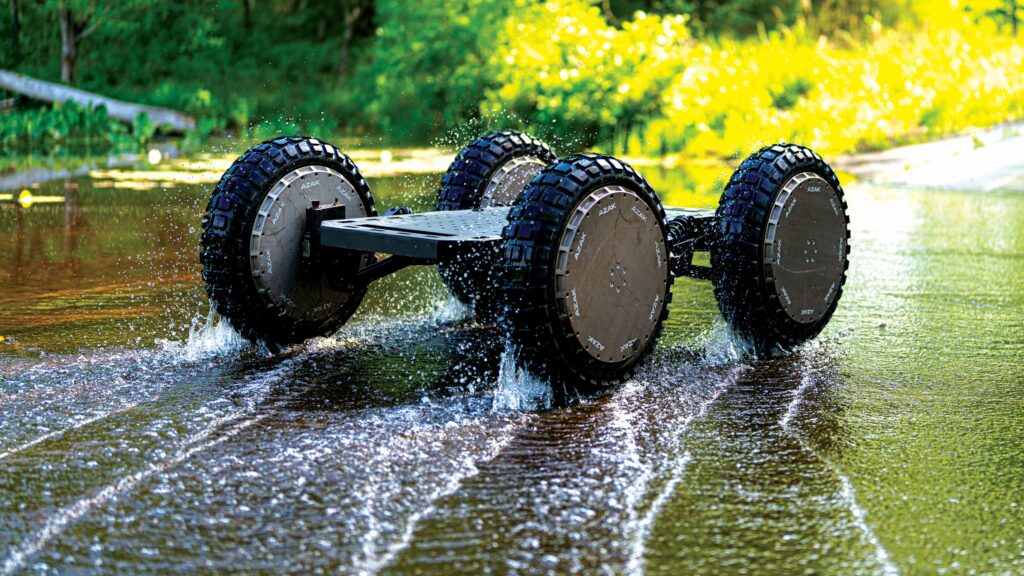
“We have videos proving that our wheels can handle rocky and water-rich environments, so we’re very excited about showing our abilities in those kinds of commercial industries and others beyond defence as well.”
Future
In addition to working on the latest generations of its wheels and handheld controllers, AZAK continues to refine and optimise its software layers to make integration of autonomy computers for varying levels of self-driving intelligence as straightforward an affair as possible.
“We honestly believe it’s already easier to integrate into our UGVs than most others of any configuration because of how unique AZAK is; the differential steering keeps controls very simple and each wheel functions independently,” Meager says.
“We’re especially excited to start working with systems for GNSS-denied operations, and other new innovations that will give us the chance to show off our control flexibility. Having great torque, carrying capacity and manoeuvrability is all very good; the user side convenience will come across better still.”
Key specifications
AZAK S26
IP67 protection rating
Height: 26 in (66 cm)
Width: 8 in (20.3 cm)
Weight: 94 lb (42 kg)
Maximum speed: 12 mph (19.3 kph)
Maximum torque: 147 lb-ft (199.3 Nm)
Four-wheel torque: 588 lb-ft (797.22 Nm)
Operating payload per 4-wheeled system: 1500 lb (680.39 kg)
Range: 60 mi (96.56 km)
Jump capability: 36,000 ft (10,973 m)
Charging time: 1.5 hrs
Time to install/replace: 3 s
UPCOMING EVENTS