



Autonomous space launch system
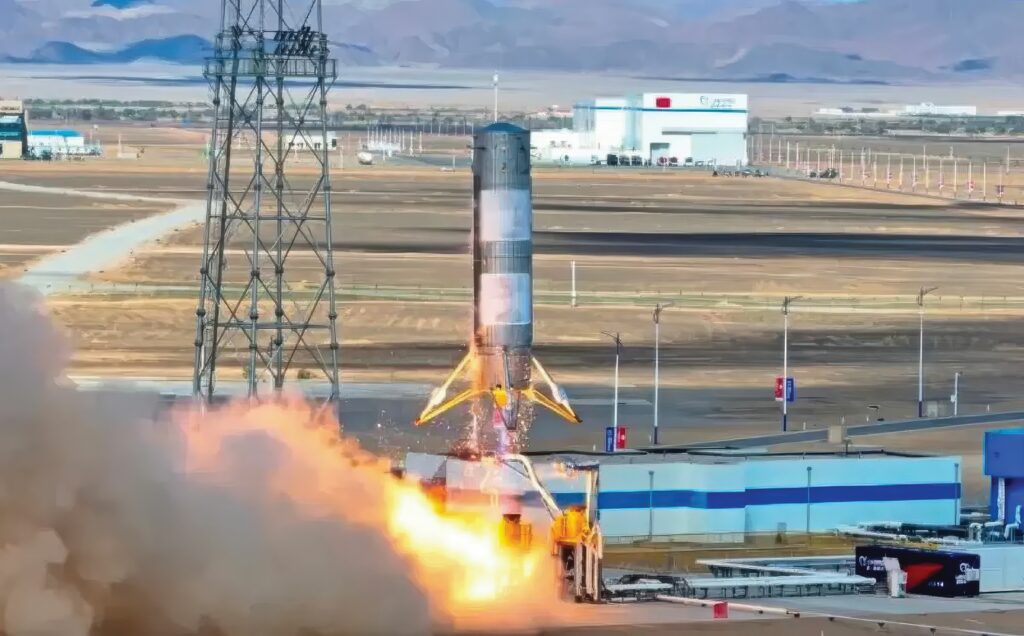
(Image: LandSpace)
Researchers in China are building an intelligent space transportation system for autonomous reusable launch vehicles that can be relaunched in as little as an hour, writes Nick Flaherty.
The AI-enabled system includes smart test launches, high-reliability flight, agile maintenance assessment and efficient operation control. This aims to achieve test, inspection and decision-making for large launch vehicles at the hour level. By integrating Return-to-Launch-Site (RTLS) technology, the system will enable hour-level relaunches after recovery.
The autonomous fault location system can detect problems in a matter of minutes and the flight reliability will improve by 10 to 100 times, said the researchers at the China Academy of Launch Vehicle Technology in Beijing, as well as boosting the lifespan of the launch vehicles.
To do this, AI enables agile testing and launch preparation. Issues such as difficulty in fault location, low safety in fault isolation, and long fault handling time may arise if a fault occurs before launch. Machine vision, large language models and data mining can be used to improve the efficiency of testing and launch control. Through intelligent, uncrewed operations in testing, launch and prelaunch fault handling, autonomous launches can be achieved, with the ability to assemble and launch within hours. Historical data can help with autonomous fault location and prediction, significantly reducing the time required to resolve faults.
AI also enables significantly improved flight reliability. The launch vehicle flies through complex flight environments during access to space, experiencing different space domains and speed regimes, with various types of actuators that are prone to failures. Avoiding rocket failure mainly relies on hardware redundancy and prelaunch contingency plans, with limited autonomous capabilities that cannot address more severe fault situations. AI technologies such as fault Bayesian probability graphs, deep learning and random forests can be used to enhance the core functions of fault diagnosis, autonomous capability assessment, decision-making and execution for launch vehicles. This would enable launch vehicles to autonomously handle unexpected events, achieving autonomous decision-making and mission replanning within several seconds in case of non-fatal faults.
The various stages of a reusable launch vehicle undergo complex and harsh aerodynamic and thermal environments during ascent and re-entry. After returning, rapid and precise detection, as well as accurate assessment of the vehicle’s health status, are necessary to ensure reliable and swift relaunch evaluations. The agile maintenance capabilities of the rocket body after multiple reuses and the relaunch release criteria still need to be established. Multidimensional sensing data collected from high-precision sensor networks, along with intelligent algorithms such as deep learning and data mining, can be used to dynamically monitor and analyse the rocket’s health status, improving the real-time processing of data, and enabling precise health assessments and lifespan predictions.
Based on this, semantic understanding and knowledge graph reasoning capabilities of vertical large models can be applied to quickly generate maintenance plans and support decision-making, facilitating rapid relaunch readiness. Deep learning and clustering analysis can be used to enable integrated navigation and communication between space and ground, Internet of Things, and sensor networks.
UPCOMING EVENTS