








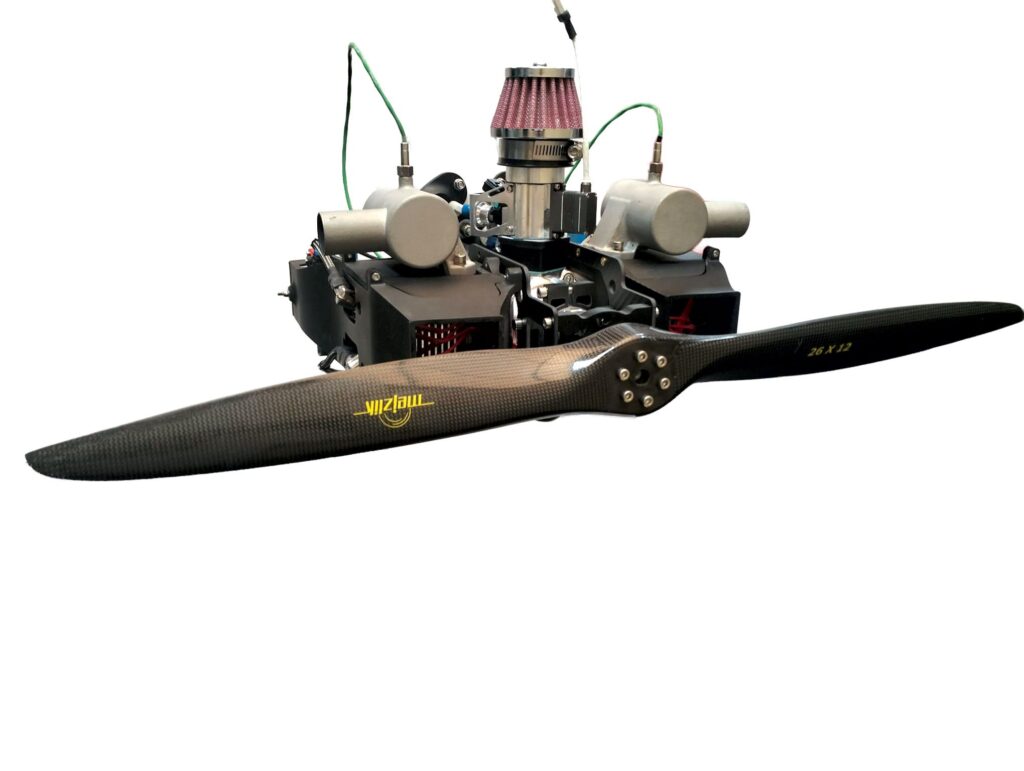
Alpha Unmanned Systems B100HF heavy fuel engine
(All images: Alpha Unmanned Systems)
Rethinking heavy
Rory Jackson investigates a low-cost, low-maintenance, heavy fuel engine developed by an established helicopter UAV manufacturer and operator
It was around eight years ago, in UNC-20 (Jun/Jul 2018), that we unpacked the Alpha 800 (or A800) helicopter UAV from Alpha Unmanned Systems. Since then, the Spanish company has not only gone on to develop that aircraft into the next-generation, higher-performance A900 UAV, but also honed its in-house experience and competencies across the various components of industrial-grade UAS into a portfolio of high-end products.
The latest of these to become commercially available, as of writing, is Alpha Unmanned’s B100HF, a spark-ignited two-cylinder two stroke based on the Desert Aircraft DA-100, but heavily modified from the original solution’s design in order to (among other key objectives) achieve stable operations while running on heavy fuels, which is a critical requirement for defence industry integrators and many other high-end clients, as readers will be all too aware.
As Álvaro Escarpenter, CTO and COO at Alpha Unmanned recounts to us, “We designed the Alpha 900 primarily for the maritime surveillance market, which we see as still being a niche with much less supply than demand, but we knew going in that we’d need some kind of heavy fuel conversion for the power plant.
“We researched the available heavy fuel engines for UAVs, but most of them were a little more expensive than what we were looking to work with: around €75,000 on average per complete power plant system. And, by and large, they were engines meant for fixed-wing integrations, not yet suitable for working on helicopters without a lot of in-house changes, like forced cooling to compensate for the fact that we’re not flying into the wind at 90 kph.
“So, given that we’d have to do some in-house modifications no matter what, we opted instead to order a DA design from the US and explore ways of converting it to heavy fuel by ourselves.”
The end result, after roughly seven years of R&D, including five years of operation and maturation on the A900 UAV (and in a testing cell configuration co-developed with the Universidad Politécnica de Madrid [UPM]), is a 2.8 kg engine displacing 100 cc, which – when running on Jet A1 – outputs 2.8 kW (3.75 hp) operating power at 6000 rpm and 30% throttle, up to a maximum of 4.5 kW (6 hp) at 7000 rpm. As of writing, the engine has also been validated for operations on JP5, JP8, Avgas and standard gasoline.
A variety of engineering innovations have ensured that the engine can run reliably on heavy fuels without needing an air-assisted rail or other direct injection (DI) technologies, and without incurring any of the myriad problems that heavy fuels can cause for insufficiently mature conversion jobs.
The company was happy to delve into those innovations with us, to explain in detail how it has managed to unlock heavy fuel UAV power in a simple, low-price and low-maintenance package (though one still reliable enough for modern, professional aerospace standards).
From gasoline to heavy fuel
Among Alpha Unmanned’s various modifications, the forced-air cooling systems were the first to be worked on, given their importance for the helicopter’s engine even when running on gasoline in the days of the A800. That meant developing its own fans and fan ducts, focusing afterwards on its own engine starting systems, before looking into the means of heavy fuel conversion.
“We realised that you can run heavy fuel without any major modifications, although you’ll get far less stable combustion than with gasoline,” Escarpenter muses.
“That means problems ranging from far higher rates of misfires and individual cylinder failures in the near term, to much worse carbon build-ups in the long term – the latter degrading the engine’s power output and reliability as time goes on.”
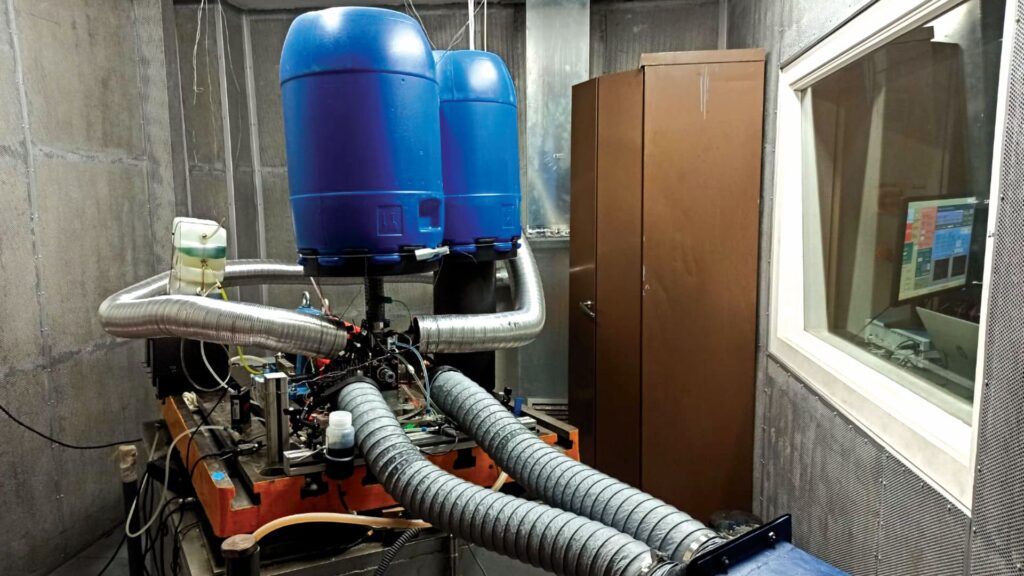
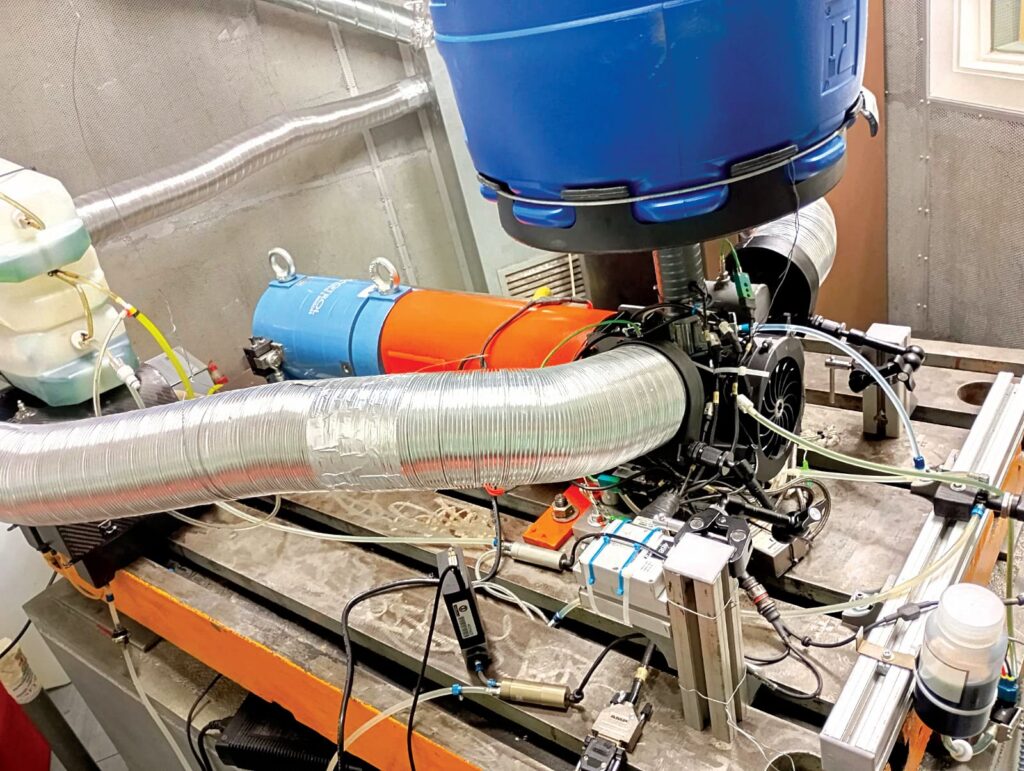
So, soon thereafter, Alpha Unmanned worked together with UPM to build a unique test bench for accurately measuring engine power and various other parameters, with doctoral researchers Raúl Fernández Rollón and David Céspedes Olalla from UPM being vital contributors here.
The test bench, as configured, enables extremely tight control over air and fuel inputs from one test to the next, including an autonomous dosing logic for precision in the latter. That then corresponds with high-resolution output measurements for granular characterisation of engine performance and isolation of the key variables that the company wants to study.
“That includes measuring fuel and air flow rates, controlling the mixture to be as constant as possible, thereby smoothing out engine performance so we can properly gauge how significantly the performance changes based on specific software and hardware alterations,” Rollón says.
“And from our references for environmental temperature and pressure, we can efficiently extrapolate how the engine will perform at other temperatures and pressures.”
Here, Escarpenter adds, “Right now, we’re integrating pressure sensors, a. which will measure inside the combustion chamber, along multiple steps of combustion, at a rate of 400–800 Hz, or up to a maximum of 100 kHz if that kind of sampling ever became necessary.”
The base dynamometer from Magtrol, which resides at the heart of the test cells, principally enables tracking of output power and power stability. Through this, Escarpenter and his fellow engineers were able to gain an early baseline reading of how well (or unwell) the minimally-modified DA100 ran on heavy fuel.
“It wasn’t long before we understood just how sensitive heavy fuel combustion is to changes in its environment,” he recounts. “Temperature inside and outside the combustion chamber is a critical factor; you need to warm up the engine before you even start it if you want to run reliably on heavy fuel.
“Some companies work around this by feeding propane gas into the air filter, ahead of the fuel, to boost the combustion in initial operations, and then they stop with the propane once the engine is running at operating temperatures. So, we explored that and other paths, including preheating the fuel, or starting on gasoline and then switching to a heavy fuel tank afterwards, all the while measuring each path’s effects on different performance parameters.”
Eventually, the company settled on what it found to be the most efficient package of modifications: one that bore just as many subsystem conversions as needed to maximise reliability. A drawback of its approach was – at the time – an undesirable consistency of carbon build-up in the exhaust over time caused by unburned residues of oil.
“Naturally, that affects how well the engine is able to breathe and ingest fresh fuel–air to replace combusted gases, and it significantly reduced the power for us, though we’re continuing to explore ideal mitigations and workarounds for that,” Escarpenter says.
“Another problem concerned how the engine’s dynamic behaviour changed when switching to heavy fuel. For instance, the required adjustment for acceleration enrichment was far more sensitive and unstable, primarily as not all of the heavy fuel you inject on one combustion cycle gets burned in that cycle.
“Heavy fuel burns slower than gasoline and impinges more significantly on the cylinder walls and throttle body, so the fuel molecules sprayed on cycle one might not get fully burned until cycles three or four. Solutions like using multiple, redundant spark plugs have been useful for increasing flame propagation and ‘catching’ more fuel, as well as preventing misfires.”
A plethora of further optimisations followed for tackling engine preheating, combustion stability, thermal management and more, to the point that just the original Desert Aircraft crankshaft and pistons are retained. The crankcase and cylinders are now made to an in-house design, the latter having been iterated via additive printing before being cast per present day.
Designing those parts in-house also depended on detailed 1D mathematical simulations, constructed and AI-trained by the UPM researchers. Through such models, the engine’s R&D personnel can quickly simulate how changes in virtually any component, from intake through to combustion and exhaust, affect outputs of power, speed, torque, noise and other parameters.

As Rollón says, “We started by using software from AVL to create the models, adjusting parameters to contrast data from – and calibrate the models based on – experimental results, and the more we calibrated the model, the more correctly it would predict the effects of, say, changing between exhaust systems, including those stemming from the speed of sounds coming from the exhaust, and how the effects change with air densities, ambient temperatures or fuel–air changes.
“It’s also quite a fast model – you can predict long-term changes in engine performance with just a day of simulation processing, saving days or weeks of testing, as well as a lot of fuel. This then helps Alpha to better pick and choose what’s worth pursuing in real-world research on the test benches.”
As of writing, Alpha Unmanned is particularly focused on feeding the model with data on how and when different failure modes (such as overheating or part failures from running too lean) can be triggered, in order to develop predictive alarms to warn operators when they are at risk of such failures due to sub-nominal conditions.
The company has already implemented numerous predictive maintenance alarms for the B100HF, describing these as “quite simple” compared with predicting outright engine failures. For instance, if the rpm of either of the redundant fuel pumps exceeds the maximum safe threshold, the operators are informed of the need to either check or replace the offending pump.
“We’re also now combining the 1D model with CFD models to see if we can further optimise SFC via factors like injector positioning, injection pressures, new semi-direct injection strategies or transfer port geometries, and through those we can also gradually plot the most stable and efficient curve between power output and fuel consumption,” Escarpenter adds.
With around 1500 testing hours accumulated across the university test bench and another at Alpha Unmanned’s airfield (the latter being a simpler set-up with a propeller, and more strictly dedicated to studying the carbon build-up issue), the engine is commercially available, having successfully operated on the A900 for years.
“But we’re dead-set on continuing our planned development path. Development might honestly be endless – there’s always something we’d like to improve. And we’re especially eager to boost our SFC and TBO – for a very low-cost engine, we think we have good figures right now, but if we can match the figures of some of the bigger names in high-cost heavy fuel engines, it would benefit both our UAV and our customers’ UAVs,” Escarpenter says.
“Even the mathematical models we use to simulate the engines are something we always want to improve. Even though they’re very accurate now, there’s still a margin of error, and you can always improve measurements towards the limits, from WOT down to partial loads and moments like that.”
Heavy fuel considerations
Alpha Unmanned offers two versions of the B100HF, which are outwardly identical but ingest fuel differently depending on the preferred mode of injection – one uses indirect injection and the other is transfer port-injected.

“There are some minor differences in engine management depending on which one we use, but either way, there’s a lot that must be precisely calibrated if you want to run on heavy fuel without an air-assisted injector rail or similar DI technique,” Escarpenter says.
Paramount among these, as indicated, is the combustion chamber temperature, which is influenced by the ambient air environment around the engine and the temperatures of the cylinders and crankcase (as well as how intake, combustion and exhaust are running, naturally).
“Heavy fuel atomisation, flow and, henceforth, efficiency are really closely linked to engine temperatures, and so we use a combination of active heating and active cooling control to ensure a full closed loop of control over how quickly we can vaporise the fuel,” Escarpenter continues.
While the active cooling system (discussed below) primarily targets the cylinder head temperature (CHT) parameter, the active heating (for engine starting) utilises two standard resistor-type heaters on each cylinder, placed such that their heat can smoothly transfer to the rest of the engine metals.
As conventional in aviation practices, Alpha Unmanned recommends engaging the heating system while pre-flight checks are being performed, allowing the system the few minutes needed to warm up the engine to operating temperatures, without wasting any time waiting idly.
“Glow plugs make sense for very fast warming in a specific spot, which works well for diesels, but our resistors work better for a well spread-out warmth across the engine, heating to roughly 150 C but conducting quite evenly, so that the fuel gets the necessary heat to atomise well as it travels from either crankcase or pre-chamber. That heating also minimises the changes of wall impingement by stopping the cylinder walls from getting too cold or the in-cylinder pressures dropping too low,” Escarpenter says.
“But there’s also a requirement for proper tuning. Heavy fuel power and efficiency really change a lot quicker and with more magnitude than gasoline when there are slight alterations in how lean or rich your mixture is, or when you’re moving from one power band to another.”

The company has worked hard to ensure the engine management system and its ancillaries can avoid common (and otherwise tolerable) errors by closely tracking parameters such as manifold air pressure, barometric air pressure and injection timing.
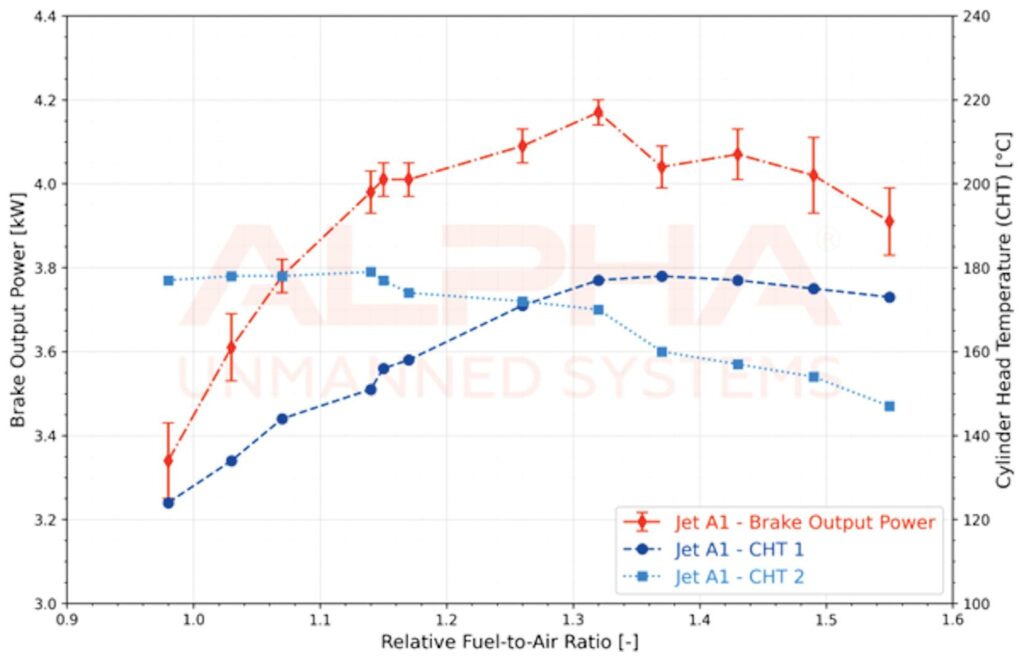
Research is continuing in-house into how different injection approaches (such as alternate injector orientations, timings, pressures or using two injectors per cylinder, as used in KTM’s off-road motorbikes) might give tighter control over fuel burn. Alpha has also found through testing CHTs against engine performance as a function of relative fuel-to-air ratios with Jet A1 that power output is maximised – and engine operation made smoothest – when both CHT values closely match each other. Accordingly, the company asserts that thermal disparities are highly unfavourable for a twin-cylinder boxer engine’s architecture, thus balanced operating temperatures should be maintained across both cylinders in the name of power and efficiency optimisation. Conversely, a large temperature differential correlates with a significant drop in power output, which is a phenomenon visible at both lean and highly rich fuel-to-air ratios.
“And while the active heating and cooling certainly give us fine control over the variables affecting fuel intake and mixing for now, downstream we have our dual redundant ignition system. As well as giving a higher power output through a more complete fuel–air burn, it of course helps keep the output more consistent and reliable than just one plug,” Escarpenter adds.
“Meanwhile, our test chamber and ECU integrate a very wide array of sensors – the latter of which we’ll talk about soon – and this has allowed us to closely model and understand why slight degradations in power or torque can happen, and compensate algorithmically.”
Starting and electricity
A variety of brushless electric machines are integrated for power generation and starting applications, depending on the use-case. For helicopter installations, Alpha opts to mount KDE Direct BLDC electric motors on the crankshaft, for their compactness and low price compared with standard alternator products, which are typically built larger and in lower quantities.
For fixed-wing and multi-rotor integrations, the Spanish company will more typically go with generators from Plettenberg or Acutronic (formerly Sullivan Products): the former being known as a high-quality European manufacturer, the latter’s starter-generators being proven as compatible with DA-based engines.
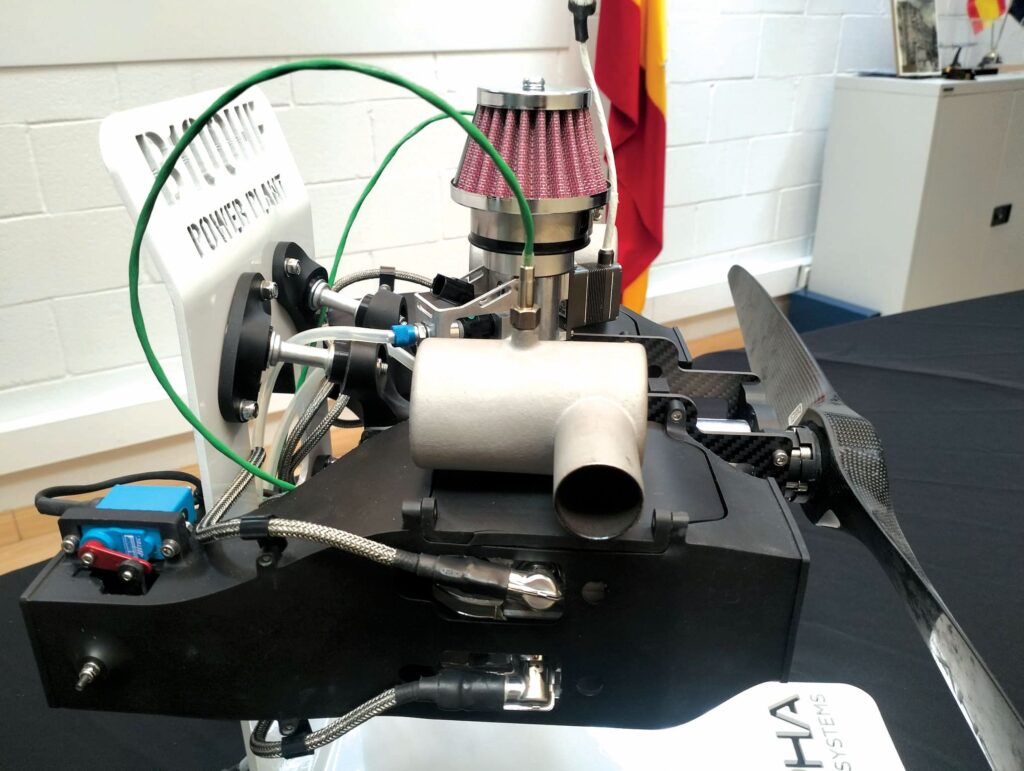
“We also have a manual, external starter for helicopter integrators who might prefer it, and that’s a more compact, lightweight solution than electric motor- or alternator-type systems, especially since normal starter-alternators form a big, heavy plate-like construct to ensure enough torque to start the engine, and to mount enough sensors to track positions and other parameters at the different operating phases,” Escarpenter notes.
Intake components
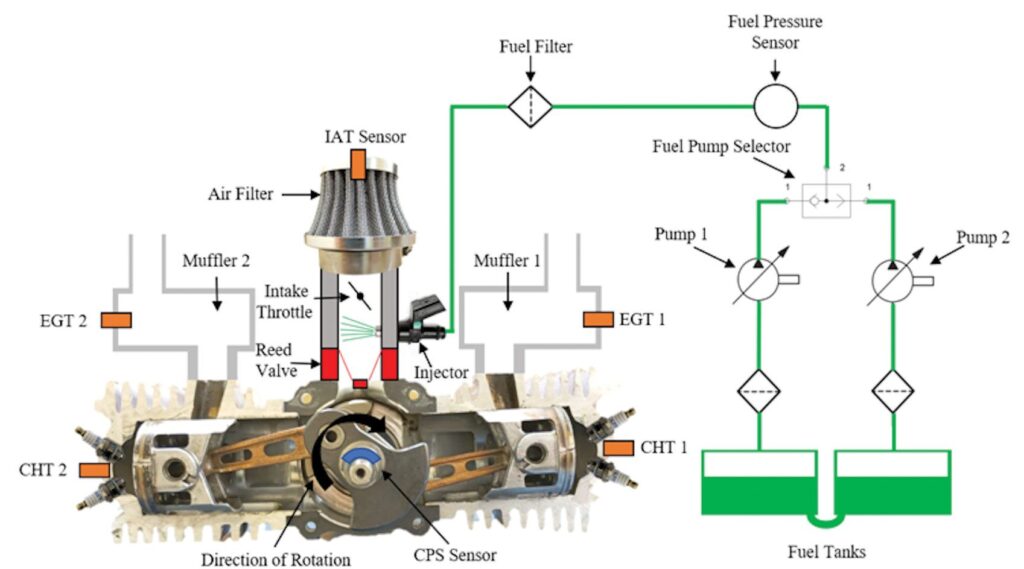
The injectors themselves are Honda components, chosen for being thoroughly mature, proven injectors, as well as for their wide commercial availability (including their guarantee of future availability). Fuel pumps from TSC Micropumps feed into the injectors, chosen for their small size, good performance characteristics and controllability (by virtue of being BLDC motor-driven and, hence, independent of engine speed).
“To filter the fuel, we use 10 and 25 μm metallic filters from Battlefield International. While metal filters can be a few grams heavier than plastic filters, you can often see plastic filters breaking or blowing up in the face of ordinary overpressures,” Escarpenter says.

“We experienced this a long time ago with plastic filters we otherwise loved. But your fuel filter is a critical component – if it breaks, your engine will stop running. So, a few extra grams is a worthwhile price to pay.”
As the stock DA engine comes with no servo throttle, being a Walbro-carburetted system, Alpha assembles its own using a conventional butterfly valve and a DA 15-T Volz actuator, which is one of the smaller servos manufactured by Volz in Germany.
“That was one of the smallest actuators we could find, and it came with really extensive documentation on its performance and reliability under strict conditions over a 2000 hour service life,” Escarpenter says.
“It also integrates a feedback sensor. That allows us to identify errors, but also to implement very precise control techniques. That’s important because otherwise you might issue a command for your throttle to move from 20% open to fully open, but then mis-estimate the time it actually takes to complete the movement by a handful of milliseconds, which is all it takes for a mismatch in your fuel mapping – which, as we’ve said, heavy fuel combustion efficiency is very sensitive to.”
Alpha Unmanned describes its throttle response as very agile, and permits precise throttle changes from 20% up to 100% and vice versa with no problems. The throttle body is otherwise conventional, and largely built of machined aluminium.
Crankcase and cylinders
As mentioned, only the crankshafts, con rods and pistons (along with directly associated componentry like rings and circlips) are retained from the stock DA engine. At the time of writing, the aluminium crankcase and cylinders are produced in-house.
Two different crankcases are available: one for conventional two-stroke lubrication via 50:1 fuel/oil pre-mixing, and one that is designed with an independent oil injection and distribution system. The former is simpler and thus contributes to a lower price, but also experiences a far higher rate of carbon deposit accumulation; hence, the latter offers the superior 200 hour (as of writing) engine lifespan.
“So, the latter needs a crankcase specifically designed to integrate the oil injectors, and via our ECU, we can meter the quantity of oil being injected to suit running conditions,” Escarpenter says.

Exact placements of oil injectors depend on how the engine is integrated and used. In Alpha Unmanned’s helicopters, the B100HF mounts vertically, and so two injectors are installed and pointed towards the engine’s four ball roller bearings (two main bearings and two big end bearings). This guarantees that the crankshaft and con rods are lubricated sufficiently, and that the cylinder walls are still lubricated via the piston rings. However, when the B100HF is mounted horizontally, such as for fixed-wing or multi-rotor UAVs, centrifugal distribution improves to the point that a single oil injector is enough.
Fuel injector locations and orientations have also been the main point of consideration inside Alpha Unmanned’s cylinder designs, with cylinder volume, combustion chamber geometries and porting (including transfer port geometries) having been optimised relatively marginally.
Fuel is injected at a pressure of 3 bar in both configurations: perpendicularly at 90° into the throttle body, or at an angle of 45° within the transfer ports injection configuration. Each cylinder has two transfer ports and a boost port, with the inlets timed to 123.2° past TDC. Per the company’s description, a loop scavenging process based on Schnuerle porting with an additional boost port is responsible for transfer of gases – the exhaust port sitting around 103.7° past TDC and at 90° to each of the intake ports (which sit opposed to one another).
The combustion chamber forms between a flat-top piston and a hemispherical combustion pocket featuring a peripheral squish band, which is a configuration that Alpha says creates a high-velocity radial squish towards the chamber’s centre, generating micro-turbulences that ensure rapid flame propagation and optimal fuel mixing. The company has also engineered a “relatively low” compression ratio of 10.3:1 to avoid knocking-style detonations, which is an additional complement to its active cooling and heating systems.
“We’ve also concentrated on designing our own heat sinks around the cylinders, creating maybe 30–40% more surface area for cylinder heat dissipation over the original design, as part of our strategy for closer temperature control and greater operational freedom,” Escarpenter adds.
“Initially we machined them, before going to additive printing for greater freedom in testing different injector integrations and similar qualities. Now, after many iterations, we’re receiving the first prototypes cast from 7071 Al, for the cost advantage that casting brings, and these are also the first with our semi-direct, transfer port injection approach.”
Exhaust
The standard exhaust pipes are additively printed aluminium, an approach Alpha has found more expedient for fitting into different airframe and packing requirements than using COTS pipes or trying to find a welding expert capable of working very thin aluminium sheets together.
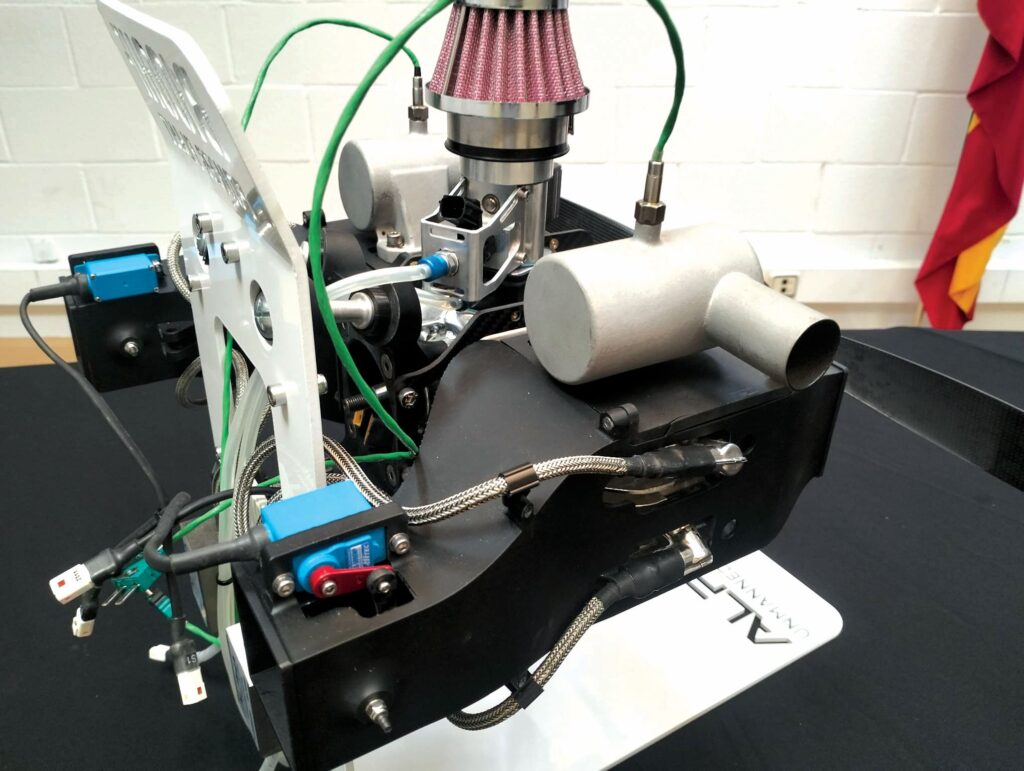
“Metal additive printing is not the cheapest approach, but we get good repeatability, and it is easier than trying to get automated CNC machines that would bend and attach thin aluminium sheets or pipes together,” Escarpenter says.
“We can also integrate KS Tuned Pipes for around 1 kW of extra power at WOT, but they’re almost a metre long, and that doesn’t include the extra 500 mm long header you need to attach them to the cylinders – so, they’re quite demanding in terms of space. That’s why we’re working on a third, more middle-ground exhaust option, which will feature a much smaller header along with a muffler. It’ll work best with a shallow operating curve, so something like hybrid configurations, which will want roughly the same power at different rpms.”
Air cooling
Two different air-cooling assemblies are available: one for fixed-wing UAVs using a tractor propeller, and one for rotor-wing UAVs. The former consists of two manifolds – one per cylinder – that catch and direct downwash air from the prop blades about the cylinder fins. At the back of each manifold is an electromechanically actuated butterfly valve, which serves to buffer and thus meter how much cooling air volume can move freely through the manifolds and over the cylinders.
“Based on how we’ve designed the manifold interiors using CFD, the amount of cooling air concentrating on the crankcase, or otherwise passing near the crankshaft, is considerably less than the volume contacting the cylinders,” Escarpenter says.
“That helps ensure that the crankcase is kept warmer than the cylinders, minimising the chances of fuel impinging in the crankcase or on the crankshaft, especially in environments with low air temperatures.”
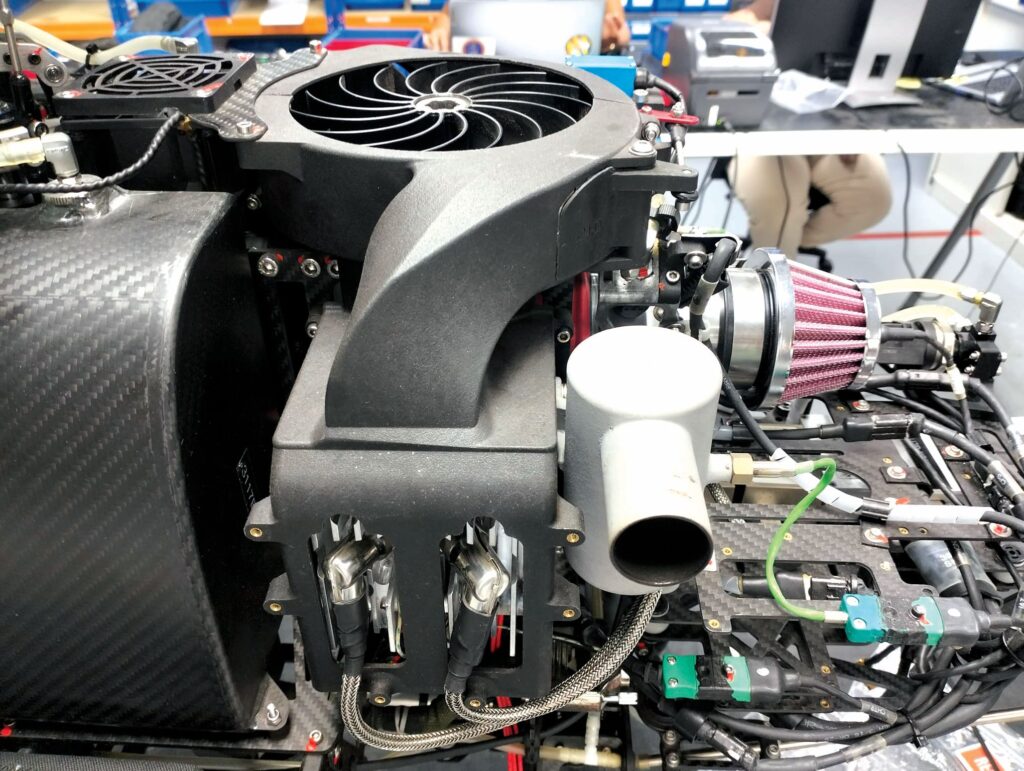
The rotor-wing aircraft version of the B100HF is the one with the forced-air cooling system. In that variant, a centrifugal fan is mounted on the crankshaft’s frontal output (where the propeller would otherwise run, opposite from the end where the engine’s alternators, gearboxes and pulleys typically run). The fan integrates inside a dedicated housing with a wide frontal inlet and two manifold channels that ferry air to their respective cylinders.
That housing features two butterfly valves that enable air to escape upstream, instead of baffling air flow out from the manifold downstream of the cylinders, thereby reducing the volume of compressed, forced air being directed to the cylinders.
“The butterflies, in either situation, are controlled by our software via a separate computer from the ECU but still part of the same engine management system,” Escarpenter explains.

“They’re a vital part of our active cooling control, and controlling them separately ensures we can account for temperature differences between them and so keep them both running at the optimal temperature levels. A healthy CHT for gasoline engines might be somewhere just over 80–90 C, which is ideal for the spark plugs’ auto-cleaning and for the oil – but for stable heavy fuel combustion, you generally need to be significantly hotter than that, maybe somewhere between 120 and 140 C. So, you really need a comprehensive thermal management system that can adjust for the extremes of hot and cold a UAV may experience as it flies.”
Alpha Unmanned will go as far as issuing a winter cover or ‘choker’ for the fan to reduce its air throughput and cooling effects, which is used by the company’s clients in colder regions such as Norway.
For those concerned about thermal expansion and contraction differentials, the company notes that the temperature difference between the crankcase and cylinder is not extreme, and the scale of cylinder cooling or heating is performed only in response to deviations from the optimal, meaning that large temperature swings should not happen.
Even the initial preheating process exhibits a gentle, gradual temperature increase curve over the 3–5 minutes that it takes to go from ambient to around 100 C before the engine can start running, and its combustions ‘take over’ the responsibility of cylinder heating. And, as indicated, the resistors used for preheating do not concentrate their heat in one spot but spread it out across the engine’s conductive aluminium, further preventing the creation of hotspots or potentially damaging differentials.
Engine management
The central ‘brain’ of the B100HF’s engine management system is an ECU from Moscat Ingenieria, also based in Madrid. Although having a supplier for a neighbour poses convenience, far more important to Alpha Unmanned is the highly redundant architecture of Moscat’s ECU, as well as certain configuration flexibilities of its embedded control logic.
“For instance, you know we have redundant fuel pumps, and predictive maintenance alerts which include detecting if a pump needs replacement – well, if the latter has been triggered, we’ve enabled the ECU to automatically switch away from the offending pump and rely on its partner or backup equivalent to continue flying normally for that mission,” Escarpenter says.

“It took us a while to learn how to change parameters in the ECU software, but once we’d figured it out, we could easily modify things like the number of injectors or spark plugs, or injector pressure levels, and we can even change injection pressures in real time now. That kind of configurability was exactly what we needed to modify this engine from a gasoline system to a working heavy fuel engine.”
The ECU’s inherent malfunction detection capabilities have also been used to track for potential ignition faults, as well as the testing regimes investigating the effects of one cylinder having ignition misfires and the other working normally.
“ECUs are, at their core, simple devices. You read the crank position sensor [CPS] and the throttle position sensor [TPS], go to a table, check how much fuel you need to inject, and maybe adjust according to some environmental correction tables. But then if something fails or a sensor isn’t working properly, it’s over,” Escarpenter muses. “If your CPS fails, for instance, you have no idea when to inject, so your engine might well stop injecting, and then you effectively have no engine.
“So, the levels of redundancy enabled by this ECU were unlike anything we saw elsewhere in the market and a critical reason why we wanted it for our engine.”
As Escarpenter alludes, the B100HF is managed through an Alpha-N strategy, based on TPS and rpm as the foremost fuel–air mapping inputs, although with corrections based on barometric pressure and MAP. The ECU typically connects to the host UAV’s main computer via an RS-232 interface, by which all engine telemetry can be sent to the flight controller, GCS and any other platform the end user wishes. That interface also enables the autopilot to set engine speeds, although PWM may also be used, or the EFI may be set to a governor mode to control speed automatically.
Additional functions running on Alpha Unmanned’s own hardware (outside the ECU but still within the standard issue engine management network) include algorithms for anomaly detection, control of the active cooling system, and a mixture adjustment control panel originally developed for engine testing and troubleshooting.
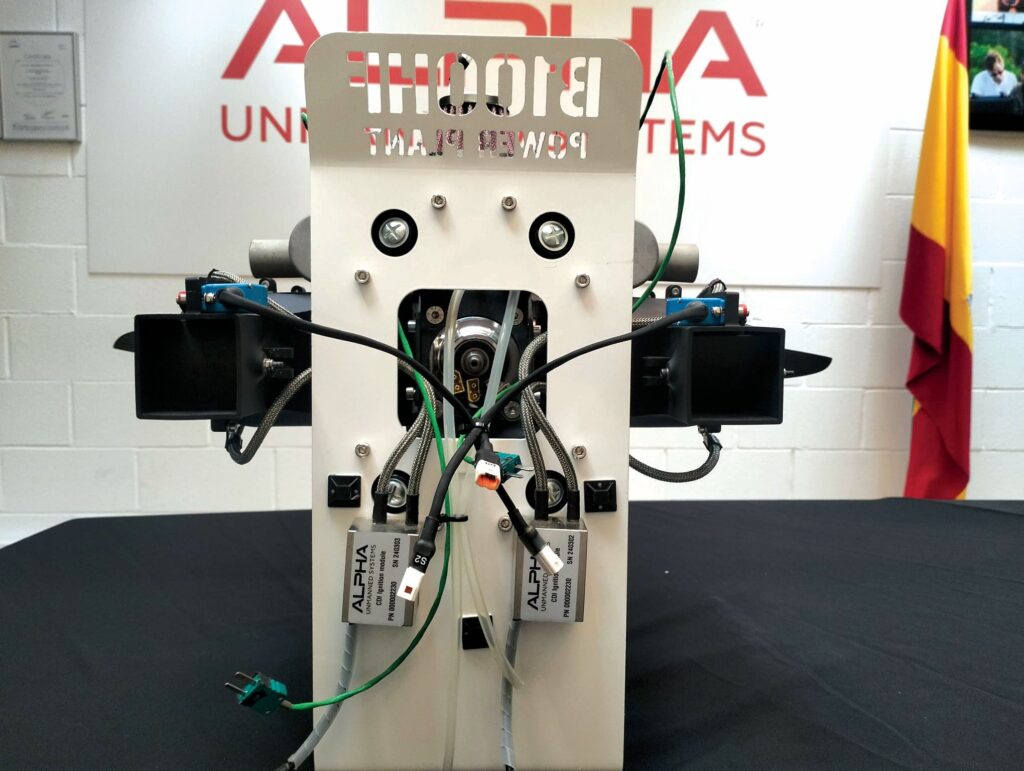
Feeding data into the ECU are two EGT sensors, two CHTs, two CPSs, a TPS, a MAP sensor, fuel pressure sensors and a board temperature sensor. With these as inputs, control outputs then run to the dual fuel pumps, injectors, active cooling servos, CDI devices and the throttle.
Future
Satisfied that the B100HF operates reliably enough for certifiable BVLOS operations, Alpha plans next to work on a larger variant, derived similarly from the 150 cc DA-150 engine, which will suit UAVs with MTOWs of 60 kg or above. It also plans to scale up its annual production capacity to meet the growing demand from UAV platform developers.
“But we also want to be able to produce customised designs and to not compromise on design flexibility, not just for different UAV integration cases but also to keep updating the engines for enhanced performance and lower-cost manufacturing techniques,” Escarpenter says.
“It will be challenging to balance all of this, but we feel we’ve made a relatively low-cost and extremely capable engine here – that’s what the UAV market needs and it’s what we want to keep supplying.”
Key specifications
B100HF
Two-stroke boxer twin
Spark ignited
Naturally aspirated
Active air cooling
Indirect injection and transfer port injection versions
Fuels: Gasoline, Avgas, Jet A1, JP5 and JP8 (Performance specifications below are consistent with Jet A1 operations)
Total weight: 2.8 kg
Bore: 42.6 mm
Stroke: 35 mm
Displacement: 100 cc
Maximum power output: 4.5 kW at 7000 rpm
Operating power output: 2.8 kW at 6000 rpm (with Jet A1) (30% throttle)
Maximum torque: 6.3 Nm at 6000 rpm
Operating torque: 4.5 Nm at 6000 rpm
Redline speed: 7500 rpm
SFC: 428 g/kWh at 30% throttle (6000 rpm), 574 g/kWh at WOT (6000 rpm).
Compression ratio: 10.3:1
TBO (as of writing): 200 hours
Some key suppliers
Block/crankcase: In-house
Cylinders: In-house
Liners/bore coating: In-house
Crankshaft: Desert Aircraft
Pistons: Desert Aircraft
Rings: Desert Aircraft
Piston pins: Desert Aircraft
Circlips: Desert Aircraft
Con rods: Desert Aircraft
Big end bearings: HQW Precision GmbH
Main bearings: HQW Precision GmbH
Seals: Toni Clark Practical Scale GmbH
Fasteners: RS PRO
Gaskets: Desert Aircraft
Ignition system: In-house
Spark plugs: NGK
Alternators: Plettenberg
Alternators: Acutronic (formerly Sullivan)
Alternators: KDE Direct
Throttle servos: Volz
Additively manufactured exhausts: Materialise NV
Air filters: Dave’s Motors
Oil filters: McMaster Carr
Oil pumps: Dellorto
Fuel pumps: TCS Micropumps
Fuel filters: Battlefield International
Fuel injectors: Honda
Fluid lines: Tygon
Oil: Motul
Rapid prototyping equipment: Anycubic
ECU: Moscat Ingenieria
Sensors: Aircraft Spruce
Data acquisition systems: National Instruments
Dynamometers: Magtrol
Test cell flow meter: Alicat Scientific
Test cell airflow sensor: Meriam Instrument
Test cell combustion chamber pressure sensor: Kistler
UPCOMING EVENTS