






Airbus Helicopters Flexrotor
(All images: Airbus)
Ready for anything
Peter Donaldson investigates the expanding versatility of the Airbus Helicopters Flexrotor
As the name suggests, combat search and rescue (CSAR) is an inherently risky kind of mission for a helicopter. It involves flying over and landing in hostile or contested territory, most likely in a race against both time and an adversary alerted to the presence of one or more downed aviators, so CSAR crews need every edge they can get. In the case of the Republic of Singapore Air Force (RSAF), that edge was provided by an Airbus Helicopters Flexrotor UAV directly commanded from one of its Airbus H225M helicopters in a recent operational trial of the company’s HTeaming technology. This trial was one of several that exercised and extended the operational capabilities of the systems through 2025 and into the following year.
As military forces push for deeper integration between crewed and uncrewed assets, the focus shifts from merely flying a drone to seamlessly merging its capabilities with the mission of the crewed platform. Taking place in early February, this trial with the RSAF followed another demonstration carried out for the Spanish Navy that teamed a Flexrotor with one of the service’s smaller H135 ‘Nival’ helicopters, and participation in a major NATO exercise involving numerous and diverse crewed and uncrewed assets. This is strong indication that such close operational and technical integration is on the cusp of becoming operational reality.
Tail-sitting ‘tiltrotor’
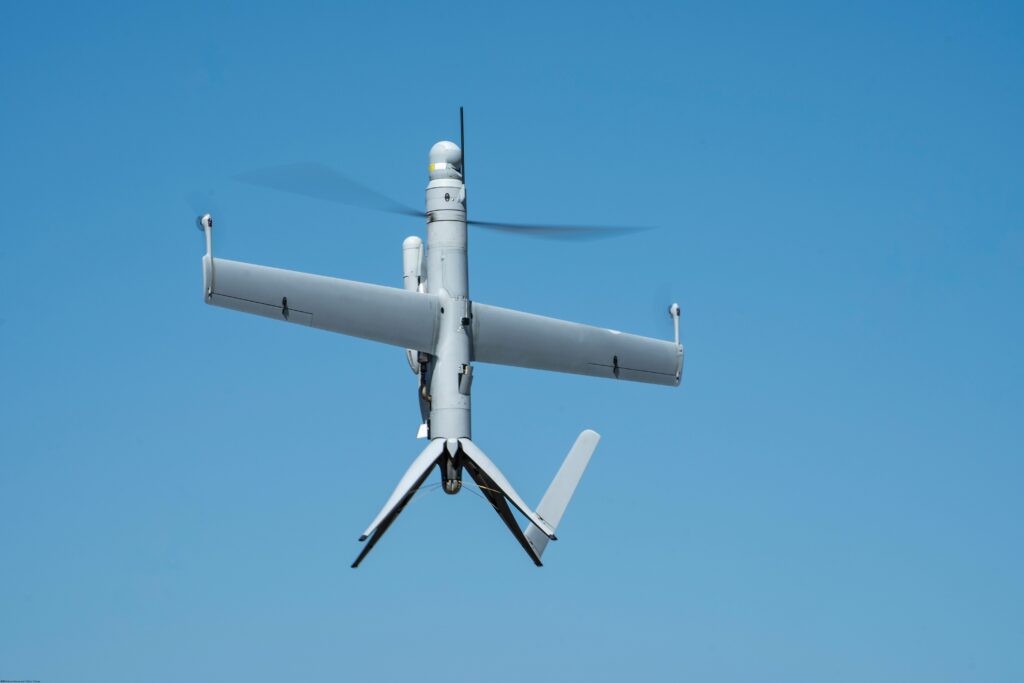
Flexrotor is a tail-sitting VTOL machine with a two-bladed rotor mounted near the top/front of its cylindrical fuselage and anti-torque propellers on the tail surfaces, a configuration that gives it the capabilities of a tiltrotor without the need to tilt the rotor with respect to the fuselage. This minimises mechanical complexity by avoiding the duplication of propulsion systems found in drones that feature separate lift and cruise devices.
Combined with a ruthless determination to keep weight to a minimum, this configuration is key to giving a Group 2 UAS performance equivalent to that of larger Group 3 systems, according to Victor Gerin-Roze, head of UAS business for Airbus Helicopters. With a maximum take-off weight of 25 kg, it carries a payload of up to 8 kg and can fly for up to 14 hrs.
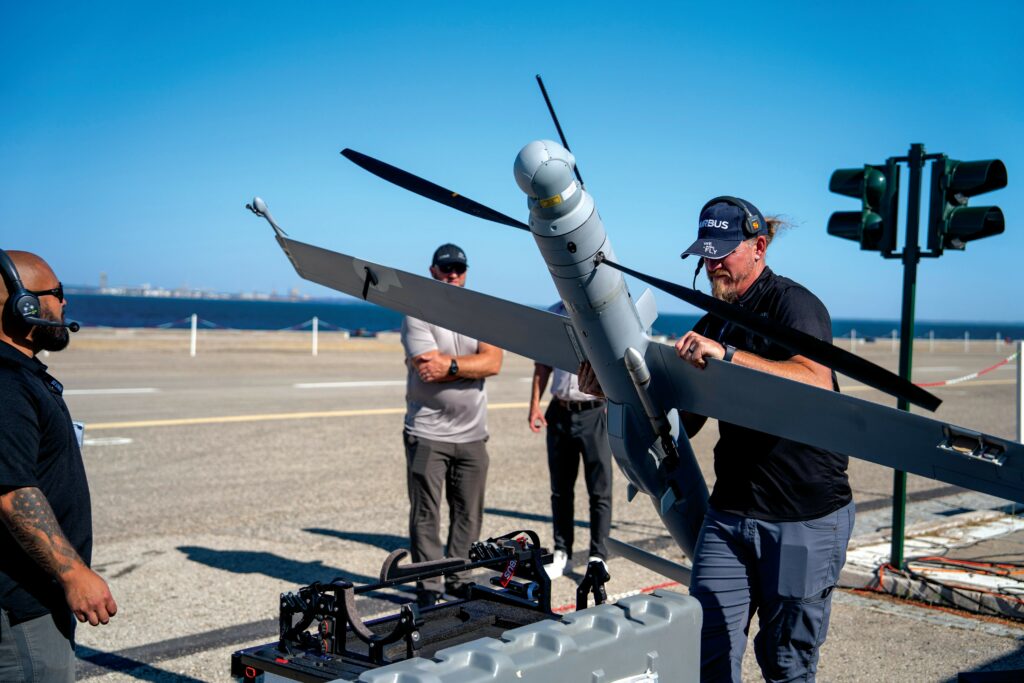
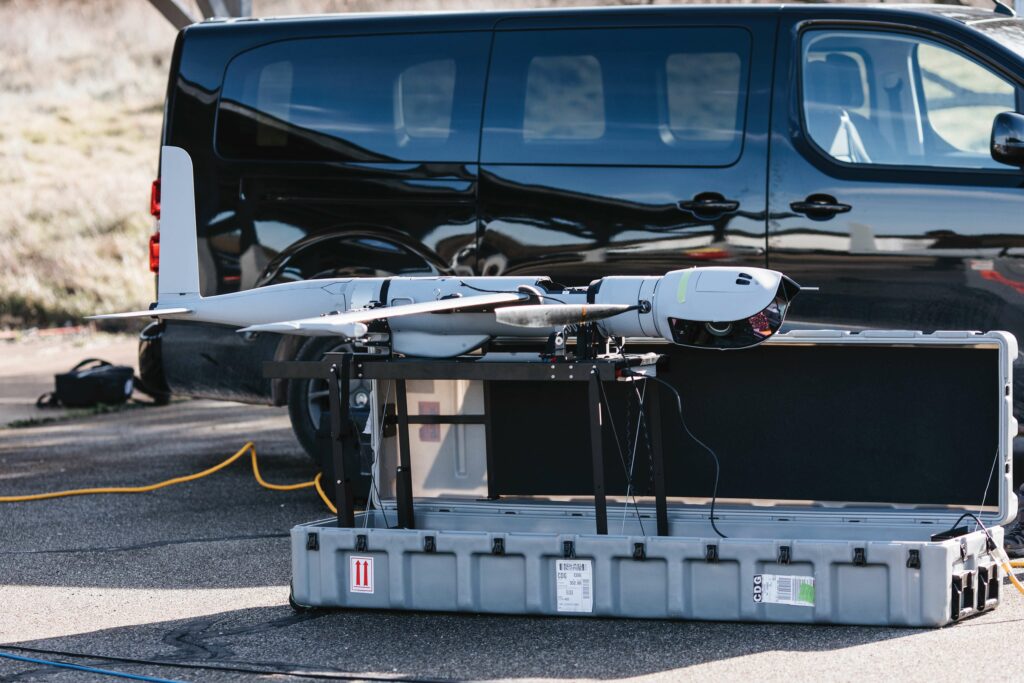
This capability comes with a remarkably small logistic footprint because the Flexrotor can operate from the deck of a small ship, loaded into a small van or pick-up truck or carried with room to spare in the cabin of the kind of medium helicopter typically employed for CSAR work. When it gets to the launch location, one person can wheel it to the launch area in its container. Assembling the drone involves raising it to a convenient working height on a platform built into the container to attach the wings and payloads. Then, it is carried to the launch point, where it sits on four long ‘petals’ that hinge out from the fuselage rear to form legs. Two of the petals support angled surfaces that, when closed, form the aircraft’s V-tail.
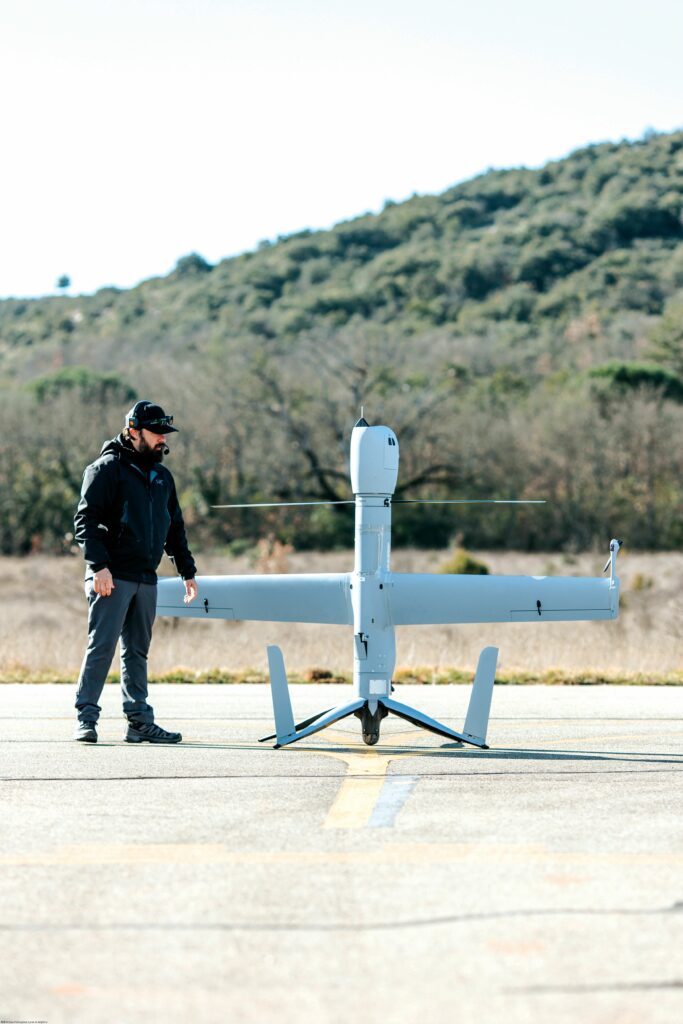
Because it stands on its tail, fundamental stability both on the ground and in vertical flight depends on the combination of a low centre of gravity and the high thrust line enabled by the rotor’s position; a situation analogous to a plumb weight supported by a string. “It’s more stable to pull than to push,” Gerin-Roze notes. This is particularly important when operating in strong, gusting winds and from ship decks in high sea states, for example.
To start the Flexrotor, the operator deploys a small tracked UGV to attach an external starter motor to fire up the engine (now a heavy fuel unit) and then withdraw. “Remote-start functionality allows operators to initiate engine ignition from a safe distance, enhancing operational safety,” he explains. “This external starter approach also eliminates dead weight from the aircraft, directly translating to increased payload capacity and extended mission endurance.”
Transition from VTOL to wing-borne flight is often tricky for aircraft with this hybrid capability, but the Flexrotor keeps the process as straightforward as possible. Under full autopilot control, the machine takes off and climbs to a safe altitude. It then noses over into a dive to pick up enough speed for its wings to create sufficient lift, following which it accelerates away in fixed-wing mode.
Payload options
The Flexrotor is designed with three main payload positions: one ahead of/above the rotor and one each in the ventral and dorsal positions. Each standard mount provides a mechanical interface along with power and data connections. Each payload is secured with a single screw, so the only tool required by the operator to attach them and swap them over if mission needs change is a screwdriver, Gerin-Roze notes.
Sensors integrated so far include members of the Hood Tech Alticam family of four-axis stabilised camera gimbals, including the 09E03 (E0960), the 09E0IR3 (MWIR3.6) and the 06E0IR. The 09 series are 10.5 in diameter systems. Weighing 3.375 kg, the 09EO3 houses an HD electro-optical (EO) camera with embedded AI-assisted video processing capabilities that include image stabilisation, target tracking, video moving target indication and automatic target recognition. The marginally heavier 09EOIR3 adds a mid-wave infrared (IR) camera. The 06 family packs similar capabilities into a smaller 5.8 in diameter package with different sensor combinations and weight of between 2.02 and 2.77 kg.

Another camera system option is the PT6 from Overwatch Imaging, which is a roll-axis camera pod for wide area search and ISR missions. The Flexrotor can also be equipped with radars such as the NSP-3 synthetic aperture system from IMSAR (more on this later).
Communications packages include Silvus Technologies StreamCaster SC4200 radio datalink and a Starlink satcom system.
The Flexrotor also has an automatic identification system transmitter and a radar transponder to let air traffic control, maritime combat management systems and other airspace users know where it is. However, it does not have the kind of sense-and-avoid system that a growing number of smaller drones have because it does not come as close to obstacles in normal operations as they do. Gerin-Roze explains that, for the Flexrotor, Airbus relies on procedures in its operating manual and, where necessary, the specific operations risk assessment approach to ensure flight safety.
CSAR wingman
He emphasises that the CSAR sortie with the RSAF was much more than a demonstration, amounting to a flight trial in operational conditions. The crew aboard the RSAF H225M helicopter connected to the Flexrotor was able to command both the UAV and its payload directly.
This amounts to NATO Level 4 interoperability, which Gerin-Roze emphasises is very important to the CSAR mission generally and this trial in particular. “Having this ability to create a bubble between the helicopter and the UAS without needing a link with the ground is, of course, important for the efficiency of the mission, as you create your own team locally.” It is also crucial for security in CSAR and other missions in contested environments, particularly on land, he notes, as a data link that only transmits between the helicopter and the drone greatly reduces the risk of electromagnetic exposure for a team on the ground.
Through STANAG 4586, NATO defines five levels of interoperability between crewed and uncrewed vehicles. Level 1 is limited to indirect receipt of imagery or other data via a GCS or a network. With Level 2, the crewed platform can receive data directly from the payload of the UAV, for example, but can only direct the vehicle or its sensors through communication with the GCS crew. Level 3 adds the ability to control the payload directly – pointing and zooming a camera for example. In Level 4, the crewed aircraft takes on the role of UAV mission commander, with a crew member able to change the drone’s flight path, assign new waypoints and control the sensor. Level 5 adds control of launch and recovery, enabling dynamic mission reassignment and handover of the asset between different controlling entities.
Much effort has been put into truncating or even eliminating the search phase in SAR and CSAR missions through the issue of specialised satcom-capable survivor radios to aircrew, devices capable of transmitting a GNSS position to rescue assets. However, there is still enormous value in obtaining a real-time picture of survivors and their surroundings, in addition to location data, so that the helicopter crew can plan their approach, pick-up and egress taking the whole situation, including any threats, into account. In the RSAF trial, this is where the Flexrotor came in.
Launched ahead of the H225M, its first job was to locate the downed pilot – with or without an initial position from the survivor’s radio. Once the Flexrotor had located the pilot, it transmitted the coordinates to the RSAF CSAR crew, who then launched their rescue mission. “During the whole flight of the helicopter, the Flexrotor acted as a spotter, checking the area ahead for threats,” says Gerin-Roze. “In the scenario, of course, there was a threat, So, the helicopter had to take an alternative flight path to avoid it, which the crew chose with the help of imagery from the UAV.”
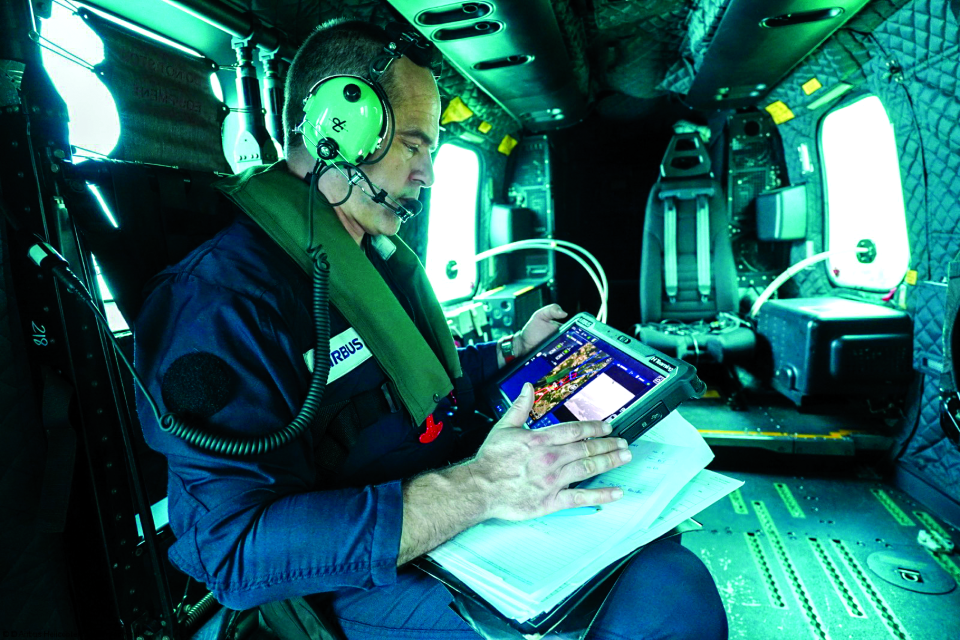
All the information from the Flexrotor is presented to the helicopter crew on a tablet computer, which is effectively the airborne ‘GCS’ portion of the HTeaming system. This is “made for digital natives by digital natives,” as Gerin-Roze puts it. “It’s very easy to use.” The GUI divides the screen in two, with the left portion dedicated to a map on which the helicopter crew member can assign waypoints to the drone, or take control of what they want to look at in other ways by defining flight patterns or simply pinpointing the centre the area they want checked, while sensor video is displayed on the right side of the screen. “Everything is configurable in the tablet,” he adds.
The system is not limited to a single drone. It allows the helicopter crew to command several Flexrotor vehicles in the same flight, and potentially more than one type of drone because HTeaming also works with Airbus’ Aliaca, Capa-X and VSR700.
Guardian angel
While a helicopter can winch a rescuer down to pick up a survivor, it will generally land if there is suitably level ground nearby. This is what the RSAF crew chose to do in this phase of the trial mission, again using imagery from the drone to help choose the landing site. It is when on the ground that the aircraft and its crew are at their most vulnerable, so the Flexrotor was tasked with providing a bird’s eye view of the H225M and its surroundings. “We emphasise the situational awareness benefits of having the drone fly up to 20 nmi ahead of the helicopter, but when you are landed, it is also very important to have this kind of wingman in overhead checking the area for you,” Gerin-Roze says. This involved the crew member defining a search area centred on the helicopter and commanding the drone to a high overwatch altitude – a capability that the crew found very reassuring, he notes.
“It’s a force multiplier. Although you can do the CSAR mission efficiently with the H225M alone, with the support of the UAS, you are doing it in a better and safer way.”
Gerin-Roze reports that the operation went very smoothly, praising teamwork between Airbus, the RSAF and Singapore’s Defence Science and Technology Agency. “The Singaporeans are very advanced technologically, and they were really willing to innovate and develop with us. There were some technical difficulties related to the data link during preparation, but during the demo it went very well.”
One of the key lessons learned, he says, is that enabling airborne vehicles to interact in real time over a high-bandwidth data link at long ranges and different altitudes is a real challenge. Here, the company was able to draw upon its experience as a helicopter OEM in relation to the integration of antennas and the management of the different signal coverage angles of each. Here, the goal was “to be able to offer our UAS customers the same performance that we have achieved with missiles and other things that are guided from a helicopter through an antenna,” Gerin-Roze notes.

Also, it soon became clear that they needed something modular and easy to install and remove, with a minimum of integration into the crewed aircraft. “That’s why we developed our roll-in/roll-out concept,” he adds. “Basically, you just need to install four to six antennas on the helicopter – the number depending on the helicopter model – and the wiring harnesses, which remain,” he explains. The other components are a box containing the modem and the link to the operator’s tablet. “Basically, if you are preparing for an HTeaming mission, you have the box in the helicopter. Then, if you need to perform another type of mission, you just remove the box so you don’t have the weight penalty.”
Maritime trials
At sea, the Flexrotor can be launched from and recovered to any ship that can operate a crewed helicopter, making organic crewed–uncrewed teaming for shipboard aircraft easier to realise. However, it can also fly from ships with decks too small for any crewed helicopter. The company proved this during the French Navy exercise Polaris 25 (May 12 to June 15), in which the Flexrotor operated from the 1100 tonne offshore patrol vessel of the Enseigne de vaisseau Jacoubet (F794) class, conducting take-offs and landings by day and night, he reports. “We demonstrated the ability to land in a space that was less than 4 x 4 m on several occasions.”
Such small ships pitch, roll and heave violently in sea states that disturb larger vessels much less, so sea state limits vary with vessel size. Gerin-Roze notes that Airbus’ rule of thumb is that if someone can carry the drone on the ship deck safely, then it will be able to take off. In terms of wind speeds, he reports that they have demonstrated that 27 kt is not an issue for the Flexrotor: “I think we can go higher.”
The Flexrotor also took part in NATO’s Robotic Experimentation and Prototyping with Maritime Unmanned Systems (REPMUS) exercise – during September 16–18, 2025 – off the coast of Portugal, combined on this occasion with exercise Dynamic Messenger. The two exercises brought together allies, partners, industry and researchers to test new uncrewed systems, sensors and innovative communications technology at sea and in the air. Together, these exercises provided an opportunity for UAS manufacturers to showcase their products.
In REPMUS, the Flexrotor’s role was to carry out several ISR missions to support a firing exercise. “We accumulated around 55 hrs overall, and we were able to detect and identify targets at sea,” Gerin-Roze says.
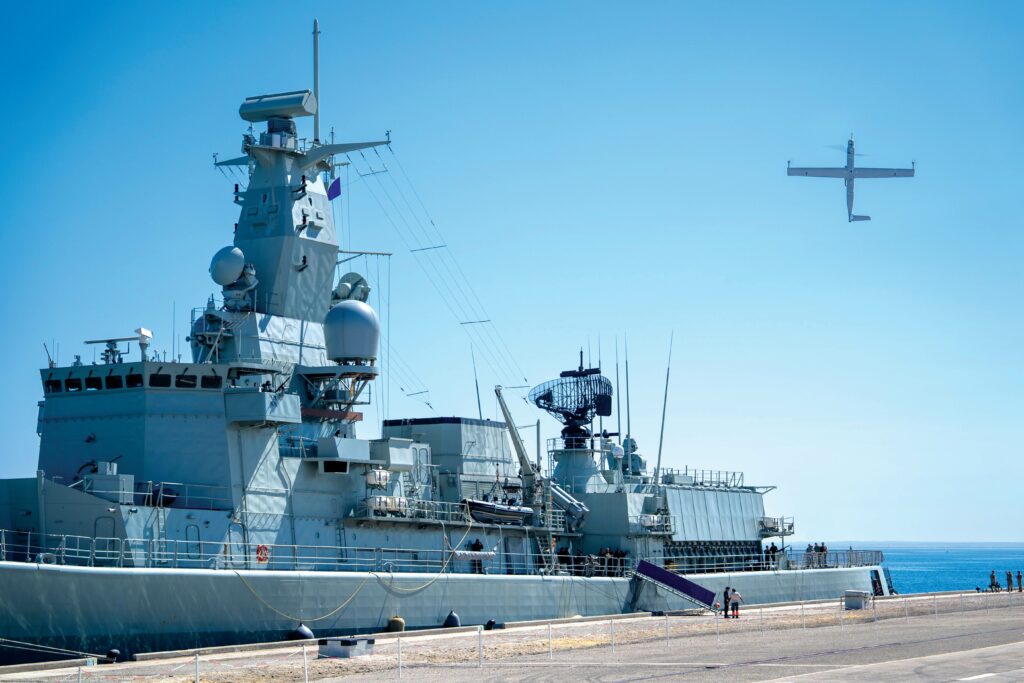
Operational challenges included high winds in which the Flexrotor proved able to take off and land “easily” when other machines could not operate at all, he reports. Furthermore, the drone operated reliably, despite an electromagnetic environment rendered ‘hostile’ by large amounts of interference from high-powered emitters such as radars and communications systems.
The Flexrotor team was hosted by the German Navy, and there were participants from 22 countries. One challenge this presented was the need to integrate the Flexrotor with several battle management systems, such as the German MESE, for example, with which the integration was described as seamless.
“The architecture of the Flexrotor’s systems is open and so is easy to integrate with different battle management systems on different types of ships,” he says. The task required very little lead time. “It was done on the spot in a matter of days.” With no hardware changes required, the main effort was a matter of ensuring that the data link was using the correct communications frequencies and protocols.
A further demonstration took place in support of Airbus’ successful bid for a contract to provide the European Maritime Safety Agency (EMSA) with multi-purpose maritime surveillance services, the award of which was announced on December 17, 2025. The EMSA mission is to support coastguard operations including search and rescue, fisheries control, environmental protection, and detection of illicit activities such as smuggling and piracy.
The contract involves provision of EO/IR and radar imagery directly into the organisation’s remotely piloted aircraft systems data centre, from where missions are monitored in real time. “As with all EMSA tenders, we needed to demonstrate our system in real conditions. In this case, we had to show that we could fly with an NSP-3 radar installed on the Flexrotor,” he says. “When you know the size of this radar, it’s quite impressive to be able to fly with it for a long time.”
The NSP-3 is a multi-mode synthetic aperture radar system that includes a 9.5 cm diameter x 67.3 cm long antenna pod and a radar electronics assembly measuring 16.8 x 10.9 x 7.7 cm. The whole system weighs 2.7 kg in MODSAR configuration, which is a little over 10% of the drone’s 25 kg take-off weight. The Flexrotor itself measures 2 m long with a 2.2 m rotor diameter and a 3 m wingspan.
In addition to moving target indication (MTI) modes for ground targets such as vehicles and people on foot, the NSP-3 also has maritime and airborne MTI capabilities. The maritime mode rejects clutter from the sea surface to detect and track vessels from large ships to small, low-profile watercraft. It can also use inverse synthetic aperture radar processing that exploits target motions such as pitch, roll and yaw to generate a high-resolution image of the vessel, allowing operators to classify it even in total darkness. The airborne MTI capability is currently focused on the detection of fast-movers, but support for detection of small, slow UAS is under development, requiring new hardware.
Gerin-Roze says that through all the demonstrations and trials conducted over the past year, the team encountered no major technical problems. The main issue was obtaining clearances to fly from different national jurisdictions. “This one is a real challenge,” he emphasises. “We want to develop quickly and to be able to fly quickly, and the lead time to get clearance is a burden.”
Future plans include extending the application of AI to Flexrotor’s sensors and payload data stream, and also bringing its crewed–uncrewed teaming capabilities to civil missions, starting with aerial firefighting and potentially extending it to police, border patrol, security, search and rescue and disaster relief.
Some key suppliers
Gimbals: Hood Tech
Synthetic aperture radar: IMSAR
Imaging sensor: Overwatch Imaging
Data link: Silvus Technologies
Satcom: Starlink
UPCOMING EVENTS