






AI controller for aerial microrobots
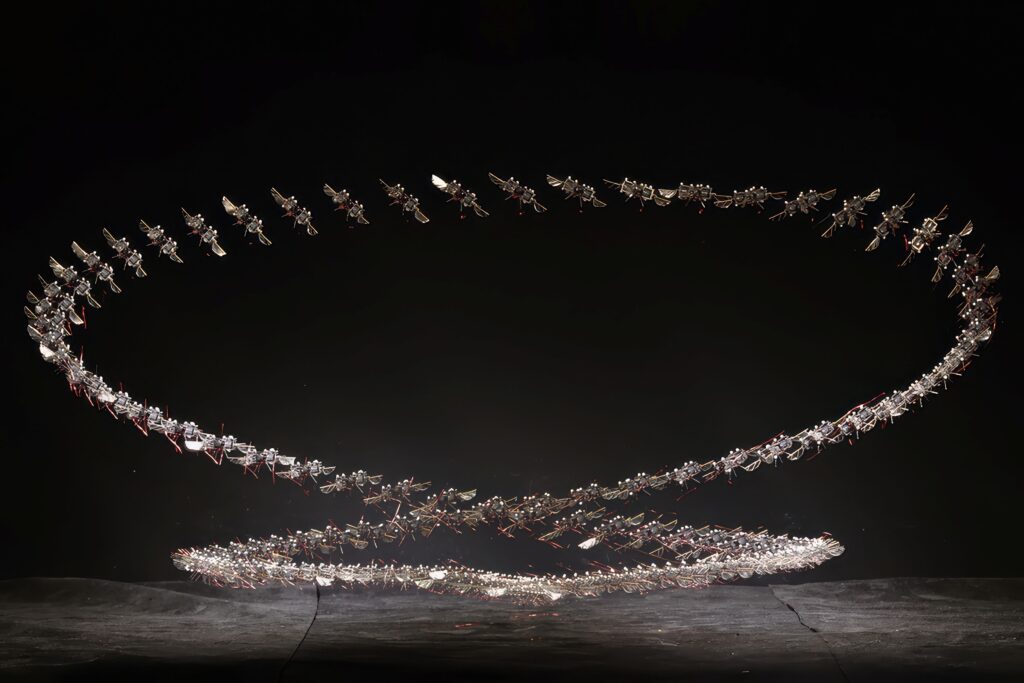
(Image: MIT)
An AI controller has been developed to drive aerial microrobots with speed and agility similar to real insects, writes Nick Flaherty.
The controller, developed at the Massachusetts Institute of Technology (MIT), allows the robots to perform gymnastic flight paths, including continuous flips. The two-part control scheme combines high performance with computational efficiency and is agile enough to complete 10 somersaults consecutively in 11 s, even when wind disturbances threatened to push it off course.
“We want to be able to use these robots in scenarios that more traditional quadcopter robots would have trouble flying into, but that insects could navigate. Now, with our bioinspired control framework, the flight performance of our robot is comparable to that of insects in terms of speed, acceleration and the pitching angle. This is quite an exciting step toward that future goal,” said researcher Prof Kevin Chen, head of the Soft and Micro Robotics Laboratory within the Research Laboratory of Electronics (RLE) at MIT.
“The hardware advances pushed the controller so there was more we could do on the software side, but at the same time, as the controller developed, there was more they could do with the hardware,” said Prof Jonathan How in the Department of Aeronautics and Astronautics and a principal investigator in the Laboratory for Information and Decision Systems.

For the first step, the team built a model-predictive controller. This uses a dynamic, mathematical model to predict the behaviour of the robot and plan the optimal series of actions to safely follow a trajectory.
This is computationally intensive but can plan challenging manoeuvres such as aerial somersaults, rapid turns and aggressive body tilting. This planner is also designed to consider constraints on the force and torque the robot could apply, essential for avoiding collisions.
“If small errors creep in and you try to repeat that flip 10 times with those small errors, the robot will just crash. We need to have robust flight control,” said How.
The planner is used to train a policy based on a deep learning model, to control the robot in real time, through a process called imitation learning. This compresses the controller into a computationally efficient AI model that can run very fast with just enough training data for the aggressive manoeuvres.
The researchers were also able to demonstrate saccade movement, which occurs when insects pitch very aggressively, fly rapidly to a certain position and then pitch the other way to stop. This process of rapid acceleration and deceleration helps insects localise themselves and see clearly.
“This bio-mimicking flight behaviour could help us in the future when we start putting cameras and sensors onboard the robot,” said Chen.
UPCOMING EVENTS