









Space rotorcraft
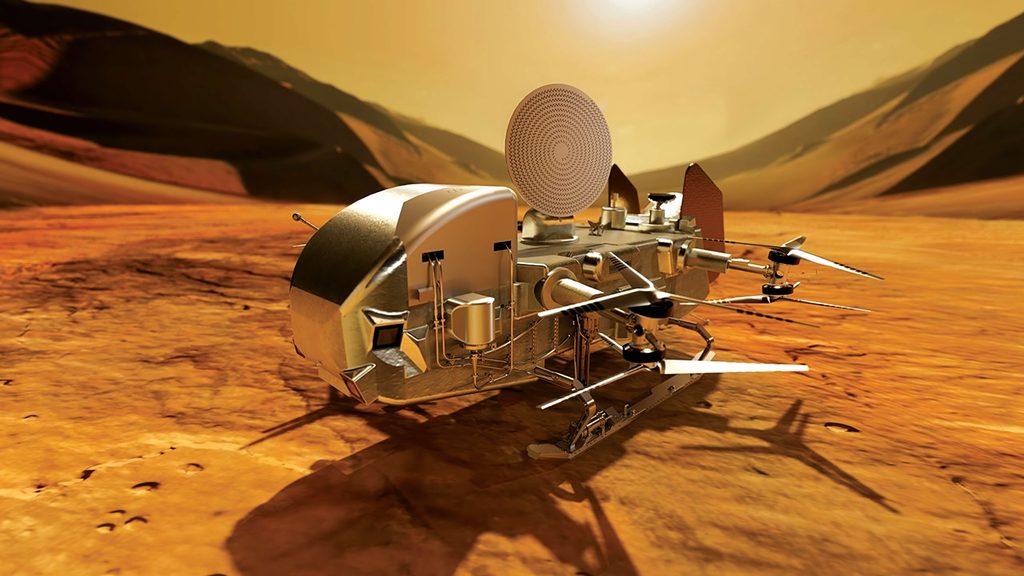
(Image: NASA / Johns Hopkins APL)
Propelling exploration
The success of the Ingenuity rotorcraft mission on Mars has put significant focus on the use of rotorcraft for exploring distant planets. Nick Flaherty reports
The next generation of rotorcraft for Mars, called Skyfall, is taking a different approach to deployment and operation, with new components such as propellers and radar systems being developed. At the same time, a rotorcraft is being assembled for a mission to explore the surface of Titan, the largest of Saturn’s moons.
Dragonfly on Titan
Dragonfly is a 3.85 m long nuclear-powered rotorcraft that is scheduled to launch in 2028 for a six year voyage.
The 875 kg rotorcraft has eight sets of 1.35 m coaxial blades, and it will conduct a 3.3 year mission to explore a range of environments from organic dunes to deposits associated with an impact crater – Selk Crater – where liquid water and complex organic materials once existed together.
Titan’s dense, calm atmosphere and low gravity make flying the ideal way to travel to different areas, freeing Dragonfly from constraints a rover would face trying to travel over the moon’s potentially rough and sandy terrain.
Dragonfly can cover tens of kilometres in under an hour, enabling it to travel to 20–30 different sites during its primary mission, covering about 70 miles (115 km) from its initial landing site.
The low solar illumination on Titan means Dragonfly will use a Multi-Mission Radioisotope Thermoelectric Generator (MMRTG), similar to the system used by NASA’s Curiosity and Perseverance rovers on Mars.
The MMRTG uses nuclear energy to produce a consistent power source alongside a 134 Ah battery. Communications will be via NASA’s Deep Space Network using large-gain and medium-gain antennas, a 100 W travelling-wave tube amplifier and an X-band radio developed by Johns Hopkins Applied Physics Laboratory (APL) in Laurel, Maryland (USA), where the craft is being assembled.
“It was pretty awesome to see the lander, as we designed it, become real,” says Hunter Reeling, Dragonfly thermal-mechanical integration and test lead from APL.
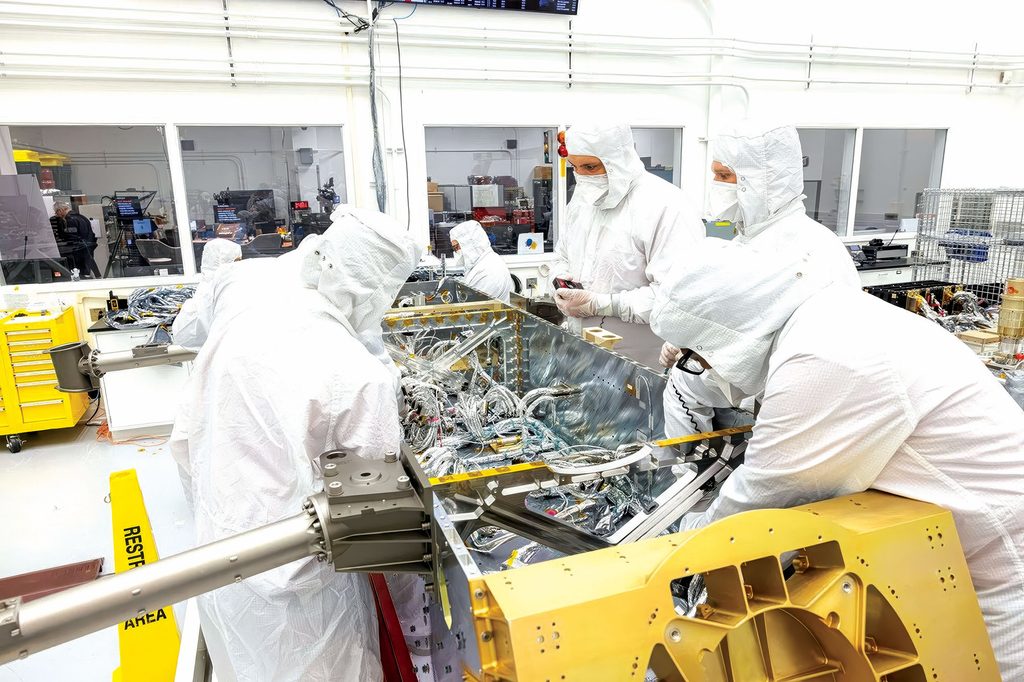
With structural testing complete and the fuselage delivered, the team started integrating the mechanical, thermal and electrical systems, starting with the wiring harness, cables and connectors that tie Dragonfly’s systems together. Electronics boxes, avionics and science instruments will follow as mission partners across the country complete their own assembly and test campaigns.
“From here, it’s about populating that structure with electronics boxes, instruments, wiring, insulation – everything that will enable its mission,” says Reeling.
Dragonfly’s operating environment on Titan poses some unique challenges. The design is insulated to retain heat from its nuclear power source and stay warm in Titan’s extremely cold conditions. So, the electrical harness had to be designed to route under a layer of thick foam insulation on the outside of the lander and accommodate the circulation of that warm air through the inside. The rotorcraft’s high power demands require both approximately 21 and 8.4 mm² wire, yet the harness has to be flexible enough to weave through a packed interior that includes the flight system and instrument boxes, as well as a nearly 136 kg battery.
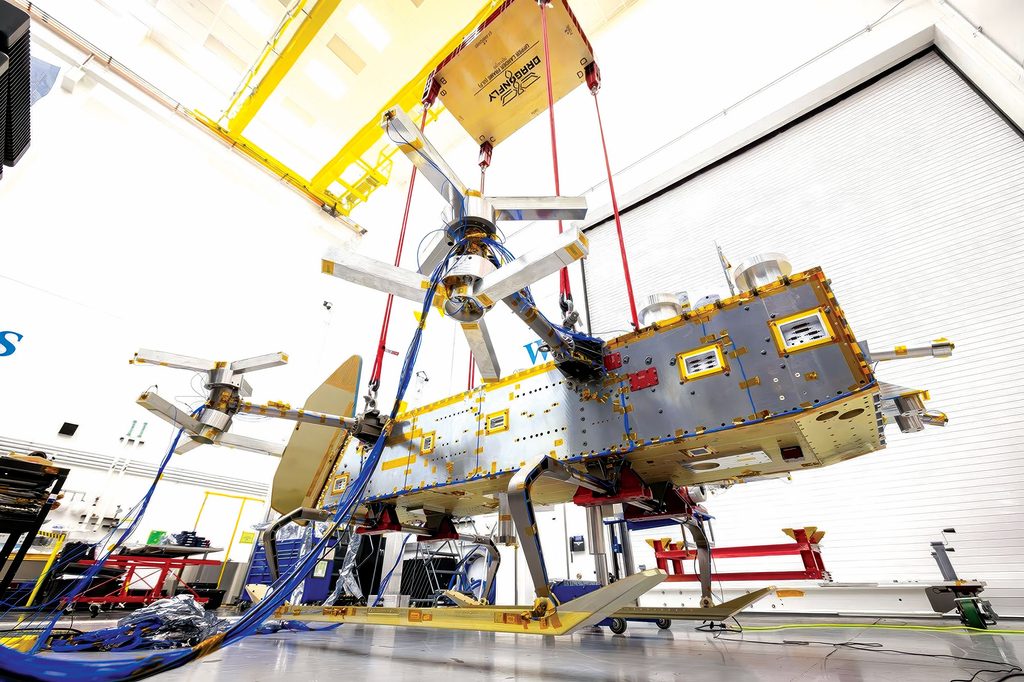
(Image: NASA / Johns Hopkins APL / Ed Whitman)
The electrical harness, assembled at APL, has to securely transmit power and data between the lander’s computers, actuators, sensors, scientific instruments and battery.
“The harness doesn’t do anything by itself, but it is necessary for everything else to function,” says Jackie Perry, Dragonfly lander harness lead at APL, which is the organisation responsible for designing, building and operating the rotorcraft for NASA. “It’s critical hardware that exists only to serve the rest of the lander. We can’t do anything without it.”
Perry’s team of engineers and technicians reached a major milestone in July when it installed the harness on the flight fuselage. “Once the flight structure was delivered and the remote interface units and temperature sensors were installed, we were able to start laying the harness,” Perry says.
The wiring harness is typically one of the first components delivered to a spacecraft. Dragonfly passed its critical design review in 2022; fabrication began in late 2024 and finished about a year later. The wire is silver-coated copper, insulated in a heat-resistant, durable polymer coating and wrapped with aluminium, which is then attached to plastic and metal connectors. Dragonfly is scheduled to launch in summer 2028 and reach Saturn’s moon Titan in late 2034.

The high-gain antenna is a disc that is 87.4 cm wide. It is made of electrically insulating foam sandwiched between two metal plates that contain hundreds of small slots. Together, these slots will narrow and focus the radio beam back to Earth. Adapted from technology originally developed for planetary defence applications, Dragonfly’s high-gain antenna – larger than that of previously flown systems – is attached to a motorised arm that will raise the antenna when the rotorcraft is stationary and lower it into a locking mechanism before Dragonfly takes off again.
“Every time the lander prepares to fly to another location, we store the antenna so it survives the vibrations created during flight and prevents resonance that could interfere with the rest of the lander,” says Jackson Banbury, Dragonfly telecommunications mechanical and thermal lead at APL.
The antenna and its gimbal are designed and tested to endure the rigours of Titan’s environment, including frigid temperatures that average around −179 C, swirling dust on the surface and potentially liquid methane rain.
Vibration and sealing tests are designed to show that the fuselage’s structural backbone can withstand the loads of launch, entry through Titan’s atmosphere and landing on the surface of this ocean world.
For vibration testing, the team installed mass simulators in place of the flight instruments and electronics being built and tested elsewhere. The ground vibration test gave the team a fleeting preview of Dragonfly in the air. Engineers used long bungee cords to suspend the rotorcraft’s structure a few centimetres off the ground, and then measured how mechanical vibrations at the rotor locations travelled through the frame to key sensors on the main body.
(Image: NASA / Johns Hopkins APL / Ed Whitman)
“Suspended for a few hours during that test – even barely above the floor – was structurally akin to Dragonfly’s first flight,” says Gordon Maahs, the Dragonfly mechanical systems engineer from APL. “It gets the imagination going about what actual flight will look like.”
The test also included a ‘sit down’ configuration, whereby the lander was lowered onto protective padding so that it rested on its skids while engineers measured how the structure would respond on Titan’s surface.
Most planetary spacecraft are built for the vacuum of space or worlds with thin atmospheres. But Dragonfly is headed to Titan, where the surface atmosphere is dense, cold and about 1.5 times the pressure of that on Earth, so engineers needed to understand how well the assembled structure could keep that environment out. The solution: pressurise Dragonfly’s outer structure to identify any gaps, cracks or holes that could allow air to flow in and/or out of the lander on Titan.
“I’ve never seen a test like it on any other spacecraft,” Maahs says. “We get a total flow rate based off of the sealing test, and that feeds our thermal analysis to determine if we’re sealed enough.”
Instruments
The Dragonfly mass spectrometer (DraMS) is being developed by NASA’s Goddard Space Flight Center and the Centre National d’Etudes Spatiales in France, while a gamma-ray and neutron spectrometer, which will be used to measure elemental surface composition including minor inorganics and classify surface materials, is being developed by Johns Hopkins APL and Lawrence Livermore National Laboratory.
A camera suite developed by Malin Space Science Systems in San Diego, California (USA), will characterise landforms and surface processes at multiple scales through surface and aerial imaging, and the rotorcraft includes a system to drill, sample and pneumatically transfer surface material to the DraMS. This is being developed by Honeybee Robotics, which is a Blue Origin company.
Testing of the foam coating that will insulate the rotorcraft from Titan’s frigid temperatures continues in the Titan Chamber at APL. The flight radio has been delivered, and additional flight systems are scheduled for delivery and testing within the next six months.
Dragonfly integration and testing will continue at APL through 2026 and into early 2027, when system-level testing is planned at Lockheed Martin. Later in 2027, the lander will return to APL for final space-environment testing before heading to NASA’s Kennedy Space Centre in Florida (USA) in spring 2028 for launch aboard a SpaceX Falcon Heavy rocket.
“We’ve spent years designing and refining this amazing rotorcraft on computer screens and in laboratories, and now we get to bring all those elements together and transform Dragonfly into an actual flight system,” says Annette Dolbow, the Dragonfly integration and test lead at APL.
Mars Skyfall
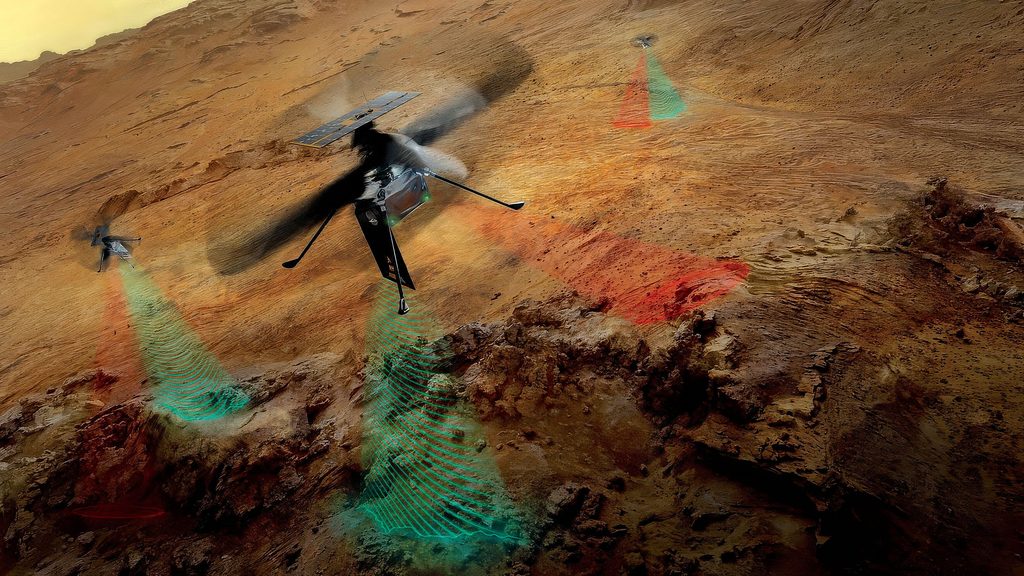
The next generation of rotorcraft for Mars will use or adapt proven features and capabilities from the Ingenuity technology demonstration. These include the structure, rotors, motors, landing gear, flight software and autonomous navigation.
Significant improvements in the Ingenuity design were subsequently made through development work on a sample rotorcraft design to scale up the lift capacity, partially by increasing the size and speed of the rotor blades. That carrying capability now allows SkyFall to carry the ground-penetrating radar (GPR)and other scientific instruments.
(Image: NASA)
A separate technology development is an ultra-low-mass direct-to-orbit communications radio, which allows the SkyFall rotorcraft to operate independently by transmitting commands to/from Earth via Mars orbiters rather than relaying via a rover or lander, as Ingenuity did.
The 5 kg Skyfall rotorcraft measures 24.5 x 22 x 21.5 cm with two counter-rotating blades, each 1.35 m in diameter.
AeroVironment (AV) of Arlington, Virginia (USA), is co-designing and co-manufacturing the rotorcraft with NASA’s Jet Propulsion Laboratory (JPL). The AV engineers previously worked with JPL to design and build the Ingenuity rotorcraft.
A fission-powered interplanetary spacecraft, SR-1 Freedom, will deliver the SkyFall payload and will release three rotorcraft into the atmosphere – reduced from the original plan for six craft. A parachute and then braking rockets will slow the descent, leaving the three craft to fly off and land individually.
Each craft will carry an advanced instrument package featuring GPR and imagers, and they will be also capable of measuring air temperature, together with wind speed and direction. The radar will collect data about subsurface features that can be combined with data from the imagers, which could help map the terrain and characterise environments on Mars that are different from those explored before. If subsurface ice is detected, these measurements may help determine its extent and depth, which could help scientists understand potential formation mechanisms and implications for Mars’ climate history.
During a single flight of approximately 2.5 minutes, one SkyFall rotorcraft is expected to cover about 1–2 km of Martian surface, and each craft is equipped with a suite of integrated operational and scientific instruments.
The compact GPR is designed to characterise subsurface geological structures and detect the presence of ice at depths of 0.5–3.0 m, while 13 megapixel colour cameras will capture overlapping mid-flight views, generating centimetre-scale 3D terrain maps. This data will be used to determine fine-scale surface details and geological changes over time, while identifying small hazards to certify safe landing zones for future crewed missions to Mars.
A specialised near-IR camera will analyse the composition of Martian regolith on the surface and characterise these features beyond the visual spectrum. Specialised sensors will profile ambient air temperatures, and by leveraging the platform’s unique ability to hover, the helicopters will measure wind speed and direction across various elevations.
(Image: JPL)
A dedicated COTS micro dosimeter will systematically measure and record total surface ionising radiation doses to assess long-term safety environments for human explorers. Combining multi-altitude wind data with visual and infrared imaging will provide insights about dust-transport mechanisms across the Martian surface.
Rotors
The atmosphere on Mars is only 1% as dense as that on Earth, so maximising the thrust from the rotors requires pushing blade tips towards the speed of sound to achieve significant lift. While Mach 1 on Earth at sea level is approximately 1223 kph, the speed of sound on Mars is significantly slower – roughly 869 kph.
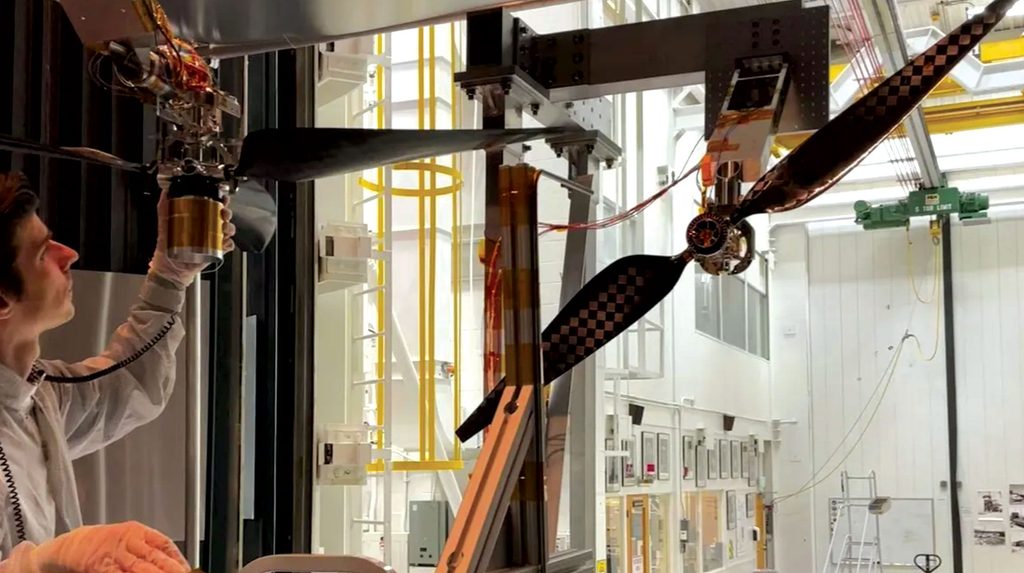
To support heavier payloads, a three-bladed rotor was developed and manufactured by AV using data from 137 test runs. The tests in the environment chamber took the rotor to 3750 rpm, or Mach 0.98, with engineers activating a fan inside the chamber to create headwinds, increasing the wind velocity. This pushed rotor tip speeds to Mach 1.08, boosting the lift capability of the helicopter by 30%.
Another two-bladed rotor was designed to be slightly longer than the three-bladed version, so speed of only 3570 rpm was needed to achieve the same near-supersonic speed at the rotor tips prior to introducing the headwinds.
“The successful testing of these rotors was a major step toward proving the feasibility of flight in more demanding environments, which is key for next-generation vehicles,” says Shannah Withrow-Maser, an aerodynamicist from NASA’s Ames Research Centre in Silicon Valley and member of the test team. “We thought we’d be lucky to hit Mach 1.05, and we reached Mach 1.08 on our last runs. We’re still digging into the data and there may be even more thrust on the table.”
“With Ingenuity, we proved we could fly on Mars. Now, with SkyFall, we’re taking a high-volume uncrewed systems mindset into planetary exploration and showing that Mars helicopters can be built as a repeatable product line, not a one-off delivery,” says Jeff Rodrian, head of MacCready Works, the advanced research group at AV.
Radar
The faster rotor speed allows Skyfall to carry a new radar system.
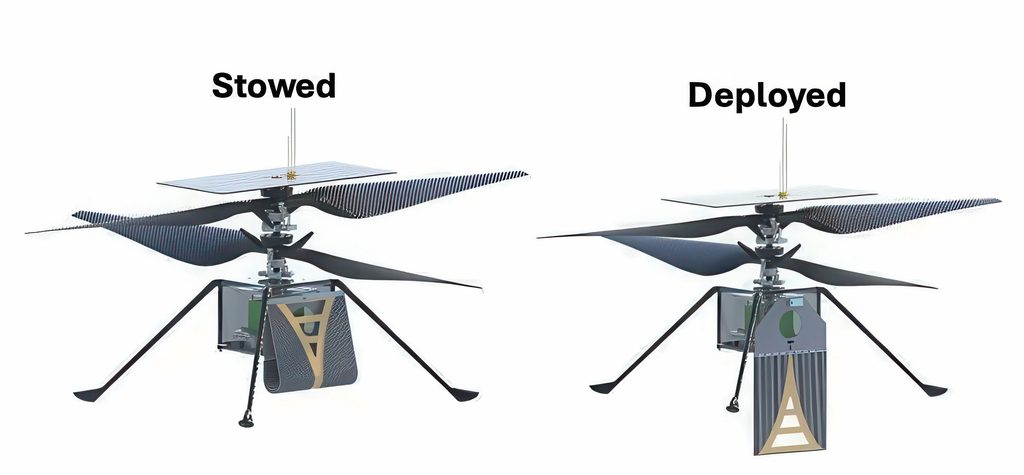
One of the key tasks of the mission is to look for frozen water using GPR. For that radar to work, each rotorcraft will carry a flexible, fabric-based antenna that will need to extend below the aircraft without interfering with landings or breaking upon impact.
Although orbiting spacecraft can map the thick Martian ice deposits tens of metres below the surface, they’re effectively blind to the top several metres of regolith, or broken rock and dust. This shallow zone is what will matter most for future astronauts, who will need to easily reach and process ice for water, oxygen and fuel.
“The only way to detect shallow subsurface ice remotely is to fly close to the ground,” says Adrian Tang, SkyFall’s GPR lead instrument scientist at JPL. “By flying low and slow, a SkyFall helicopter could capture radar images that resolve the fine layering where dry soil gives way to ice, detecting its presence and mapping its extent.”
(Image: JPL-Caltech)
The GPR will use an ultra-wide frequency range from 500 MHz to 2.5 GHz. The longest wavelengths can penetrate several metres below the surface. The shorter wavelengths provide finer detail about the uppermost layers and surface texture.
This is where the antenna design comes in. A traditional antenna operating in that part of the electromagnetic spectrum would need to be 48.3 cm long and have a clear view of the ground, but the minimum clearance between Mars’ surface and the base of the helicopter’s fuselage is only about 15.2 cm. Therefore, the team needed an antenna that wouldn’t interfere with or be damaged by landing.
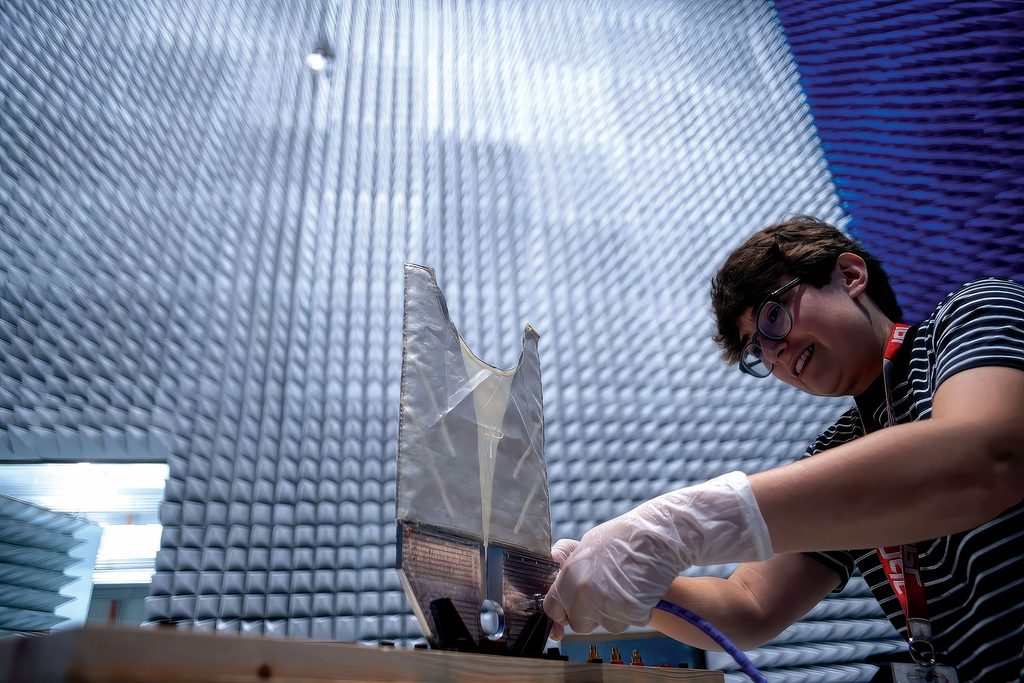
The antenna, called Vivaldi because it looks like a violin, can transmit and receive signals across a large, continuous range of radio frequencies, and its flat, lightweight profile can be easily cut into flexible, metalised fabrics.
While the standard footprint of the original design was efficient and robust, it was still too large to work with SkyFall’s ground clearance. However, the dry Martian regolith blocks radio waves far less than Earth’s soil, so the team developed techniques to reduce the antenna’s size even more without sacrificing sensitivity.
“Although we managed to shrink the antenna quite a bit, it is about one and a half times longer than the helicopter’s legs,” says Christine Gebara, SkyFall GPR mechanical lead at JPL. “That means during landing that Vivaldi has to bend out of the way – and if it lands on a rock, it bends even further. But when the helicopter takes off again, the antenna must spring back into place for data collection. Because SkyFall is expected to make dozens of flights exploring Mars, we needed an antenna that could repeatedly handle those pressures without losing its shape in flight.”

To ensure their downsized Vivaldi could withstand flight operations, the team sheathed it in polyester and then layers of Vectran, the flexible, superstrong material used for the landing airbags containing NASA’s Spirit and Opportunity Mars rovers. To help the antenna maintain shape while airborne, engineers added flexible fibreglass tape springs and a lightweight magnesium mounting structure. The entire set-up weighs about 150 g, slightly more than two violin bows.
Working in JPL’s Environmental
Test Laboratory, engineers bent the antenna to simulate one possible orientation after a SkyFall flight at Mars. Then, they ran it through dramatic thermal shifts to simulate the Martian day–night cycle, during which temperatures can swing by as much as 94 C. Repeatedly flexing the antenna replicated dozens of landings, with tests in an electromagnetic test chamber to verify that its ability to beam and receive radar signals hadn’t diminished.
By the end of the test campaign, the antenna had withstood 200 simulated Mars landings, more than double what would be required for a successful prime mission, with no loss of performance.
“This test checked every box it was supposed to and answered our biggest technical questions,” says Tang. “While we still have work ahead of us before the antenna is fully flight-qualified, this was a major milestone and the hardware performed exactly as expected.”
SkyFall is expected to launch aboard NASA’s Space Reactor-1 Freedom in late 2028 and release the rotorcraft on Mars 660 days later.
UPCOMING EVENTS