






AIE 40ACS Wankel rotary
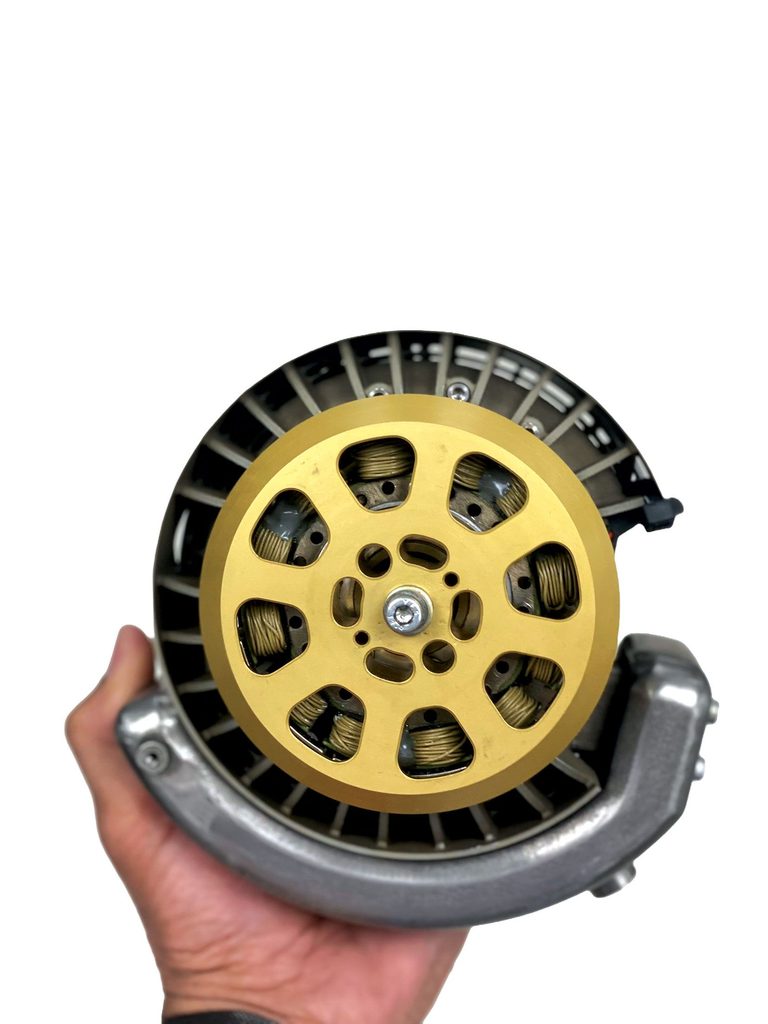
(All images: AIE)
This SPARCS joy
Additive manufacturing, well-informed engineering decisions and some creative design work helped make this engine – the smallest professional-grade turnkey Wankel commercially available. Rory Jackson investigates
We first covered the UK-based Wankel rotary manufacturer Advanced Innovative Engineering (AIE) a little over 10 years ago. That article (Issue 007, Apr/May 2016) featured a deep dive into AIE’s first UAV engine, the 225CS, so-named for its functional displacement of 225 cc and for its leveraging of a patented cooling system termed ‘Compact SPARCS’, meaning an integrated size-optimised variation of the company’s Self-Pressurising Air Rotor Cooling System.
The company’s founding, a few years prior to the publishing of that article, was driven by opportunities opened up in the UAV space both by the ownership of such technologies and by the inherent advantages of Wankels in high-rpm, small-to-medium aircraft applications. Small aerospace Wankels can compete effectively with four-strokes owing to the former’s capacity for high brake mean effective pressure (BMEP) and volumetric power density, and low specific fuel consumption (SFC) and vibration, as companies like AIE have proven with their range of successful customer integrations and partnerships over the past decade.
Following the 225CS’s launch as a successful showcase of SPARCS’s performance and reliability benefits in a form factor suited to the tactical UAVs of the time, AIE went on to explore the full extent of where it could take its Wankels. It first scaled up to the 650S, a 650 cc engine designed according to SPARCS in its non-compact form, since replaced by a 650CS solution and now powering UAVs at the maximum practical size of a liquid-fuelled, single-rotor Wankel (anything significantly larger and such a design may experience combustion inefficiencies leading to efficiency losses).
Scaling down, however, posed a more daunting and tantalising challenge. The number of small, industrial-grade UAV applications (particularly made by companies seeking efficient, low-vibration hybrid range extenders) soared over the period 2016–2026, and as Saleel Panthakkalakath, executive director at AIE lays out for us, “While our larger 225 and 650 cc engines have principally competed with four-stroke UAV engines, a very small Wankel engine could similarly compete with two-strokes, matching their power densities and part counts while exceeding their vibration performance and consequently their ease and efficiency of mounting.
“Essentially, by providing a very small, lightweight engine with such low vibration that it could be mounted on normal rubber dampers, we could eliminate the need for very complex, technical, and weight- and cost-inefficient mounting systems on small UAVs; it posed a potentially huge advantage over two-strokes in those kinds of integrations.”
However, unlike larger Wankels for which there were precedents such as Mazda’s various 654 cc ‘cylinder’ engines, very few Wankels historically went smaller than 100–200 cc. But after some conceptual R&D, the company felt confident in pursuing a 40 cc engine – equating to an estimated 5 hp – because going any smaller would lose out on marginal efficiency gains, both from SPARCS and other factors (much like exceeding 650 cc).
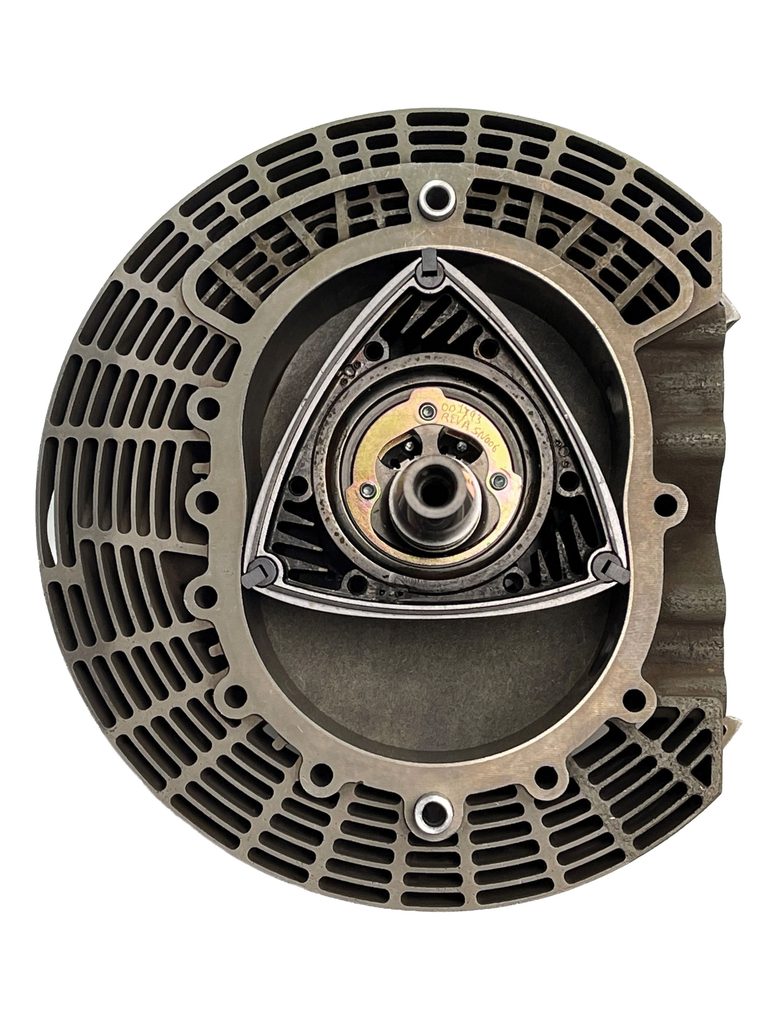
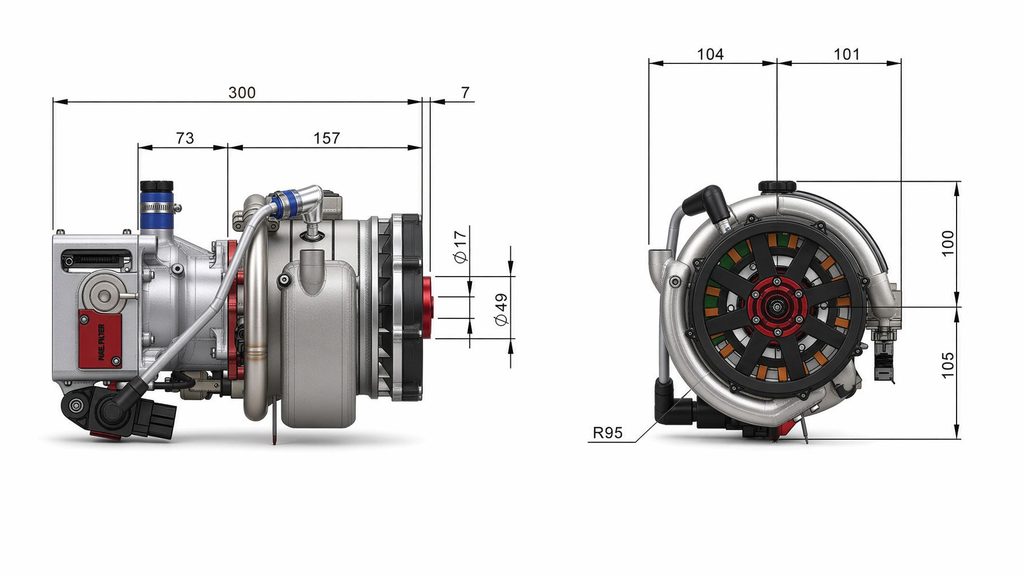
The result of much iteration and engineering since then has been the 40ACS, first unveiled in late 2024 as an air-cooled, normally aspirated, spark-ignited Wankel. The core engine weighs 2 kg, measures 195 x 172 x 163 mm at maximum dimensions, consumes between 310 and 350 g/kWh, and has proven output of 5 hp (3.7 kW).
It is electronically fuel-injected with multiple compatible fuels (inherently tolerant as Wankels are of differing fuel types), and though AIE preferentially runs it on JP-8, it can be re-optimised for various kerosene and gasoline grades upon request.
As Nathan Bailey, managing director at AIE says, “Right now, the 40ACS’s active customers have it in pusher propeller and hybrid applications, although across the board around 95% of what we supply is now hybridised applications.
“So, while the 40 cc seems a little more demanded by companies making fixed-wing UAVs with rear engines at the moment, we’re now very well-versed in hybrid configurations, especially for multi-rotors, and we can accommodate most any request in that regard from prototype through to batch and serial output.”
To AM
Two technologies were central to the design, engineering and optimisation of the 40ACS. The first was the aforementioned SPARCS or Compact SPARCS; as a reminder, SPARCS technology resolves the challenge of cooling the Wankel’s (otherwise overheated and stressed) rotor by recapturing blow-by gases that otherwise escape into the engine’s core past the rotor side seals, and recirculating them via an internal (and crankshaft-driven) centrifugal fan in a closed-loop air-cooling circuit.
While this also reduces the oil consumption that conventional Wankels are known for, most critically, the recirculating gases pass through the rotor rigorously absorbing its heat, thanks in part to being pressurised (pressure increases as engine combustion pressure increases), with this heat then being dissipated via a heat exchanger through which the gases are subsequently ducted.
In SPARCS, this heat exchanger sits outside the engine; in Compact SPARCS, the heat exchanger is installed inside the engine, placed on the cold side of the engine (outside the third of the trochoid chamber corresponding to the air–fuel intake). Advantages of the latter include its smaller overall footprint when accounting for the ancillary systems, and its potentially longer TBO owing to the reduced thermal differential around the trochoid circumference extending the lifespan of the Wankel’s largest single component (especially because a single liquid-cooling loop can then be shared across the powertrain).
The former, however, offers better flexibility with respect to choosing or sizing the external heat exchanger to match the application because Compact SPARCS’s internal heat exchanger (and, if desired, liquid-coolant passages) must be permanently machined or casted in place. That significantly limits the reconfigurability of Compact SPARCS-based engines, and demarcates something of a minimum volume requirement before investing in casting moulds as the engine design gets smaller, owing to the design intricacy and complexity of optimising the SPARCS parts at very small sizes.
Hence, the first 40 cc attempted was actually a 40S – not a 40CS – as tested and showcased in late 2016 with a liquid-cooled heat exchanger on the housing and an additional liquid-cooled radiator separate from the engine. While it sold well to some aerospace, marine and terrestrial applications, AIE soon determined that its small UAS target market found the overall powertrain too heavy (at roughly 6.5 kg for its 5 hp output) and complex a proposition, relative to the simple, turnkey two-strokes that such integrators were used to being able to plug and play on their drones.
“It was around five years ago that we decided to reopen the 40 cc development project, but by approaching the challenge from a completely different angle: namely, entirely air-cooling the engine to shed its weight right down and make it as integrationally simple as possible,” Bailey says.
Ironically, the key to such simplicity was ensuring highly complex internal and external part geometries to facilitate or even exceed AIE’s targets for optimising cooling, gas recirculation, packaging, intake and exhaust. Achieving such geometries at prototyping or even sizeable batch volumes would be inordinately expensive via casting, and CNC machining posed too wasteful an approach (and potentially unreliable, given that very small, intricately milled parts may deform and re-set unpredictably from the thermic effects of CNC’ing).

Hence, the second of the 40ACS’s core empowering technologies: additive manufacturing (AM). Laser-sintering metals to tight tolerances stood to provide both reliable and highly creative solutions to the engine’s unique thermal and CFD needs; however, it was also a much loftier proposition and a rarer area of expertise in 2021.
AIE therefore engaged with programs such as the Digital Reconfigurable Additive Manufacturing facilities for Aerospace (or DRAMA), learning from AM experts on engineering feasibility, materials, heat treatments, and thermal and CFD studies. That led to a first printed iteration of housing components consistent with the company’s SWaP targets for the engine, which were thereafter assembled and bench tested in a very effective proof of concept, validating the great potential AM posed for remaking the 40 cc engine.
“We’d had concerns going in, for instance if our molybdenum or nickel silicon carbide layers would stick where we needed them to, but the overall quality of that first iteration honestly exceeded our expectations,” Bailey recounts.
“That drove us to try printing other parts, and the steel rotor became a big target as that really drives Wankel engine prices to a significant degree – much more so than the housing – largely due to the many stages of rotor manufacturing including multiple grindings, heat treatments and QC needed.”
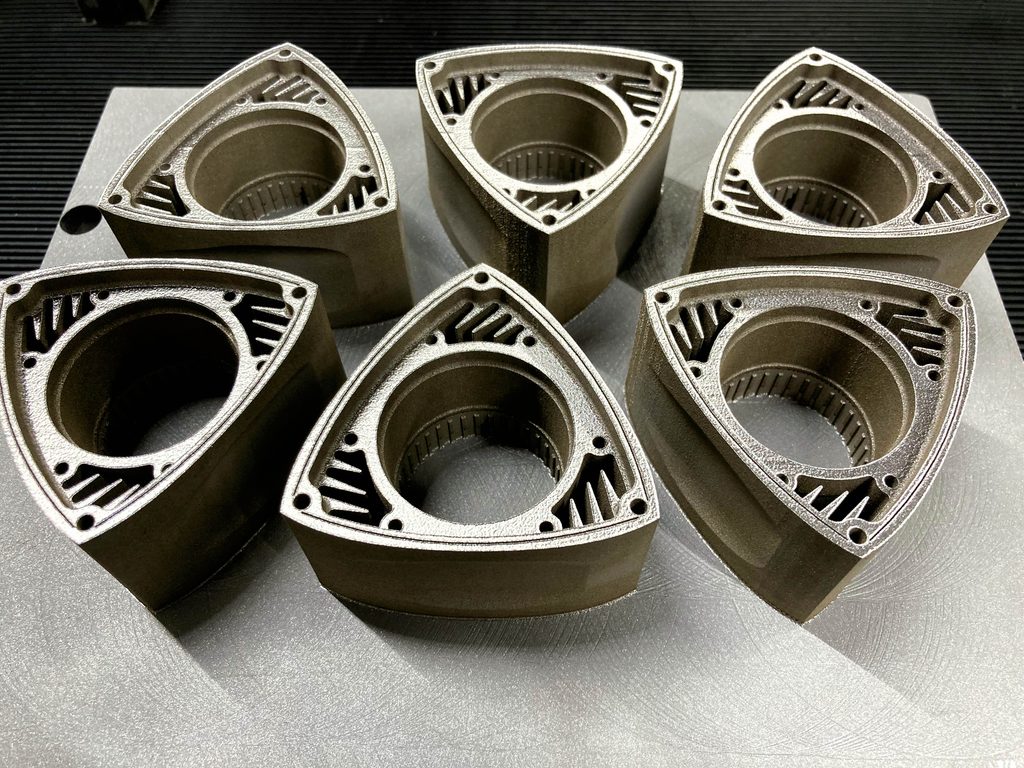
AIE subsequently confirmed in 2024 (in partnership with researchers at Wolverhampton University in the UK) that the rotor could be printed from an ideal choice of steel, while also being redesigned for improved weight, strength and other crucial performance factors unlocked through the geometric complexity easily accessible through AM. The rotor was then subjected to a machine finishing, dialling back its many production stages to just two.
The printed rotors will soon be bench tested as part of complete engine assemblies, having been validated in other ways amid AIE’s many other R&D, manufacturing, commercialisation, integration and maintenance focuses – among which were successful AM of intake manifolds, exhausts and ancillary system mounting assemblies.
“AM allows us incredible design flexibility, especially by rapidly printing new types of components, mountings and so on. We started working on different customer configurations after 2024, picking up our first contracts in early 2025 before really starting to engage with long-term platform supplier relationships in 2026,” Bailey continues.
“Much of that meant tuning the engine to operate on heavy fuels, but the big thing has been enabling the 40ACS’s plug-and-play capability, by which it comes with its own mounts, fuel connectors and electrical connectors. Integrators just bolt it into the vehicle, plug two electrical connectors and a fuel connector in, and it’s ready to fly!”
Hence, the complete, plug-and-play 40ACS powertrain comes with a total weight (integrating and connecting all possible ancillaries) of 4 kg, rather than the 6.5 kg of the predecessor 40S.
Block printing
As the company discovered over the course of developing both the 40ACS and other AM-driven engines, the combination of AM with easily manifested CAD and CFD modelling greatly accelerated design and iteration processes, not only for core engine parts like housing plates and rotors, but also for ancillaries such as liquid-coolant pipes and thermostat housings.
“All of these components that would usually take multiple rounds of designing, fabricating and assembly to see if we could fit them into a very tight, turnkey-style space, we could instead just model, print and validate,” Bailey recounts.
“It helped that we’d meanwhile received a special contract for an air-cooled 225CS, which came to revolve around seeing how far we could exploit AM in engine making. [It] let us investigate some more exotic tech – like lattice-type heat exchange geometries – and gain incredible freedom with ways of designing or mounting all the ancillary items around the engine.

“So, engine production for us is largely no longer a question of whether or not we’ll use AM; it’s a question of how many units of something we’re going to make. If it’s anything less than a really huge order, we’ll almost certainly 3D print it.”
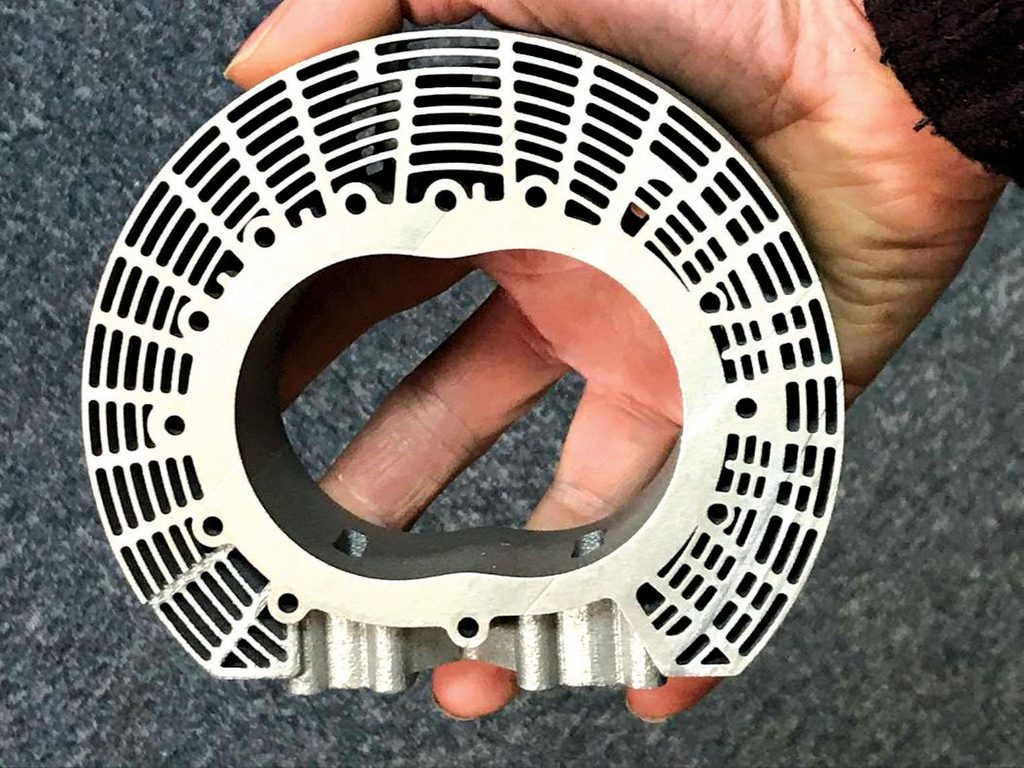
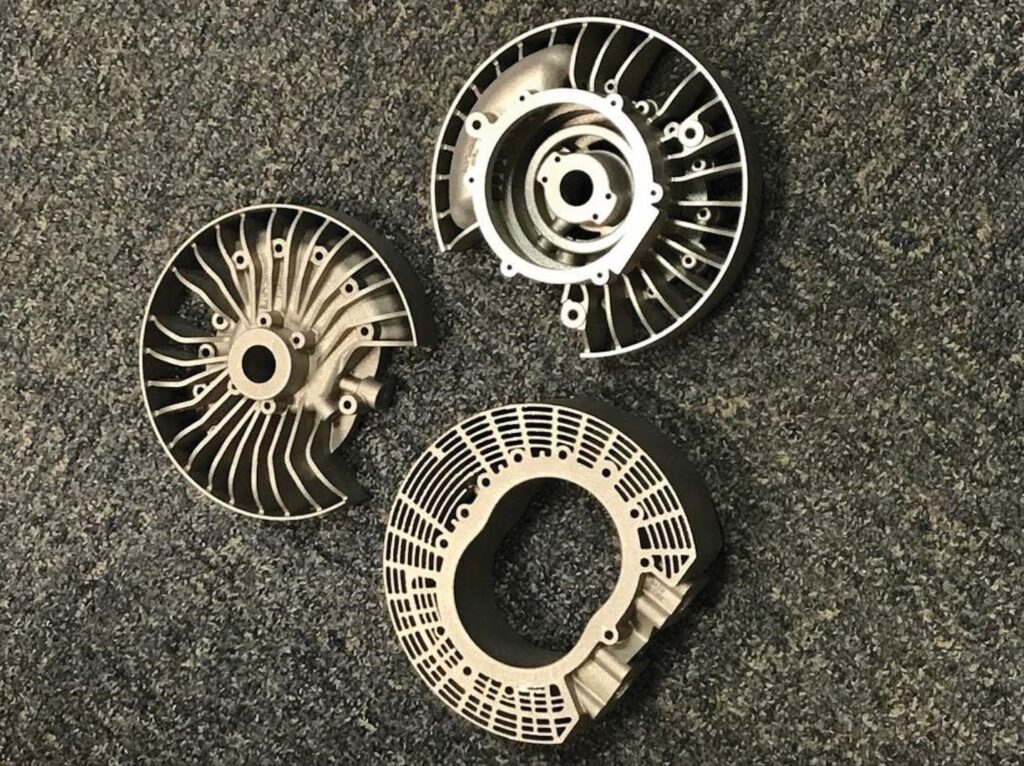
The 40ACS’s main housing – including its combustion chamber and internal heat sink – is formed from aluminium powder through laser powder bed fusion (LPBF), before being heat treated to consolidate and improve material density, potentially with multiple rounds of heat treatment to maximise stability.
AIE is presently, however, experimenting with CP1, an aluminium–iron–zirconium powder alloy, which was formulated for LPBF and is characterised by strong thermal and weight efficiency. “Printing in CP1 stands to eliminate one or more rounds of heat treatment from our overall housing production process, and result in parts that are really stable dimensionally, which is great because the bigger the component, the more challenging the heat treatment process,” Bailey adds.
As mentioned, the main C-SPARCS heat exchanger is integrated into the colder, intake side of the Wankel chamber. So, it greatly evens out the thermal differential (relative to the combustion and exhaust side) that typically occurs in air-cooled Wankels, as well as absorbing the heat extracted from the rotor. An additional heat exchanger is also positioned on the outside of that integral heat exchanger so that the heat can, at the very last, be released into the atmosphere.
“We’re not in favour of the classic Fichtel & Sachs method of charge-cooling the rotor because heating the intake charge before it reaches the combustion chamber counteracts the volumetric density and, hence, the potential energy needed for optimising your power density,” Bailey says.
“Even arguments that it’s good for heavy fuel don’t really hold water with us, as warmed charge is far more prone to knock, and there’s other considerations that we can get into if we have to. In any case, we don’t use our gases for heat extraction until after they’ve passed the point of their usefulness, so we don’t sacrifice any power density to cool our rotor or balance our housing temperatures.”
The 40ACS’s standard-issue inner heat exchanger is designed with a simple, linear geometry (resembling most heat exchangers), which has proven sufficient for cooling across all speeds and power bands, rather than needing to resort to lattice- or gyroid-type fins. Observing a cutaway of the housing allows one to see that the inner, SPARCS-critical heat exchanger provides a dense concentration of extractive structural elements about the intake portion of the housing circumference, while secondary heat extraction surfaces wrap evenly around both the main SPARCS exchanger and the rest of the trochoid chamber.
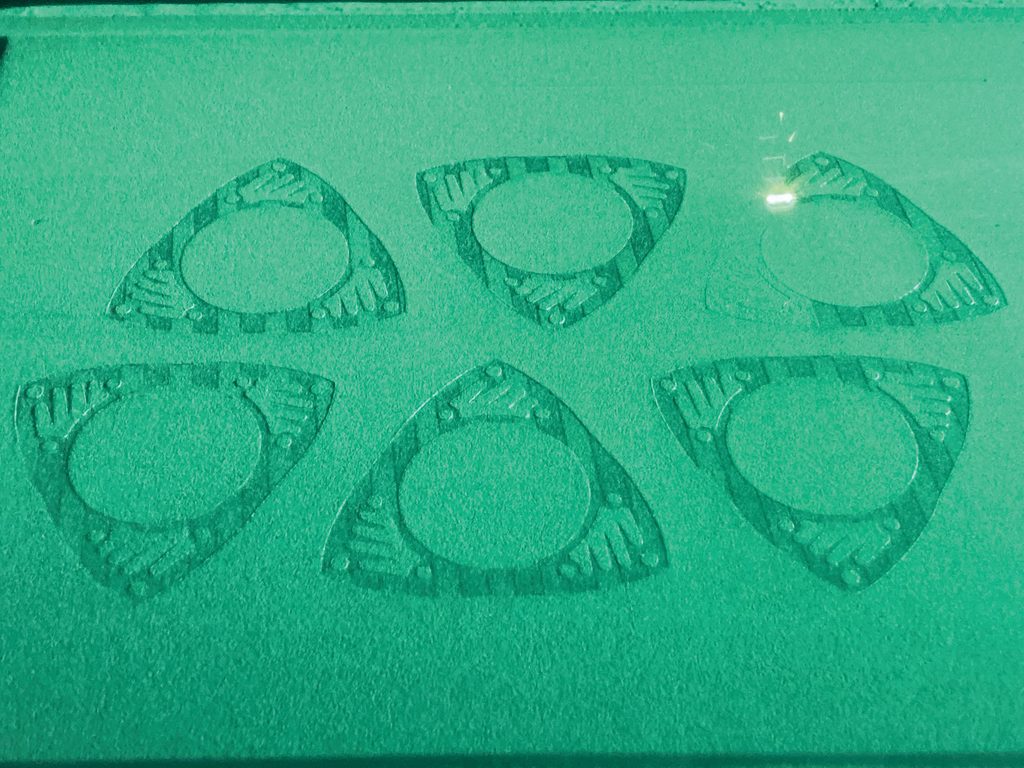
While AIE declines to reveal its printed component supplier, it notes that its machinery can print up to six rotors at once or a single housing with both of its end plates.
“AM has also gotten much faster than it used to be. We went from waiting for samples two days at a time in 2021 to just a handful of hours today, likely thanks to the newer machines packing multiple lasers working together,” Bailey muses.
Naturally, this has also accelerated AIE’s R&D loops, given that different engine sizes and trochoid dimensions (calculated through AIE’s proprietary mathematical approaches – which differ significantly from the classic Fichtel & Sachs dimensioning approaches used by a majority of Wankel suppliers) can be rapidly requested, received and bench tested in a growing variety of materials.
Packaging ancillaries
While the end plates are not complicated components, printing them means AIE can forego making casting moulds for them that could be disproportionately expensive (particularly in the absence of bulk orders), or CNC machining them from billet, which could be costly, time-consuming and materially wasteful.
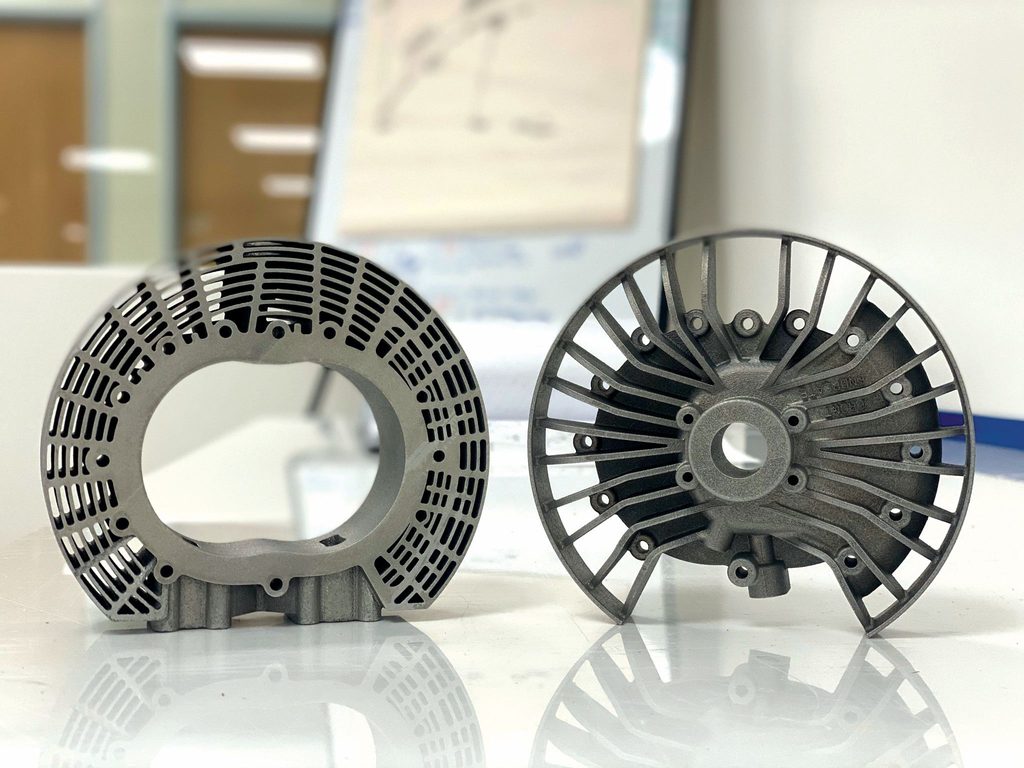
“Casting the end plates would also still require some machining to finish them afterwards, and anything we can do to reduce time-on-machine is great for reducing costs and lead times. So, printing them honestly makes the most sense,” Bailey adds.
AM also allows the company great flexibility in altering mounting points for generators, brackets for coils and other ancillary integration systems – it simply sends a new print job to the supplier and waits for the parts to arrive.
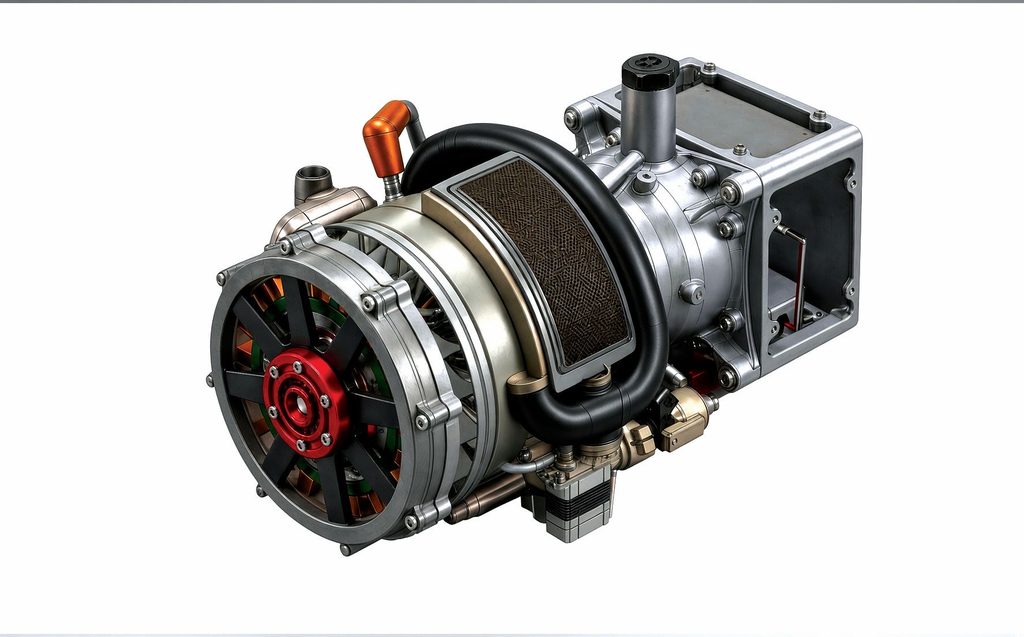
“As well as eliminating additional bracketry jobs that we’d otherwise have to make ourselves, that’s what’s allowed us to take the fuel pump, the ECU mount, the oil tank and all the rest, and bolt them all into a single-piece unit that wraps around the 40ACS, and just holds all the ancillaries in a single box, instead of having a mess of individual plates, brackets and so forth that each need to be mounted – somewhere – for us or the customer to have to figure out,” Bailey says.
“You could maybe machine something akin to that box from solid billet, but the cost would be unbelievable: you’d be removing 99% of the material! So, AM is genuinely the cheaper, more efficient way.”
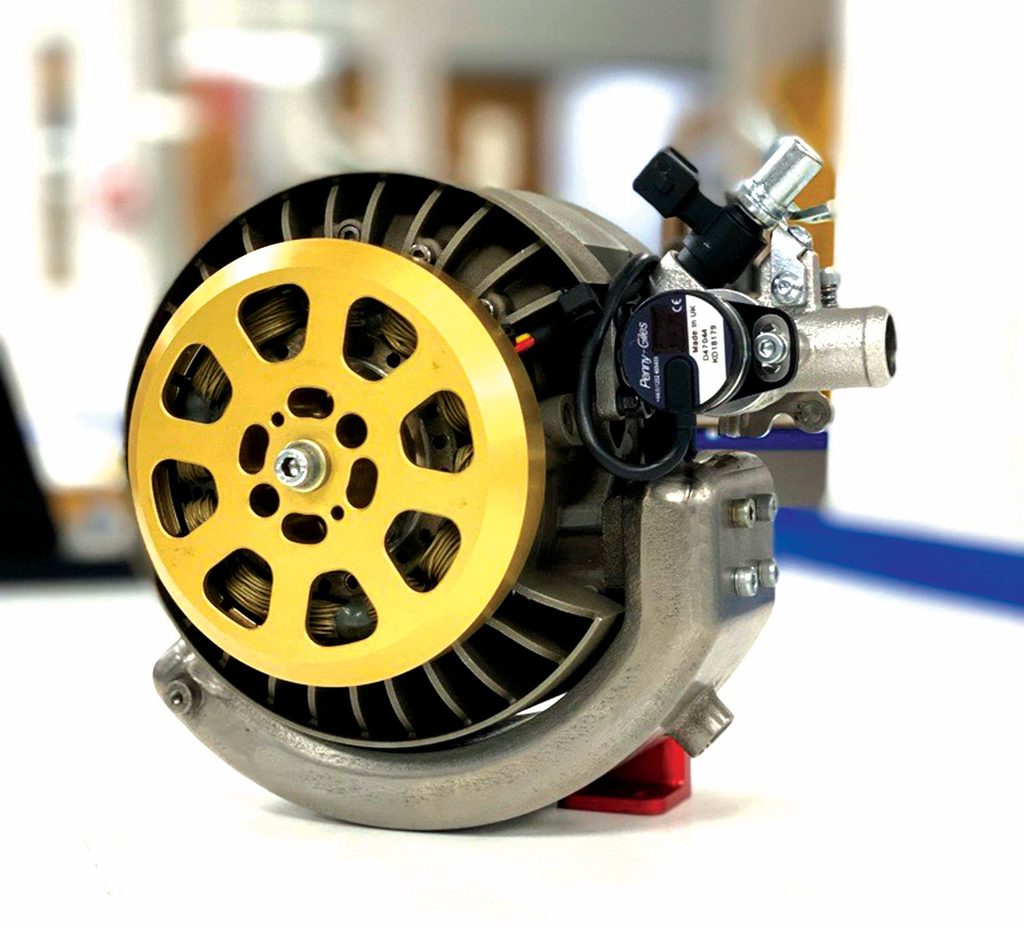
In its standard, turnkey configuration, the 40ACS’s intake and exhaust manifolds wrap concentrically around the main housing’s circumference at opposing sides – their shapes curved to match the engine’s cylindrical profile – while the choice of motor-generator mounts to a governor fastened on the power take-off.
“And the generator or alternator mostly just depends on how much electrical power and value for money the customer wants,” Bailey notes.
“We’ve worked with lots of different suppliers, for instance we’ve recently started working with ePropelled, we’ve done projects with Helix in the UK and we’ve done at least one system with Plettenberg for a customer.”
The air filter typically mounts conformally onto the intake manifold (the former designed with curvature to match the latter), with the cylindrical oil tank mounting directly behind the engine and the ancillaries box then bolting behind the oil tank. The box mounts the fuel pump, fuel filter, dry breaks for the fuel lines, pump control unit, pressure regulator, ECU and electrical connectors with a mount for the ignition coil at its underside.
“On top of housing all those ancillaries, the box also interfaces with the engine through the radial oil tank, but we’ve made the interfaces modular so that they’re semi-independent of each other,” Bailey continues.
“You can take the oil tank out, you could omit the box if you want to mount things differently and so on. The box and the oil tank are both additively printed, along with the housing, end plates, exhaust, intake and potentially the rotor soon too; AM really has driven the ability to customise any part as needed and then get it all really tucked-in tight.”
Rotors
Typically, AIE’s rotors are cut from billet as two pieces: an outer piece formed of three flanks from a strong but malleable choice of steel for withstanding combustion shocks, and an inner bush made from a steel that can be hardened to hold a needle bearing. Once both have been almost completely machined, the inner component is pressed into the outer and then pinned in place, before a final milling is performed to finish the rotor as a complete part.
“We’ve changed steel multiple times and can use a variety of grades, but there’s nothing in the rotary engine that requires pushing material capabilities too hard or chasing after very exotic materials; at the end of the day, it’s all just steels and aluminiums at its core,” Bailey muses.
The company continues to evaluate whether the additively printed rotors will become standard issue because the parts remain new relative to the 40ACS’s other printed componentry and will take further maturing. Early iterations included printing the rotor and its gear together as a single piece, but the latter came with too much supporting structural debris, which mandated considerable fine, complex machining to clean the gear to specification.
Instead, AIE anticipates either machine-cutting, grinding or spark-eroding the gear before pressing it into the printed rotor (the gear geometry being too complex to produce via electric discharge machining).
“Generally, 3D printing serves to eliminate machining tasks; and when you machine a rotor, you’re machining literally every single surface down to all the complex heat exchange geometries and seal paths,” Bailey adds.
“When we print just the rotor, the only thing we have to machine into it is the seal paths; it really minimises the work needed for each rotor. Machining the gear separately means we do lose something of the advantage of AM but there’s still a lot gained overall.”
Seals
The apex and side seals are produced by Advanced Innovative Manufacturing (AIM), a sister company spun-out to handle and verticalise AIE’s conventional production requirements wherever possible.
“Right now, AIM has multiple CNC capabilities, mainly milling but with 3-axis, 3+2- and 5-axis machines included there, as well as CNC turning for rounded parts like shafts, and electric discharge machining too,” Panthakkalakath says.
“On top of that, it also has a metrology area, with both conventional metrology tools plus some newer coordinate measuring machinery as well. It’s not AS9100-certified just yet, but we’re implementing a system by which everything will be traceable, and that’ll put us on a path towards certification.”
The 40ACS’s side seals are designed very slightly thicker than those of the 225CS, whose seals are narrow for Wankel engines in order to reduce friction without losing performance or lifespan.
“The 225CS’s seals work brilliantly in operation, with really low friction, but they’re also difficult to manufacture, and then extremely difficult to get the slots and installation in the rotor done because they use very deep and narrow slots,” Bailey explains.
“That causes a high unit cost and technical challenge. So, with the newer 40 cc engine, we chose to widen the seals a tiny bit, which makes slot machining so much easier and it also makes the seals a bit more robust.”
a well-positioned injector and other ancillary choices to keep its footprint as compact as possible
Depending on the application, AIE will manufacture the apex seals in different materials and configurations, with high-end ceramics, cast iron and other types available. For instance, ceramic seals are avoided in favour of cast iron seals for its heavy-fuel rotaries, as any instance of knocking would risk shattering the ceramics, which would consequently break the engine. Meanwhile, the company has found the cast iron seals work for the lifetime of its heavy-fuel Wankels, and has yet to receive complaints of seal wear or requests for special techniques to alleviate such wear from any of its heavy-fuel customers, despite what some might otherwise expect.
As AIE does not treat or coat the seal slots, however, it is exploring ideal coatings for the seals themselves, as a means of better preserving both the seal slots and the inner walls of the trochoid chamber and end plates (in the unlikely event that the oil is insufficient to prevent metal-on-metal contact).
“We know that seal springs have been a challenge for some, and some companies resort to chrome-plate-tipping the springs and exotic things like that, but generally we opt for tried-and-tested materials and treatments,” Bailey says.
“Although, we are engaged with an SBIR program in the US right now that’s focused entirely on new coating technologies for Wankel engines, be they aimed at preventing corrosion, reducing friction and other benefits for all sorts of different Wankel components, there’s one company that’s trying their technology on some seals from the 225CS right now. They’ve plated those seals with their coating and they’ll soon test them in their specialised ‘rubbing rigs’ for a really controlled look at how they perform.”
Shaft, gears & bearings
The eccentric shaft is very conventional in its design, materials and manufacturing (the latter including machining, heat treatment and grinding to finish), mostly because the shaft design heavily dictates the geometries of surrounding components – from gears to rotor and bearings – with the shaft running in two needle roller bearings, and an axial ball roller bearing added for accommodating thrust loads. “You want the shaft to be as chunky and thus strong as possible, and to not deviate from clearly established design conventions there because it’s constantly being pressured to bend under the combustion load,” Bailey explains.
Consequently, AIE tends to go through very similar multi-physics analyses and iterative loops across its different engines with respect to the overall geometry and packaging of the rotor–shaft–gear–bearing assembly. Minor differences occur from a practical standpoint, such as the omission of certain seals around the 40ACS bearings and shaft typically applied in the larger engines for reducing oil consumption (as including them would have meant adding some inordinate complexity and weight about the rotor-shaft assembly relative to the size of the 40ACS).
Consistencies across the engines include hardening the fixed ‘stationary’ gears located in the end plates while leaving the rotor gear unhardened (to prevent mechanical failures resulting from excess shock and vibration between two interplaying hardened metals.
As indicated, end plate printing and thus fixed gear hardening are handled by AIE’s AM supplier, such capabilities being challenging to verticalise for AIM owing to the upfront capital requirement of such machinery and their supporting infrastructure (like gas and atmospheric management for laser powder beds), although additional 5-axis machines – particularly smaller, more agile ones – are on AIM’s shopping list for the future.
“We do have surface grinding capabilities for small and highly accurately produced parts, but not in a CNC capacity. So, that’s something we’d like to introduce for more efficient output with time,” says Panthakkalakath.
“And as it stands, a key strength of how AIE and AIM gel together is the feedback loops that are already empowering progress in areas like redesigning engine parts for better, more efficient manufacturability. It’s a very tightly integrated routine of interactions between both teams.”
Intake
A single injector is installed close to the intake, although not with a direct angle into the airflow path: positioning it so would have caused the injector to stick outwards and interfere with the engine’s packaging efficiency.
“Therefore, we decided to bring the injector around on an elbow, meaning it’s not firing directly at the rotor, but the better use of space means we’re able to integrate a heater system for cold starts with it. So, the injector fires onto a heating element to better vaporise the fuel and that heater also warms the intake air,” Bailey explains.
As indicated, the intake manifold is additively printed, although from an in-house Formlabs printer using laser sintered liquid resin. Naturally, metals are excessively strong and heavy for the needs of an intake manifold, and using AM with easily-moulded plastic is how AIE ensures a tight wrap of the manifold around the engine and thus a compact overall footprint.
“On top of making a very good quality manifold, that also lets us fabricate the mounting requirements for our air filters very easily, especially since we really prefer flat-panel filters over conventional circular air filters nowadays,” Bailey continues.
“That allows us to package them around the engine very closely, or users to bring the intake to the side of the vehicle if mounting it into a rotary UAV. It also makes servicing much easier, as you can remove the air filter without having to take the cowl and other parts off. We originally got that Formlabs printer for prototyping, but it’s proven more than capable of printing fully airworthy manifolds, so we’ve kept on using it.”
Wankels are inherently tolerant of changes in fuel types and grades, owing to design qualities such as how their intake, combustion and exhaust processes divide into separate chambers. Hence, there are no differences in the engine core between the gasoline and heavy-fuel versions of the 40ACS.
“There is a power derating in larger Wankels when switching to kerosene, as at a certain point you become torque-limited, and have to resort to speed increases to up your power to avoid knock,” Bailey says. “But we don’t see this with the small 40ACS engine.”
“And over and above the little re-engineering work, you want to get a really fine atomising of your heavy-fuel spray, and that’s when direct injection [DI] starts to hold some promise.”
DI enables Wankel designers to spray heavy fuel straight onto the hot rotor flank for optimal atomisation (and blow-by loss minimisation), and offers a pathway to significant gains in larger-capacity Wankels such as AIE’s 225 and 650 engines. However, in the 40ACS, port injection performs sufficiently well for AIE’s targets, and integrating DI would entail pointlessly high losses from ancillaries such as pumps (whether electric or mechanical), driving lobes, mounts and so on.
In the future, however, AIE may investigate low-pressure DI: that is, using a standard injector and driving it to its upper performance limit of 6–7 bar. This will create challenges such as timing the injection for as long a spray as possible within the limits of the rotor compression, but could enhance power and torque outputs on heavy fuel for the 40ACS without weighty, oversized pumps, higher part counts and costs, and so forth.
“As for the larger engines, we might go to twin-rotor 225 and 650 designs for parties interested in high heavy-fuel power. As much as that might up the losses via the rotor seal packs, it would really enhance balance and mitigate derating for torque and offer some safety advantages,” Bailey adds.
Exhaust
CFD for the 40ACS’s compression and combustion were simulated and optimised using many of the same processes and tools as for AIE’s larger engines. The company does not anticipate going smaller than 40 cc because doing so would require increasing operating speeds (and changing much else of the core concept and development approach) to prevent sealing losses around the rotor.
“We’ve seen a couple of engine suppliers for model aircraft in Japan who make sub-40 cc Wankels in really high volumes, and they’re fantastic quality, die-cast pieces of kit, but they need to run them at 20,000 rpm with nitrous fuel,” Bailey muses.
One noteworthy optional enhancement for the 40ACS, however, concerns the exhaust. The AM work for the 225 and 40 cc engines has swayed AIE to increasingly offer printed titanium exhausts as an alternative to industry-standard, tubular steel pipes.
While such COTS stainless steel exhausts are often large and heavy (especially relative to the 40ACS), and Inconels are prohibitively expensive, titanium can be printed in a form factor that wraps around the engine. Upon exploring AM designs for such exhaust systems with Warwick Manufacturing Group, AIE quickly found that excellent muffling performance, thermal stability and weight reduction could be achieved.
“Titanium wouldn’t otherwise have been our first choice, but when you look at the operating temperatures, the structural properties and the fact that you can print it to suit whatever packaging or integration case you’re dealing with, it makes total sense,” Bailey says.
“The pipes we’ve printed are honestly amazing to pick up and move around. When you’ve spent your life working with steels for rotors and other heavy parts, titanium parts can feel like they’re not even real by comparison.”
AIE has also explored exhaust designs beyond simple pipes, such as double-skin Inconel pipes for greatly enhanced heat shielding. These are extremely challenging to construct conventionally, but through AM become just another print job (resulting in another high-performing choice of exhaust system that Bailey lauds).

“If we were going to supply thousands of units per year, then that would be a big hurdle to overcome, but in the small volumes the UAV space expects, additively printing these really good exhausts is ideal,” he comments.
“And while it’s a bit hard to make Wankels run quietly without adding ever-larger and -heavier mufflers, we’re starting to go deep with our design software into really intelligent muffler designs, which build in novel sorts of acoustic chambers and baffles to knock out specific frequencies that most affect the human ear.”
ECU
Typically, AIE opts for ECUs from GEMS to manage its engines, but to better match the 40ACS’s small size and weight, the new engine uses a Power4Flight ECU.
“Both ECUs are very, very small and run on CAN, which is the interface of choice in most high-end UAVs nowadays, and the software’s largely interchangeable between the two so they’re very compatible from a development or maintenance perspective,” Bailey explains.
Management of the 40ACS (and AIE’s other Wankels) follows many of the same high-level principles as standard four-strokes, given that the former are still, fundamentally, spark-ignited and naturally aspirated combustion engines running an Otto cycle of intake, compression, combustion and exhaust.
The biggest difference concerns timing because the ignition system fires once per shaft rotation but with a longer power stroke relative to that of a four-stroke – this tends to be easily accounted for in the management system. Thus, AIE develops a base calibration map and then tracks key health parameters to ensure the engine runs within safe bounds.
“That means we measure for much of the normal health and performance parameters across the engine: ambient pressures, temperatures both at ambient and typical hotspots. On the larger engines, we’ll often also measure lambda and manifold air pressure for a closed-loop system that corrects for mixture discrepancies,” Bailey continues.
“If we’re using the GEMS ECU, then that also comes with built-in closed-loop knock strategies, and taking some spark timing and possibly some fuel out. The Power4Flight ECU doesn’t have that, but the smaller the engine gets, the lower the combustion pressures and the more tightly you’re operating within the knock threshold. Hence, the chances of knock are already so low with the 40ACS, we really just don’t see knock, ever. So, it doesn’t make sense to switch for a heavier ECU to sense something that isn’t ever there.”
Future
Just as the 40ACS and its underpinning technologies were explored through R&D consortia with academic and research organisations, so is AIE continuing to develop the engine for alternate fuels (ranging from diesel to hydrogen) with Brunel, Cranfield and other universities.
As of writing, that R&D consists largely of 1D and 3D simulations, with bench testing to follow in due course. While hydrogen combustion applications remain somewhat niche, the company anticipates diesel compatibility posing considerable utility for European users, given diesel’s widespread availability, and that the 40ACS – even with anticipated derating – would still be half the weight of an equivalent conventional compression-ignited reciprocating engine (and far lower in vibration).
“On top of that, we’re also constantly working on application-specific development, building packagings and integrating generators and so on as customers need – we don’t really sell any ‘standard engines’ so much as batches that are customised for end users,” Bailey explains.
“And demand for that is increasing with supply chain resilience and strategic import restrictions becoming prevalent. We’re getting more interest from integration and application cases that we’d never had before; from markets and users who are now struggling to get the kinds of engines or parts they used to get quite easily.
“We can’t talk too openly about what those are just yet, due to NDAs, but there’s very likely going to be a much greater diversity of applications that our engines pop-up in, in the years ahead.”
Key specifications
40ACS
Wankel
Single rotor
Spark ignition
Naturally aspirated
Air cooled (with patented Compact SPARCS)
Fuels: Heavy fuels, gasolines, Avgas
Effective displacement: 40 cc
Core weight: 2 kg
Total weight with ancillaries: 4 kg
Dimensions: 195 x 172 x 163 mm
Power output: 5 bhp (3.7 kW)
Operating SFC: 310–350 g/kWh
TBO: 500 hours (based on fixed-wing configuration mission cycle)
Some key suppliers
Machining: AIM
Machine tools: Mazak
Machine tools: Doosan
Machine tools: DMG-MORI
CMM: Quality Control Technology
CAD: Solidworks
CAM: Autodesk Fusion
Dynamometers: Froude
Plastic AM printer: Formlabs
Throttle body: Jenvey Dynamics
Bearings: INA
Seals: AIM
Oil pumps: Dellorto
Fluid lines: Samco
Fuel pump: TCS
ECUs: Power4Flight
Alternators: Plettenberg
UPCOMING EVENTS