

RTsys NemoSens micro-AUV
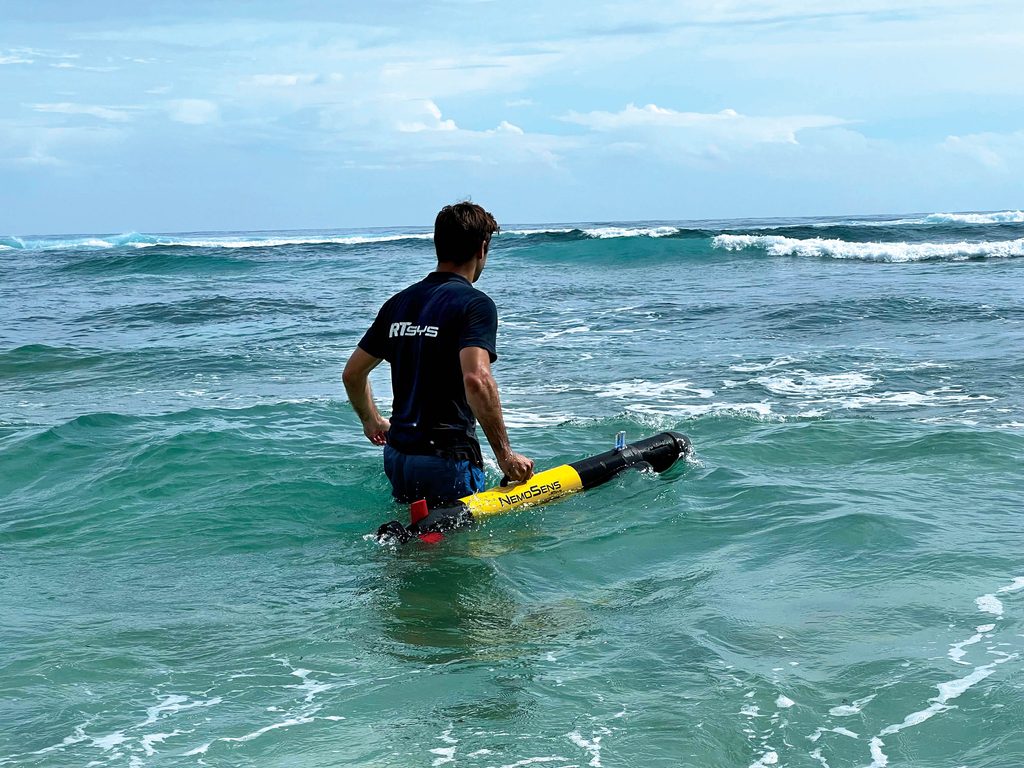
(All images: RTsys Group)
Just a quick dip
Fast, flexible and highly mobile survey operations are the name of the game when it comes to this micro-AUV, and why the French company responsible chose to develop it, as Rory Jackson learns
While the rising tide of small, low-priced, modular AUVs has done much to widen accessibility of high-resolution ocean data, particularly among academics, researchers and environmentalists, people often forget that such micro-AUVs can bring enormous benefits to larger, well-funded organisations across defence, petroleum and other industries, far beyond just their affordability.
“Our pursuits here at RTsys Group have never revolved around ‘democratising’ ocean data through cheap technology; we’ve seen that happen plenty across the ROV and UAV industry, and it certainly works, but budget constraints affect both small and large companies, and both defence and civilian industries,” says Pierre-Alexandre Caux, business director at RTsys.
“For their primary surveying needs, well-funded industrial giants will use a big, heavy AUV that’s 4 m or more in length, and carries dozens of kilograms of payload for 6–8 hours or longer per dive. Around it, they’ll have a big vessel, a big crane, many operating personnel on deck and a control room behind with additional trained persons working inside.
“All of that adds up to a huge price tag – millions of euro per mission in some instances – and on top of that level of crew and payload complement far exceeding actual requirements in many instances, there will be plenty of occasions and edge cases where a mobile, flexibly deployable micro-AUV acts as a really helpful complement to the larger, primary AUV.”
As an example, Caux describes how many offshore industry companies own or rent large glider AUVs (or USVs) for lengthy hydrography surveys, lasting months at a time in certain cases, periodically surfacing to upload data with highlighted points of interest (POIs). In such cases, redirecting the glider’s attention to these POIs can be disruptive to the mission schedule, potentially dangerous to the expensive AUV, and hence a costly and daunting proposition overall.
“Instead, an away team of two personnel can deploy into the water with a RIB, go to the approximate coordinates of the POI, and drop a micro-AUV to scan just that zone or POI, while the main mission continues on schedule and the million-dollar AUV or USV continues undistracted,” Caux explains.
“But while that use-case is what we aimed for, and it’s the way many users leverage our AUVs, some customers do also like them as an alternative to the large AUVs because reducing the size of your AUV reduces the size of the crewed vessel you need, the number of personnel you need; you skip needing a crane. It’s just so much less money and stress per mission, especially if all you really need is a side-scan sonar and one other mission-specific payload – be it a camera, or CTD, or magnetometer or so on – and absolutely not all of the six or seven payloads a big AUV will cram in.”
Nimble NemoSens
And as much as democratising ocean data access was not RTsys’ main goal, Caux also concedes that some (but not all) customers will still opt for its AUVs’ controlled-cost (although for their size, high-quality) introduction to UUV technology and regular operations, before taking the greater, riskier plunge with a bigger, costlier AUV when stepping into deeper waters, some years down the line.
As a strategy, it has worked: after 11 years of operation, RTsys now sells around 50 AUVs annually, and has grown from a staff of 35 people six years ago to 110 personnel today, in a group aggregating three marine technology SMEs. Most recently, it has opened a new, highly modernised, 5000 m2 production facility to cater for its growing global customer base.
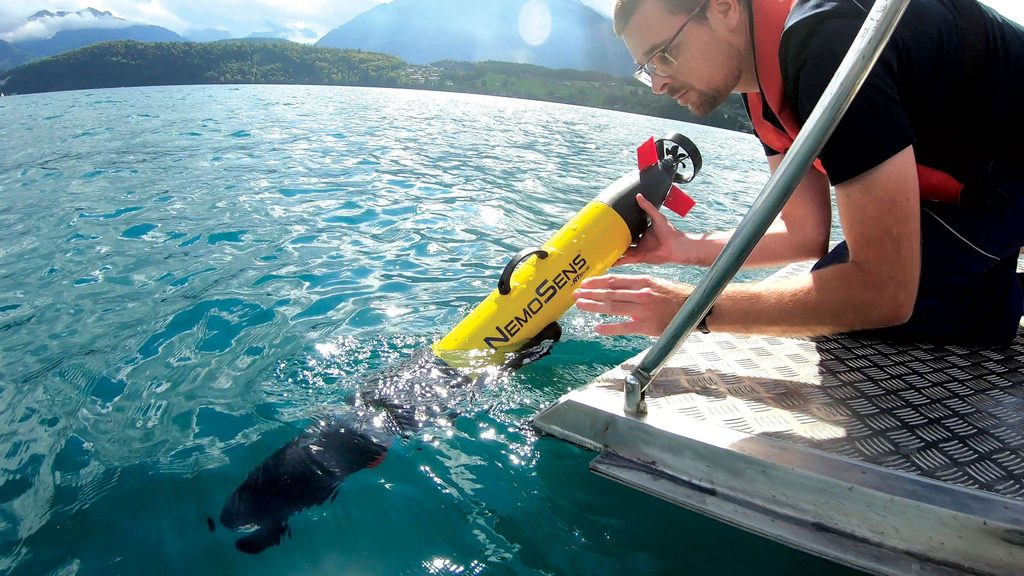
The French company began its development of the COMET-300 – its first AUV – in 2015, following customer requests for an AUV small enough to be launched and recovered by hand or net from a RIB, instead of needing a large, crane-bearing, ocean-worthy vessel. The requested AUV also had to be light and mobile enough (when accounting for all ancillary mission equipment such as GCSs, hooks, swappable payloads, batteries and so on) to be rapidly transportable by plane, speedboat or even a car.
While that project yielded a successful product in the form of the 2400 mm length, 32–40 kg two-person portable COMET-300 AUV, RTsys elected in 2020 to continue the ‘micronisation’ (a French word by origin but technically accepted in British English) process its engineers started with that vehicle, eager to see just how much smaller and more mobile an AUV they could develop.
“We’d had customers both from defence and some civilian industries who confirmed that, as much as a two-person portable AUV saved time and mission costs, they somehow still needed even more speed and transportability for their standard missions,” Caux recounts.
“While a smaller AUV cannot dive to extreme depths, it can still be made to operate for many hours, and most missions that these customers needed will only last two to three hours and run in very shallow waters, from 2 or 3 m running down to 100–200 m.”
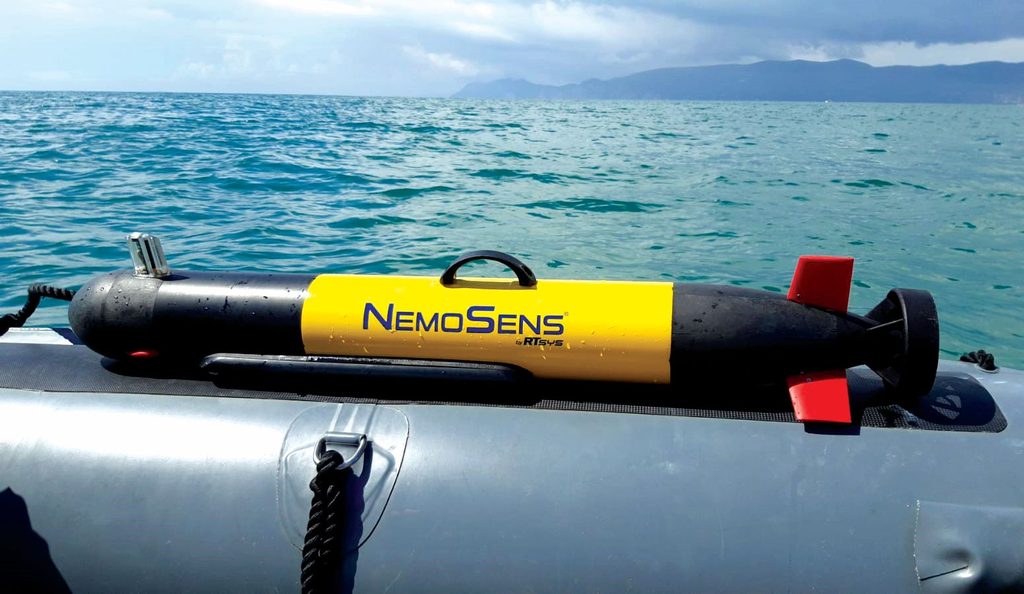
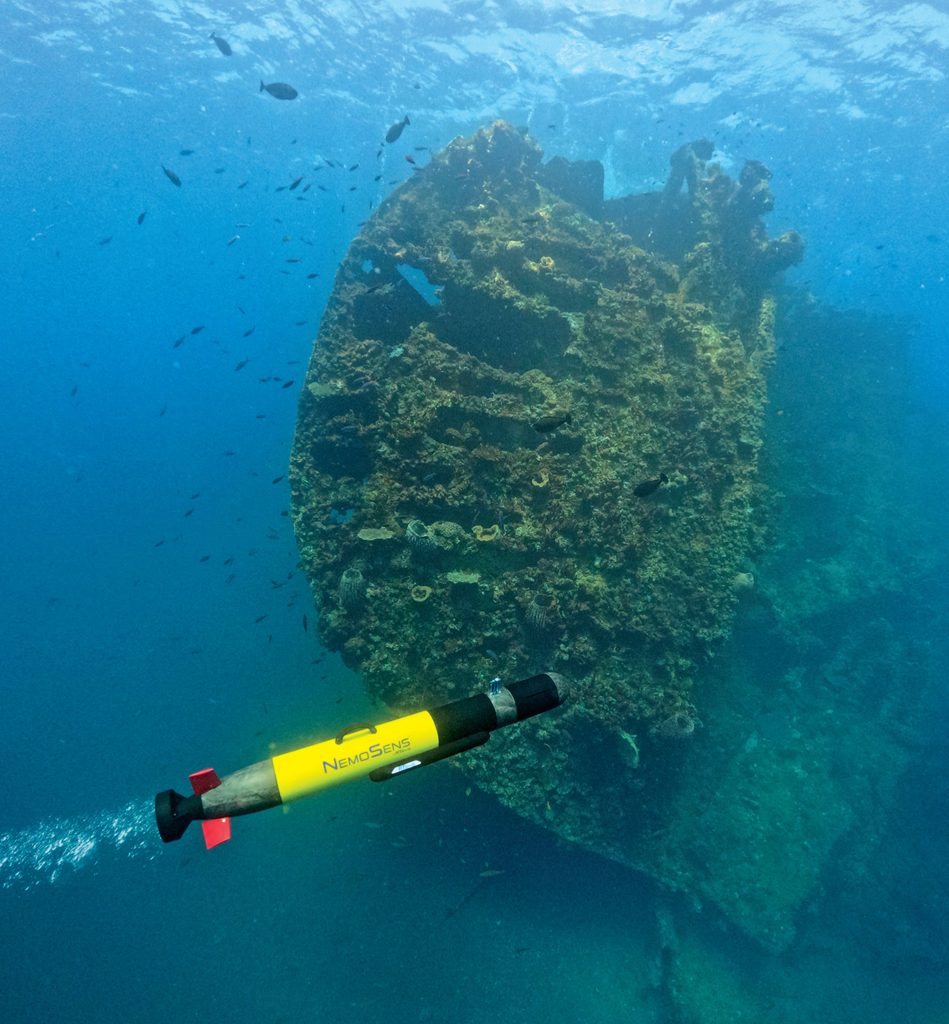
Hence, the result of said micronisation – the NemoSens micro-AUV – has a maximum endurance slightly exceeding 10 hours and a depth rating of 300 m. The battery-powered, torpedo-shaped, tri-finned AUV integrates a side-scan sonar as its standard hydrography tool, a pressure sensor for depth tracking, a GPS for surface localisation and an INS-DVL for underwater navigation.
To ensure reliability and performance in line with industrial customers’ expectations, RTsys has opted, wherever possible, for the highest-performing components that could fit within NemoSens’ footprint.
“Again, we’re not trying to democratise ocean data through cheap parts,” Caux emphasises. “You can’t navigate the ocean without a good DVL. You can’t image without a good sonar. You can’t travel efficiently without a good propeller, and you can’t operate or communicate without a good battery management system. So, while our subsystems are certainly more compact than those of a large AUV, we really didn’t spare any expense in seeking to maximise the reliability of every component.”
Among those subsystems that RTsys has maxed-out relative to their size, Caux particularly lauds the micro-AUV’s side-scan sonar. Shrinking any sonar down is especially hard engineering owing to the impact on acoustic frequencies of shrinking transducers. Hence, the
900 kHz system was co-developed with Klein Marine Systems over a two year partnership to meet NemoSens’ footprint and hit performance specifications consistent with naval standards.
However, NemoSens’ standout capabilities go beyond the SWaP-C optimisation and the ease of deployability that follows. As the company notes to us, a micro-AUV-sized INS-DVL will accumulate a detrimental amount of drift in both navigation and survey data before long.
“Now, if you’re only surveying 20–30 m down, then you can surface periodically to get a GNSS fix that corrects your drift; but if you’re 100-200 m down, you’ll already have reacquired some error before you’ve returned down to where your survey left off,” Caux notes.
To resolve that issue, along with a few connected concerns, RTsys has developed some unique technologies for underwater localisation and communication. On top of saving time by eliminating that cause for periodic surfacing, these capabilities optimise data accuracy and enable a safer, more comforting degree of real-time tracking and post-survey recoverability for RTsys’ AUVs.
Those technologies were developed to maintain NemoSens’ ease of deployment, low budgetary requirements and lean ecosystem of ancillary equipment; hence, we explore their particular designs and functionality below.
Live & synchronised
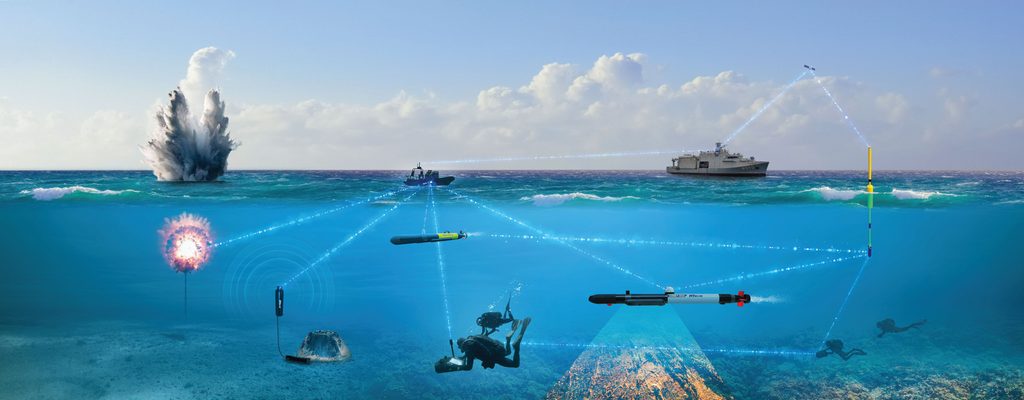
The first that bears noting for its prominent role is RTsys’ RACAM (repositioning and communication acoustic modem) system, through which the company facilitates a real-time wireless tracking and feedback capability from the vehicle, through the water, to the surface operators (whether using Comet-300 or NemoSens, or their handheld sonar SonaDive used by many EOD and Combat Divers around the world).
For the unfamiliar, RF waves attenuate rapidly in water, making acoustic waves the only means by which underwater wireless data links can be maintained, albeit with significantly lower bandwidths, shorter effective transmission distances and longer latencies than over-air wireless links. Making acoustic modems work well depends on having highly robust algorithms for signal tracking and synchronisation to compensate for these hurdles, as well as the slow and fluctuation speeds of sound underwater, not to mention judicious power management owing to the technology being prohibitively energy-consuming for an AUVs’ finite battery stores.
“The ‘RT’ in RTsys stands for ‘real time’, which should drive home that the RACAM protocol has been central to our IP since our founding,” Caux explains.
“Through RACAM, the surface operator can track the live position and mission progress of up to 30 of our AUVs, including some limited but good-integrity communications back and forth between them and the vehicle. We first implemented this technology in combat situations, in diver head sonars, which successfully enabled divers to send and receive texts underwater, both diver-to-diver and with the surface, including for safety-critical and medically relevant messaging situations.”
Naturally, AUV users – particularly newcomers to the field – can gain immense reassurance by seeing their AUV’s position being updated in real time, rather than waiting the 10 hours or longer with no sign whether their AUV is still alive and going to return safely or not. Moreover, operators can identify with confidence if the AUV gets trapped in a fish net or is otherwise impeded, and then venture to recover it in most cases.
“Obviously, we can’t acoustically transmit or receive very dense data sets like side-scan sonar images or CTD readings; it’d be like sending 3D videos as an email attachment,” Caux muses.
“While we certainly hope acoustic modem technology will improve enough in future to enable preview-like snippets of data, for now we can transmit short lines of data corresponding to vehicle position, including heading, depth, attitude, speed and distance from the RIB, and internal health and state data on critical subsystems like power management and the comms system itself.”
Developing any high-performance acoustic modem takes both considerable hardware and software engineering. The engineering challenge becomes especially acute when trying to both cram one within the 12.4 cm diameter of NemoSens’ hull, and operate within the finite battery energy that the AUV can fit onboard.
“It’s a systemic problem: acoustic modems use a lot of power, and if you want a strong bandwidth and excellent update rate, you’ll normally end up using a very big modem and a similarly-upscaled power management system to go with it,” Caux explains.
“Where the bulk of our success comes from – if one briefly glosses past our aftersales support, the assistance from our networks of local partnerships, the overall reliability of our AUVs and the customer-oriented nature of our R&D – was an electronics board we called SDA14.”
The ‘SDA’ stands for Synchronous Data Acquisition, with the ‘1’ and ‘4’ signifying a single, synchronised output generated from four acoustic input channels. The board formed the operative core of RTsys’ first generation RACAM concept, with the current generation as of writing built around an SDA416: 16 input channels and 4 synced outputs.
“This proprietary electronics board is very low-SWaP, but still enables high bandwidths and rates,” Caux says. “We still use the term SDA14 as shorthand when talking about it in-house, even though we’ve long moved past the implicit technical spec. But the latest version of the board is implemented across all our platforms, including both AUVs, our diver head sonar and all our acoustic recorders.
“Incidentally, those recorders are deployed in applications ranging from sea mammal detection to noise surveillance around critical marine infrastructure and can operate non-stop for six months at a time. It’s challenging to record for six months at a time on a single battery. So, getting SDA14 as low-power as possible was crucial, on top of repeatedly testing and improving it to be reliable over such periods, and then also getting it small enough to fit NemoSens.”
Time to transmit
Embedded software and acoustic management were then central to ensuring every RACAM node could communicate together with good timing. The overall CONOPS encompasses several such nodes, starting typically with RTsys’ surface communications module provided for the operator.
“That sends, over typically a three-second pulse, a communications packet to the AUV which then answers, and that back-and-forth sequence repeats for each other node, be there other vehicles, divers or recorders,” Caux continues.
“Getting timings aligned across all nodes to prevent miscommunications or disorder is absolutely critical, which is why we use a technology called TDMA: time-division multiple access. That ensures each node has a dedicated slot for communication, and each slot is programmed to communicate in its turn, one after the other.
“So, if you have two nodes, the operating communications cycle will run every six seconds: three seconds per transmission and three seconds per response – and for the record, a three second latency over 2 km of water is extremely fast.”
That cycle can be programmed to occur between every possible node pairing in the water, with potential for networked or swarming tactics between multiple AUVs, or AUVs coordinating as support ‘crew’ around divers, or both divers and AUVs responding to alerts from recorders across a border region.
“Naturally, we’ve also engineered to ensure exactly the same clock in every RACAM node. If even part of a second of error is permitted in communications that error will grow exponentially over a four to six hour mission, and you could start to lose track of a crucial asset,” Caux notes.
“It might sound simple when explained this way, but it’s taken 15 years of development and optimisation to have acoustic communications work at this kind of level, and even so, we still want to extract further performance by adopting new chipsets, new transducers, new architectures and any other relevant innovations as they happen to further the power, accuracy or synchronisation of this technology.”
Sparse-LBL
While being able to track vehicle health data in real time is a boon for operator morale and maintenance planning, transmitting positional data can be considered a minimum operating requirement because experienced AUV operators are used to receiving such information over an ultra-short baseline (USBL) acoustic localisation system.
Notably, RACAM is engineered to use LBL (long baseline) positioning rather than USBL. As a reminder: both use an array of multiple transducers to triangulate an asset’s position based on the relative difference in acoustic time-of-flight between each.

The baseline refers to the distance between the array’s transducers. A traditional LBL system has multiple such nodes placed in a known distribution on the seafloor – potentially hundreds of metres apart – thereby achieving close accuracy, potentially down to 1 cm of error. A USBL, by contrast, uses a single module with the transducers rarely more than an arm’s length apart, and often has 1–2% error of the total distance to the AUV. Hence, 20–40 m of error could be expected when an AUV is 2 km away from the USBL array.
On top of being more accurate, LBL also enables a horizontally wide area in which AUVs can localise, even near the surface, whereas USBL only operates practically in a finite, downward-facing ‘cone’ because acoustic signals running parallel to (or almost parallel to) the surface suffer mounting interference and much greater susceptibility to measurement errors.
However, USBL has the prominent advantage of being far easier to deploy, simply being lowered by tether from a mission vessel into the water in most cases, rather than requiring the immense time and cost of installing and then recovering nodes on the seafloor.
To marry the advantages of LBL with the cost-efficiency and deployability of USBL (and of NemoSens itself), RTsys provides a solution it calls Sparse-LBL. This ecosystem can be deployed in marine biology, coastal water quality monitoring and dredging-related monitoring, along with other civilian applications, while also being offered for defence work such as mine countermeasures, ISR and special forces operations.
“Along with the aforementioned surface communications module, which has an inherent range of 2 km, we also provide multiple LBL relay buoys that can extend the trackable network to a 4 km radius around the mission vessel, and also enable a floating, surface-based LBL network – the buoys being easily deployed and recovered by RIB, or perhaps around a ship deck,” Caux explains.
Crucially, the buoys can also (wherever chosen by the end user) integrate RF and GNSS modules. The former will maintain seamless communications with the main vessel up to 10 km away for real-time situational awareness of both the surface and the subsurface assets. The latter facilitate GNSS referencing of the AUVs’ coordinates, with error limited to 10 m at maximum – a workable margin for industry.
Most importantly, the GNSS-aiding prevents the build-up of drift (as with UAV navigation systems), which would otherwise grow to hundreds of metres over the hours of each mission. Hence, even if NemoSens might start a survey 10 m off its mark, in the worst-case scenario, it would still be only 10 m off, even 10 hours later.
“Drift is a huge problem for both recovering micro-AUVs at the end of a mission and matching micro-AUV survey data to its actual locations under the water,” Caux says.
“Without that, efficiently gathering large bodies of hydrographically accurate data with micro-AUVs would be impossible. For us, not only is it routinely achievable, but our micro-AUVs then never have to surface to reacquire their position; the buoys acoustically transmit corrective data and each micro-AUV continues following its correct survey path, even after the 10th mission hour.”
Ecosystems flourish
Buoyed by this and other successes, RTsys remains determined to continue expanding the components and interoperability of its ecosystem, and is presently working with multiple partners on how best to integrate aerial assets with its underwater systems, with the buoys and modules of RACAM and Sparse-LBL doubtless set to serve as bridges between the realms.
“We also think micro-AUVs will gradually be able to dive deeper. Our acoustic communications and positioning with be crucial enablers here, but so too will be continuing advancement in other components, for instance the ongoing micronisation we’re seeing in fibre-optic gyroscopes, which could really enhance positioning accuracy between aiding source updates,” Caux says.
“These pathways, along with improving our vehicles’ autonomy to include features like underwater automatic target recognition, or intelligent, real-time decision-making like smart alterations of survey paths by the vehicle itself, could unlock some very exciting capabilities for all kinds of end users, and we’re eager to see where our customers want to take this technology next.”
Key specifications
NemoSens
Micro-AUV
Approximate dimensions: 1 x 0.183 x 0.124 m
Weight: Just under 10 kg
Depth rating: 300 m
Operating speed range: 2 to 6 kts
Operating temperatures: 0 to +50 C
Maximum endurance: Over 10 hours
Maximum sea state: 4
UPCOMING EVENTS