







Multi-purpose AGV chassis
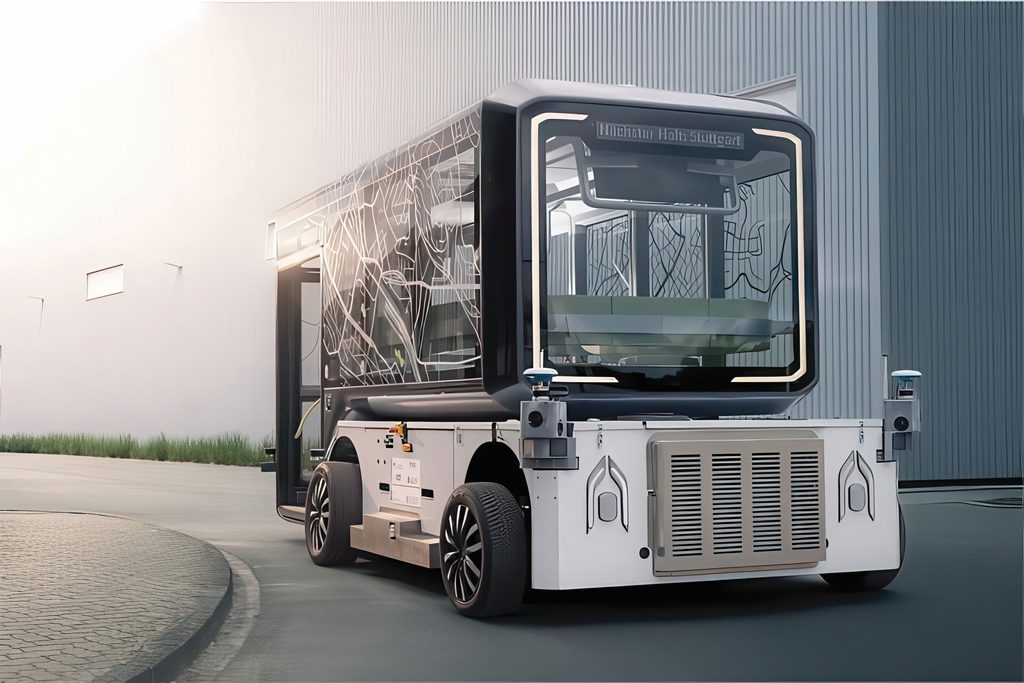
(Image: Amadeus Bramsiepe, KIT)
Researchers in Germany have developed a chassis for a modular autonomous ground vehicle, writes Nick Flaherty.
The design developed at the Institute of Vehicle Concepts of the German Aerospace Centre (DLR), which features a rigorous separation of the vehicle from its function, has been pursued continuously across multiple projects at DLR for several years.
A key element of the concept is the drive chassis that includes the essential technical components, such as the electric drive consisting of four hub motors, batteries, steering system and central functions for control, monitoring and energy supply. All of these were developed at the Research Institute for Automotive Engineering and Power Systems Stuttgart (FKFS). The drive board moves autonomously under the capsule intended for each task, lifts it up, and locks it in place – human intervention is unnecessary.
“We want to make vehicles that suit more than one single purpose,” said Prof Kora Kristof, vice president for digitalisation and sustainability at the Karlesruhe Institute of Technology (KIT). “A vehicle that adapts flexibly to different tasks saves resources.”
Dr Michael Frey from KIT’s Institute of Vehicle Systems Technology (FAST), added: “The principle is similar to that of a swap container. Instead of designing dedicated vehicles for each task, the vehicle remains the same, only the superstructure changes.” FAST was responsible for the design of the chassis with its integrated lifting system, which enables the vehicle to pick up and drop off the capsules without requiring additional infrastructure. “The implementation basically requires nothing more than a free space for the capsule and the vehicle,” he said.
To pick up the capsule, the vehicle establishes a digital connection with it. “Thanks to the flexible technical architecture, the vehicle can adopt different functions depending on its task,” said Prof Eric Sax, who heads KIT’s Institute for Information Processing Technology, which is where the electronic and software-based control centre of the vehicle was developed. This unit interconnects and coordinates the various vehicle functions and capsule technologies. The functions and sensors automatically adapt to the selected capsule, for example, for transporting passengers or delivering goods. New software can be installed using a wireless connection, in much the same way as a smartphone update is performed.
The vehicle uses sensors such as cameras, radar, and Lidar to recognise its surroundings. The sensor concept and the systems for data processing and motion planning were developed at Ulm University in Germany. By interacting with the motion systems elaborated at FKFS, the vehicle can perform manoeuvring and docking movements with centimetre precision.
A locking system developed at DLR keeps the capsule safely in place during travel.
“The insights we gained in the U-Shift II project will help us to advance automated vehicle concepts and the technologies associated with them. With this research, we’re supporting Baden-Württemberg as an automotive hub, establishing important baselines for taking these innovative mobility ideas to practical application and preparing their transfer to the road,” said Prof Meike Jipp, director of the Energy and Transport Division at DLR.
UPCOMING EVENTS