
SYOS Aerospace’s SM USV family
Team effort
Developing uncrewed machines that can successfully operate in groups as a single connected unit demands a very specific approach. Peter Donaldson explains
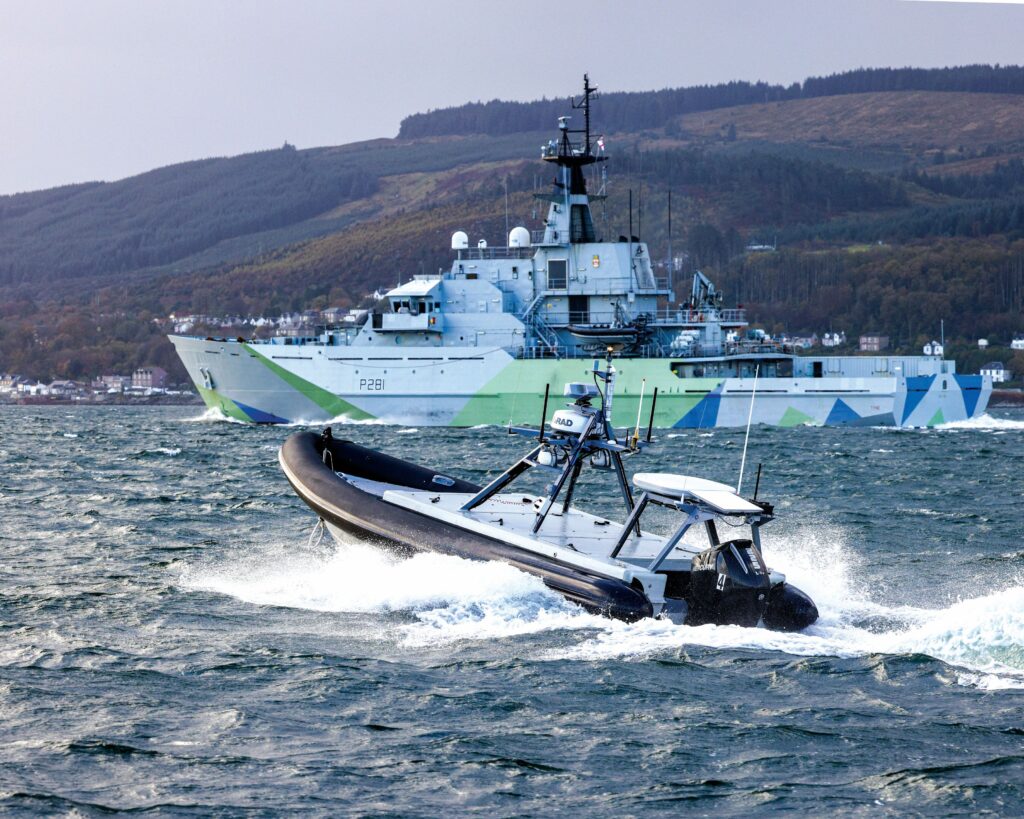
Increasingly, developers of uncrewed systems are creating machines able to cooperate in groups to complete complex missions in contested environments. “Operators need autonomous systems that work not as isolated platforms but as one connected force,” says Sam Vye, founder and CEO of SYOS Aerospace, which offers a family of airborne, ground-based and maritime vehicles running on a common software backbone and commanded through the same control system. This architecture underpins their interoperability, and their ability to accept a wide variety of sensors and other payloads with a minimum of integration effort so that new capabilities can be generated quickly. The focus of this article is SYOS’ offshore-capable SM USV family, members of which are used in combat by Ukraine, with others undergoing trials with the UK Royal Navy and selected by the Royal New Zealand Navy.
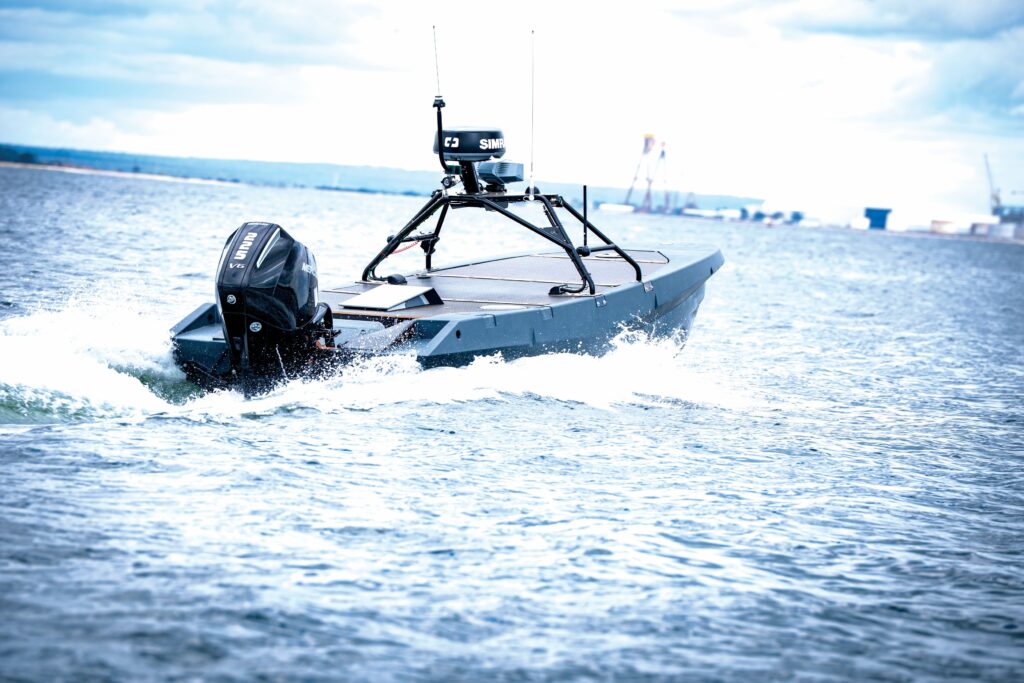
The current members of this family comprise the combat-proven SM300 with 300 kg of payload capacity and a range of more than 700 NM – more than 150 of which have been deployed with Ukrainian forces – and the 7.2 m long SM400 with up to 500 kg of payload and 950 NM of range. Both are capable of tracking and engaging static or moving targets using onboard processing of EO/IR camera imagery; both feature primary, alternate, contingency and emergency (PACE) communications, jamming and spoofing resistant GNSS and advanced terrestrial navigation; and both use a command-and-control (C2) system that allows the operator to set the mission intent and re-task in real time, while execution and synchronisation are handled autonomously.
SYOS emphasises intelligence, surveillance and reconnaissance (ISR) and ‘one-way effect’ (kamikaze) missions and counter-UAS payloads for the SM300. Its SM400 sibling, meanwhile is described as a high-speed tactical USV with an emphasis on fleet shadowing, electronic warfare (EW) and ISR missions, payload delivery and other high-risk tasks.
Concept and philosophy
Vye describes SYOS’ philosophy as one of rapid, operationally driven design for flexible capability.
“SYOS was founded on a simple premise: autonomous systems should be operationally relevant, rapidly deployable and accessible at a scale traditional defence acquisition struggles to achieve. The maritime domain offers perhaps the clearest example of that approach. SYOS started with the autonomy, developing the software architecture first and then engineering the platforms around it, rather than beginning with a hull and insourcing the autonomy.”
With that architecture in place, operational capabilities can be delivered remarkably quickly; with the process proven on the SM300 – which features a purpose-designed hull engineered for volume production – and the SM400 USV that went from customer requirement to delivered vessel in under 90 days, he says. Rapid delivery of capability is also aided by the company’s running of two headquarters, one in the UK and the other in New Zealand, with R&D and production in both, plus an operational presence in Ukraine that feeds back into development.
Another element of this responsiveness is the concept of a “minimum deployable capability” that embodies the adage that the best is the enemy of the good. Engineering effort at SYOS is focused on autonomy, sensing and system integration, “which is where it delivers the greatest operational advantage,” Vye emphasises.
(Image: SYOS)
“Naval architecture matters – stability, seakeeping and payload volume – all have to be right for the mission, but proven hull forms exist, and chasing an exquisite bespoke hull adds years and cost without adding operational effect,” he says. “That discipline is also a cost strategy that keeps the platform affordable and attritable to free the budget for a higher-end sensor stack, so the operator gets a premium sensing and autonomy capability at a competitive price.”
The software backbone and control complex is called the Autonomy and Augmented Intelligence Mission System (AAIMS), which is common to all SYOS platforms across the air, maritime and land domains, meaning that once a capability is developed it can be rapidly integrated into any of them. “This is minimum deployable capability in practice,” he says. “Get a capable system into operators’ hands quickly, then continuously improve it through operational feedback and rapid iteration – at a pace that nobody waiting for ‘perfect’ can match.”
One of the keys to rapid integration is standardisation of power and connectivity. If a payload can draw power and reach the vessel’s network, it can be integrated. Another is AAIMS’ open architecture. “Several recent third-party fits have been close to plug-and-play,” he states.
Operational feedback
SYOS’ presence alongside the Ukrainian military enables operational feedback into the design of the SM family “directly and in detail,” Vye says. He elaborates that the feedback loop runs from operators straight into engineering with no intermediaries, and has driven improvement in physical resilience of the vessel’s mission system, thermal resilience, situational awareness and human factors.
At sea, any mission system can suffer from the effects of shock and vibration. While the hull will happily absorb the punishment, they found that the electronics needed extra protection, which comes from elastic mounts, hardened connectors and improved wiring harnesses throughout the vessel.
Sustained operation in hot conditions revealed the need to improve thermal resilience of the mission systems, which the team tackled with higher-grade components, mounted on heat sinks where necessary in both vessels. Additionally, the SM400 received a climate control system for its payload bay, a system that extends its protection to core mission system components.
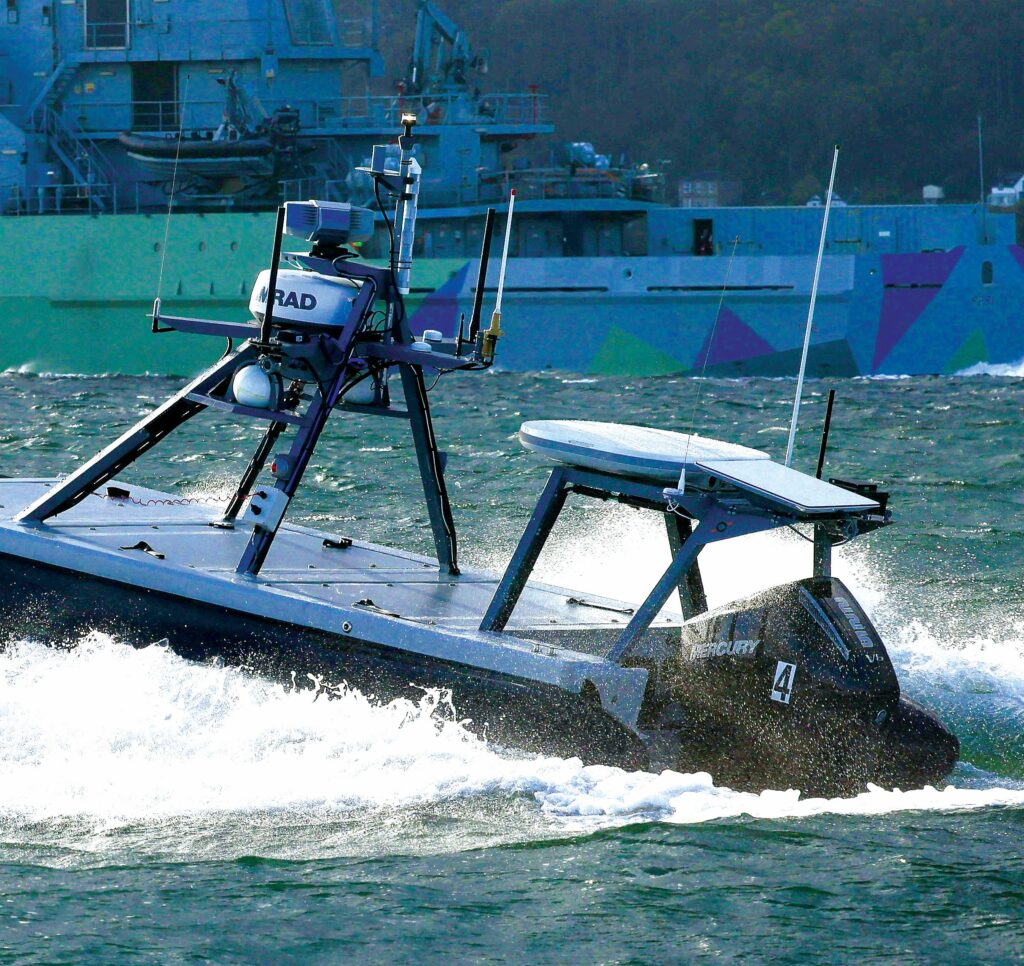
Operators also asked for better situational awareness, leading to the integration of fixed camera arrays and a radar. Photographs of the Royal Navy SM400 show a camera system from SeaAI and a Simrad marine radar on the forward four-legged mast (with two satcom systems on the aft mast: namely a Kymeta Peregrine U8 and a Starlink terminal).
(Image: Royal Navy)
Human factor improvements focused on ease of use and robustness. In the first case, the operators effectively co-developed the operator interface, Vye recalls, down to where information is shown in the camera view. Meanwhile, the physical systems were ruggedised to survive the realities of how crews treat equipment in the field.
Hull, propulsion and power
The two vessels have different hulls, the SM300 using one designed in-house and roto-moulded from high-density polyethylene – a material chosen for its tolerance of impact, speed of manufacture and cost-effectiveness at volume, while the SM400 uses a proven, off-the-shelf, fully enclosed hull selected for seakeeping, stability and payload capacity. In both cases, the hull’s job is to deliver the payload safely, remain steady enough in rough water that its sensors remain effective and to protect the electronics. “Platform quality and stability are treated as an engineering requirement for the autonomy.”
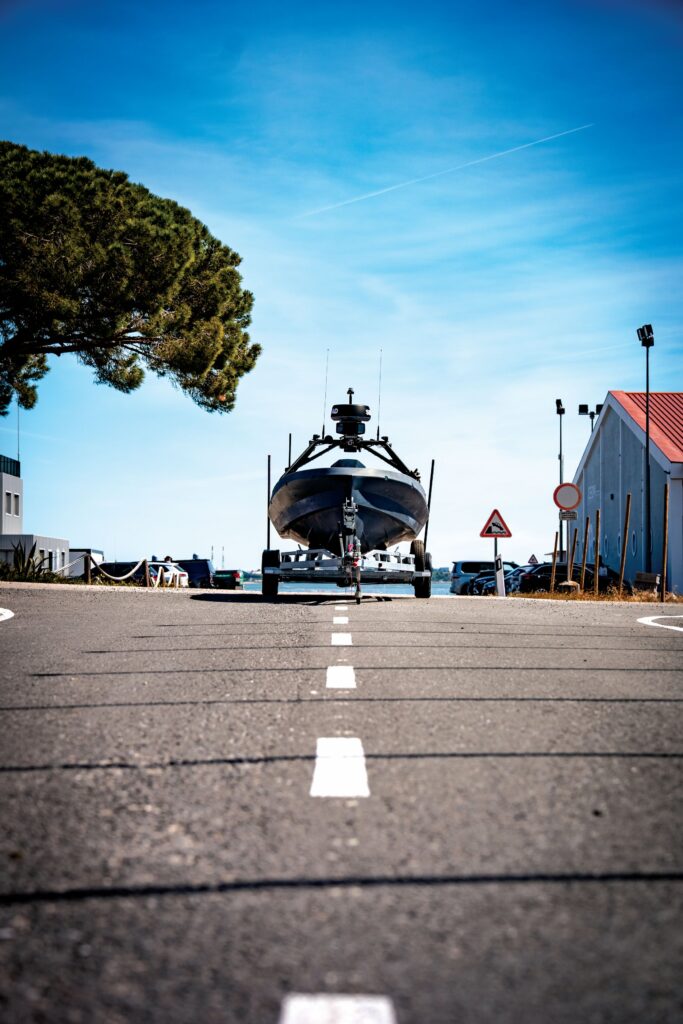
Propulsion power is provided by a 225 hp Mercury outboard motor running on petrol, which was selected after a careful trade-off study. “For equivalent power, diesel outboards are substantially heavier and roughly three times the cost – a poor fit for a platform philosophy built on affordable mass, easy maintenance and rapid production fit-out,” according to Vye.
“Petrol propulsion keeps the vessels light, quick to build and simple to sustain in the field. The engines carry their own management systems, which optimise fuel consumption continuously; the AAIMS sits above as the data and decision layer – ingesting engine and fuel-state data into the operational picture, feeding it back to the operator and using it in mission-level calculations, rather than duplicating what the engine already does well.”
The SM400 features an auxiliary generator for the payload bay so that its power demands are separated from the systems that drive and control the vessel, and even the most power-hungry of payloads never compete with the needs of the boat itself. Dedicated to high-draw payloads and the climate control system, the generator is a 3.5 kW diesel unit that enables the vessel to support EW suites, radars and “sensor farms” through extended missions – at the cost of the logistic complication of providing the SM400 with two different fuel types.
(Image: SYOS)
The SM300’s 700 NM range is achieved at 25 knots in calm seas with its 300 kg payload, and the SM400’s 950 NM range is realised at the same speed with a 500 kg payload. Both can loiter for more than 10 days at idle. Vye describes range as a configuration choice because fuel tankage can be extended substantially in either vessel, at the expense of payload. While the concept of operations is built around returning to base for refuelling, Vye notes that there is no technical barrier to replenishment at sea, should the mission require it.
Resilient nav and comms
Maintaining navigation and communication in a heavily contested EW environment and persistent jamming and spoofing of GNSS signals can never be guaranteed, but SYOS applies proven protection methods in layers. “It starts with a hardened controlled reception pattern array GNSS receiver – with up to 16-channels – giving a very high degree of protection against jamming before any fallback is needed,” Vye explains. “Beneath that sit independent navigation methods: dead reckoning, cooperative positioning by radio-frequency [RF] triangulation between vessels in a group and terrain-relative navigation where the mission geometry supports it. Communications follow the same layered logic across mesh radio, satellite and other bearers, with a structured fallback hierarchy.” For operational security reasons, he declines to map the specific PACE pathways or quote navigation accuracy in public.
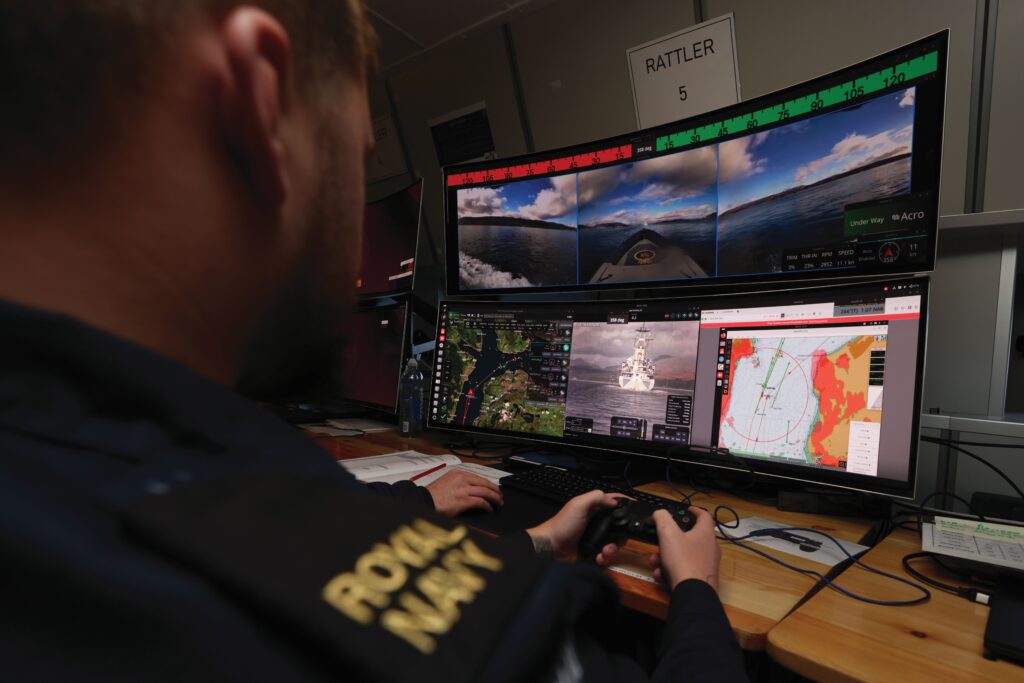
The C2 principle employed puts the human operator in the highest position of authority, giving them responsibility for tasking the vessel, selecting routes, defining behaviours and setting objectives, leaving execution to the AAIMS. Specifically, the autonomous system executes detailed routing in accordance with the selection made by the operator, station keeping and perception-driven behaviours such as automatic target recognition, where the AI can follow an operator-designated object.
(Image: Royal Navy)
“Authority over anything that matters stays with the human – always, and by design, including any use of force,” Vye says. He stresses that the “augmented intelligence” in the AAIMS is carefully chosen wording. “The system exists to offload the operator, not to replace their judgement. Swarming is where this multiplies: a single operator can command a swarm by controlling the lead vessel, with the remaining vessels coordinating autonomously in configurable formations. One operator, many hulls, one tasking chain – that is what force multiplication looks like in practice.”
Integrated UUV
The AAIMS also enables the SM family of USVs to operate subordinate vehicles, for example the SU10 tethered ROV, which typically integrates with the USV via a fibre-optic link and a launch and recovery system. That link allows the SU10 to be controlled over the USV’s satcom system from anywhere in the world, although it can also serve as a standalone asset deployed from the shore or a crewed vessel. The fibre-optic tether allows the host vessel to keep moving while the ROV works at full depth.
Running on internal batteries, the SU10 has an endurance of between 4 and 10 hours, depending on environmental factors. However, replacing the fibre-optic tether with a cable that can deliver power as well as sensor data and C2 signals allows “extended or indefinite” operations. The vehicle can operate down to 500 m and can be configured for inspection, interaction and ISR missions.
“The SU10 was built to give operators rapid-response subsurface capability that deploys from the systems they already operate,” Vye says. He describes its mission set as deliberately broad, including mine countermeasures and seabed assurance, persistent surveillance of subsea infrastructure, harbour security and a contribution to anti-submarine warfare as part of a distributed, persistent uncrewed layer.
“None of this is theoretical. Earlier variants have spent several years in commercial service on pipeline survey, inspection and intervention work in New Zealand’s offshore oil and gas sector.”
Multi-vehicle operations
SYOS’ approach to multi-vehicle operations, through the AAIMS, is to provide a shared interface. This means that what any single vehicle sees, all the others and the operator know, Vye explains, generating a single, continuously updated common operating picture rather than a screen per vehicle. In the communications architecture behind this capability, the bearer adapts to the network geometry, with vehicle-to-vehicle traffic typically riding a mesh network, and the link back to the operator can go over satcom for over-the-horizon reach, while the SU10 uses its tether back to the USV. “A typical mothership pattern has UAVs meshed to the USV and the USV relaying the integrated picture to the operator over satcom.”

Not overloading the operator is critical to successful multi-vehicle operations, even more so when different types of platforms are also under their command. The layers of the AAIMS divide the work up the way a good crew would, Vye notes. “Onboard autonomy handles the immediate – navigation, perception, coordination with nearby vehicles – so the system remains capable in communications-limited environments; the operator level handles tasking and the integrated picture; the mission level handles coordination across a fleet. The effect is that a small team can run a mixed, multi-domain force without drowning in vehicle-level detail.
“Critical decisions are placed deliberately. Collision avoidance and immediate safety-of-navigation behaviours run onboard because they cannot wait for a link; anything involving the use of force sits with the human operator, without exception.”
The onboard AI is also a key contributor to operator workload reduction, automatically detecting, classifying and tracking objects in real time. The classifier distinguishes between, for example, a sailing boat and a power boat, a buoy or a person in the water, and the system provides a range calculation to each. Once the operator has designated a target, it can be tracked and followed autonomously. “Classification and tracking are autonomous; the decision about what to do with that track is down to the operator.”
Skilled assembly
Both the SM300 and the SM400 are designed for assembly by skilled workers, without the need for heavy fabrication, Vye explains, moving the scaling challenge from the shop floor to the supply chain. SYOS’ UK operation is located within the English south coast’s maritime autonomy cluster, with key suppliers and custom fabrication capabilities close by. “Where something can’t be bought reliably, the ethos is simple: we make it ourselves.” The AAIMS scales the way all software does – essentially free of charge, with the hundredth boat running the same stack as the first.
Both variants are built in this UK assembly plant, with production shifting between the SM300 and SM400 according to demand, and the supply chain is designed to adapt. “For a customer in another jurisdiction, sourcing and assembly can be reshaped to meet sovereign requirements because SYOS controls every element of the system.”
The second HQ with R&D and production in New Zealand is part of SYOS’ approach to resilience, providing access to independent industrial bases and supplier networks, along with the ability to serve different customer communities from the appropriate jurisdiction, with export licences handled accordingly, he explains.
In terms of extending the SM family’s capabilities, 2026 has so far proved a busy year, with multiple new payloads integrated, spanning EW suites, RF sensing and geolocation systems, and counter-UAS effectors – with further integrations from “major sensor and communications partners” in progress. Mine countermeasures and anti-submarine warfare payloads are the logical next step for the family, Vye says, and work is under way. “Almost none of this required platform redesign – it is the payload-agnostic architecture doing what it was designed to do.”
Also, the SM USV family is growing with the addition of a larger vessel, which will be about 12 m long and, Vye says, will be here by the end of 2026.
Key specifications
Length: 7.2 m (SM400)
Payload: 300 kg (SM300), 500 kg (SM400)
Range: 700 NM (SM300), 950 NM (SM400)
Endurance: 10 days loitering at idle
UPCOMING EVENTS