



UAVs
(Image: SkyFall Industries)
From the front
In the face of growing global conflicts and international tension, more and more high-tech UAVs, extremely cost-efficient, energy-efficient, and intelligent, are being innovated. Rory Jackson investigates
While a great many innovations and milestones are touted across conference halls, expo floors and product websites pertaining to uncrewed aircraft, military uses are a standout hotbed at present. Regrettably, warfare is rife throughout more parts of the world than ever, and that conflict has spurred the creation of numerous advanced, frontline-fit and highly manufacturable UAVs, the longing for survival against one’s enemies potentially being the only innovation-driver stronger than industry competition.
As well as bringing valuable design lessons that uncrewed systems engineers of every stripe might benefit from perusing, these highly diverse military UAVs come with additional capabilities in novel civilian applications that stand to maintain their usefulness come peacetime – which we will delve into henceforth.
Strike and logistics
Although Ukraine now purportedly boasts a number of the world’s most advanced and active UAV defence tech companies, SkyFall Industries is one of the nation’s largest, having been founded after the Russian Federation’s invasion began in 2022 and grown steadily since.
The company does not go public with all of its drones or capabilities; however, it has gradually drawn back the curtain on some highly successful interceptor, FPV-type and medium-to-heavy lifting multi-copters, not to mention considerable capabilities across flight and mission autonomy, as well as airframe customisability.
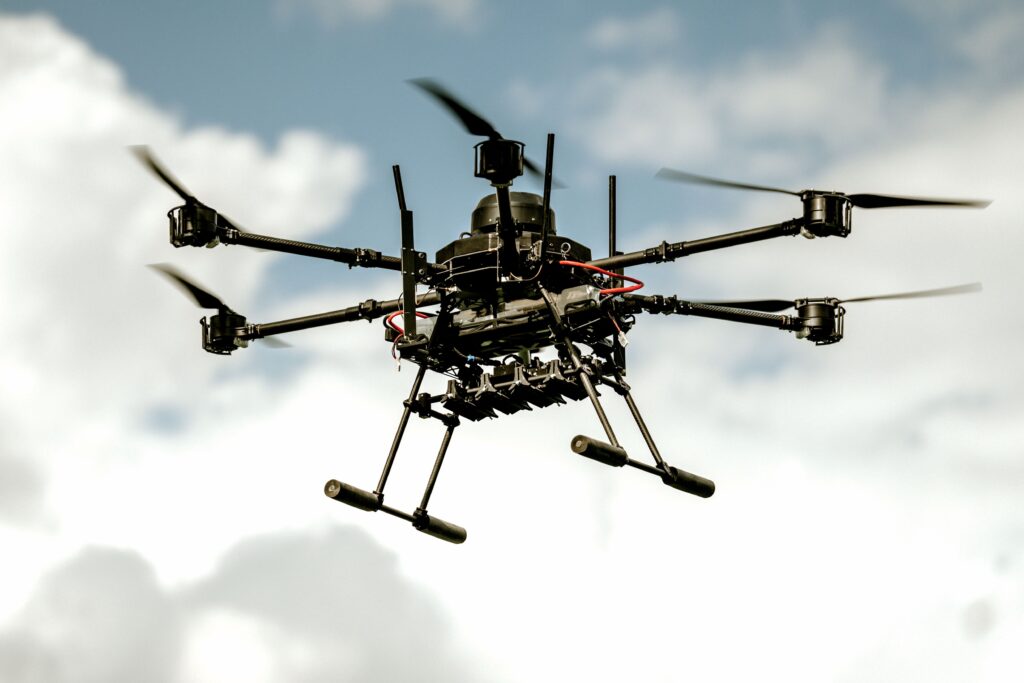
Its Vampire hexacopter, however, stands arguably tallest among its (publicly revealed) vehicles, SkyFall citing the carbon multi-rotor as “the most popular drone in Ukraine right now,” and its most effective craft for bombing operations. As of writing, Vampire has dealt with thousands of real-world targets successfully, and has been utilised rigorously for both strike and logistics operations, with the Ukrainian manufacturer able to scale annual production of the drone to a capacity potentially exceeding 100,000 units.
(Image: SVR Corp)
Although it might appear outwardly as just a standard hexacopter platform, the system has been designed from the ground up for a few key qualities that SkyFall’s business development director explains to us (the spokesperson’s exact identity having to remain anonymous).
“Originally, Vampire was conceived as a cable-tethered reconnaissance drone for taking pictures of battlefields, but the game-changer was when we attached an ordnance-dropping payload to it, dropped a munition unit and successfully hit a target – that was when its new life as a strike UAS started,” they recount.
The dropper payload features a number of small, actuated silos that can be modularly and rapidly adjusted to drop various different forms of munition or supply item. Because of this, end users can quickly reconfigure Vampire from an anti-tank operation into mine countermeasure work, into dropping medical kits or ammo for friendly troops and so on.
“Additionally, if someone comes to us with a novel new form of weaponry, like gravitation bombs, high-precision bombs or so forth, we can quickly integrate them into Vampire’s dropper to start deploying them in real-world operations,” the company spokesperson continues.
Assisting in Vampire’s capabilities are its comms system, which remains fully effective up to 45 km (with frequency hopping among its smart comms features), along with computer vision in its autonomy stack via an EO/IR camera. Its electric powertrain enables up to 40 minutes of flight and top speeds of up to 80 kph, per standard operating conditions.
“And we have extensive proof at this point of Vampire’s ability to destroy many types of targets – including tanks, armoured personnel carriers and military warehouses – from a lot of different altitudes and in all kinds of weather conditions,” the spokesperson adds.
“So, the end user can have confidence that Vampire can execute their strike or their logistics requirement, whatever the mission environment.”
Vampire has, for instance, delivered considerable quantities of humanitarian aid (including food, water, radios, medical supplies and drone repair kits) across Ukraine, including to populated civilian areas attacked by Russian FPV drones, where human responders have been unable to attend without putting their own lives at dire risk.
“We also mass-produce a lot of components that autonomous drones need, which are applicable not just to our platforms – and key to our manufacturing scalability – but to other UAVs worldwide,” the business development director notes.
Other companies in Ukraine are successfully broadening the range of tools available to the country’s uncrewed aerial defences. Among them, SVR Corp has started publicising its Strum 10-300 FPV quadrotor and its Strum VR FPV interceptor, both of which are semi-autonomous solutions.
As Oleksandr Pinkevych, engineer at SVR Corp tells us, “The Strum 10-300 typically starts missions being remotely operated, but as it’s standard for drones to get jammed sooner or later at the front lines, it carries out the last mile fully autonomously.
“So long as the end user has confirmed a target, the drone locks onto that target through its EO/IR camera, and flies to it autonomously, usually carrying a munitions pack atop its hub for a one-way mission.”
The Strum 10-300 is a small drone, at 590 x 530 x 175 mm, with a 3 kg maximum payload, and a 16,500 mAh, 6S3P battery pack. Its onboard energy enables 16 minutes of flight endurance with said 3 kg payload, which typically translates to 25 km of tactical operating range. Its target-tracking intelligence provides up to 350 m of lock-on range.
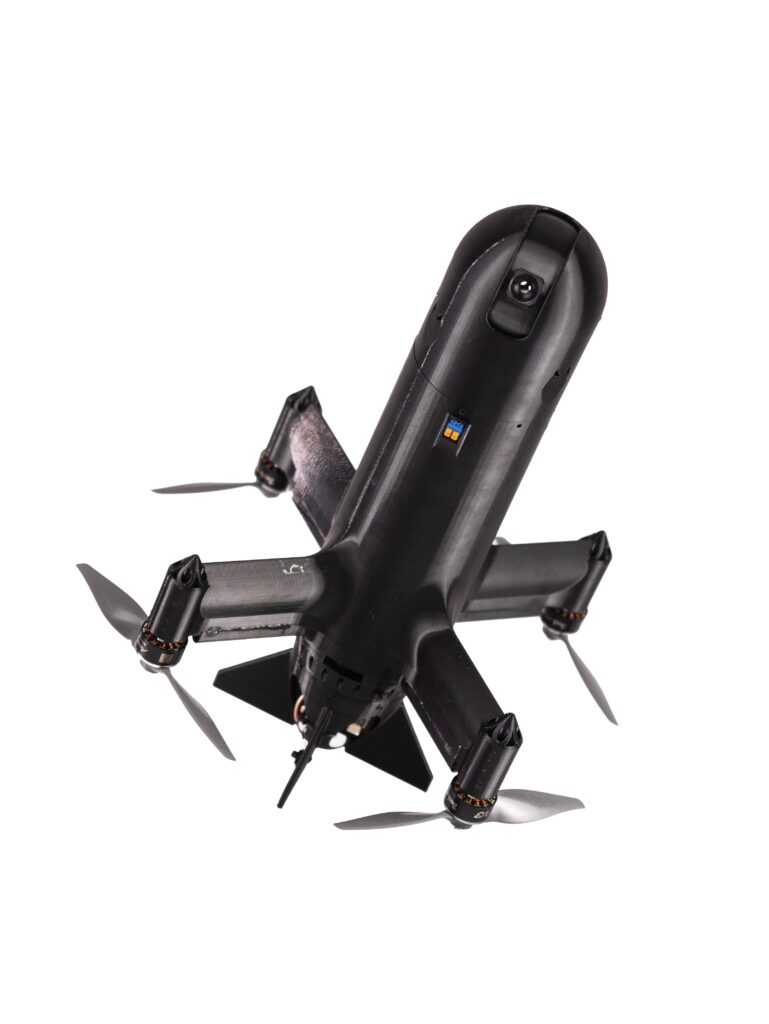
The Strum interceptor is a significantly more complex creation, per the technical challenges involved with cost-effective air defence against enemy aircraft (particularly larger, slower and much more expensive drones than those Ukraine preferentially fields).
“Our interceptors are operated successfully almost every night in Ukraine, and we have a video from each one of its successful interceptions of Russia’s Shaheds and similar drones,” Pinkevych explains.
“Per its operating principles, when a radar detects a Shahed signature in Ukrainian airspace, an interceptor positioned nearby will take off and fly to the interception area autonomously, at which point an operator takes control to steer the interceptor into the Shahed.”
Thus, the interceptor’s last mile is carried out manually, although SVR plans to develop autonomous intelligence for the highly dynamic and precarious closing in by which interceptors contact their targets.
“I’m the main software engineer behind this interceptor, and I can tell you that autonomously guiding that last bit of an interceptor’s mission is unlike any other kind of autonomy software,” Pinkevych muses.
“You’re dealing with totally different speeds, turbulences and other forces from what you’d find in any remotely comparable drone operations. So, the kind of algorithm suitable for pulling that off would be different from anything we’ve done before, not to mention the models needed for continuous target detection and tracking, and for reliable and timely triggering of the combat payload.”
For reference, the Strum VR FPV interceptor flies at up to 300 kph and carries a 500 g combat payload (not including its camera systems, for which different versions are available with either EO or IR sensors, for either daytime or nighttime flights).
Special forces and ocean filmography
While there are many dangerous mission types handled by special operations forces (SOF), working as combat divers is arguably the most directly dangerous to SOF personnel. The principal reason for this is that SOF divers cannot surface in potentially dangerous areas – whether to communicate, localise or merely figure out what is happening above the waterline – without revealing their location and putting their own lives at immense risk.
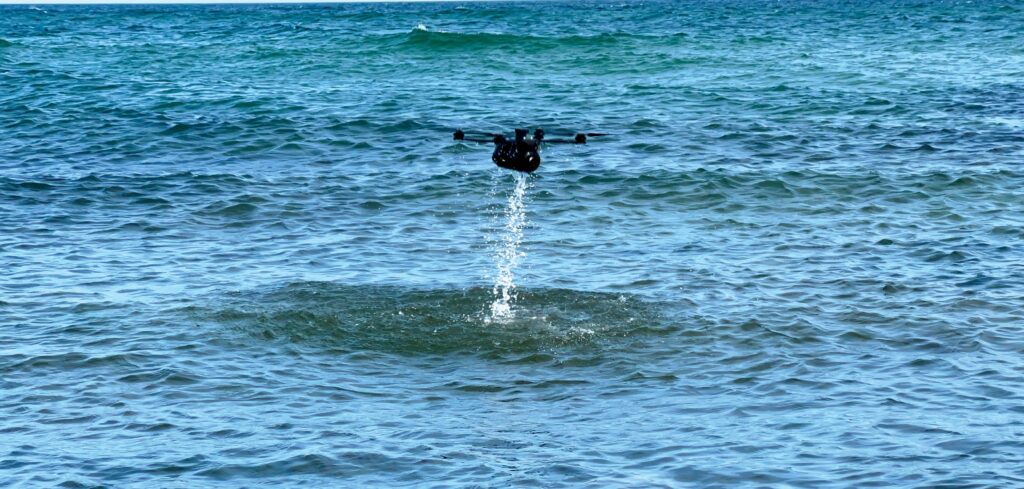
SOF dive support was the first problem Nereus Dynamics set out to solve. The Denmark-based company’s Nereus Diver is a 1 kg submersible electric quadrotor measuring 30 x 30 cm with arms extended. It’s one use-case for a platform designed to do many.
As Cosmin Ciorba, CEO at Nereus tells us, “Our drone can be launched either by a diver, from a submarine or from a USV, resistant to up to 30 m depth, and then is able to transition from subsurface to above-surface dynamics, and vice versa.”
Considerable design work has gone into ensuring the UAV is mechanically rugged and stable enough to resist the pressures and currents of underwater environments, including judicious sealing. The company notes that the transition between aerial and aquatic operation is defined almost entirely in software, rather than through mechanical transmissions or moving parts that switch between pulling water and air.
The UAV also comes with a dedicated controller, by which the operator can issue commands or programming, while staying safely submerged beneath the surface, potentially at a significant and safe distance away if using a suitably lengthy fibre optic tether.
(Image: Nereus Dynamics)
Ciorba emphasises that the Nereus Diver is the first product in a planned family. The same drone that a SOF team relies on can just as easily inspect a port, sample water quality or survey marine infrastructure. The ability to cross the waterline in a stable, repeatable manner is what unlocks all of it.
As one example, he notes that the drone could be stored on a USV and equipped with acoustic and optical sensing payloads (payload capacity allowing), enabling it to perform mapping or inspection both above and below the surface. Hence, inspections of wind farms, harbours, suspension bridges or other marine infrastructure could be carried out by a small, cost-effective USV carrying only a Nereus Drone, rather than needing a very large and expensive USV capable of carrying both a UAV and a ROV simultaneously.
Aquatic research and filmmaking also stand to benefit from the Nereus’ capabilities. For example, scientists or documentary producers could continuously track seabirds, cetaceans or reptiles as they move up or down past the waterline.
Less dynamic applications could include studying or modelling reefs, river mouths and offshore wrecks, as well as sampling climate data from both airspaces and water columns in given locations to better understand changing correlations between the two. Alternately, much faster and more dynamic applications like filming sailing competitions or oceanic expeditions could take better advantage of the drone’s aerodynamic shape and capable propulsion system.
Earlier in 2026, a prior generation of the Nereus Diver was tested at the Flume Tank North Sea in Hirtshals, Denmark (touted as Europe’s largest flume tank and simulation facility, as of writing). There, the subsea launch and transition to aerial flight was validated, with a Navy Special Warfare diver engaged in the testing loop, successfully receiving real-time control and thermal imaging streams and providing key feedback towards the Nereus Diver’s present-day iteration.
Decon, paint and washing
Over the past several years, we have seen a small but significant proliferation of drones carrying fluids or hoses as payloads for all different manners of spraying work, ranging from spraying farmland with fertilisers and pesticides, to painting, coating and washing building walls.
As these types of drone operations shift increasingly from remote control to autonomous operations, they pose new technical challenges in maintaining stable, intelligent flight amid the changing loads of hose pressures, onboard fluid payloads, required spray angles and so on.
Now, Apellix (based in Florida, USA) is tackling an additional layer of complexity with this sort of operation by successfully developing and offering drones capable of autonomous decontamination services.
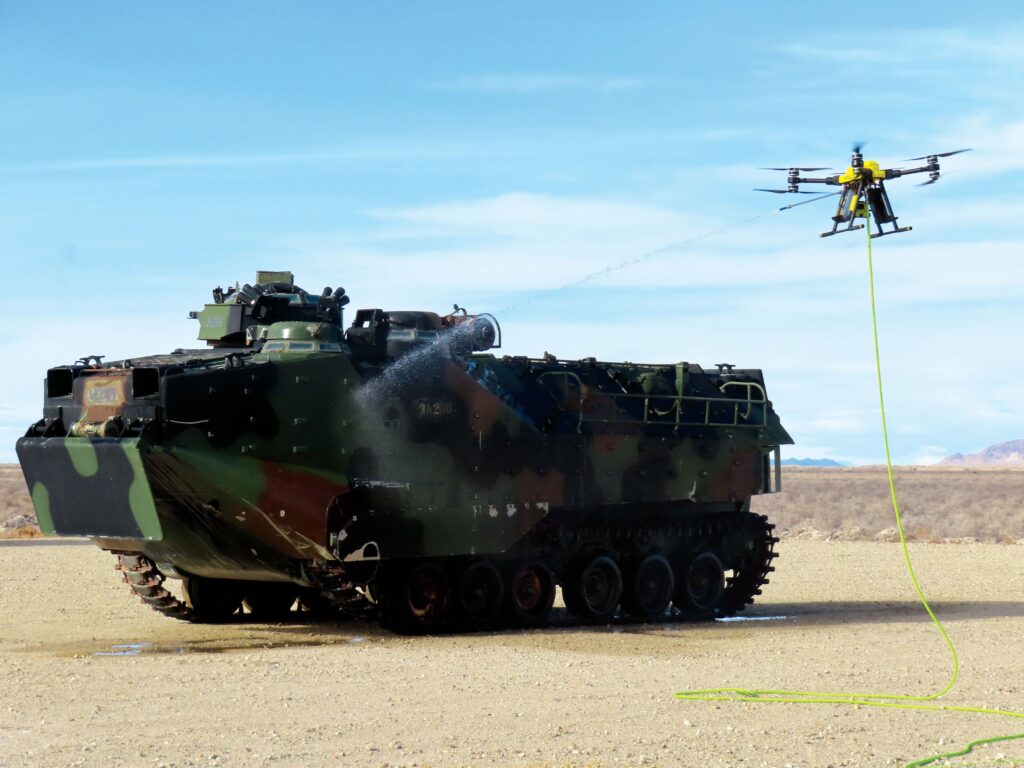
(Image: Apellix)
As Jeremy Countryman, mechanical engineer and head pilot at Apellix recounts to us, “Our first product was released about three years ago, and that was our Apellix B1 Power Wash drone, capable of autonomous airborne salt washing and pressure washing. In Q2 of 2025, we started selling our second-generation aircraft, the B2, and an NDAA-compliant version called the Apellix Blue. And more recently, we’ve launched our Apellix Spray Painting Drone, a semi-autonomous craft, which can do around 3000 ft2/hour.
“The new decon drone has been in development for two years through a partnership with the US government, and essentially mixes the two sets of operating dynamics together into a package that’s fully autonomous.”
As Countryman explains, the drone’s services are particularly applicable to military vehicles that may have suffered chemical, biological, radiological or nuclear (CBRN) contamination. The first stage in such operations is often washing down an affected vehicle with bleach to kill biological organisms and neutralise harmful chemicals. This is then followed by a scan that detects signs of anything of concern that might remain.
“If there is anything dangerous left, they need an encapsulation agent sprayed over the vehicle to securely cover them up – that’s where our spray-painting experience comes into play,” he notes.
“The biggest benefit is that it keeps human decontamination specialists out of harm’s way. Currently, their normal way of working is that two decon personnel in cleanroom suits stand on 8 ft ladders with pressure washers in hand.

“But doing that every time actually makes them a prime target for enemy forces because they’re the ones best placed to put critical military vehicles back into operating condition – by definition, that classifies the decon teams as high-value targets.”
Thus, with Apellix’s CBRN decontamination UAV, those personnel are able to stay away from the ladders and away from the decon operation in entirety. When the drone has been assigned a work target, they press a button to commence its launch, standing from a safe distance all the while. Once close enough, the drone scans the vehicle to understand what type of vehicle it is and to determine where CBRN contamination is likely to be concentrated about the vehicle’s body.
That then defines the map by which its flight pattern, mission duration and key points for prolonged agent spraying are fixed. Once those points are executed, the drone can scan the vehicle again for remaining contaminants. The data from that scan then automatically inform a second mapping for encapsulant spraying, which may be administered via a second hose and tank mechanically coupled to the drone.
This approach also keeps the decon personnel from having to decontaminate themselves afterwards. That, and the drone’s autonomy, significantly improving the efficiency of the work both for the decon teams and for those wanting the affected vehicles back in the field.
While detailed specifications on the decontamination drone are yet to be published, Countryman comments, “It can fly pretty much indefinitely via a tethered, ground-based power supply – that tether also providing unjammable comms – and comes to around a 30 lbs [13.6 kg] all-up weight, while measuring about 3 ft by 3 ft [approx. 1 m x 1 m].”
ISTAR and scientific research
Athlon Avia Scientific – Production Enterprise is a company based in Kyiv, which originated as a small engineering project in 2014, but has since grown into one of Ukraine’s biggest defence drone OEMs.
Its flagship COTS solution is the A1-CM Furia, a flying-wing bodied aircraft which, on top of flying a lengthy list of frontline ISR missions for Ukraine’s MoD, National Guard, Security Service and Armed Forces, has also been presented for use in scientific research for organisations such as AVIA Lab, the largest student aviation modelling laboratory in Kyiv (part of the Kyiv Aviation Institute National University) where, together with its members, Athlon Avia plans to develop the laboratory’s production and research capabilities.
As Yevhen Motolyzhenko, deputy director of international cooperation at Athlon Avia tells us, “We were officially adopted into the Ukrainian Armed Forces in 2020, before the full-scale invasion started. Today, Furia is deployed with more than 100 brigades in Ukraine and has been involved with at least 50 government contracts since 2020, the only real limiter for us being the rate at which we can scale up our production facilities.”
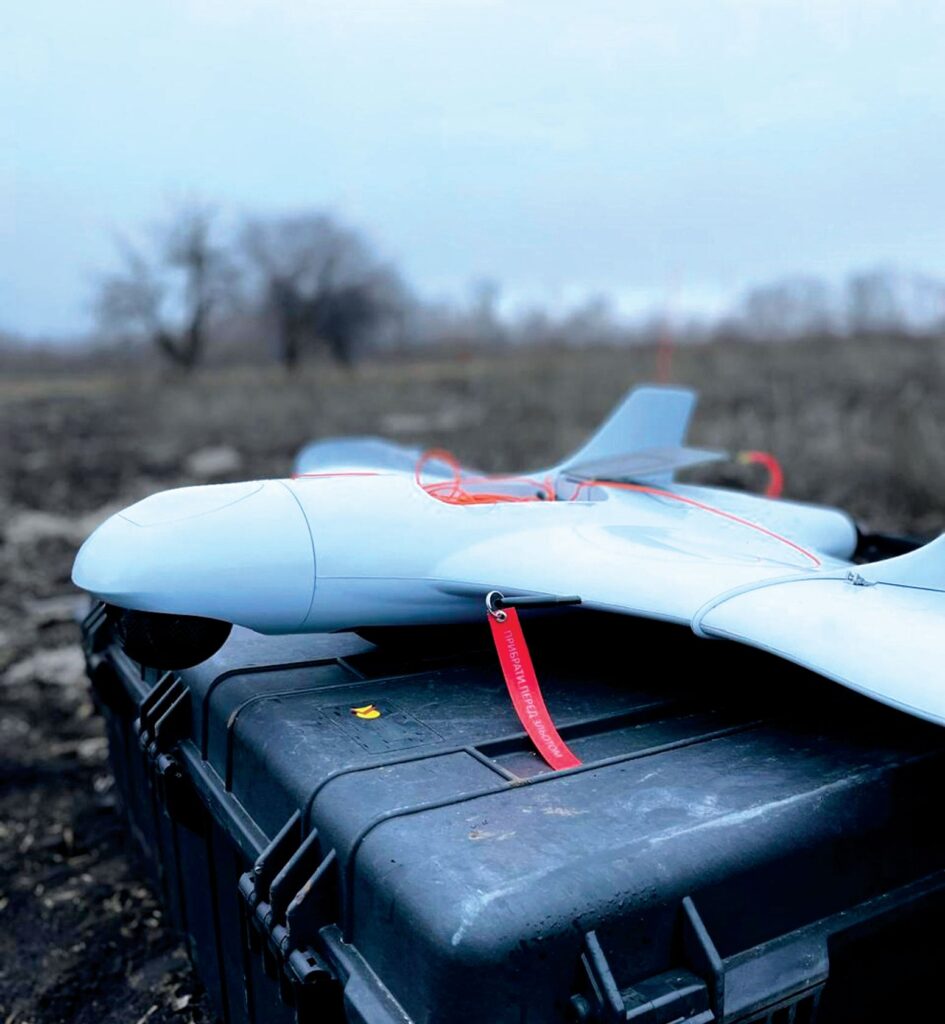
(Image: Athlon Avia)
At time of writing, Athlon Avia’s production factories are positioned and supplied well enough to produce up to 300 Furia UAVs per month. However, the complete A1-CM Furia UAS consists of three Furia UAVs, three EO daytime payload modules, three IR nighttime modules, a GCS, together with a ground antenna and its associated paraphernalia.
“Demand for Athlon Avia products exceeds 3000 units per month and we are doing everything we can to meet that demand,” Motolyzhenko adds.
“As you can imagine, all production and immediate supply chains are in Ukraine, but we’re actively trying to combine with solutions, components and ideas from other companies and countries that appeal, particularly if doing so brings opportunities for us to enter European markets with our UAS solutions.

“For our part, we have considerable experience and resources in-house when it comes to R&D in uncrewed systems. Athlon Avia has its own R&D centre, testing airfields, training centres, and facilities for manufacturing and prototyping, so we can easily progress through new projects, including new variations on Furia or our loitering munition drone, the ST-35 Silent Thunder, or of new ideas for drones from partners in other countries.”
He notes that interest in the company’s products has come from groups in the US, UK, EU, and across parts of Latin America and Asia, with the latter including prospective partners in the Middle East seeking cost-effective and scalable means of protecting critical infrastructure against strikes from hostile forces.
As of writing, the Furia is a 6.5 kg MTOW aircraft, with a 2 m wingspan and 0.9 m length, powered by a 65,000 mAh Li-ion battery for flight endurances lasting up to four hours (its electric motor and pusher prop enabling a
70 kph cruise). The system can thus cover 200 km of frontline survey distance per flight, while keeping to a 50 km operating range from its operator as limited by its effective comms.
“At the beginning of the year, we unveiled the third version of our product, which offers greater capabilities, and now, with a little extra skill, our military personnel can even achieve more than what is specified in the technical specifications,” Motolyzhenko says.
Furia’s versatility in operations is notable in that regard because it may be launched from either elastic or mechanical catapults, and then land either with a parachute or on its belly (with the flight in between being operated autonomously, semi-autonomously or by remote control).
“We have already integrated an EO/IR combined gimbal for day and night vision in a single payload, which is currently in use. We are also deploying an AI-powered solution for detecting and avoiding enemy interceptor drones,” Motolyzhenko adds.
Cold environments
Whether fighting through the Ukrainian winter, surveying along borders shared with Russia, or performing mapping or inspections in northerly latitudes, icy climates pose arguably the worst conditions for a UAV to operate in.
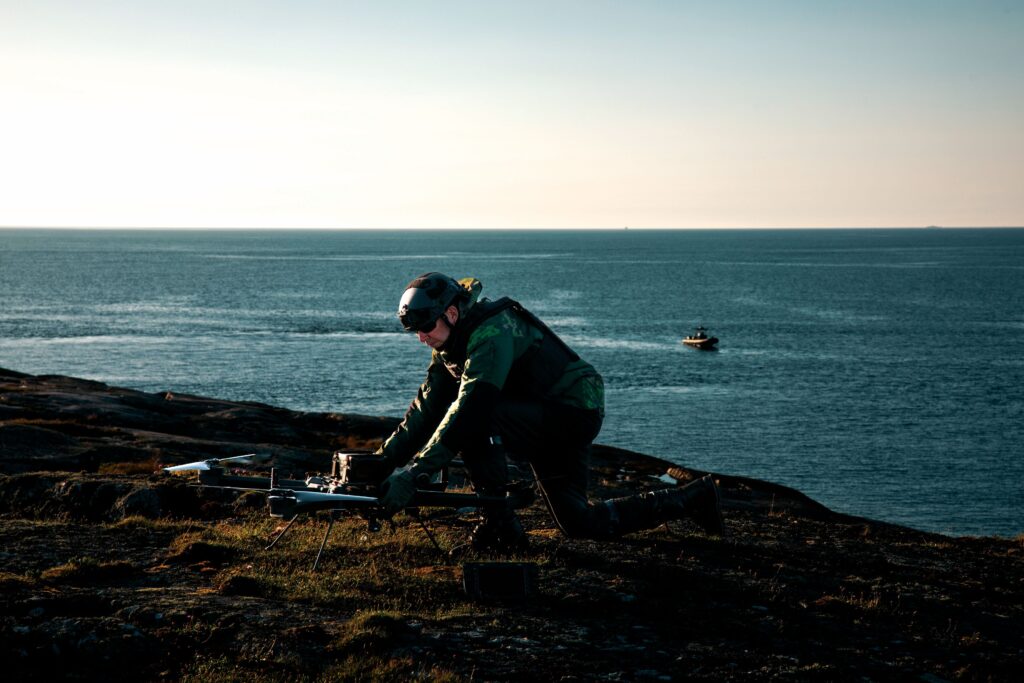
Sweden-headquartered Airolit AB understands this closely, and today supplies UAS designed expressly for long, reliable lifetimes in conditions that could grievously weather airframes and hamstring powertrains of conventional drones.
“The Nordic dimension is such that defence forces in the north really must strive to have equipment that will keep on working through -25 C conditions – and right now, everyone industry-wide has really set their eyes hard on the new target of reliable operation at -40 C – and it’s no different when it comes to engineering quality drones,” says Christoffer Segercrantz, country manager for Finland & the Baltics at Airolit.
Gesturing towards some of Airolit’s UAVs, Segercrantz emphasises that the rotor arms are aerodynamically shaped to minimise the incidence of ice catching on them, and that potential points of ingress are tightly sealed to IP55 standards to keep ice and water from penetrating the hull where it could freeze and crack apart the airframe.
“There’s additional technical IP that’s gone into how we maintain continued, stable operations amid the debilitating effects of very cold temperatures on batteries and electronics – but we can’t reveal that at this time,” he comments.
Airolit discussed two of its quadrotor UAVs with us. The smaller of the two was the S1, originally developed for ISR applications, but also intended to serve as a flexible payload carrier for any other missions that must be performed in a wide array of weather conditions.
As standard, the system can come with an 80x optical zoom EO camera, as well as options for tactical and agricultural thermal cameras and combined EO/IR gimbals, with FLIR, Sony and Workswell solutions among them. However, Airolit is open to integrating other and custom payloads upon request, including Lidars, loudspeakers and cassettes for laying optic fibre lengths, so long as they don’t significantly breach the 3 kg payload capacity and can mount securely beneath or atop the airframe.
The S1 can fly for up to 75 minutes thanks to its solid-state Li-ion battery, has a 6.4 kg MTOW and a top speed of 28 m/s (100.8 kph), and the ability to tolerate winds up to 25 m/s (90 kph).
“Larger than the S1 is our CX10, with which we fly different kinds of radars – including passive and active radars – as well as CBRN sniffers and mine detection systems, but also explosives,” Segercrantz adds. “Really, just about whatever you want!”
The CX10 can fly for up to 90 minutes, with a 20 m/s (72 kph) top speed and a 21 kg MTOW, along with similar EO and IR payload options as the S1, with a 10 kg payload capacity if equipping a 25 Ah solid-state battery or 6 kg of payload if carrying 50 Ah of energy.
“But we also use tethers like Elistair’s Safe-T 2, which enables continuous power and comms for uninterrupted operation,” Segercrantz notes. “I come from Finland, where we have 1300 km of borderline with Russia, which is constantly spoofing and jamming our GNSS and comms. So, tethered drone operations are very popular because you can work completely radio-silent with your radars and other payloads.
“Being a payload-agnostic platform helps a lot in that regard, not just agnostic to hardware but to software as well. I really want to emphasise how important it is to treat software as a payload too, especially different kinds of application-specific analytics for flight behaviours, target following, object avoidance and so on. That category of technologies is something defence forces and civilian groups alike really seem to show more interest in.”
Summary
Despite the above cases largely featuring dual-use technologies, each notably comes with a distinctly different and specific CONOPS and set of selling points relative to the others.
That variance highlights an important difference in definition between dual use and mere ‘multirole’ uncrewed systems: dual use more typically means a vehicle whose design and engineering have narrowed in on a specific, critical, military need. And as particularly highlighted by the Ukrainian drones noted above, that need is existential – that is, driven by survival – and not merely offering the convenience of a platform that can lift a camera up to a useful altitude.
(Image: Airolit)
A valuable lesson lies within for any uncrewed systems engineering teams that want to get past the start-up phase: drones and robotics should first address humanity’s direst need, and not merely provide a convenient or mildly interesting alternative to existing practices. That does not, however, mean that everyone should pivot to supplying military drones and forget that the world’s civilians are constantly enduring crises independent of warfare.
Whether one looks to natural disasters, ecological crises driven by climate change or new pandemics forcing mass self-isolations, all can benefit from uncrewed systems that keep people out of dull, dirty or dangerous situations. And those systems designed from the outset for people in need will stand the test of time, whether applied to the military or civilian worlds.
UPCOMING EVENTS