







International Drone Show 2026
Norse to meet you
Rory Jackson reports from this annual exhibition in Denmark, which teems with a unique wealth of critical, warfront-proven uncrewed systems
The International Drone Show takes place each year at Hans Christian Andersen Airport, in the Scandinavian robotics hub city of Odense, Denmark. Its 2026 edition brought considerable growth over the previous year, including roughly 50% higher attendance and nearly double the number of exhibitors lining the show floor (along with a plethora of conference sessions and live demonstrations).
Moreover, the show has been honed into an invaluable concentration of technologies vital for autonomous military systems operators and developers. Among the aisles of the expo floor were waves of previously unencountered high-tech uncrewed vehicles (many of them proven in active conflicts or intended to be so), novel innovations across avionics and propulsion, and providers of precision engineering and manufacturing services – a selection of which we present below.
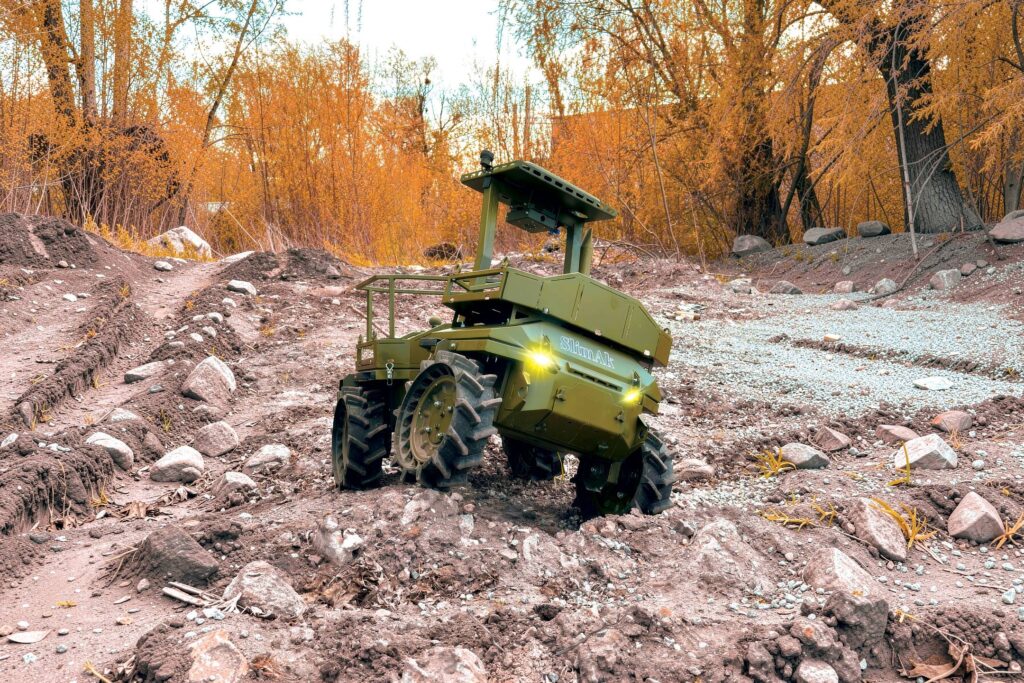
Hazakk presented its SlimAk UGV, a four-wheeled rugged uncrewed off-road system designed with two articulating chassis that enable it to traverse very uneven terrain in a stable and reliable manner, each chassis having the freedom of movement to adjust to different elevations and inclines about the central tow point at which they are joined.
“We’re based in Poland, but we have a factory in Ukraine, and we’ve sold 50 units to the Ukrainian military,” said a spokesperson from Hazakk.
“It’s a 4×4 drive system, and through the hydraulic suspension system the two halves of the vehicle can rotate safely and with great freedom, even through severe mud or snow; that’s also helped by two scrapers we’ve designed in front of the forward wheels. We create our own wheels to maximise grip and traction, and so the UGV can carry up to 120 kg, although we recommend a maximum operating payload of 80 kg.”
The onboard hydraulics can also damp shock and vibration from integrated remote weapon stations, minimising turret recoil in order to maximise firing accuracy.
While the SlimAk’s standard operating range is around 40 km, Hazakk can install a generator and fuel tank onboard to extend its range by a further 40 km.
Communications with the UGV are most often achieved using Starlink, although wi-fi, ELRS and even fibre optic links have also been used. Forward vision is provided via three near-infrared cameras, two of which mount in the dorsal frame above the forward chassis.
The Gor is a UAV produced by Airlogix in Ukraine, which has been engineered and deployed as a key link in reconnaissance operations chains, particularly as a tool for target acquisition and airborne tactical data relaying.
“Our Gor aircraft can cover up to100 km of mission range with tactical image transmission and can stay airborne for up to four hours,” said Dmytro Piatrin at Airlogix. “It carries an EO/IR camera for day and night operations, with 40x optical zoom and 2x digital zoom on the EO sensor and 8x digital zoom on the IR.
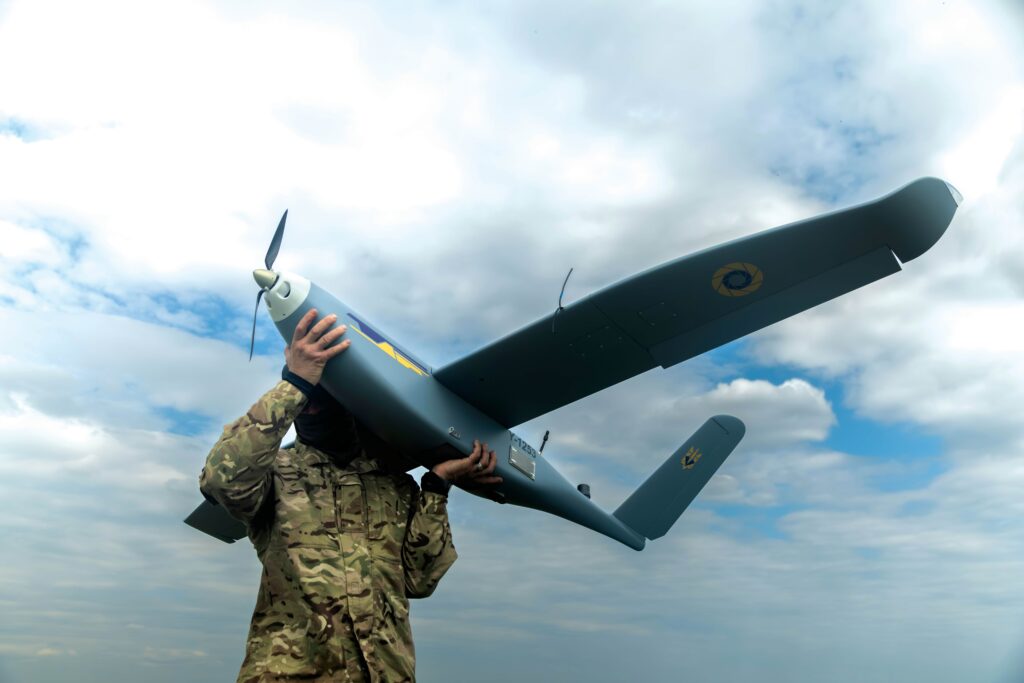
“The main value of this UAV lies in correcting artillery fire, as well as relaying information to and from mid-range strike aircraft, like our Anubis and Seth-X UAVs, which are built in Germany in partnership with Auterion.”
The UAV is catapult-launched and belly-lands, its gimbal retracting into the hull during both phases to ensure its protection and thus safe operation for tactical data gathering in subsequent missions. Proprietary software from Airlogix enables robust control of the gimbal for that purpose; additional company software is used for mission control and path planning.
To avoid communications being jammed, two different data links are used: a high-frequency band link and a low-frequency band link, with the UAV using both links simultaneously throughout the full duration of each flight so that jamming of one causes no significant interruption to the UAV’s connection back to its operator.
“Our clients’ missions typically need just 20–50 m accuracy of the UAV’s position. So, rather than using controlled reception pattern antennas, which can be very expensive, we use radio beacons to triangulate Gor’s position amid jamming,” Piatrin added.
Mila Nordic is a manufacturer of high-end battery modules and packs for demanding applications, with production facilities located in Denmark and Poland.
“From our R&D facility in Denmark, we research and develop tailored battery solutions, but we try to focus on projects that have a unique element to them. We need to see that the client needs some kind of specific or unusual feature, capability, performance criteria, design or so forth before we accept the project,” explained Lasse Petersen at Mila Nordic.
“If it’s just a normal request to put together some battery cells and slap a BMS and housing on them, it’s hard for us to compete on price and there’s plenty of other companies who can do that.”
The company also designs for manufacture from as early in each project as it can, suiting new packs or modules to be efficiently and smoothly produced for the customer’s anticipated needs on production volumes and delivery times.
As part of that, its assembly lines are scaled to enable thousands of batteries to be output per order, including QC and testing to a range of standards. Mila Nordic can also produce batteries using either lithium-ion or sodium-ion cell types, the latter presenting potentially lower costs, improved sustainability and better sub-zero temperature performance than lithium or lead-acid batteries.
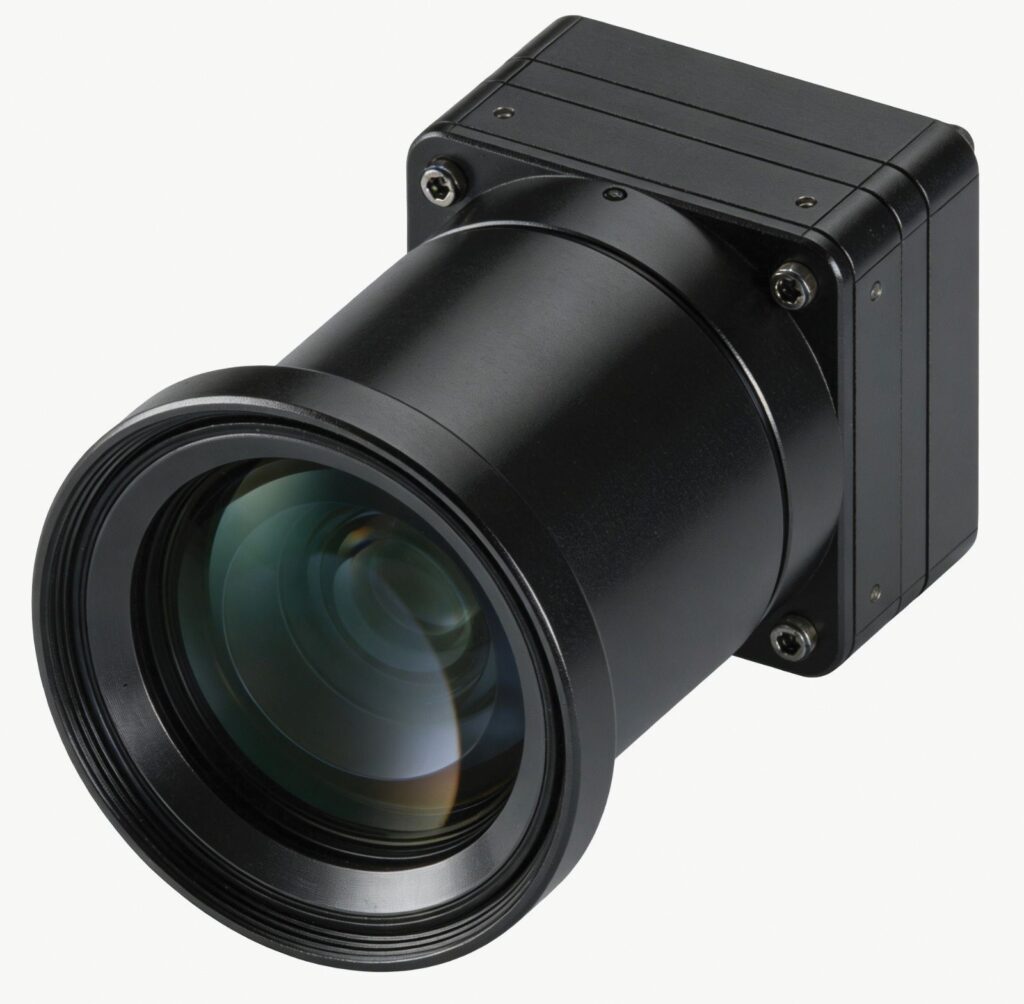
Fira Vision, an Ireland-headquartered producer of thermal imaging systems, showed us its latest HD thermal camera core, the UL12 Series.
“As well as using a high-definition thermal sensor, it comes with a wide range of interfacing options, including USB 3.0, Camera Link, MIPI CSI-2, HMDI, SDI, Ethernet and BT1120,” said Roy Mitchell at Fira Vision.
The UL12 is an LWIR module, operating in the 8–15 μm range of thermal sensitivity, and comes with a 1280 x 1024 detector. The weight of each system will vary depending on the customer’s preferred lens, with configurations running as light as 50 g.
“And we do a great deal of customisation down to the sub-component level, whether it’s the interfaces, the lens housing, or even the lens material or shape. We make some lenses from germanium and can even make some from polymers, which can help to reduce the weight,” Mitchell added.
The company’s standard range of lenses can enable detections of humans up to 16,700 m away, as well as recognising them at 8400 m and identifying them up to 4200 m away, along with identifications of vehicles at distances of up to 10 km.
Unmanned Defense Systems (UDS) displayed two military-oriented UAV systems that it designs and manufactures at its facilities in Lithuania.
The first was the Forecaster, a high-speed fixed-wing drone engineered for intelligence, surveillance, reconnaissance and target acquisition missions.
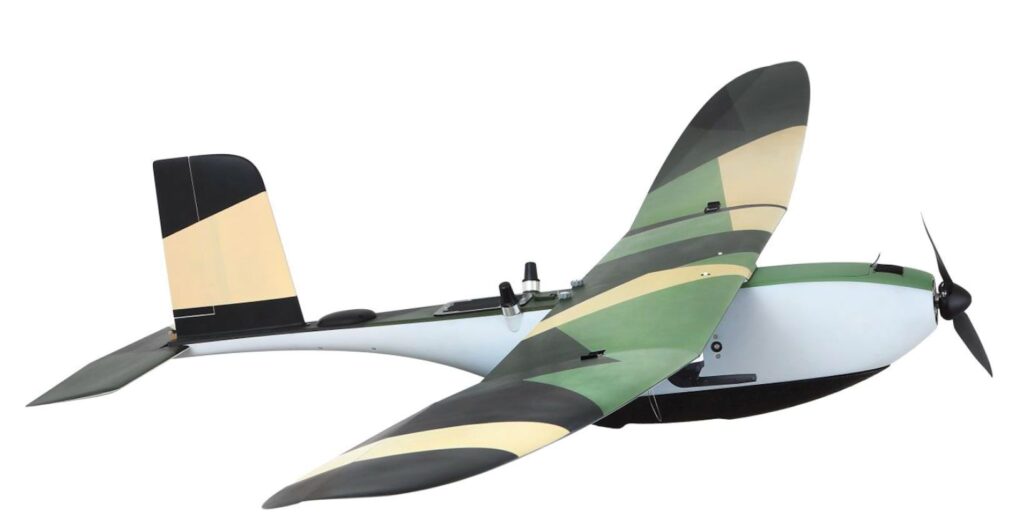
“It flies with 6 kg of total weight, and up to a 65 km radio link distance from its GCS,” explained Zilvinas Cibulskas from UDS.
“It’s hand-launched and then deep stall lands, all while safely carrying an EO/IR gimbal that it can retract into its undercarriage for protection. What’s notable is its longer-than-average flight time – about four and a half hours, nearly double that of drones of similar size and weight – along with its good EW resistance, which we’ve engineered by testing it on the frontlines in Ukraine.”
A strategy of optimisations across the Forecaster’s aerodynamics, weight, batteries, propellers and control trim have been key to maximising its energy efficiency and so extending its flight time. The aerodynamics in particular are put down to a combination of intensive digital simulations, real-world testing and the company’s lead aerodynamicist (whom Cibulskas cites as “the best in Lithuania”).
Also on display was the Avenger 5, a smart loitering munition UAV with a 280 kph maximum speed, 150 km flight distance and 90 minutes of flight endurance.
“Avenger 5 uses basically the same avionics as Forecaster, meaning any operator who’s learned to fly one can easily fly the other and experience the same degree of reliability,” Cibulskas said.
“We’ve taken efforts to integrate good optics in its gimbal, to ensure good target locking at up to 2 km away, and it transitions from loiter to target pursuit mode with precision automatic target tracking thanks to our sensor fusion technologies, so it can strike extremely accurately without needing radio or GNSS signals.”
The company also briefed us about its upcoming Hauler quadrotor, which it is designing as a multi-payload UAV. The system presently integrates a laser designator, and UDS is meanwhile working on further payload integrations with its partners.
Simplex Motion has relocated manufacturing of two of its electric motors for drones – the SD2814 and SD3515 – back to Sweden, where it is headquartered.
“We moved all of our electronics production back, from China to Sweden, a couple of years ago,” said Pär Jalbin of Simplex Motion. “That’s an easier task than moving motors, as electronics parts and production machinery are more standardised and widely available. Moving the motors back has meant acquiring more specialised machinery and supply chains.”
Arguably the hardest challenge has been selecting and acquiring the ideal automated winding machines, with high standards among Simplex Motion’s staff for quality, cost and delivery times.
However, with the machines now received and functioning, the company anticipates moving at least six motor models into its Swedish production facility – which can be used either for propulsion or actuation.
The SD2814 is a 108 g motor that can output up to 2400 g of thrust and draws 40 A of current in normal operations. The SD3515 meanwhile weighs 155 g and produces 6200 g maximum thrust, with 80 A of max current consumption. Both devices function with 3-8 S batteries (over 12 to 32 V inputs).
Simplex Motion additionally disclosed that its SD3110 and SD3115 motors are the next to be transferred back to in-Sweden manufacturing.
North Sea Electronics (NSE) is a Norwegian designer and producer of electronics systems for very harsh environments, having accrued expertise in making subsystems for ‘downhole’ drilling machinery, capable of withstanding the immense forces experienced while operating in borehole environments.
“So, we know how to design systems for very high temperatures up to 177 C, as well as severe pressures, shocks and vibrations from the ground-up. We’re also very used to making things that are highly miniaturised because in downhole integrations you’re given very limited diameters to work inside of,” explained Richard Fyhn of NSE.
“Being used to engineering components for these constraints, we’re now in special military applications like hypersonic missiles, and we’re actively developing atop that expertise to apply our electronics to the drone market.”
Although high-temperature electronics can be crucial for uncrewed systems componentry such as ECUs in engine bays, ESCs integrated inside electric motor housings or flight controllers for UAVs loitering in 50 C heat, NSE can alternatively use its high-temperature rating capabilities to enable higher power throughput, thanks to its understanding of ventilation, thermal conduction and other factors influencing efficiency at the board level.
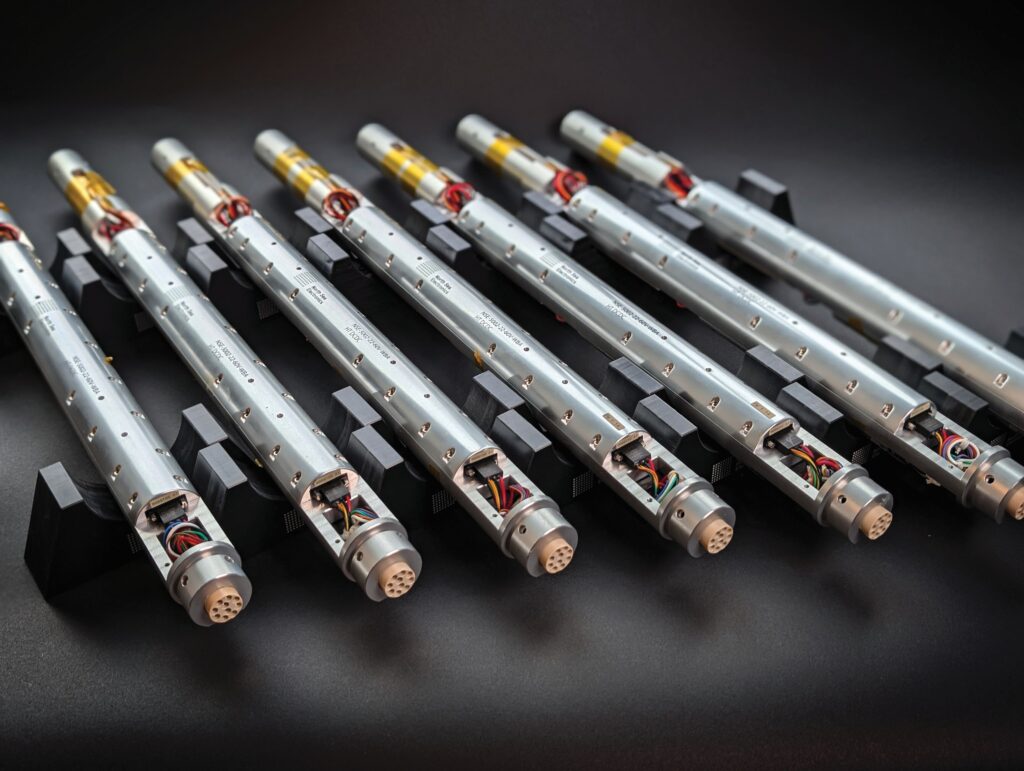
“There can be physical limitations to how much computing power or sensor functions we can implement in a very-high-temperature solution, but we’ve successfully developed working camera systems downhole before – so there’s a fairly wide range of potential solutions we could design for the uncrewed space,” Fyhn added.
NanoPing showcased its Raft network optimisation algorithm, which was originally invented 10 years ago at Denmark’s University of Aalborg (AAU), and forms the core of its eponymous solution for low-latency communications in mission-critical systems.
The Raft protocol combines forward error correction (FEC), automatic repeat request (ARQ), and carrier bonding. FEC helps recover from packet loss without requiring retransmission, ARQ enables missing or corrupted fragments to be resent when needed, and bonding allows traffic to use multiple carriers concurrently. Together, these mechanisms help rebalance and optimise connectivity based on real-time network conditions and application requirements.
“That ensures we repair end-users’ data transmissions on the fly and use multiple different links at once to route traffic in the best available way, helping to reduce issues such as jitter in Lidar modelling or full-motion video, packet loss during high-resolution image transfer or lag spikes when delivering time-sensitive commands,” explained Nicolai Jørgensen at NanoPing.
The company can work with virtually any IP-based traffic, comms protocol and data type, and does not look at customers’ data content when doing so (only at the integrity levels with which it is transported from end to end).
“And you can tweak different facets to achieve what ‘successful comms’ means to you. If, say, you need a live video feed for in-the-loop remote control, you can set up a parameter to prioritise video latency minimisation over video resolution because you don’t need a perfectly crisp image but you do need to react quickly to whatever’s in front of the vehicle,” Jørgensen continued.

Hence, end users may prioritise latency, data throughput, fidelity of data resolution or other qualities.
To onboard Raft with new users, be they the vehicle OEMs or data link suppliers (even those developing very small modems or routers into which Raft can still easily integrate), the company develops proof-of-concepts with each customer to ensure Raft and NanoPing are tuned to help reach their specific mission targets.
“The Raft algorithm was co-developed by our now-CTO, as well as another AAU academic from MIT and one more from TU Dresden, and it’s now commercialised after a decade of tuning and ready for UAVs or any other industry that needs stable, reliable connectivity,” Jørgensen said.
Brasa Defence Systems showcased its Unhuman UGV, which the Latvian company has developed over the last seven years to enhance defence organisations’ carrying capacity during field operations on a per-soldier basis.
“A single soldier can carry approximately 40 to 50 kg at most – our UGV Unhuman, which is in its third generation now and has been funded in part through four grants from the Latvian MoD, can carry up to
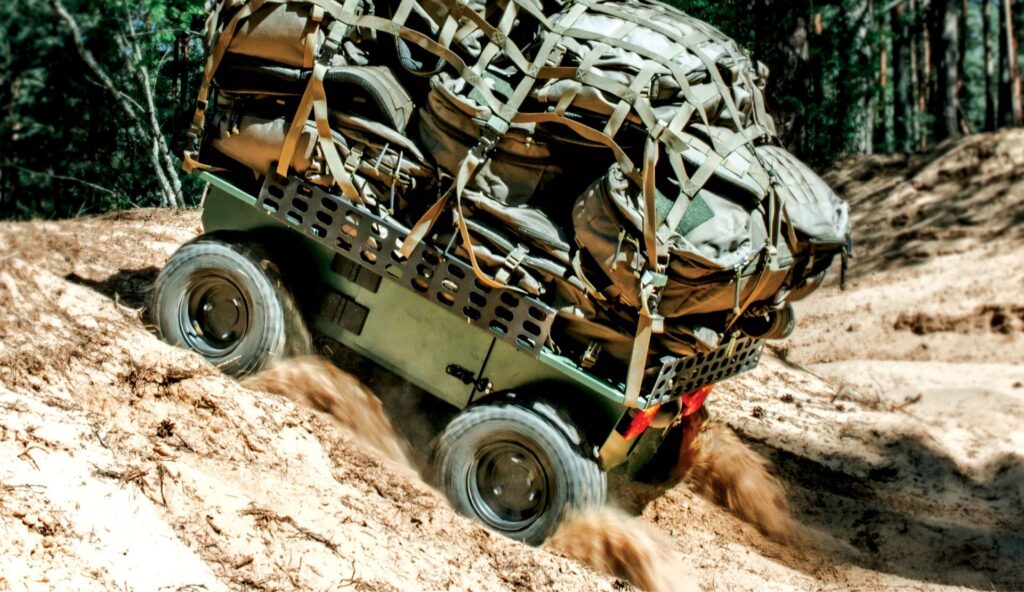
200 kg of payload, plus a 10 kg high-capacity dual battery pack, while weighing just 110 kg empty,” said Kristaps Kalass at Brasa Defence Systems.
“We’ve also tested it many times while carrying much more than 200 kg, but 200 kg is a smart rated level to adhere to. It’s also sized to Euro pallet 1200 x 800 mm standards to help end users calculate and plan their logistics.”
Over the generations of Unhuman’s development, Brasa has focused particularly on reducing its mechanical complexity, along with its costs of production and operation, while also expanding its modularity.
“Modularity isn’t a unique property at all anymore, but what’s quite unique about Unhuman is that it’s assembled from just five distinct, separate, welded parts, so it’s very easy to produce and maintain,” Kalass added.
“We’ve also simplified its software and UI such that customers have successfully learned to program or drive it with about five minutes of usage. And the modularity is also very helpful to re-shape or reconfigure the carrying dimensions or other sections to different customers’ needs.”
The UGV can operate with waypoint-based autonomy and convoy-style follow-me functions, while also integrating a range of cellular, satellite, military or other radios for comms.
Lastly, the company has designed Unhuman as a stealthily quiet UGV. It’s 3.5 kW all-electric powertrain enables a top speed of 13 kph, and generates approximately 200 Nm of max torque. Judicious combinations of motors and gearboxes have also been vital to minimising noise output during operation.
“We’ve seen a lot of UGVs over our research that are really loud. That’s not necessarily always a bad thing, especially since quieter components can be more expensive and we can swap-in louder, less-costly powertrains on request, but in defence, stealth is often a paramount concern. Hence, Unhuman is issued as a quiet vehicle as standard,” Kalass said.
Prototal Group is one of Europe’s foremost manufacturing specialists in polymer- and metal-based solutions for the aerospace, defence, medical and hypercar industries, headquartered in Jönköping, Sweden. The multinational company owns around 130 industrial additive printing machines and an equivalent number of injection moulding systems, populating its 10 production facilities spread out across Sweden, Norway, Denmark, Italy, Austria, Scotland and England.
“This large industrial base gives us the capability to produce advanced components from prototyping through to full-scale, high-volume manufacturing by combining the strengths of our different sites,” said Karin Holst at Prototal.
“We’re also certified to aerospace and defence standards at our facilities in the UK, but we’re open to achieving those same certifications in other countries, pending sufficient demand for it.”
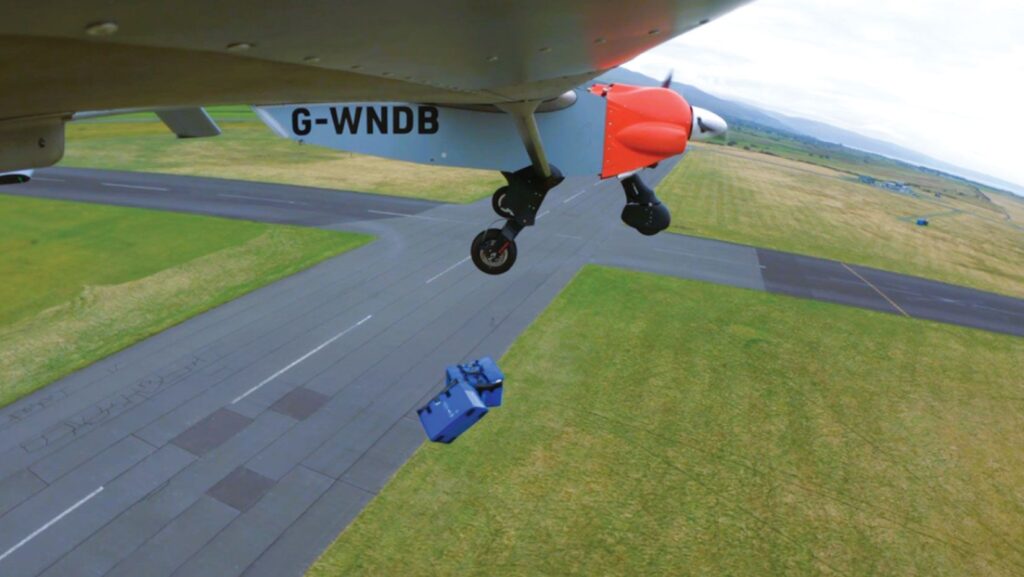
For serial additive production, the company uses selective laser sintering and multi jet fusion and will opt for injection moulding at the very highest volume orders, depending on customer requirements such as time to market, cost per part or part geometric complexity.
“And while it’s well-established that injection moulding can produce parts from a wide range of materials, we have a broad range of materials that we can additively print with, and we’re always open to incorporating new print materials into our portfolio,” Holst added.
“We partner closely with both our machinery and materials suppliers. So, even if we don’t have direct expertise with something specific a customer asks after, our suppliers will, and we’ll work together with them to bring in whatever new capabilities in additive manufacturing the market seeks.”
E-Magy is a Netherlands-based company that has patented a novel silicon-based battery anode material.
“What’s unique about our ENS30 material is that we use cheap metallurgical silicon as an input, and then we give it a nanoporous structure, enabling it to work in Li-ion batteries with very high energy density, as a pure silicon anode,” explained Fergal Harrington-Beatty at E-Magy.

The process of creating the silicon anode has been developed over the past few decades, having originated from a European research project. E-Magy presented its IP and capabilities particularly for drone usage at the show, where it estimated cells made from its anode (without necessarily using any other advanced materials or techniques) could achieve 70% faster charging times, 30% higher gravimetric energy densities and 10% weight reductions.
As of writing, ENS30 stands to enable cells of 350 Wh/kg with charging and discharging up to C-rates of 4.4.
E-Magy is now working with various partners, including at least one cell manufacturer in Spain (and under an MoU with manufacturer Tulip Tech in the Netherlands), to offer a uniquely high-energy battery made entirely in Europe, down to all input materials, and can supply pilot or beta test-sized batches of tens of units at a time.
“So, we’re well past the lab stage; we’re ready to scale with cell manufacturers, and also there’s interest from companies in Asia and the US in using our materials in non-conventional, non-lithium electrolyte cell approaches, like solid-state batteries, which we think is going to be a really big growth area,” Harrington-Beatty added.
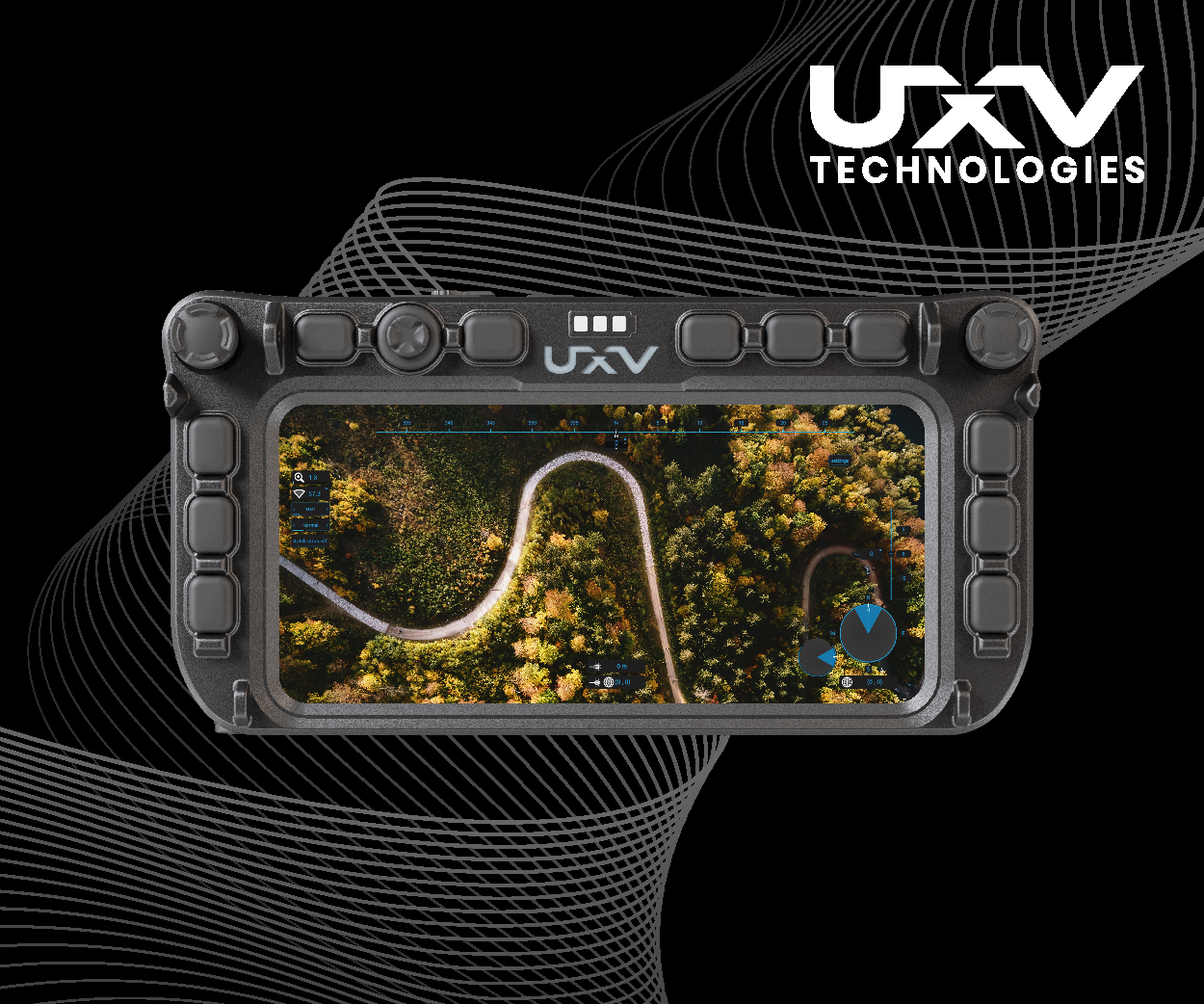
UXV Technologies unveiled its SRoC SingleGrip controller, a single-handed control peripheral for remote operation of uncrewed and automated systems, along with some updates to its previously released SRoC DualGrip.
“Our SingleGrip and DualGrip controllers can connect to users’ own devices or screens with all the same options in USB HID, Nett Warrior connectors, joysticks, buttons and switches that you’d get with any handheld SRoC controller today,” said Simon Vestergaard at UXV Technologies.
The SingleGrip additionally features an E-Stop, a safety button to help prevent dangerous incidents with controlled assets, a Picatinny mount for attachment to rifles, and both new devices feature deadman push buttons (with additional safety switches) for added layers of customisability.
Additionally, with the rising use of FPV goggles in airborne strike and ISR operations, the DualGrip and SingleGrip controllers now allow end users to fasten on their own FPV sticks, enabling a cleaner feel while controlling the system (particularly if wearing gloves).
“We’re also working on a gesture-control ability, by which end users will be able to wirelessly and devicelessly issue commands to a given platform via our SRoC systems,” Vestergaard added.
“Designing the SingleGrip came as part of our efforts to really round-out our whole ecosystem of control hardware, with devices that can mount into different vehicles or base camp situations – the kinds of situations where operating an uncrewed system using something with an inbuilt screen isn’t feasible.
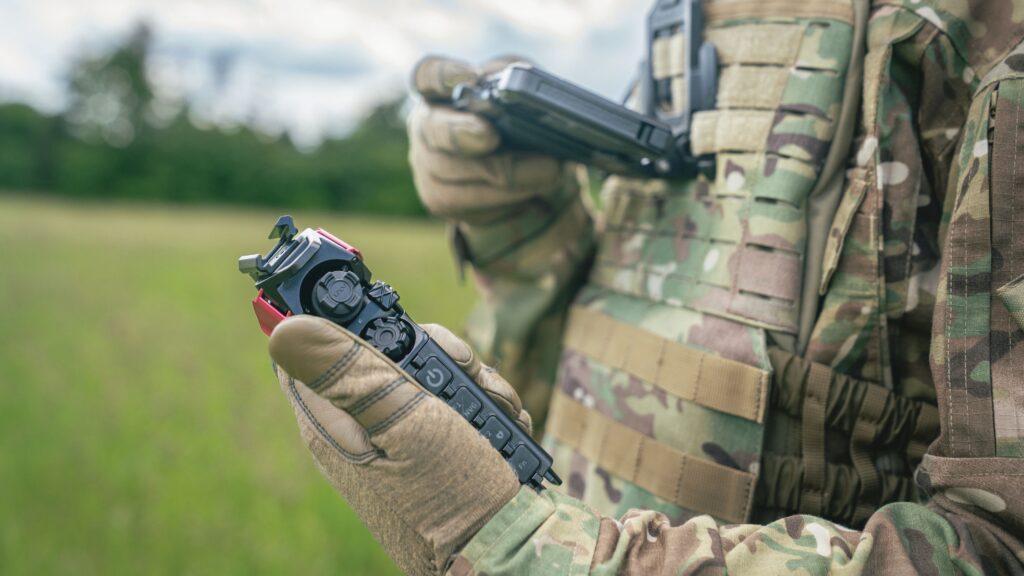
“Now, they can plug into whatever smaller device they might’ve already had – be it a Samsung, Panasonic, Toughbook or other device – with either SingleGrip or DualGrip, via a power distribution system like our Nett Warrior Pico Hub, along with our Soldier Radio Module to quick-swap any Silvus, Doodle Labs, DTC, Persistent Systems or other radio in and out as needed.”
The SRoC SingleGrip is expected to enter full production around the end of 2026
UPCOMING EVENTS