









Certo Aerospace Capstone VTOL UAV
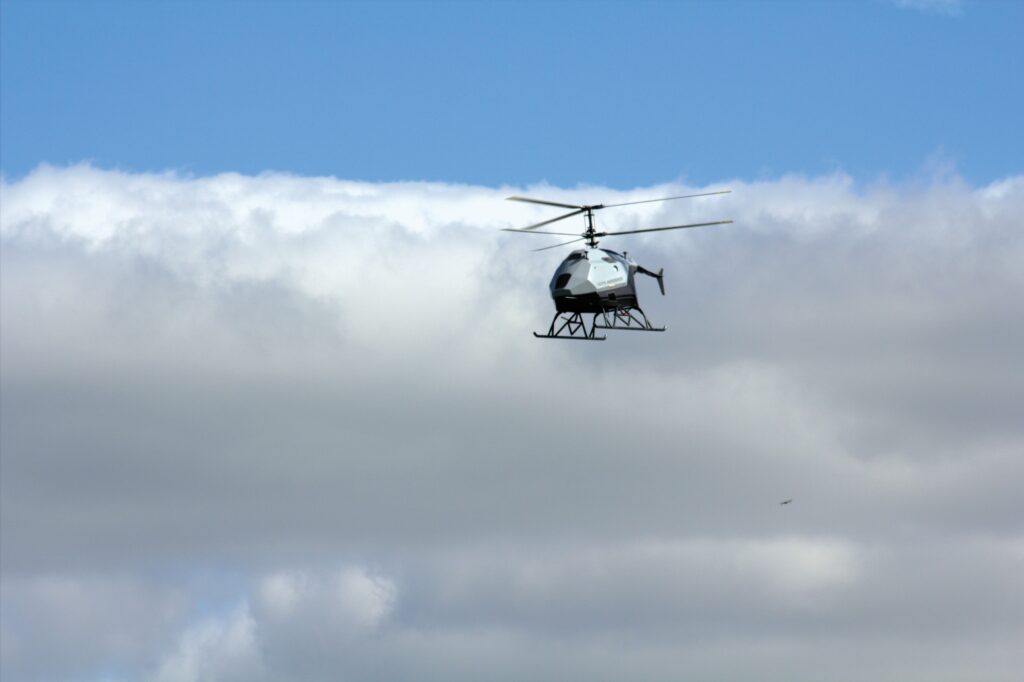
(All images: Certo Aerospace)
Doff your cap
A UK-built coaxial rotor UAV stands to bring very stable, nimble and heavy-lifting power to a multitude of defence and government users on both sides of the Atlantic. Rory Jackson investigates
Vertical lift stands out as an especially interesting technical arena for competitions between differing uncrewed aircraft configurations, with many impending examples such as the UK government’s Project NYX (aimed at deciding Britain’s loyal wingman UAVs for its Apache crewed helicopters) slated to showcase the competing capabilities of very different aviation designs.
Such competitions matter because proponents of non-conventional vertical lifting aircraft have imparted to us a number of criticisms of conventional helicopters that call their otherwise unquestionable value into doubt. The dangers of helicopters’ tail rotors, for instance, make them a collision hazard amid trees, buildings, human beings and other objects even for trained pilots and robust flight controllers, and the loss of that tail rotor necessarily means losing the helicopter’s capacity to remain in controlled flight.
Coaxial rotor aircraft are a well-established alternative both in literature and in a multitude of real-world deployments, notable for not needing tail rotors owing to the torque-balancing effect of the two contra-rotating main rotors.
That lack of the tail rotor requirement has historically meant eliminating the complexity and the risk of the tail rotor system – its rotors, shaft and gearbox – in exchange for the added complexity of having a coaxial shaft system at the main rotor. Not only does this conveniently contain the platform’s mechanics in a smaller central volume, but it also saves significant energy from being needed for anti-torque, instead deploying it entirely in the lift and control of the main rotors, making for a significantly more energy efficient aircraft.
Coaxials are by no means the only alternative to standard helicopters. Tandem helicopters like the Chinook, for instance, are being developed by a few uncrewed systems manufacturers. This configuration can be prone to higher dry weight than their equivalent coaxials owing to their added gearboxes and prop shafts, and their required length can prohibit their VTOL operations on some ships and in confined clearings or urban spaces. And multi-rotors are near-dominant among small UAS applications, but when scaled up for high-power lifting work, these can noticeably lose aerodynamic efficiency and controllability.
Certo Aerospace, headquartered in Frome, England, has studied closely the merits and disadvantages of the various VTOL configurations, and its design team’s conviction of the coaxials’ net advantages for the uncrewed segment has fuelled its long-running development of the Capstone UAV.
While Certo has existed in its current form for around five years, the engineering group underpinning it has been designing and testing coaxial flying machines for more than 10 years, starting – unusually – with a flying motorcycle.
As Justin Tooth, CEO of Certo Aerospace recounts to us, “Our original invention from 2011 was called SkyBike – essentially an experimental motorbike control system atop a coaxial rotor system. But this was turned from a piloted system into an inverted, coaxial drone, called SkyFalcon.
“Soon enough, we found ourselves on a big, three-year, US DoD contract, called the Unmanned Logistics System-Air Joint Capability Technology Demonstrator programme [ULS-A JCTD]. The DoD there wanted a drone that could lift 100–200 kg to integrate US autonomy to, but back then the US didn’t really have any VTOL uncrewed systems. So, they came to England and found us with SkyFalcon and Malloy Aeronautics with their TRV-150 and swiftly put us on programme.”
After COVID and the end of the ULS-A JCTD, Tooth and his team undertook a series of pivots, reconfiguring the drone into the more conventional (and, importantly, more scalable) coaxial helicopter shape, rebranding the company as Certo Aerospace, as well as refinancing, restructuring and relocating to Frome.
“Those changes took the aircraft in the direction our engineers wanted, with a bigger rotor disc and a better engine, allowing us to work its development up to a TRL 6 within a few years,” Tooth says. “We’re now at TRL 7, in our fourth year of flight trials, and getting back into defence development contracts, mostly in the UK but also in negotiations with our longstanding American friends for demonstrations across the Atlantic.”
Those contracts have included the UK MoD’s uncrewed cargo and casualty evacuation (CASEVAC) initiative Project MORRIGHAN published in 2025, and Royal Navy (RN)-funded anti-submarine warfare (ASW) demonstrations in February 2026. Impending focuses for Certo see the Capstone UAV as part of BAE Systems’ bid for Project NYX, and working similarly towards the RN’s ATLANTIC BASTION programme aiming for strategic-grade ASW through crewed–uncrewed naval teaming. Farther ahead, Capstone’s weight, payload and power capacities make it eligible for a copious array of upcoming publicly viewable projects and tenders that, naturally, Certo is building much of its product strategy around.
Capstone is (as of writing) coming out of a three-year spiral development programme, and is now entering an 18 month route through military user evaluations, together with avionics and payload integrations, on the pathway to commercialisation.
As of writing, two aircraft are constructed, with two more in build. Each unit weighs 300 kg empty, and can carry an additional 300 kg of payload and fuel, trading off fuel and payload mass for up to 10 hours of flight endurance (with suitable tanks). Certo cites five hours as a practical operating endurance and 500 km as its operating range
At 45 L, its smallest fuel tank still provides 90 minutes of flight in the highest fuel consumption case – that is, fully laden and hovering out-of-ground-effect. But the intention is to fit a 120 L fuel tank in due course that will treble that endurance.
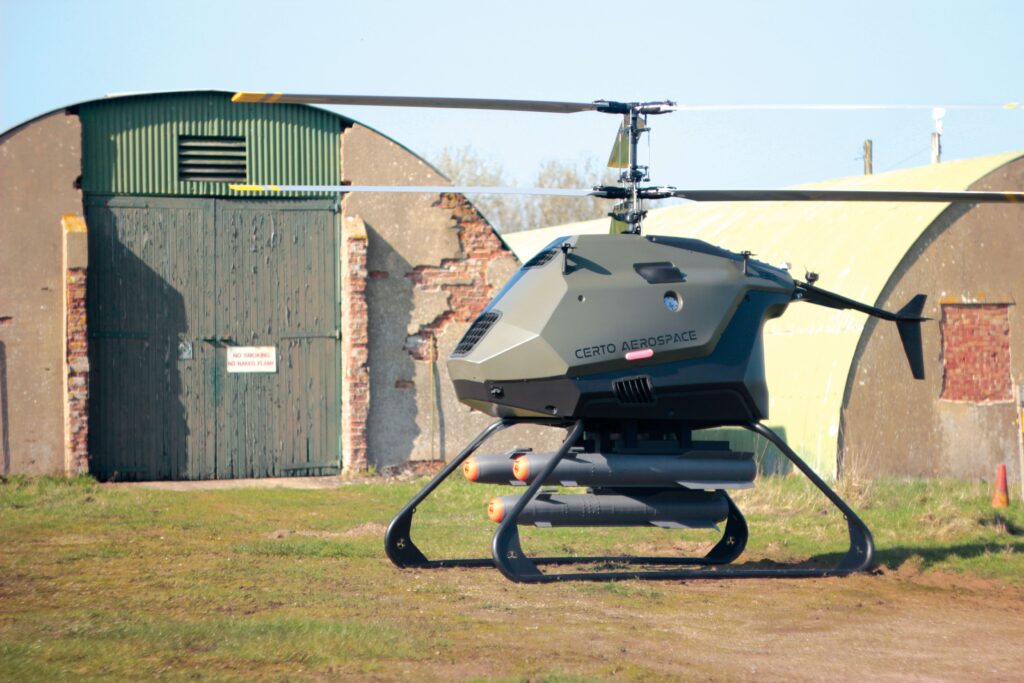
The UAV additionally achieves precise, agile control through how its coaxial rotor and flight control systems have been engineered, with cyclic and collective pitch on both discs, enabling it to operate with impressive stability and reliability in surface winds up to 30 knots, and attain airspeeds of up to 80 knots thus far in tests at its airfield but with a design speed of 115 knots.
Given Capstone UAV’s standout capabilities, we reached out to Certo Aerospace, which was happy to detail the stringent engineering and innovation that has been implemented across its powerful – and now extensively matured – uncrewed platform.
Concept of Capstone
Capstone was originally designed to combine desires for a downsized reimagining of successful coaxial crewed aircraft with those for a highly modular testing platform for robust R&D cycles. As a result, its early versions retained key beneficial flight characteristics in a compact form factor, while also using the least number of components practically possible, thereby minimising dry weight. Spiral development thereafter optimised Capstone’s efficiency and ruggedness for ongoing operations beyond those original targets.

“Platform performance has exceeded initial design specifications and is continuing to surpass expectations throughout its development phase,” adds Rob Manley, technical director of Certo Aerospace.
“The most noticeable diversion from a conventional system is the rotor head itself, being instantly recognisable with two sets of rotor discs, one above the other. This removes the need for a tail rotor and the associated mechanics, and therefore reduces the overall working footprint down to around 60% of that of a conventional system.”
The cornerstones of the UAV concept are simplicity and modularity: each subsystem can be removed from the platform while leaving all others in place. The aircraft is built around a largely open, steel alloy structural airframe, to which everything else mounts, enabling flexible integrations and demonstrations for specific use cases with minimal changes to the core system. This concept continues down to the undercarriage, which is considered mission specific and can be fully customised for the end user.
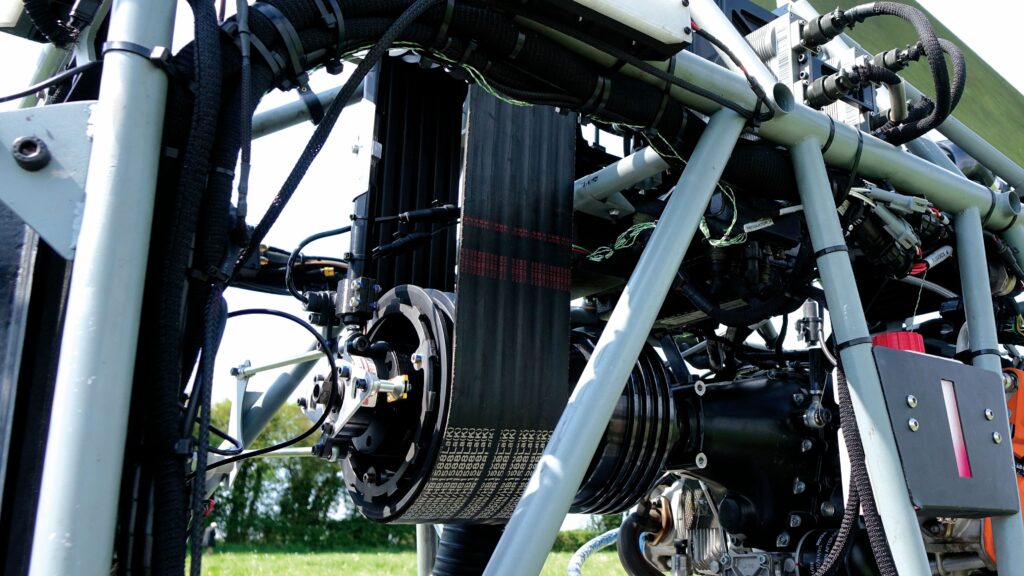
“Losing the tail rotor has allowed us to keep the mechanics centrally located, which helps in all other areas of the platform,” Manley continues. “The rotor head is driven through a toothed belt via a centrifugal clutch to the custom Edge Performance gasoline engine mounted directly underneath. Towards the front of the platform, within the nose section, is the cooling system providing forced and ram-air cooling effects, and towards the rear are the fuelling and electrical systems. This configuration ensures good CoG balance as well as efficient placement of both mechanical and electrical sub systems.
“Being liquid fuelled, the ability to integrate different fuel tank sizes is inherent in this design. While we currently operate with a modest 45 L tank, the platform has the ability to support over 120 L with minimal changes. For Capstone, endurance is a balance of payload and fuel and we can easily adapt to focus on either.”
Rather than employing a vast pool of personnel, Certo is instead honed around a small specialist team: 20 persons in total, 12 of whom are multi-skilled engineers covering the company’s field of expertise from concept innovation, certification and compliance through to flight testing. The engineering team covers overlapping competencies in electronics and avionics, airframe and undercarriage design, complex aeromechanics, rotating machinery, propulsion and manufacturing. Third-party suppliers are contracted for specialist works or specialist machined components to Certo’s own designs that then get assembled in house.
“In addition to covering the full aerospace product life cycle, keeping your engineering teams compact means every single individual is aware of what’s happening across the whole engineering enterprise,” Manley notes.

“The workshop team is integral to our flight test team, and members of the design office typically join for particular tests or to see their hardware in action. It keeps us agile and innovative enough to meet the needs of rapid spiral development in a heavily regulated environment. This feedback loop is critical when trying to validate projections on platforms that can achieve VTOL to three-figure speeds in short order and in varied flight conditions.”
Platform development
While the UAV went through many redesigns and variants over its lifespan as both the inverted coaxial SkyFalcon and later as the Capstone, the lion’s share of learning went into how pitch – both collective and cyclic – could be optimally controlled at both rotor discs because prospective customer demands drove bigger and more powerful versions of the aircraft.
“At a certain scale, SkyFalcon’s inverted configuration just became unwieldy, so it made sense to put the blades back up top where nature intended. This made the aircraft far more stable and generally more sympathetic with engineering stresses and strains, the system now being under traction, rather than under compression as before. Swapping in a far more reliable and familiar engine was also an easy decision,” Tooth recounts.
“Ultimately, the dual coaxial rotors make the system really powerful, and since they’re large and so aerodynamically efficient, with collective and cyclic pitch on both, we can very precisely and rapidly shape the mass airflow coming down through the rotor head, and, hence, the instant resultant effect on attitude and applied thrust. The aircraft flies itself far better than any pilot could, and I don’t say that lightly.”
Having served as a RN pilot for six years, Tooth has a useful background in landing Lynx helicopters of 5000 kg MTOW on numerous frigates’ flight decks at night. He recalls the daunting nature of those operations particularly in high sea states, and affirms that the right integrations of autonomy stacks and sensors will improve the assurance of such complex flight manoeuvres and landings over those of human pilots, or even remote operators in-the-loop, by a significant margin in the near term.
“But it’s a fascinating case issue because just as there are still many different VTOL configurations competing against one another for the bigger UAS space, there are also five or six different automated deck landing technologies, using different means of spatial location, comm suites and software logics to get on the deck,” Tooth observes.
“Having a stable platform that’s very good at controlling its relative position is a vital starting point, so Capstone is a natural candidate for necessarily nimble but heavy-duty work like that. But ultimately, we’re a platform developer; we’re not developing autonomy on the level of battlespace decisions, or inventing new forms of GNSS-denied navigation, and all the rest of the advanced avionics.
“Instead, our machine comes with its own integrated proprietary flight control layer, and then it’s up to others to pick and plug-in their ideal smarts for the various mission functions, which acting in harmony will transform a UAV from being basically an automated vehicle into something that is a fully autonomous uncrewed air system.”
Rotor head
Capstone’s rotor head combines novel configuration choices, refined control geometry and measured material selections to turn torque into stable flight. It has been developed in-house over a period of five years, drawing upon technical expertise accumulated from the earlier history of the firm.

Much effort has been expended to simplify what could be seen as a mechanically complex assembly of levers, rods and bearings (not to mention the control servos, rotor blades and shafts), into something assembled and maintained reasonably easily. Additionally, the UAV’s modularity and compactness are such that the rotor head can be quickly removed from the aircraft if something more than basic servicing is needed.
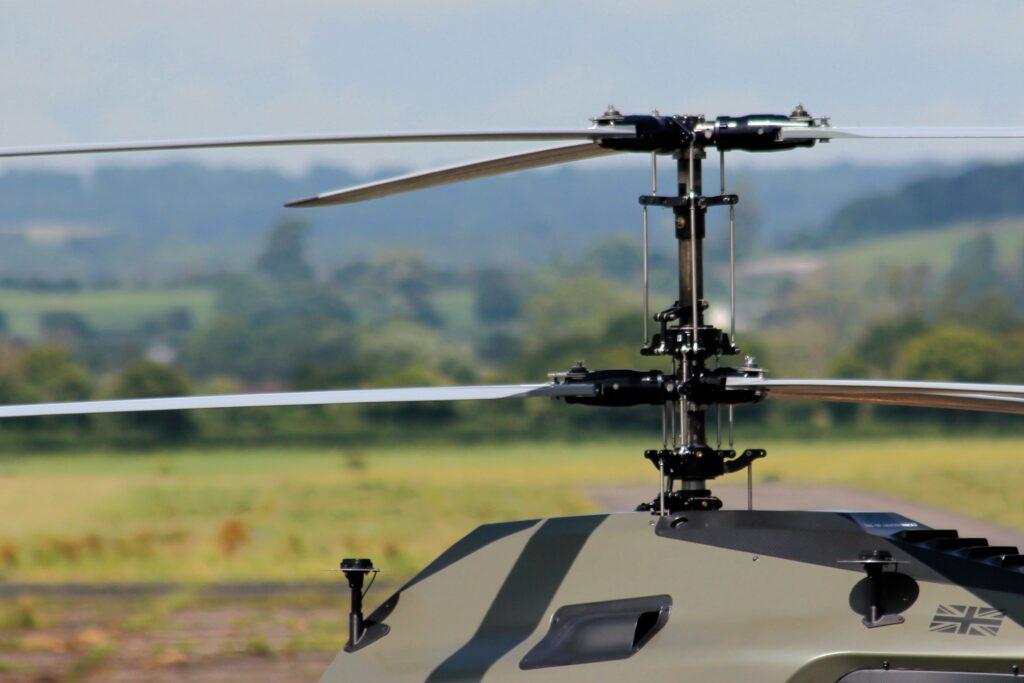
The two contra-rotating hubs each hold three rotor blades, controlled by four dual-redundant servo actuators. In addition to the advantages of coaxials previously discussed, Manley notes, “Utilising both discs for control gives us excellent flight characteristics in very difficult flight conditions, such as those you may expect around ships’ superstructures, above forest clearings and between buildings where crosswinds or turbulent air are to be expected.”
All four control servos are mounted to the main rotor gearbox as a pack, allowing them to be removed as a set, with their configuration providing redundant control across the collective, cyclic and differential inputs on both rotor discs.
“We’ve been using Volz’s servos for our control for over a decade and have a very good relationship with them. Over the years we’ve changed servo types, moving over to dual redundant units and have jointly made various customisations that make them ideally suited to this platform,” Manley adds.
The six blades are made from a carbon fibre skin around a foam core material, for maximised strength versus weight, with fully characterised behaviour in flight. At a disc diameter of 5.2 m, they form the largest extent of the platform and sit neatly above head height, although this depends on the mission specific undercarriage selected.
The blades come from Gyrotech in Poland, Certo citing the consistency and level of assurance of their quality (as well as the value for money) as having been critical over the course of aircraft development. Also vital was Gyrotech’s willingness to work with Certo towards custom variations on their standard blades where needed, such as bespoke blade roots for optimal rotor head connectivity and redesigned blade tips for performance optimisations.
A noteworthy feature has been included in the blade retention system, where the blades’ in-plane damping mechanism allows quick blade folding. “This reduces transport and storage prep to minutes rather than hours, and enables storage of Capstone units alongside existing assets, or having multiple units stored or transported in a 20 ft shipping container.”
While the high-level design conventions of coaxial rotor shafts are something of a solved art, there were considerable nuances that Certo has had to face when developing this coaxial system.
One pertinent addition has been dedicated high-speed data loggers, an example being a module mounted directly on the rotor shafts, allowing measurements to be taken during test flights, thereby validating and benchmarking material performance across multiple highly-stressed parts in-flight.
The spiral development process also has seen multiple improvements and upgrades over the last 18 months focused on weight reduction and increased component life. Any added complexity of coaxial rotor shafts is seen by Certo as manageable and worth the additional effort for the increased flight performance. “The use of simulation tools, digital twinning and physical test assets have driven material choices, material processing treatments and therefore the final geometry of the parts,” Manley notes.
One example of such material choices that the technical director comments on is the use of aluminium alloy over more exotic materials. “It is surprising how quickly you can be drawn to specialist materials to overcome engineering challenges, but when you look at the whole life cycle, the number of load cycles actually required, the increase in manufacturing time and cost, the reduction in surface treatments readily available and the difficulty in repair, more readily available materials can turn out to the best.”
Certo is also now developing their marinisation strategy, which will occupy much of its next development cycle, and spur investigations into optimal surface treatments and similar engineering choices.
As well as robust mechanical design, Certo’s software sensor suites pertaining to the rotor head and its control continuously log over 200 data points in operation, in pursuit of accurate, comprehensive data inputs, as well as low-latency monitoring and command outputs (Volz’s use of a CAN interface in their servos assisting in the richness of available diagnostic data).
“There are further nuances when you come to interactions between the control software and hardware; for example, the phasing of the control inputs to the blades on a coaxial system is a complicated process to refine and can vary depending on flight conditions. A small change in the control geometry has many knock-on effects,” Manley says.

“Similarly, changing the specifications of the rotor blades – like going slightly heavier or lighter, stiffer or more flexible, maybe a slight change in balance – would have consequences for the blade’s response to control inputs and therefore the vehicle’s performance.
“This is especially pronounced on coaxial platforms because you now have two rotor discs interacting with each other as well as with the fuselage. This adds an additional layer of consideration for how the blades move in relation to one another, such as how they cone, how the discs tilt and where they tilt in relation to one another in different flight manoeuvres.”
Relying on simulation alone to filter through all possible rotor designs for the optimal combination of design and control architecture (including control geometries, linkage lengths and transfer angles from servo output shafts into rotor blades) would have been extremely time consuming, not to mention dangerous – Manley reminding us here of the “rubbish in, rubbish out” hazard of simulation data inputs and outputs. Hence, Certo’s engineers ran simulations and physical flight tests in parallel, each validating the other, resulting in more efficient rotor head development.
Their gradual and combined hardware-software development approach, first in simulation before moving to real-world physical trials, led to a highly adjustable rotor head assembly, including a mechanical control geometry and software control algorithm (the latter residing in the flight controller) that could be adapted and changed, plus an interface for monitoring and analytics of blade performance and behaviour.
Part of the physical test programme that has accelerated development was the ability to monitor blade behaviour in flight. “Blade tip path and the interactions between the two rotor discs were a limiting factor in early R&D trials. We needed to develop a method of monitoring to both validate control geometry and ensure minimum blade separation values throughout all flight modes,” Manley says.
“Optical-based blade-tracking equipment is generally used to trim the blades on a single-rotor helicopter, ensuring the rotor disc is true and flat; this became the basis for our solution. By adapting the concept, we’ve now got onboard tip-tracking capabilities at both the upper and lower rotors simultaneously.”
To develop that capability, Certo took delivery of specialist line-scan cameras and integrated them into a test arrangement, pointing them at Capstone’s blades from three different positions around the fuselage. Software was developed to allow the cameras to monitor both upper and lower rotors, in practical terms, mapping the tip positions of the rotor discs at three points around a circle.
“That data, fed through to our custom GCS in real time, allowed us to create a visual graphic showing both rotor discs, which ways they coned, leaned and where any ‘pinch point’ – as we call the closest interaction point between the upper and lower disc – occurred around the discs,” Manley continues.
“So, when we’re doing envelope-expansion flight trials, we can have a look at the simulation and compare that with what the rotor head is doing in reality, even during the most complex flight manoeuvres. This has resulted in the ability to adjust the control inputs to the rotor head in real time for the vehicle flight characteristics we need, whenever we need them. And all of that can then feed back into the original design specification for whatever our next big technological jump will be.”
Powertrain
A major enabler for Capstone is the EP917Ti engine from Edge Performance in Norway. As a reminder, Edge Performance’s operating model (as detailed in UNC-66) consists of upgrading BRP-Rotax aircraft engines for the digital control, safety and high power requirements of industrial UAVs, the EP917Ti being Edge’s re-engineering of the Rotax 915iS LMM/HMM.
“There are multiple benefits in using the Edge Performance version of the baseline Rotax engine. For one, having a certified, locked-down ECU was difficult for us because we needed to integrate our flight control system into it to operate and monitor engine performance remotely. But we don’t need to be certified under our flight authorisations. So, having an Edge Performance conversion instead, with its custom ECU option, gave us the flexibility to integrate as we wanted,” Manley explains.
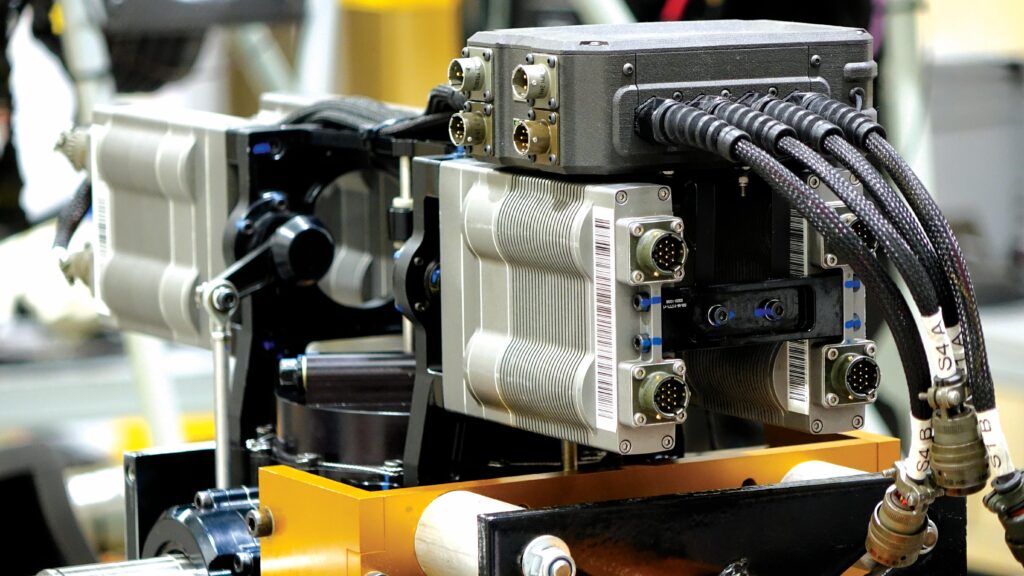
“We can also include features such as an overspeed governor on the engine and, of course, we also get a little bit more power with Edge Performance than with Rotax. That’s not strictly required but it gives us more headroom; a bigger safety net at the top end, for when we’re doing more thrilling flight manoeuvres, or the kinds of heavy vertical lifting work that’s otherwise difficult for other platforms.”
The EP917Ti is a four-stroke, opposed four-cylinder, turbocharged, spark-ignited engine, displacing 1352 cc and typically running on gasoline. It outputs up to 180 hp (133 kW) of maximum power with 224 Nm of torque at its 5800 rpm operating speed, with a dual redundant ECU and EFI system (including an EGT sensor for closed-loop engine management).
The frontal thermal management section holds a custom unit (which Certo describes as very weight-efficient) packaging the EP917Ti’s coolant radiator, oil radiator and intercooler, with a fan driven mechanically off the engine for constant, forced-air heat dissipation.
Being liquid fuelled, the decision to carry either more payload or more fuel for longer flights is a relatively simple one that can be made during mission planning.
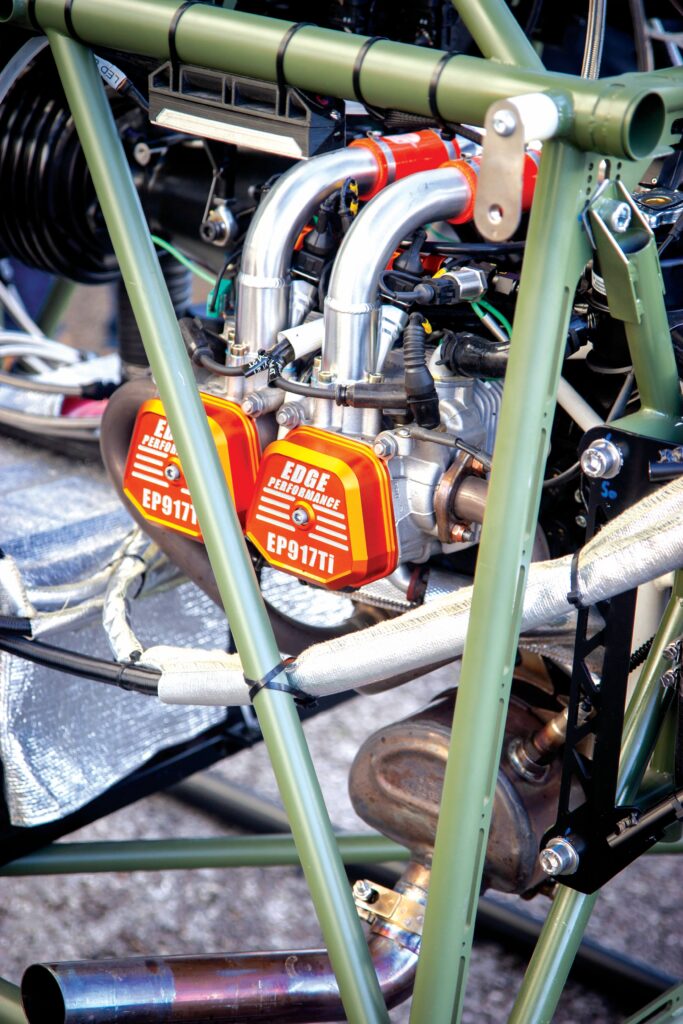
“Our standard 45 L plastic fuel tank incorporates suitable safety standards, and the fuelling system alongside it has been developed around general aerospace practice such that all the optimal fuel filters are mounted in the right place, with no chance of overpressure in heat, or underfuelling. It also uses a twin pump set-up and performs the necessary checks on power up, giving us dual redundancy wherever we could have it,” Manley adds.
“The flexibility baked into this platform means that, as noted, we can switch from that basic tank to something with much higher capacity without issue. For instance, a lightweight bag or bladder tank to save weight will be utilised for the 120 L version, or if the customer requests, a Kevlar-reinforced fuel tank could be fitted if operating in contested airspace. No demand-pull modification like that will ever be ignored because we can provide solutions to any requests along those lines very quickly.”
Steel structure
Capstone’s primary load-bearing and subsystem-mounting structure is, as mentioned, a welded frame of tubular alloy steel. Choosing steel over more widely touted aerostructural materials such as carbon, aluminium or titanium largely came down to the relative difficulty of modifying the latter materials for agile R&D, maintaining or repairing any of them in the field and other inherent weaknesses of theirs.
“We don’t want to rely on something that loses its airworthiness after getting a simple scratch in the field; we need something repairable, rugged, and that can be produced relatively quickly and inexpensively. A tubular steel airframe provides a structurally sound, lightweight and stiff solution ideally placed for the work we are doing,” Manley says.
“Additionally, our staff includes coded welders onsite, who form part of our wider workshop team, ensuring we can have airframes welded together or repaired on demand for supply, testing or R&D purposes.”
Steel components for the airframe are typically laser-cut to Certo’s design specifications by third-party suppliers offsite, with tolerances exact enough that the tubes fit together “like a big, three-dimensional jigsaw”, as Manley puts it. That enables ease and rapidity of airframe assembly for Certo’s personnel, particularly by minimising the number and complexity of jigs or fixtures needed to put the UAV structures together – as a result, the company estimates that a single engineer can assemble an airframe within eight business days.
The airframe appears externally simplistic but is expertly designed to transfer all flight loads whilst maximising flexibility with respect to replacing components, adding new instrumentation or upgrading subsystems (such as the planned fuel tank upsizing previously mentioned). As part of that, the engine mounts on a dedicated subframe, held in place with six bolts – four at the front, two in the rear – such that these can be unscrewed easily to remove the engine complete with cooling and oil systems, in the event of any end users wanting to swap out the powertrain to perform needed maintenance or an overhaul, or wanting to switch to a preferred new power unit.
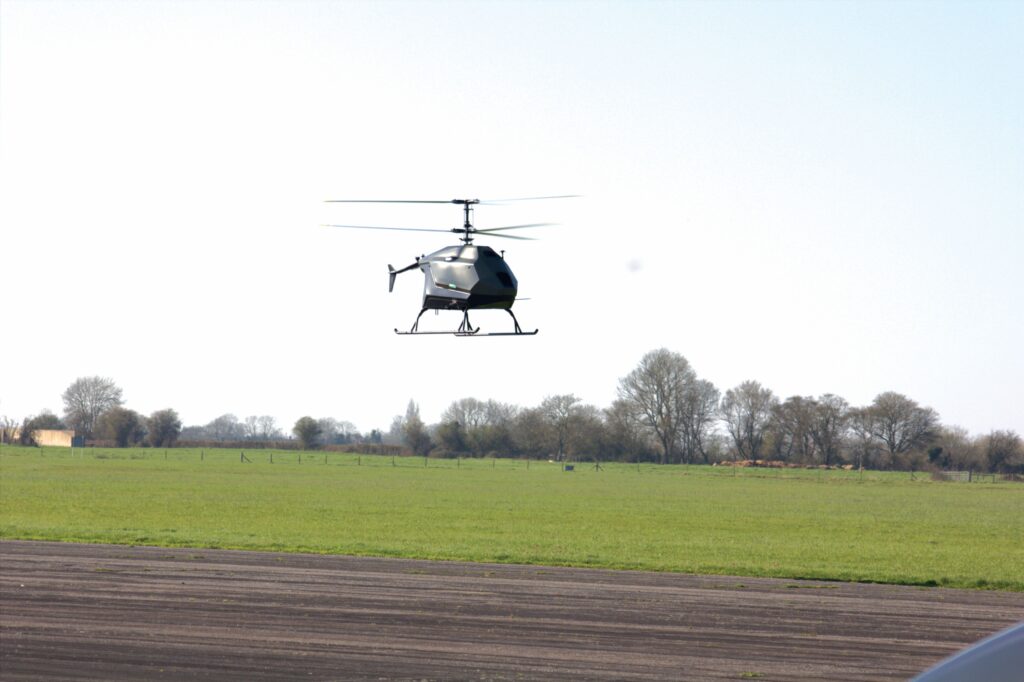
“It’s proven a very useful way of adding modularity and future-proofing the aircraft, not to mention keeping maintenance a very efficient process,” Manley adds.
“We’re working towards a new heavy fuel engine option in the next 18 months, which is a big area of focus and effort for us. That’ll result in a powertrain developed specifically for our platform, with all-UK or -European IP, which will empower us to do R&D quickly and flexibly using a preferred fuel type.”
Presently, the airframe and its fairings may be oversized relative to Capstone’s future operating requirements, largely to assist with the need to fit in, or rapidly swap, as much instrumentation as possible during the UAV’s R&D stages, and also to gradually characterise its thermal management requirements with plenty of space for heat exchange. Hence, these components will be subject to future optimisations that will unlock considerable extra capability and performance.
“The bodywork is a carbon-fibre moulded fairing, very lightweight, but ultimately not required for the aircraft to operate,” Manley notes. “That also means that, if it gets damaged for whatever reason, the UAV is perfectly serviceable. It’s not meant to be an exquisite aircraft; it’s meant to be rugged, get knocked about a bit and keep on performing as intended.
“So, the bodywork gives it some form and shape for now, but there’s room for refinement in terms of both system-level heat management and aerodynamic efficiency – and the latter of those two is notable because our major limiter on airspeed, based on all theoretical and analysis work we’ve done, is the drag on the fuselage. We’ve identified in our development processes that we can reduce that frontal area drag by about 50%.”
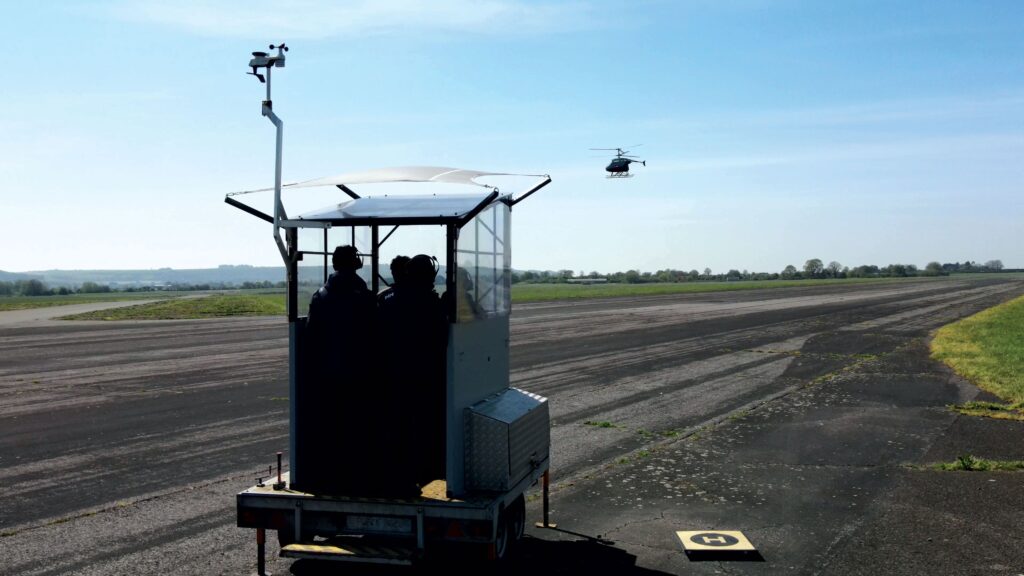
To that end, aerodynamic R&D is being undertaken in partnership with a few different companies and institutions, including aerodynamicists at Sophrodyne Ltd. Once the results are implemented next year, Certo’s engineers anticipate Capstone’s top airspeed increasing from just over 100 knots to over 135 knots without additional propellers.
Avionics
Certo’s flight control and vehicle management systems have been developed in-house over a period of eight years, its custom solutions providing a control architecture suited not only to handling the complexity of the aircraft’s subsystems, manoeuvring and dynamic capabilities, but also to allowing the underlying flight control algorithms and telemetry to be refined as part of the ongoing aircraft development.
“Whether you’re tuning the flight control algorithms for varying payloads and speeds, configuring the engine management and rotor governor systems, or any of the fail-safe protocols and procedures, we can adjust them in real time through our own in-house developed GCS software,” Manley notes.
“For R&D purposes, it’s been a fantastic decision, but it also allows us to smoothly integrate third-party mission systems and smart payloads such as sense-and-avoid, precision landing systems and other useful solutions for expanding the UAV’s autonomous functionality, all of which we’ve been able to demonstrate successfully in various R&D programs over the years.”
The on-board avionics will be kept in-house, and with assistance from Certo, supplied Capstone aircraft will be able integrate whichever choice of mission processors, smart payloads and other avionics that the customer may be best served by.

“Our interface protocols allow any external third-party mission processors to control the platform,” Manly explains.
“This is all managed by our built-in avionics, which are fitted as standard and consist of two main components. One is the flight control system that accepts high-level mission instructions, including take-off, loiter, land and waypoint commands, or low-level velocity and acceleration controls for precise control, even as required for agile ‘nap-of-the-earth flying’. The second component is a general vehicle management system that controls the engine, the governed rotor rpm and the many other systems required by the aircraft; it’s also able to integrate with and control any third-party systems or smart payloads”.
Whilst the built-in avionics package seems ideal for many of their current customers, Certo also supports customisation or replacement of its flight sensors, catering for instance to defence customers wishing to put in their own choice of RTK-GNSS module or a military-grade anti-jamming solution.
“It’s worth saying, however, that we’ve done a good deal of analysis on our avionics and sensor choices, not only for general control, telemetry and navigation systems, but also for the C2 link for our remote pilots,” Manley says.
Via that link, the proprietary Certo GCS software allows for aircraft arming, engine starts (and warm-ups), spool-ups and take-offs. These can also be set with planned GNSS waypoints, altitude changes and profiles for speed, acceleration and deceleration, along with other dynamic behaviours.
If required, the GCS also integrates with external mission processors and aircraft-mounted payloads. “Historically, we’ve undertaken multiple sensor-augmented missions, including smart payloads for autonomously guided precision landings using UWB radio beacons, as well as scanning Lidars that also perform landing site evaluations,” Manley adds.
“But we’re not wedded to any particular third-party vendors. Our avionics team includes software, firmware and hardware engineers, providing us with the flexibility to integrate with almost anything. For instance, we’re also planning to work with companies like Cambridge Sensoriis and Agilica to perform automated ship deck landing trials, and with the University of Liverpool, we’re developing and analysing the required interactions with moving platforms. This will, in the future, be used to build up to Ship-UAS Operating Limits activities so that we can start demonstrating real-world ship deck landings in maritime conditions, be it with the UK RN, civil applications or others.”
Specialised mission systems & flight operations
“With eight bolts, you can take off the standard undercarriage and replace it with specialist mission-specific types,” Manley explains. “Those range from a palletised system, CASEVAC, ISR sensor packages, ASW with deck locking systems, under-slung load systems, kinetic effectors – anything, really.”
The array of mission systems available to Capstone, thanks to its immense payload capacity, enables considerable leeway beyond the classic EO/IR and Lidar payloads seen in most UAVs.
This has an effect on the type of flight authorisations available (such as ORAs and UK SORAs within the civil sector) and the types of flights permissible with a platform of such capability, with few places inside the UK having specialised facilities for supporting the full extent of feasible R&D flight operations.
Hence, when Certo’s local flight test site in Wiltshire is no longer large enough for the speeds and ranges required, the National Drone Hub in Cornwall, operated by Wholeship Limited, will be utilised. The latter has an extensive mix of over-land and -water flight test areas, allowing safe and speedy envelope expansion trials. It has also supported Certo in gaining SORA-based flight authorisations from the CAA for high-speed flight trials, to be conducted later in 2026.
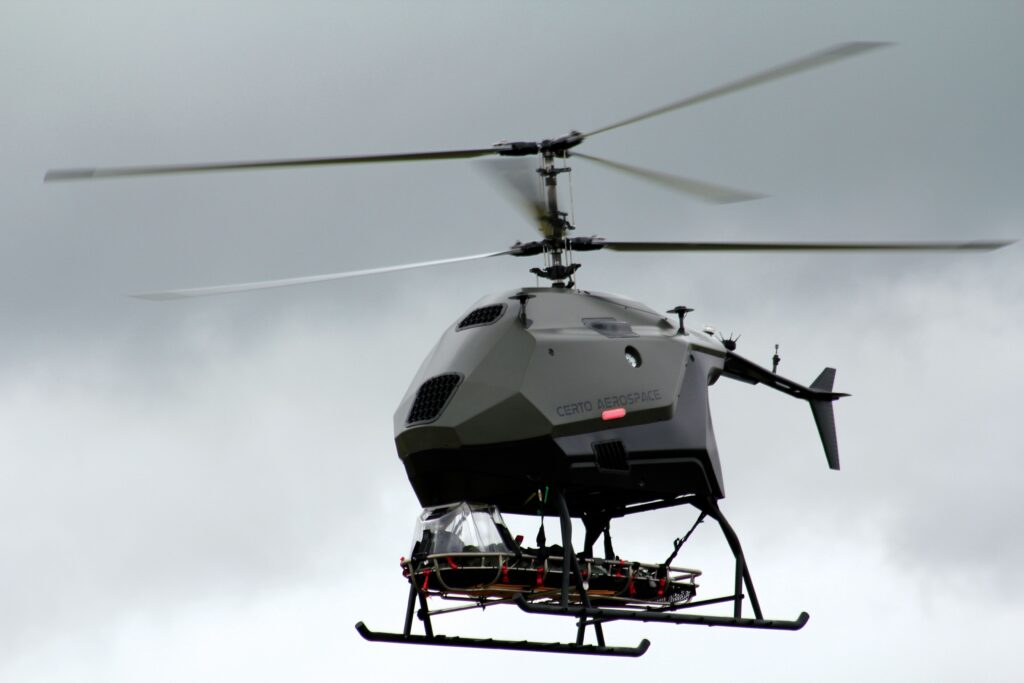
In addition, a key facilitator in expanding specialist mission systems has been HeliOps, based in Portland (UK).
“They’re growing as a UAS test centre, with facilities that allow us to expand Capstone’s flight envelope, including over water and using multiple types of vessels for maritime trials, but they also have key technologies for rapid R&D, turning prototype components around really quickly,” Manley explains.
“They have a very strong military focus and experience, meaning embedded practical knowledge of mission systems integration standards, and they are completely across what’s needed to design and specify mission equipment accordingly.”
Certo also cites SkyLift UAV, with which Certo has had many years of collaboration, as a key provider of containerised payload solutions that Capstone can attach and lift for applications such as logistics or CASEVAC (SkyLift’s main business and source of experience being UAS logistics for maritime-based wind turbine maintenance).
“Capstone is dual-use in every respect; the undercarriage is the role-fit section, and can be changed out for whatever the use-case needs it to be, and SkyLift provided us a really fantastic containerised and interfacing solution,” Manley comments.
For further or more specific CASEVAC work, Certo works with Black Space Technology – also met through Project MORRIGHAN – whose Rapid-ACE flightworthy stretcher incorporates a multitude of casualty remote monitoring systems (highly akin to the Avilus Grille UAV’s casualty-carrying medical cabin, as unpacked in UNC-65).
“Their stretcher also has a vacuum bag to prevent casualties moving around and hurting themselves further, along with a fully autonomous casualty vital sign monitoring, defibrillator and ventilator system, using COTS wearables and digital imagery to monitor and detect clinical deterioration in a casualty during any CASEVAC mission,” Manley says. “And its sensors feed back through our own flight management system and to our GCS for a fully integrated solution.”
Future
In addition to commercialising Capstone over the next 18 months, Certo Aerospace anticipates working on a few other items to expand its offerings and capabilities.
For one, Manley and his technical team will be developing their own heavy fuel engine, whilst ensuring Capstone’s speed, range and payload are still maximised after switching to a slightly heavier unit with the benefit of a more efficient fuel.
“Based on the designs we’re finalising and the parts we’re choosing, it’s going to be a very solid engine, guaranteeing the reliability needed to put our UAV into service, including on JP-5 and JP-8, to meet the preferred fuel policy,” Manley notes.
Additionally, the coaxial helicopter configuration has been found through Certo’s (and others’) research to scale up extremely efficiently because the blades don’t all run in the same plane. As they grow to increase lift, the main aircraft does not have to grow in proportion; effectively, doubling Capstone’s dry weight would more-than-double its payload capacity. Hence, as customer demand for ever more payload evolves, Tooth anticipates that a Capstone 2000 (with 2000 lbs payload) or potentially a Capstone 1400 or 1800 will emerge in the years ahead.
“But for now, we’re focused on Project NYX for the UK Army, as well as contracts in the US and with naval groups. And after the military customers have absorbed and evolved our systems for the defence use-case, that’s when we plan to start making aircraft for other government-related activities such as coastguard, fire suppression, disaster relief and other work that would generally reduce risks to life,” Tooth states.
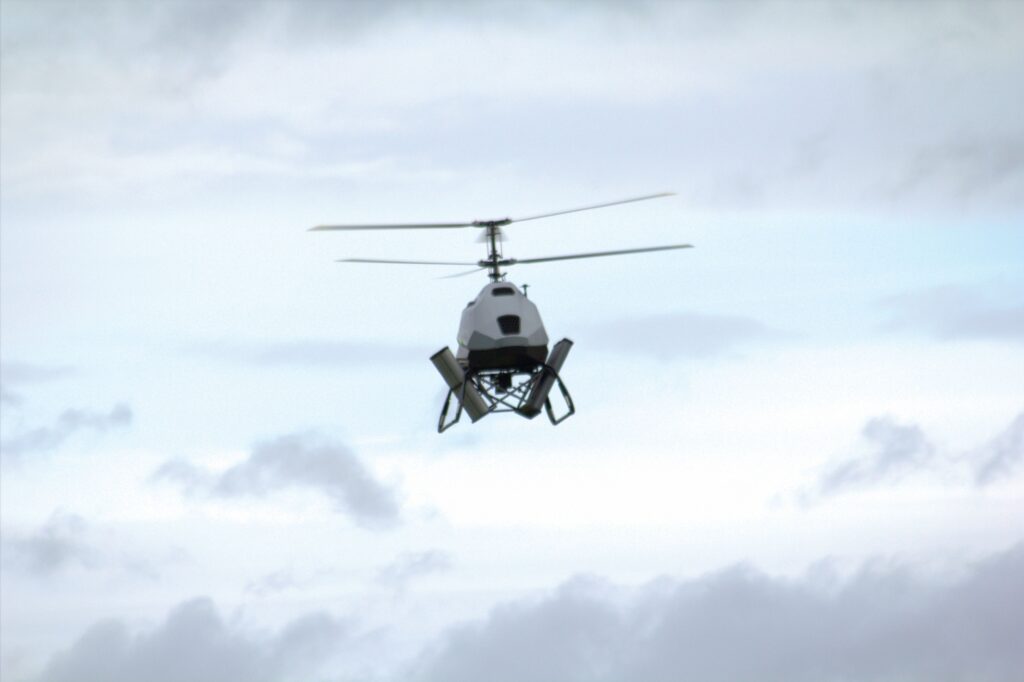
“And then beyond that, there’s further potential in agriculture, construction, logistics and other markets that are still waking up to what heavy-lift VTOL UAVs could do for them. If you think of these bigger drones as analogous to cars, then really we’re only in the year 1901; we’re all still figuring out what the best aircraft configurations, power plants, CONOPS and so forth are.
“That’s why I’m sure there are many decades of growth ahead for this particular field of aeronautics. We are actually still on the flat part of the curve.”
Key specifications
Capstone UAV
Coaxial helicopter
Turbo four-stroke engine
MTOW: 600 kg
Rotor disc diameter: 5.2 m (blades fold to within 1.3 m in length, width and height)
Payload capacity: 300 kg
Maximum endurance: 10 hours
Operating endurance: 5 hours
Maximum airspeed: 115 knots
Wind tolerance: 30 knots
Some key suppliers
Engine: Edge Performance
Propellers: Gyrotech
Actuators: Volz Servos
Testing & engineering services: HeliOps
Flight test facilities: National Drone Hub (Wholeship Ltd)
Precision components: Langstone Engineering
Precision components: Duckworth & Kent Engineering
Containerised payload solutions: SkyLift UAV
CASEVAC payload solutions: Black Space Technology
Precision landing Lidar: Garmin
Sense-and-avoid radars: Cambridge Sensoriis
Ultra-wideband navigation & positioning: Agilica BV
UPCOMING EVENTS