


Enhanced VLA model to support robotaxi development
(Image: NVIDIA)
NVIDIA has developed a set of AI models and tools for Level 4 robotaxis, writes Nick Flaherty.
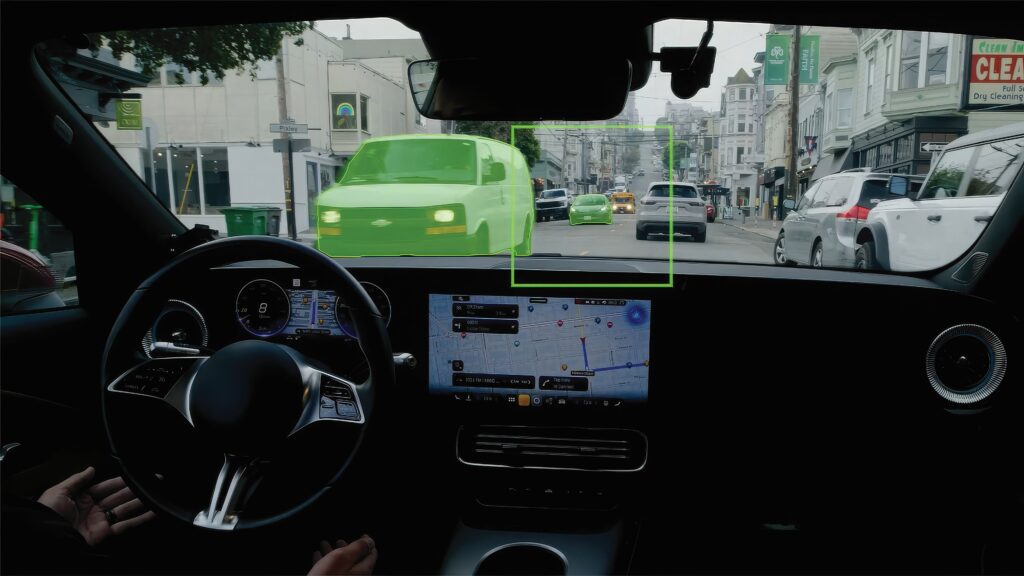
Alpamayo 2 Super is an open Vision–Language–Action (VLA) model with 32 billion parameters that reasons, plans and acts across the full driving stack for safer, scalable Level 4 development. This goes beyond trajectory generation to reason, plan and act across the full driving stack and avoids the need to build key autonomy infrastructure from scratch, and NVIDIA says that it provides human-like perception, reasoning and action. A key point is that it is open and provides visibility of the decision-making process, which is needed for safety validation and regulatory collaboration.
The previous version, with 10 billion parameters, has been downloaded close to 400,000 times and includes post-training scripts that allow researchers and developers to adapt the models to their own datasets, scenarios and driving policies.
As well as reasoning, Alpamayo 2 Super includes auto-labelling, scene understanding and model critiquing, and it can distil knowledge into smaller models to provide the building blocks for scalable Level 4 AV development and deployment. It also now includes 360° situational awareness across front, side and rear view cameras, giving the model complete context for safer lane changes, merges and intersection crossing.
This is intended to run on the AGX Thor processor running the Hyperion DriveOS operating system.
Contract manufacturer Foxconn is using the DRIVE Hyperion platform for integration, scaling and deployment of Level 4 EVs starting in Taiwan, with Kaohsiung expected to serve as an early deployment city, before expanding across Asia. It plans to launch a robotaxi service in 2028, starting with airport-to-city routes and later expanding along corridors linked to Taiwan’s high-speed rail network.
Vehicle maker VinFast is working with stack provider AutoBrains for services in Vietnam, and AutoBrains is also working on a programme to launch a robotaxi program in Munich with rideshare giant Uber using DRIVE Hyperion. Uber is currently planning rollouts of robotaxis in the US in 2027.
Various tools help developers integrate the VLA model into a software stack based on DriveOS.
AlpaGym is a high-throughput, closed-loop reinforcement learning framework that trains AV models on the consequences of their driving decisions in simulation before road deployment. The open‑loop training evaluates models against recorded data and generates a single round of actions, running models through continuous decision and observation cycles in NVIDIA’s AlpaSim, with every braking, steering and navigation choice affecting the environment. This shows compounding errors and edge‑case failures that static datasets miss, allowing models to learn from experience.
OmniDreams creates photorealistic closed-loop AV scenarios for developers to simulate rare and long-tail driving scenarios at scale.
A neural reconstruction agent in NVIDIA’s Omniverse NuRec environment allows developers to reconstruct real-world fleet data into photorealistic 3D scenes and adapt them across various vehicle sensor configurations.
UPCOMING EVENTS