






New antenna boosts underwater comms
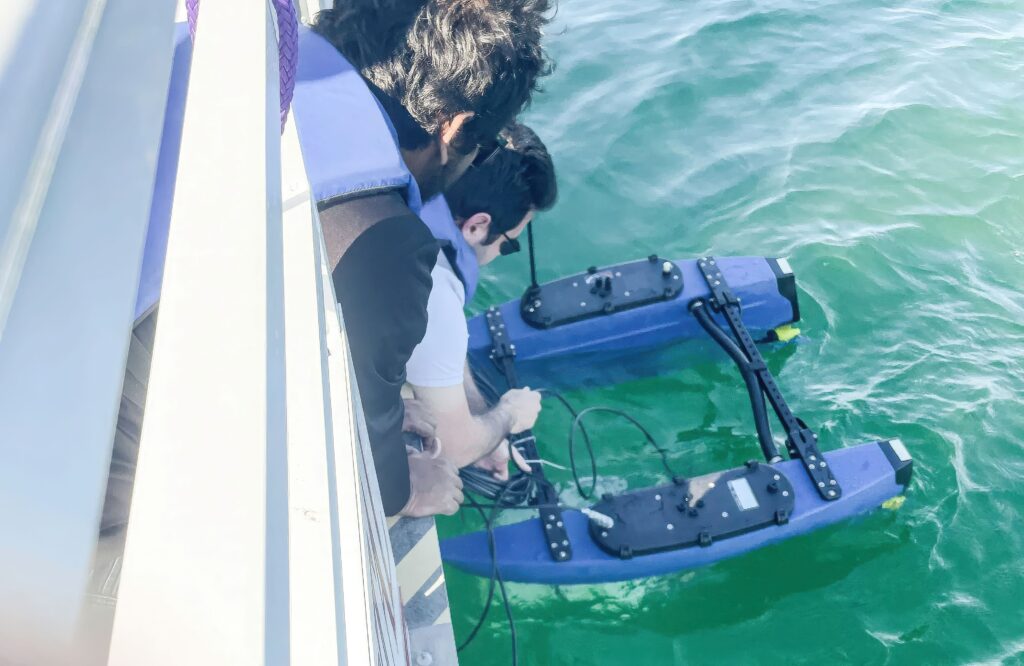
(Image: University of Florida)
Researchers in the US have created a new magnetic antenna to boost underwater communications, writes Nick Flaherty.
BlueME is a compact magnetoelectric (ME) antenna system designed specifically for underwater communication. Unlike conventional approaches that can require large antennas or significant power, BlueME operates with its own natural resonance frequency to efficiently transmit and receive very-low- and low-frequency (VLF/LF) electromagnetic signals underwater.
In seawater, electromagnetic signal attenuation ranges from approximately 1 to 10 dB/m depending on both frequency and conductivity. This high attenuation severely limits the viability of RF communication for marine robotics applications.
BlueME uses a piezoelectric transducer to generate the required VLF signals and is housed in a custom 3D-printed enclosure. In ocean experiments using a frequency sweep from 30 to 40 Hz, the system demonstrated communication over 700 m while operating with a compact, energy-efficient architecture and consuming less than 10 W of power.
“Efficiency is super critical,” said Jahidul Islam, assistant professor in the Department of Electrical and Computer Engineering at the University of Florida. “Our design benchmark was to keep power consumption very low – ideally lower than a standard stereo camera system – while maintaining robust communication performance. Our compact, energy-efficient BlueME system achieves that balance, operating around 10 W of power at maximum capacity.”
Adam Khalifa, a faculty fellow at the University of Florida added: “I’ve spent years designing miniature wireless implants and studying efficient power transfer in highly conductive environments. At one point, it clicked that many of the same physical challenges inside the human body also exist underwater. Our body is effectively made of lightly salted water. That realisation opened the door to thinking about ocean communication in a completely different way.”
Continuing, Islam said: “Underwater multi-robot coordination remains difficult because communication bandwidth and range are so limited.”
Khalifa concluded: “We are still in the early stages, but advances in compact underwater communication could fundamentally change how autonomous marine systems collaborate and operate in complex ocean environments.”
UPCOMING EVENTS