



Boosting lift for Martian helicopters
(Image: Jet Propulsion Laboratory)
Researchers in the US are testing a new type of propeller for the next-generation Mars helicopter, writes Nick Flaherty.
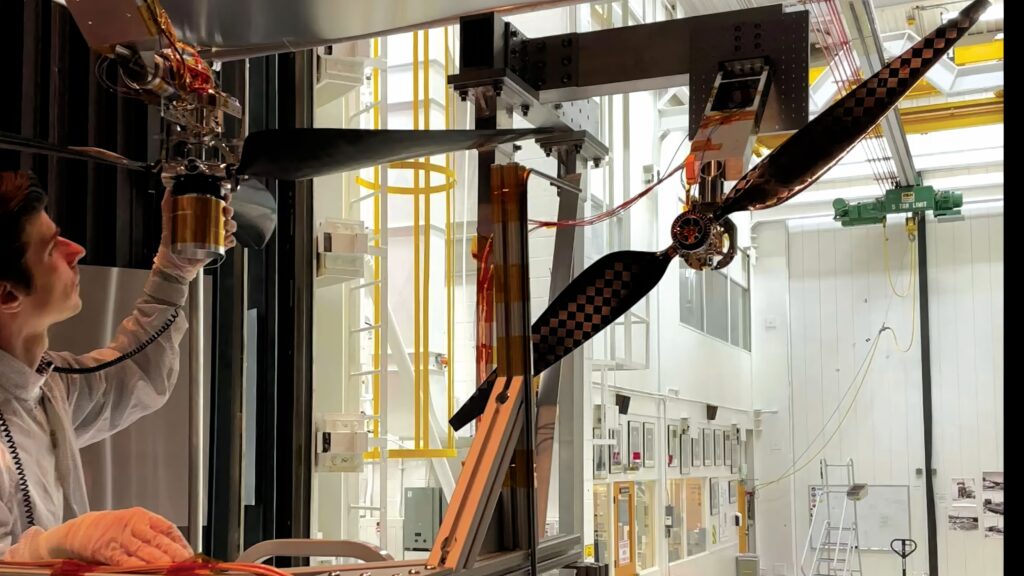
The tests at NASA’s Jet Propulsion Laboratory in Southern California took place in a special chamber that can simulate environmental conditions on Mars and showed that the tips of the blades can be accelerated beyond Mach 1 without breaking apart.
A three-bladed rotor was developed and manufactured by AeroVironment in California and data gathered from 137 test runs will enable engineers to design a helicopter capable of carrying heavier payloads – including scientific instrumentation – in a project called SkyFall.
The atmosphere on Mars is only 1% as dense as that on Earth, so maximising the thrust from the rotors requires pushing blade tips toward the speed of sound to achieve significant lift. While Mach 1 on Earth at sea level is approximately 760 mph (1223 kph), the speed of sound on Mars is significantly slower – roughly 540 mph (869 kph).
The team running the previous helicopter, Ingenuity, never allowed the rotational speed of their composite-skinned foam rotors to exceed 2700 rpm (Mach 0.7) during the helicopter’s 72 flights on Mars for two reasons: to avoid the unpredictable physics of the sound barrier and to ensure that an unexpected gust of wind (from a dust devil, for instance) wouldn’t send the rotor tips over the sonic edge.
The tests in the environment chamber took the rotor to 3750 rpm, or Mach 0.98. The engineers then activated a fan inside the chamber to create headwinds, increasing the wind velocity for the next run.
This pushed rotor tip speeds to Mach 1.08, boosting the lift capability of the helicopter by 30%. This would allow future missions to support heavier scientific payloads, including advanced sensors and larger batteries for extended flight.
A two-bladed rotor is slightly longer than the three-bladed version, so a speed of only 3570 rpm was needed to achieve the same near-supersonic speed at the rotor tips prior to introducing the headwinds.
“The successful testing of these rotors was a major step toward proving the feasibility of flight in more demanding environments, which is key for next-generation vehicles,” said Shannah Withrow-Maser, an aerodynamicist from NASA’s Ames Research Centre in Silicon Valley and member of the test team. “We thought we’d be lucky to hit Mach 1.05, and we reached Mach 1.08 on our last runs. We’re still digging into the data and there may be even more thrust on the table.”
The SkyFall mission is designed to carry three next-generation Mars helicopters, half the number originally planned, to the Red Planet in December 2028 using a nuclear-powered spacecraft called Space Reactor-1 Freedom. The helicopters would be deployed from orbit in an entry capsule and make their way to the surface under their own power, hence the name SkyFall.
UPCOMING EVENTS