


Ocean Aero Triton
(All images: Ocean Aero, except when specified otherwise)
Triton tames the ocean
Peter Donaldson delves into the mythology surrounding the world’s first and only Autonomous Underwater and Surface Vehicle
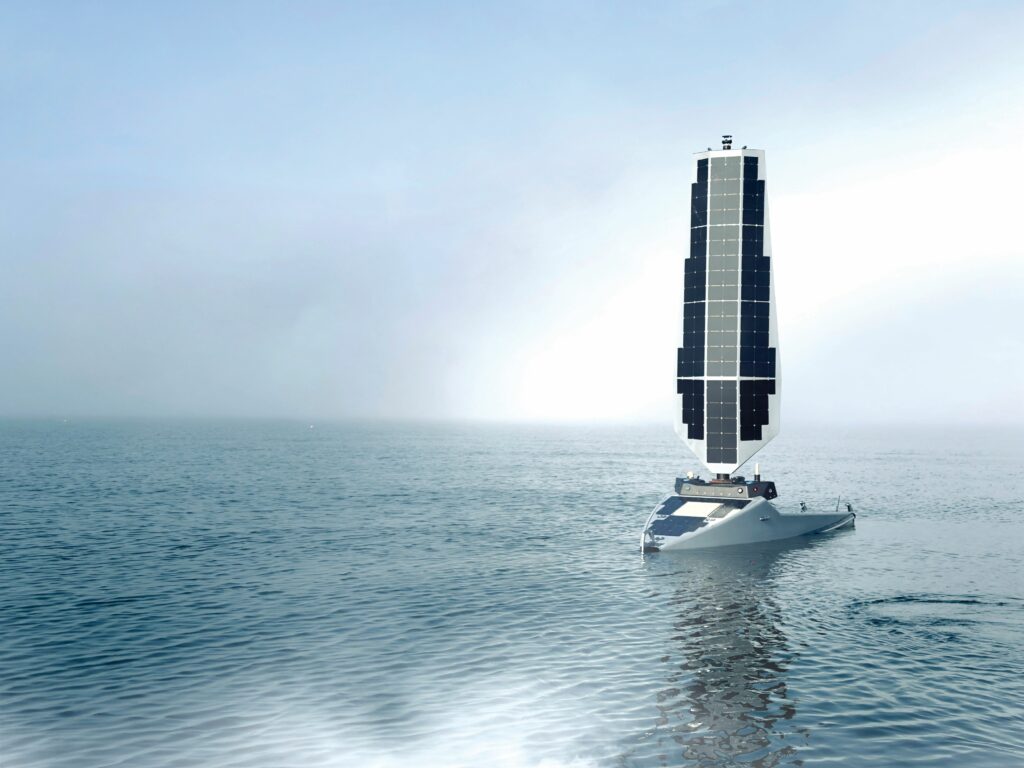
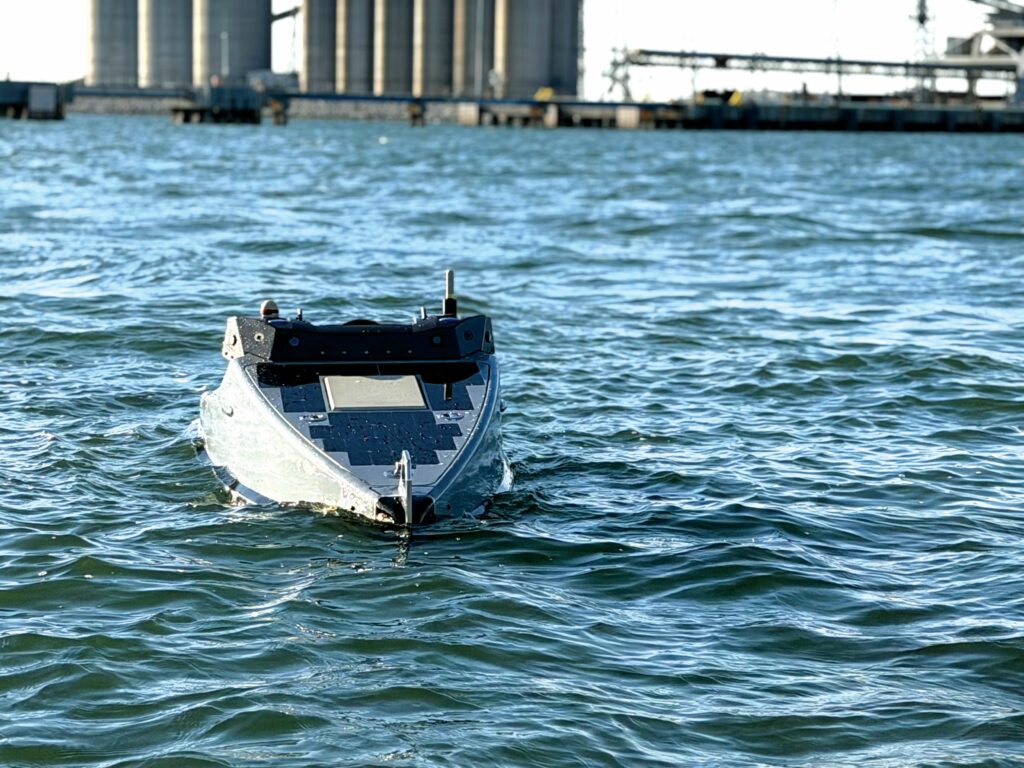
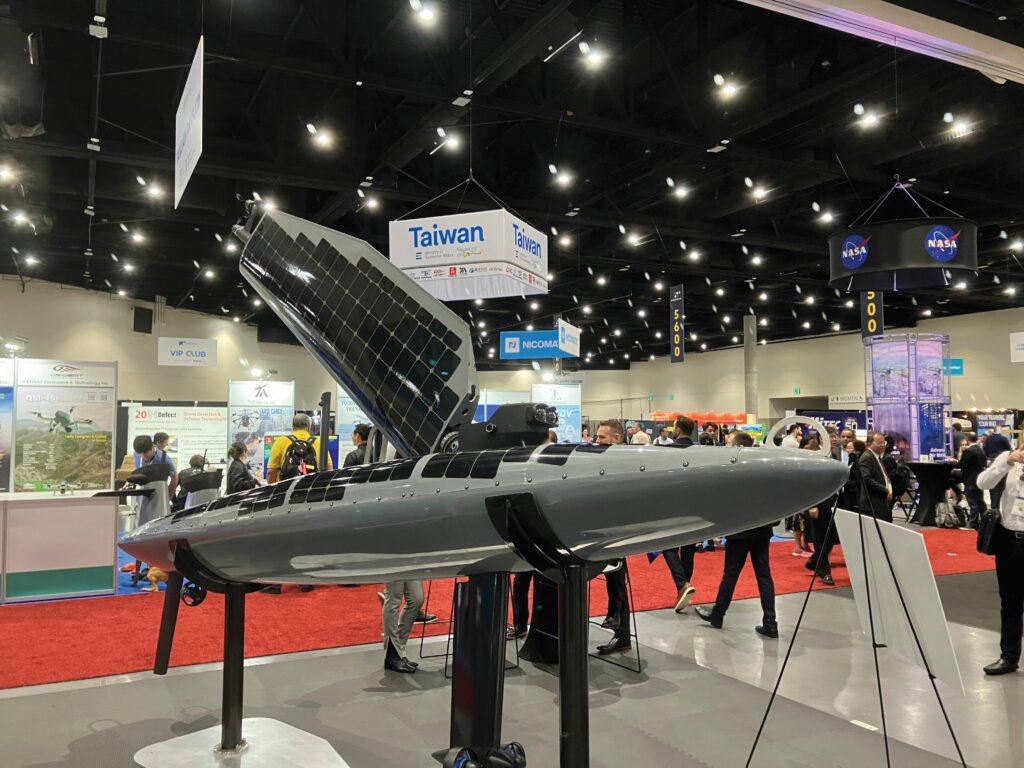
As an Autonomous Underwater and Surface Vehicle (AUSV), Ocean Aero’s Triton is at home in two domains: surfacing to exploit solar and wind energy, and then folding its wing sail and submerging to avoid detection, harsh weather, collision risks or other threats. For the past year, this submersible sailing vessel has been conducting persistent surveillance of subsea infrastructure and seabed change detection for the Port of Gulfport – a busy commercial harbour in the US state of Mississippi, where container ships, tugs and recreational traffic create a complex operational environment. This article examines some of the key practical lessons that have come out of this deployment and the wider operational implications of the technology.
The purpose of the project – a partnership between the Port of Gulfport, Ocean Aero and the University of Southern Mississippi – is to detect irregularities in both port traffic and infrastructure, a project that has the potential to save the port millions. Additionally, Triton’s monitoring capability is expected to play a crucial role in post-hurricane recovery by identifying potential threats to port infrastructure in the aftermath, and helping ensure that both the channel and the harbour are clear for ship traffic.
Lessons from Gulfport
The early results are striking. Ocean Aero claims the Triton can deliver twice the scan frequency at less than half the cost of traditional crewed survey vessels.
No amount of laboratory testing fully prepares a system for the messy reality of a working port. Ocean Aero learned this lesson shortly after deploying the Triton in Gulfport. The challenge was not the vehicle’s performance underwater – it was what happened on the surface, in the dense electromagnetic fog of a commercial harbour.
“We experienced intermittent RF and cellular communication dropouts,” says Pasquale DeRosa, Ocean Aero’s SVP of mission operations, “caused by a dense mix of port infrastructure, vessel traffic and shoreline interference – conditions that didn’t fully present during predeployment testing.”
The consequence was a fundamental rethinking of communication assumptions. Ocean Aero’s key takeaway was not to harden the links – although that helps – but to design around the certainty of failures. “The key lesson learned was the importance of designing core vehicle command and communication capability around graceful degradation,” he explains. “That means assuming communications will be intermittent, preloading mission autonomy, building comms modality failover across multiple command-and-control pathways, and validating robust fail-safe and recovery behaviours before deployment rather than relying on persistent connectivity.”
Mark Henderson, Ocean Aero’s chief technology officer describes deconfliction in the port as a learning phase for all concerned, and Ocean Aero’s approach is conservative. “We deconflict with marine traffic at all operational levels and suspend activities when major movements are planned. We maintain our own watch as well to ensure that we aren’t in the way.”
Chief operating officer Bob Marthouse emphasises the need for regulatory reform. “The biggest barrier is that there is a limited regulatory framework for uncrewed systems,” he says. “Existing US Coast Guard [USCG] regulations are designed for human-operated vessels. This required working closely with the Port of Gulfport to allow for autonomous operations.” He emphasises that existing USCG rules and maritime regulations generally need to be updated to include autonomous vehicles, and suggests that Ocean Aero’s work in Gulfport could be used as a case study.
Advanced sonar Payloads used in and around the port include bathymetry, side-scan sonar (SSS), and magnetometers. Their role is to generate high-resolution datasets for use in real-time change detection, with the aim of detecting irregularities in both port traffic and infrastructure.
With every watt being sacred, sensors that produce high-quality data while drawing little power are essential. Supplied by Forcys, the Wavefront Systems Solstice 3000 multi-aperture sonar (MAS) fits this profile, producing a 200 m swath width at 100 m range, and resolution of 0.15° along-track with very low power consumption at 18 W.
The MAS technology fits into the performance gap between conventional SSS and synthetic aperture sonar (SAS), aiming to blend high resolution, more like that of SAS, with the robustness and reliability of SSS. It’s worth taking a quick look at the differences in how these systems work.
A typical SSS has a single acoustic aperture per side and maps the amplitude of the echo from each ping directly to a single pixel in the cross-track direction, imaging a strip of the seafloor – an example of ‘incoherent’ processing. This is simple and robust, but resolution degrades with distance, and both the signal-to-noise ratio (SNR) and the contrast are limited. Power consumption is typically low to moderate.
SAS uses ‘coherent’ processing of both phase and amplitude of successive pings to synthesise a very long virtual aperture mathematically. This achieves constant high resolution at all ranges but is fragile. It requires precise phase alignment and is easily degraded by vehicle motion or environmental noise. SAS consumes significantly more power than the other two technologies.
MAS uses a physical array of elements – 32 each side in the case of the Solstice 3000 – to process returns from multiple angles incoherently (amplitude only) using a multi-ping multi-look (MPML) technique. It ignores phase information entirely, trading the theoretical maximum resolution for extreme robustness to motion and multipath interference. MAS improves upon conventional SSS by using MPML to boost the SNR at long range, suppress speckle and achieve range-independent resolution – without the phase fragility of SAS.
Ports and harbours are particularly difficult environments for sonar because they are relatively shallow – typically 5–20 m – and have hard, flat floors, vertical walls, quaysides, pilings and ship hulls that act as acoustic mirrors. The result is a complex cacophony of echoes in response to every ping, coming from many directions, a problem known as multipath. The Solstice 3000 MAS features multipath suppression arrays and specialised processing to overcome this problem.
Sensor fusion challenge
Much of the intelligence generated by such operations relies on sensor fusion, which continues to be a challenge at the edge, Henderson says. “The survey world is not presently set up to handle the unique challenges and opportunities that uncrewed systems present.”
He notes that Ocean Aero relies heavily on Ethernet for payloads because it is “ubiquitous, fast, reliable and universal.” Presented with sensors that lack an Ethernet interface, the company generally maps them onto Ethernet with its standard payload computer. This can be set up with a wide variety of interfaces including CAN, Serial, RS485, RS422, USB, wi-fi and more. “For Triton, we bring the comms interfaces, and we can abstract those in a variety of ways through VLAN, direct interface, software and hardware routing,” he explains.
“In a couple of cases, we do take raw sensor data and embed them directly into how the Triton operates. What we have seen is that very few others have the reliability that we generally expect from our payloads. We do this via Ethernet at the hardware level, JSON or similar descriptive data formats at the interface level, then we display those data on our UI using direct database insertions.”
Data pipeline
Persistent surveillance with high-resolution sensors generates a fire hose of data, too much for any deployed AUV to transmit in real time. Recognising this, Ocean Aero has built a data pipeline that balances immediacy against depth, “ensuring decision-makers see what matters quickly without sacrificing analytical rigour,” as DeRosa puts it. Onboard processing initially time-aligns, quality-checks and performs light analysis on the data to identify notable changes or anomalies. This edge processing generates concise alerts and summaries in real time, while consuming minimal comms bandwidth.
Priority insights can include unexpected changes in seabed elevation, alterations in object shape or shifts in magnetic signature. These are inferences resulting from algorithms comparing new sensor readings with baselines established by previous missions.
More computationally intensive analysis happens later in the cloud, for which high-rate comms systems, including Starlink and Iridium satcom, cellular and mesh radios can be used to upload the data. Information from multiple sensors and missions is combined, reprocessed and validated to create high-confidence maps, trend analyses and reporting products for the end-user dashboard.
Latency varies by environment. “In areas with strong connectivity, near-real-time change indicators can be visible within minutes,” DeRosa says. “Offshore or remote operations introduce longer delays due to satellite constraints, but critical alerts are still prioritised for rapid delivery.”
Autonomy and buoyancy control
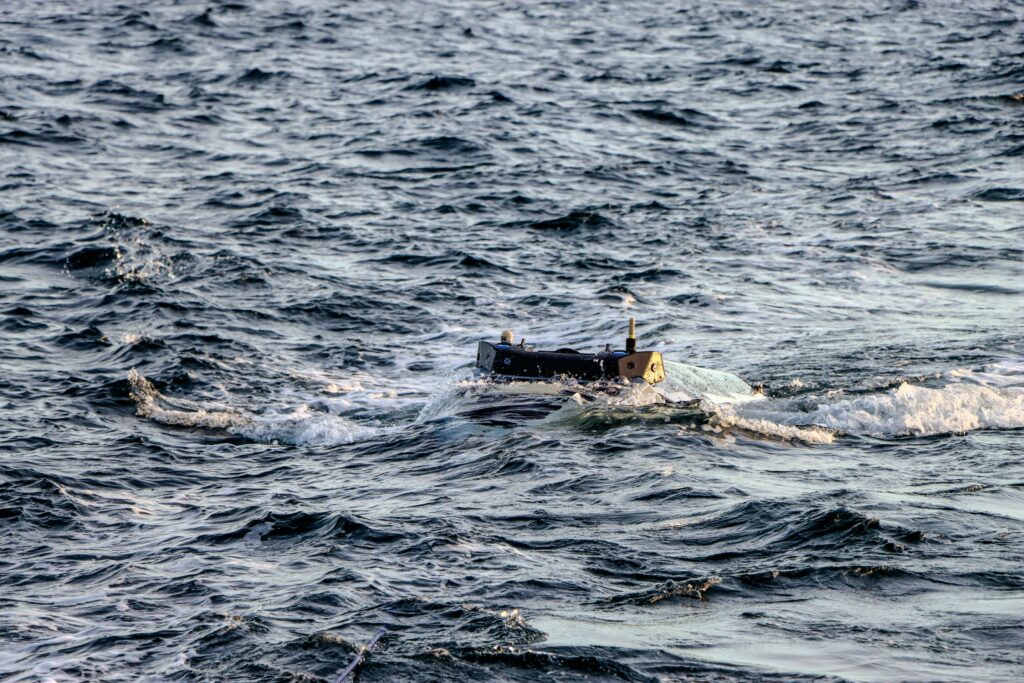
Ocean Aero’s autonomy philosophy is deliberately conservative: waypoint navigation at the core, with edge-based obstacle avoidance and a threat-evasion routine that culminates in a dive – because, Henderson notes, getting 20 m underwater makes a vessel effectively invisible. When submerged, electric thrusters on the hull and keel propel Triton at up to 2 knots.
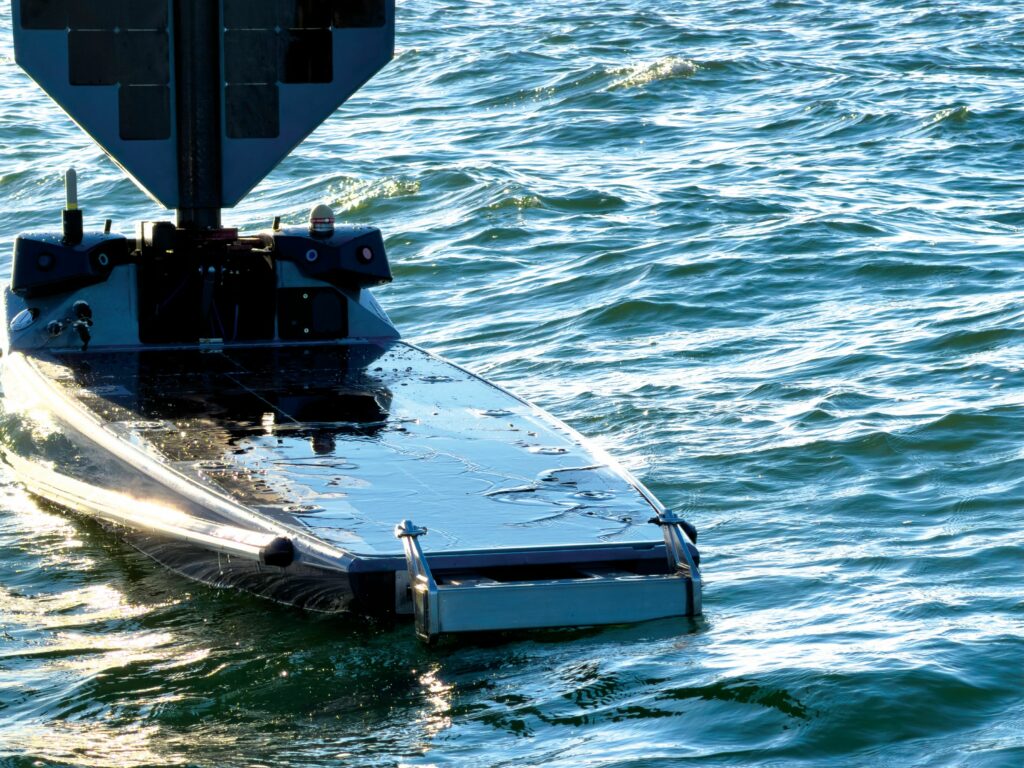
The ability to exploit the third dimension for collision avoidance is particularly valuable for the busy and restricted waters in and around a port, although it comes with its own challenges. “All ships can sink once,” Henderson adds. “What is most critical is knowing that you can always make it back to the surface.”
For the Triton, that certainty rests on its emergency recovery system. DeRosa describes it as “almost completely federated from the other operations of the Triton, providing stand-alone constant supervision of the platform while it is underwater.” The engineering challenge lay not only in designing the system but also in proving it. Henderson notes that the emergency recovery system has “thousands of hours of design, analysis and testing” behind it, plus “thousands of hours of real-world experience.”
The buoyancy control mechanism is simple by design, moving oil from a variable volume to a fixed volume. “Again, the critical portion of that is in testing, hammering out all of the failure mechanisms, and learning where the wear points are to determine the maintenance schedule,” Henderson continues. Testing and experience build confidence in the platforms, enabling Ocean Aero and its customers to deploy them in busy waters and trust them with high-value sensor packages.
Every watt is sacred
As an environmentally powered vessel with a hybrid energy system, the Triton must successfully balance intermittent, weather-dependent generation against the demands of propulsion and ‘hotel’ loads, so energy management is a critical function. “In some instances, we can pack enough energy onboard that we effectively forget how critical a function it is and, in general, we are spoiled by how available energy is to us every day,” Henderson observes. Despite this, the company’s engineers follow a mantra: “Every watt is sacred,” Henderson says. The newest Triton generation is operating with a peak solar-to-hotel load ratio of nearly 10:1. “We think that is the sweet spot for endurance and operations. Getting higher ratios would be brilliant but, at the moment, it seems impractical given the state of the art.”
Energy storage follows a similarly pragmatic trajectory. The company keeps pace with battery chemistry advancements but does not bet on breakthroughs. Triton’s modular packaging method is designed for the rapid implementation of new chemistries as they become available.
At a tactical level, power budgeting is dynamic, controlling every onboard system to balance operational needs against available energy. However, the direction of development is toward abstraction, with Ocean Aero working to push these decisions “into the autonomy stack and away from the supervisor.”
Waypoints, obstacles and threats
For persistent surveillance missions, the foundation of Triton’s autonomy is waypoint-based navigation. “In general, people want a robot to do what they tell it to do,” Henderson observes. “So, waypoint autonomy is likely a backbone for autonomous solutions for a while.” The Triton runs additional routines on top of that backbone, specifically to address the problem of unintended outcomes. The first layer is obstacle avoidance, running at the edge. If something – a buoy, a shoal, a sleeping whale – lies between the vehicle and its waypoint, the Triton manoeuvres around it, as is standard practice for many USVs.

The second layer is a threat evasion routine that monitors for vessels or objects with which it is at risk of colliding. This is active surveillance of the vehicle’s surroundings. When edge processing identifies a potential threat, the vehicle initiates progressively higher levels of avoidance, culminating in a dive if necessary.
Business model and operating costs
The headline cost-effectiveness measure of twice the scan frequency for half the cost of a crewed alternative is just part of the business case. Bob Marthouse also points to annual operating costs of approximately 3% of the system’s purchase cost, along with an expected operational lifespan of 5–7 years, driven primarily by its batteries. For context, conventional crewed survey vessels often require 10–15% of capital cost annually in maintenance, crew wages, fuel and insurance.
Ocean Aero offers three contracting models to meet diverse customer needs, as the company elaborates with us. The first is straightforward procurement, in which the customer buys the Triton and operates it. The second is the ‘GOCO’ government-owned, contractor-operated model – where the asset belongs to the government but is operated by the Ocean Aero team. The third is company-owned, company-operated – effectively sensing as a service, where Ocean Aero retains ownership and operates the Triton on the customer’s behalf.
Development roadmap
Ocean Aero’s immediate technology roadmap focuses on endurance and autonomy. The company is exploring additional ways to gather energy or generate power locally, building on the existing wind–solar hybrid architecture. Algorithms are being continually refined for efficiency, Henderson says. “Most of our efforts are tied to improvements in autonomy and reducing the required attention from operators,” he adds. This includes, for example, automated natural language updates at mission completion and interactions in which operators are queried in a natural way when a decision is necessary.
Mission planning is also being augmented. The goal is to exploit not just real-time weather data but also forecast data, generating recommended mission profiles against specific objectives. This moves the operator from route-planning to objective-setting – a subtle but significant shift in cognitive load.
Bob Marthouse notes the technical hurdles that stand in the way of multiple Tritons working together in a coordinated manner on missions such as wide-area search, for example. He stresses that the AUSV has been designed and built with all the required hardware to support cooperative operations. “The only requirement left is a software upgrade.”
Looking five to 10 years ahead, Ocean Aero predicts extinction of the “operator” as a role. “The operator will be a field commander who directs fleets of Tritons with natural language prompts,” Henderson says. “Those prompts will fall through a series of automated steps that will then plan and direct the Tritons to accomplish specific missions, automatically compensating for the specifics of the situation, availability of sensors, current performance of specific boats and other minutiae that in previous times overloaded users with data without context.” This implies that while today’s autonomy compensates for known variables, in the future it will compensate for unknown variables as well, using onboard reasoning to adapt mission execution to conditions that were not anticipated in the predeployment briefing.
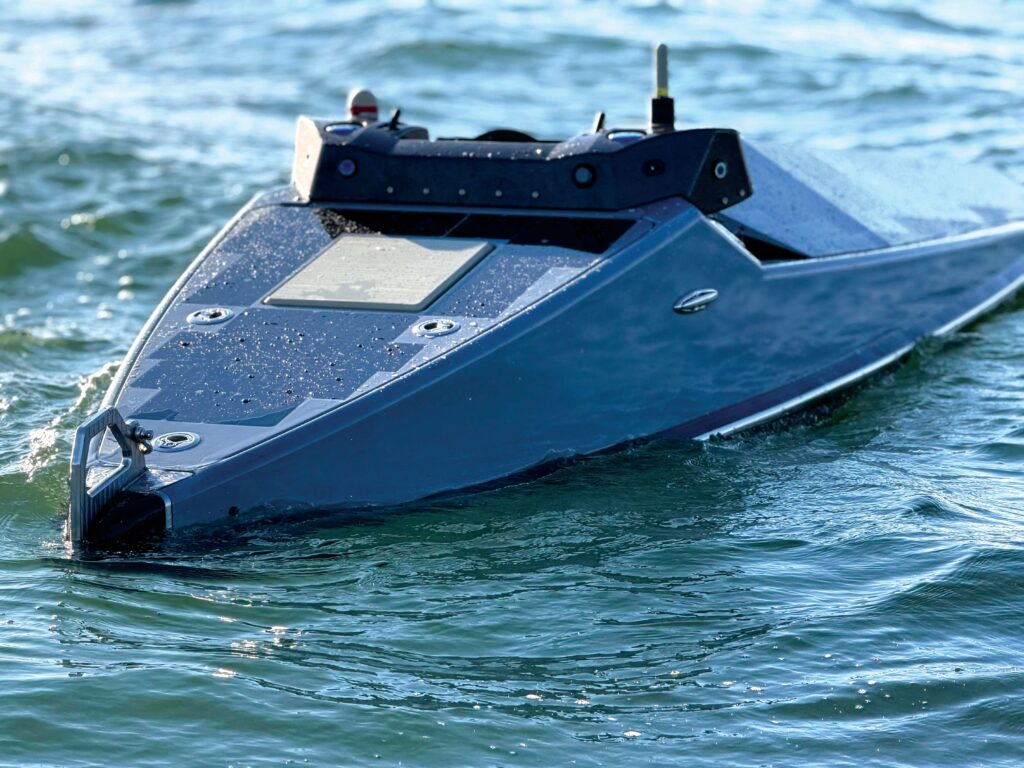
While the Triton’s design is scalable, the company emphasises that the 15 ft (4.5 m) long, 350 kg vehicle is optimal for its customers. Any smaller, and the end-user’s trade-offs would be the endurance, battery power or the payloads they can place on the vessel. Ocean Aero can also scale larger, potentially to a Triton thrice the size of the ones it uses now, which may be useful for defence contractors.”
USV and UUV convergence
For years, USVs and UUVs have been treated as distinct product categories with different customers, different engineering challenges and different regulatory paths. Ocean Aero argues that this separation is about to collapse – and the Triton is the leading edge of that process.
“In the future, all USVs will be required to dive or be very, very fast. All UUVs will have to be at home on the surface,” Henderson predicts. This is an operational observation rooted in the realities of contested environments. A USV that cannot dive is visible to every satellite, every radar, every passing fishing boat. A UUV that cannot surface has no way to exfiltrate data, recharge or receive new mission commands without an acoustic link that is slow, short-range and detectable.
There are also implications for traditional towed systems used in intelligence, surveillance and reconnaissance (ISR) and mine countermeasure (MCM) operations, he argues. “Generally speaking, the traditional towed systems don’t map very well on autonomous platforms – certainly not in non-permissive environments. They were originally designed for crewed platforms, and their shortcomings, compensated for by having people at hand, do not seem like the end state that autonomous systems are enabling.”
Beyond ports and MCMs, the most promising “blue-sky” applications focus on persistent, autonomous ocean sensing and intervention at scale, DeRosa argues. These include long-duration monitoring of seabed and infrastructure change (pipelines, cables, CO2 sequestration sites), autonomous maritime domain awareness across wide areas, environmental intelligence to support climate resilience and offshore energy, pattern of life monitoring and distributed sensor networks for early detection of anomalous activity, he says, to name just a few. “A common thread is moving from episodic surveys to always-on, data-driven presence, where autonomy, edge processing and networked uncrewed systems enable insights that were previously impractical or cost-prohibitive.”
The Triton’s dual modality offers specific tactical advantages that neither pure USVs nor pure UUVs can match. For long-term ISR, the vehicle can transit on the surface using wind and solar, then dive when it encounters threats or unfavourable conditions. For long-range sensor insertion, it can take advantage of lower surface transit costs, then occupy the sensor location either on the surface or submerged. For data quality, it can dive to depths free from surface disturbances – waves, currents and biofouling – that degrade sensor performance on any towed or surface system.
Perhaps the most significant capability is data exfiltration. Small UUVs collect valuable underwater data but struggle to get those data back to shore or to a command node without surfacing. The Triton solves this natively; it collects undersea data, surfaces when safe and then transmits its data via cellular or satellite link. “We can exfiltrate that information back,” Henderson notes, “something that many of the small UUVs struggle with.”
He acknowledges that these capabilities are still new to the market. “We still have to educate the consumer that these capabilities exist.” Port authorities, navies and survey firms have decades of institutional knowledge built around single-domain platforms. Teaching them to think in dual-domain terms is a slow process.
For a port organisation looking to implement an AUV programme, Henderson’s advice is to form an industry/government team, which he regards as essential. “The team meets regularly to go over results and discuss any changes that are needed.” Clearly, technology alone does not guarantee success. The governance structure – regular reviews, shared risk, transparent communication – is what turns a pilot project into an operational capability.
Key specifications
Max submergence depth: 100 m (328 ft)
Max surface speed: 5 knots
Max subsurface speed: 2 knots
Weight: 680 kg (1500 lb)
Length: 4.5 m (14.8 ft)
Water line to top of sail: 3 m (10 ft)
Water line to keel bottom: 0.75 m (30 in)
Hull width: 1 m (39 in)
Battery capacity: 30 kWh
Solar collection: >1250 W
Payload: 50 kg (110 lb) body, 50 kg (110 lb) keel, 5 kg (11 lb) wing
Surface endurance: 30+ days
Subsurface endurance: 10+ days
Some key suppliers
Hybrid acoustic-inertial navigation system: Sonardyne
Multi-aperture sonar: Wavefront Systems (now Forcys)
Payload provision: Forcys
Satcom: Starlink, Iridium
UPCOMING EVENTS