









In conversation: Michael Robbins

(Image: Messe Düsseldorf/Tillmann)
Agenda for change
The president and CEO of AUVSI, Michael Robbins, talks Peter Donaldson through the politics involved in advancing the adoption of uncrewed systems in both civil and military arenas
Like it or not, leading an industry association is a highly political job. Michael Robbins, president and CEO of the Association for Uncrewed Vehicle Systems International (AUVSI), was educated as a political scientist and had an early introduction to national-level US politics when – not long out of university – Michigan Congressman John Dingell appointed him his chief of staff working out of his Washington, DC, office. While being thrown in at the deep end like this, he also found time to study for his master’s degree.
Growing up in Detroit – ‘Motor City’ – through the 1980s and ’90s gave Robbins an appreciation for cars and the car industry, while as a child he was instilled with a passion for aircraft by his grandfather, a US Navy veteran and general aviation pilot who took him flying and guided him around air shows.
Disrupted schooling
Money was tight and disruption frequent for the Robbins family through Michael’s early life, which impacted his schooling. “I was a good student, but not great,” he recalls. “We lived in trailer parks and moved a lot, so I attended a lot of different schools.”
However, he doesn’t regard this as entirely negative. “Growing up on the poorer end of the economic scale did bring about a certain degree of resilience and what I like to call ‘grit’.”
If there was a subject in which he excelled, it was history, in which he retains a keen interest. Southeast Michigan made “an outsized contribution” to the Allied industrial effort in World War II, with many sectors of Detroit’s industry converted to military production and turning out trucks, tanks and heavy bombers, etc, to which he draws parallels with the need to scale up military drone production today.
Reflecting on his student days, he acknowledges many “tremendous” teachers, who shaped his approach to history and critical thinking. He credits his graduate thesis advisor Ralph Nuremberg with making him a better writer and analyst, and with pushing him to deliver an excellent thesis – even though it took longer than anticipated! That thesis was on congressional redistricting, which deals with changes to boundaries between political constituencies.
Political and professional lessons
Robbins holds the late John Dingell in high regard and learned many political lessons from him, including some on getting complex legislation passed. A long-serving, powerful member of Congress known for his support of organised labour, social welfare measures and other progressive policies, Dingell was a pragmatist who focused on getting things done. “He was all about starting in the middle and working across the aisle to build as big a coalition as possible, and only moving out to the right or left as far as needed to get enough votes.”
Robbins stresses that he brings this approach to his work at AUVSI. “We always strive for consensus and bring a diplomatic approach to how we deal with issues among our members, the broader industry and legislators,” he says.
Learning from failure is part of resilience, and being thrown in at the deep end as a political chief of staff in Washington, DC, at the tender age of 23 provided plenty of opportunities to make mistakes. “That first year was pretty rough,” he recalls. “There were a lot of things I did that just didn’t show the kind of judgment and maturity that the position demanded. It wasn’t for lack of effort, it was just not knowing.” However, Congressman Dingell’s mindset was somewhat like that of Silicon Valley in that he accepted this as part of a learning process. “And that’s something that I’ve tried to bring with me throughout my time as a leader, and also instil into the teams that I’m leading.”
His first opportunity to apply a consensus-focused, diplomatic approach to a membership organisation came when he left Dingell’s office in 2011 to join the Air Line Pilots Association (ALPA), serving four years as managing director for government and public affairs. He moved into private industry in early 2015, buying and running a gym in Washington, DC, and – in the same time frame – co-founding consulting firm Intrepid with the outgoing president of ALPA, Lee Moak, a former Boeing 767 captain and US Marine Corps and Navy Reserve fighter pilot. Intrepid helps small and medium enterprises win military contracts.
(Image: Ocean Power Technologies)
He regards Moak as a mentor, who has taught him the importance of keeping on top of detail, even while dealing with strategic issues because “everything matters,” and of a resilient “never quit” attitude. Moak also instilled an appreciation for the importance of relationships, Robbins emphasises. “Treating each person with dignity and respect and understanding what makes them tick has been a real key to our success here at AUVSI.”
Robbins’ initial contact with AUVSI came when the organisation became one of Intrepid’s clients in 2019, and he joined in a forward-facing role under contract in June 2020.
Situation room
As an officer in the US Navy Reserve, he serves on a voluntary basis in the Pentagon on the Joint Staff watch floor – a command and communications centre for the National Command Authority, including the President and Secretary of War. It is responsible for monitoring global events and coordinating military responses during crises. This he regards as more training in leadership because he has witnessed examples of both bad and good leadership – the former relying on the force of rank, the latter on mutual respect – and he strives to emulate the latter.

“At AUVSI, it’s not about me, it’s about the mission. People who work here are motivated by the mission, by knowing that the work our members are doing is hard. They’re taking new technologies from the R&D phase and starting to operationalise it. They are often on lean budgets and trying to raise money, and the technology they are working on is challenging, but the outcome is very positive – you’re bettering society, and you’re keeping soldiers, sailors and marines out of harm’s way.”
Asked what he regards as the most significant gap between what the US military needs and what the industry is currently delivering, he is unequivocal. “They need to acquire and integrate uncrewed systems at scale,” he says. “We’re not able to transit the Strait of Hormuz because we are not willing to put crewed assets in harm’s way. If we were able to do that with uncrewed assets – small and medium surface and subsurface ships – the situation would probably be quite different. That’s just one of many, many examples where we know we need this capacity and we don’t have it yet.”
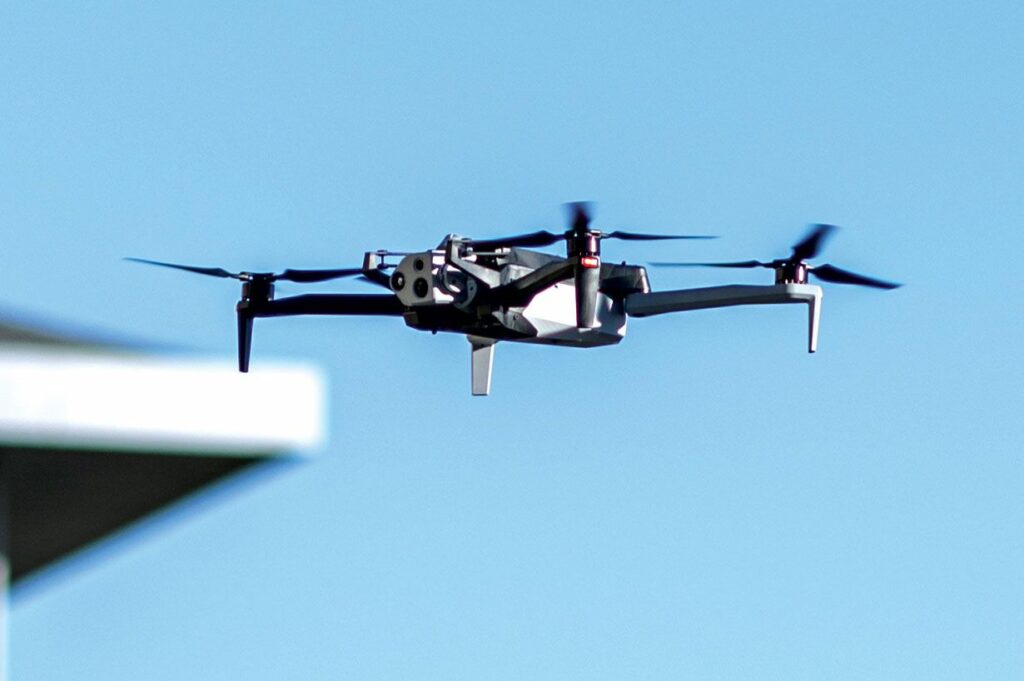
Robbins stresses the importance to industry of a clear and sustained demand signal from the government, which has not always been there but has been more consistent thanks to the Ukraine War. “In 2024, the Pentagon bought about 4000 drones across all different types of platforms, but they’ve already bought more than 30,000 this year. That’s a good signal that times are changing.”
(Image: Joby Aero Inc)
Alternative acquisition paths
Start-ups are essential to this innovation, but it can be difficult for them to navigate the Pentagon’s acquisition system on the way to their first contract. His advice is to seek partnerships and alternative pathways, which are approaches for which AUVSI can provide contacts and guidance. “That’s been a big focus of ours, and we’re finding real success through commercial solutions that the Defense Innovation Unit offers, other transaction authorities, consortiums or through initiatives like the Drone Dominance Program.”
He argues that uncrewed systems’ ability to extend operational reach into contested environments is not yet well understood among military leaders. With war in the Pacific against China in mind, he cites autonomous vehicles conducting logistics missions and others in the decoy role as potential game changers. The first eliminating the risk to humans in moving material forward, and the second enormously complicating the adversary’s targeting.
Further, the wars against Russia and Iran have seen all sides make effective use of relatively simple, low-cost strike drones in large numbers against high-end platforms and strategic targets. Ukraine’s success against major Russian warships and Iran’s destruction of key US ballistic missile defence radars are just two examples. “You can achieve a lot with low-cost systems at mass scale – you don’t always have to have super-exquisite platforms.”
“One of the lessons we are taking away is there must be more learning from ongoing conflict, and more rapid absorption of that learning into changes in tactics and procedures, along with acquisition and integration of technologies.”
Overcoming barriers
If there is one regulatory change that would immediately unlock the most innovative capabilities in civil uncrewed systems, it is in the regulation around flight beyond visual line of sight (BVLOS), he believes. “Finalising the BVLOS rule in a way that is performance and risk based would really help to enable the furtherance and expansion of complex commercial operations in the US. That’s something that we’ve been waiting on for a very long time, but we are going to have very, very soon.”
An awkward barrier remaining is the FAA’s reluctance to authorise the use of UAS detection and mitigation systems, which he insists should move forward together despite important differences between them. Detection feeds an airspace picture that can be liberally shared for situational awareness, while mitigation might ultimately involve disabling or destroying an intruding drone and therefore needs highly trained operators.

Robbins also served on the US Department of Transportation’s Aerospace Resiliency Task Force that monitors supply chain vulnerabilities, of which there is a long and familiar list that includes semiconductors – 90% of which come from Taiwan – lithium and graphite for batteries, plus motors and related materials such as rare earth magnets and boron. For all of these components of the “brains, heart and spine” of a drone, the US still relies heavily on China.
To compete with China in drone manufacture at scale, he believes that the government should improve incentives and reduce barriers for industry by, for example, removing tariffs and export restrictions between allies. This, he says, would enable the US “to create a drone ecosystem of democratic allies that have a shared interest.”
Asked to identify an aspect of uncrewed systems that has a low profile today but is likely to be mainstream in 10 years, he pointed to embodied AI – the integration of AI into physical systems that interact with the real world. While AI can be applied to all kinds of platforms, he sees the integration of agentic AI into legged and humanoid robots as ready to explode. “Robots on the ground are a pretty small segment right now,” he says. “But as humans we operate on the ground, so that’s the largest opportunity to integrate embodied AI robotics into our daily lives and it is coming soon.” Again, he calls for smart policy to enable Western industry to compete with China in this area.
Family life provides his main opportunity to disconnect from work and recharge, although being married with four children and an elderly dog keeps him busy. He also likes to stay fit through yoga, running and lifting weights, and also endeavours to read a book a week encompassing fiction, industrial history, plus biographies of leaders – both good and bad. The reading, he believes, helps provide the perspective, range and depth that help him think through complex strategic problems.
When he eventually moves on from AUVSI, he wants his legacy to be a stronger industry. “It’s not about me, it’s about the team and the organisation we represent. Our goal is to build a more scaled, resilient industry that’s moving focus from R&D and innovation to operations. As an association, we are evolving to meet the new challenges that that will bring.”
Michael Robbins
Michael Robbins is president and CEO of the Association for Uncrewed Vehicle Systems International (AUVSI), the industries main representative body. Born in the early 1980s in Detroit, Michigan (USA), he moved around a lot with his family in his childhood. He earned a bachelor’s degree in political science and communications from the University of Michigan and a master’s degree in public policy from Georgetown University. He served as chief of staff to US Congressman John D. Dingell from 2002 to 2011, and then moved to the Air Line Pilots Association where he was managing director, government and public affairs until late 2014. He subsequently spent three years as owner and coach at a Washington, DC, gym, which overlapped with his co-founding of business consultancy Intrepid. Joining AUVSI under contract from Intrepid in 2020, he served as executive vice-president, government and public affairs, then as chief advocacy officer, before going full time as president and CEO in March 2024. He is also an Officer in the United States Navy Reserve.
UPCOMING EVENTS