



AUV for long-duration subsurface missions
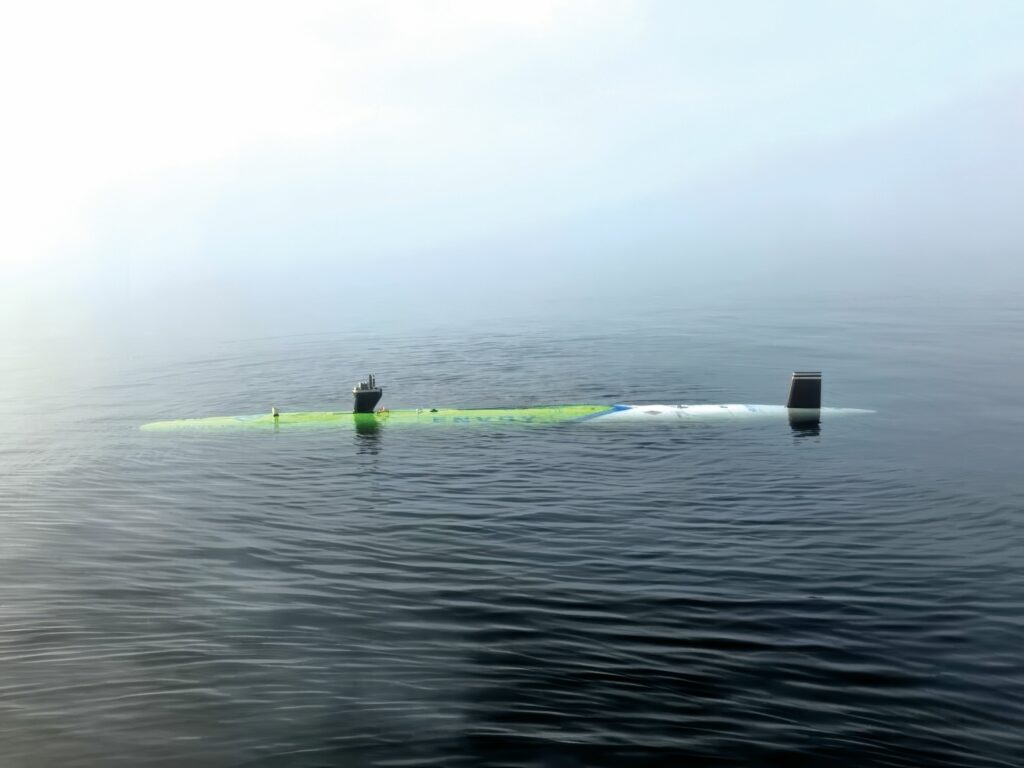
(Image: Cellula Robotics)
Cellula Robotics has demonstrated its Envoy Autonomous Underwater Vehicle, capable of travelling for over 2000 km using a hydrogen fuel cell, writes Nick Flaherty.
The 1.5 kW fuel cell was developed with Infinity Fuel Cell and Hydrogen using its Mystic 2000 Proton Exchange Membrane fuel cell with Advanced Passive Water Removal (APWR). The passive water removal is incorporated into each cell of the power plant stack, and only a pressure differential is required to remove and discharge liquid product water from the power plant. The APWR system eliminates the gas circulator, centrifugal separator, heat exchanger (condenser) and controls that comprise the water management system in the conventional aqueous electrolyte fuel cell power plants now in service. It also can simplify the reactant supply system by elimination of fuel and oxidant humidifiers. No rotating or active components or gas circulation are required in the APWR system, and it can operate in any orientation.
Completed fully submerged, the mission provides a realistic indication of usable underwater range beyond a straight-line transit figure. Over the course of the profile, the 8.5 m long Envoy AUV executed more than 4000 turns and manoeuvres, each of which increased energy demand compared with steady, linear travel. This makes the result a more meaningful demonstration of real-world subsea performance in practical operating conditions. The Envoy has a 500 L flooded payload bay for sensors.
“The significance of this result is not just the distance travelled, but that it was achieved fully submerged in a mission profile that better reflects real subsea operations,” said Neil Manning, CEO of Cellula Robotics. “That is what makes the endurance meaningful for operators, with the potential for fewer recoveries, more continuous operations and greater efficiency offshore.”
Longer fully submerged missions can reduce the number of recoveries and relaunches required, support mission continuity and make better use of vessel time in programmes where logistics, weather windows and offshore intervention all affect cost and execution.
UPCOMING EVENTS