
Vectored thrust for UAVs
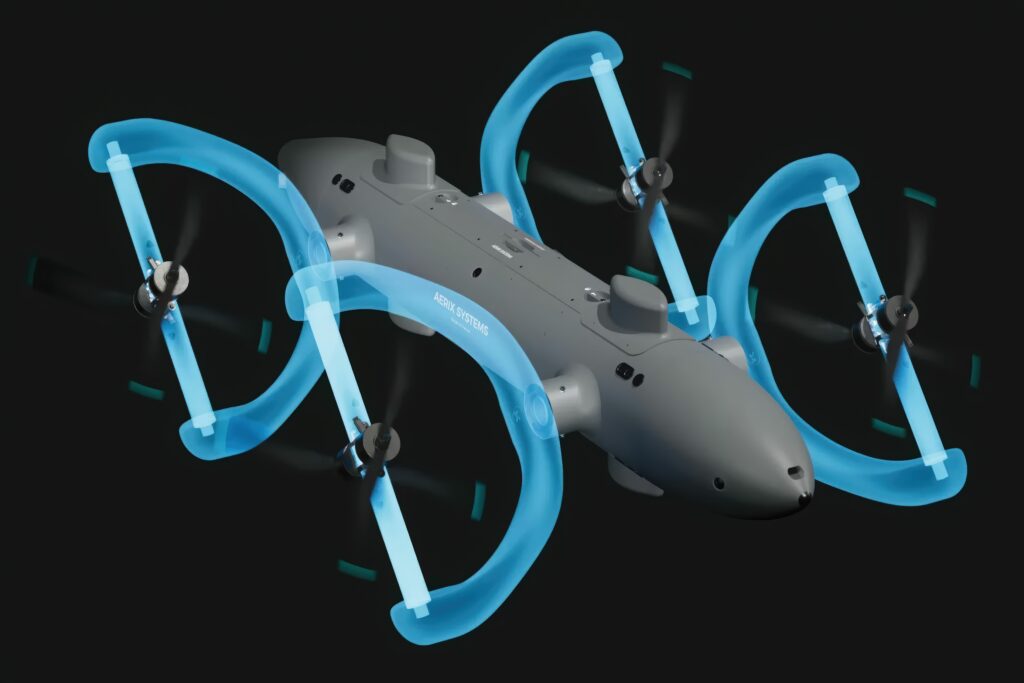
(Image: Aerix Systems)
Aerix Systems has developed an omnidirectional propulsion system that gives any propelled vehicle new flying capabilities, writes Nick Flaherty.
The T-16 is used in the AXI-M1 and u1 UAVs to provide vectored thrust to decouple the drone’s orientation from its direction of travel.
The system is built on ‘agnostic’ propulsion units that can reorient thrust independently across two continuous axes. This eliminates the ‘tilt-accelerate-stabilise’ lag found in standard UAVs that need to tilt to change direction.
The T-16 rotors can pivot to point airflow forward, backward or sideways. This allows the UAV to accelerate laterally at up to 3.5g or maintain high-speed forward flight while keeping the airframe perfectly level.
As a result of using vectored thrust, the UAVs rely on proprietary guidance, navigation and control algorithms. These control laws manage the complex kinematics of rotating propulsion elements in real time to ensure stability even during 90° ‘snap’ turns. The vectored thrust also allows the UAV to maintain its position or rotate on its axis without being pushed off course by wind or momentum.
The AXS-M1 is the flagship larger version with a maximum speed of 200 kph with a payload of up to 10 kg and range of 35 nmi with a 3 kg payload and is based on a tubular airframe with multiple attachment points and electronic ports. This allows the propulsion system to be integrated with various modular sensors or logistics grippers.
The vectored thrust gives the ability to move in any direction while pointing sensors or cameras at a fixed target, making it ideal for 360° industrial inspections and surveillance. The system is also capable of taking off and landing in non-standard orientations, even from moving platforms or in extreme turbulence.
UPCOMING EVENTS