






Miniaturised solid-state batteries
(Image: Patrick Mercier/UC San Diego)
A chip that integrates reconfigurable solid-state batteries could enable nanoUAVs and microrobots to be powered for longer periods of time while staying lightweight and compact, writes Nick Flaherty.
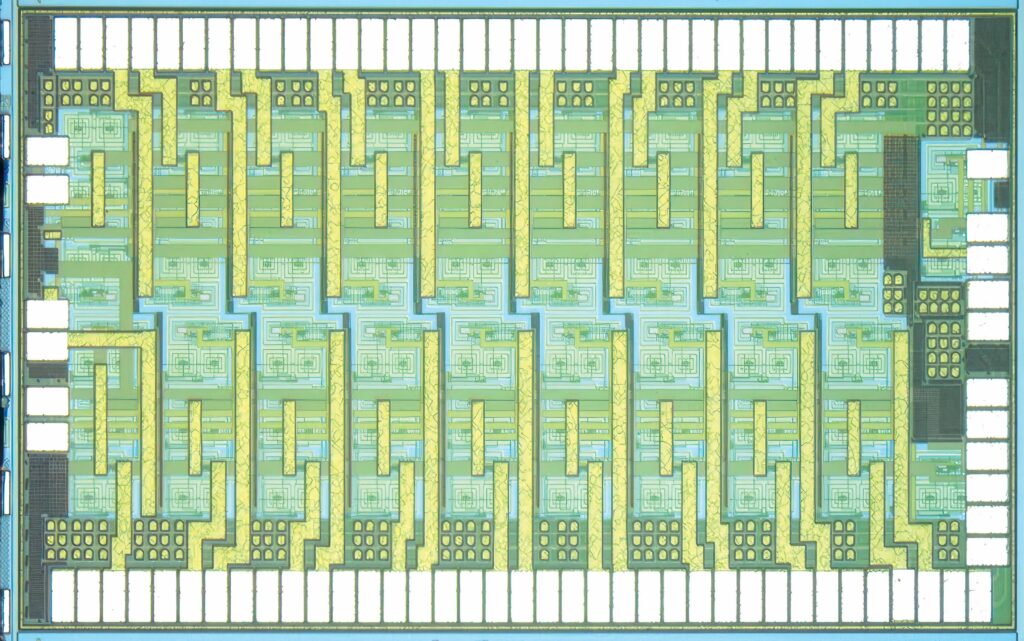
Researchers from the University of California San Diego and CEA-Leti in France have developed a self-sustaining circuit with miniaturised solid-state batteries that combines high energy density with an ultra-lightweight design.
“In order to maximise the flight time, you need to minimise the weight of all the components of the system, and that includes the battery and all electronics needed to process power,” said Prof Patrick Mercier, a researcher at UC San Diego Jacobs School of Engineering. “It’s a very difficult and delicate trade-off.”
“Instead of having one larger battery, we could take that exact same battery and slice and dice it up into 10 or 20 or more individual batteries,” said Mercier. Each of those individual batteries will have the same energy density as the larger parent battery connected to a driving circuit with a so-called flying battery configuration. This allows the system to dynamically switch how individual battery units are connected, adapting in real time to the system’s shifting energy needs.
This means the batteries can either be connected in series for higher voltage operation of a microactuator or in parallel to maximise energy storage efficiency. This switching between series and parallel configurations happens in tens of milliseconds, all without the weight of additional passive components.
The system also adds energy recovery, recharging the solid-state batteries adiabatically. “We can drive the microactuator extremely efficiently and recover some of the energy that we deliver to it, such that the battery continues to last even longer,” he said.
Using 18 battery units of an early commercially available solid-state battery, the system generated up to 56.1 V while operating continuously for 50+ hours. The entire system weighed just 1.8 g.
“The batteries operate in a micro-cycle mode (1 ppm depth of charge), effectively minimising cycling issues,” said Gaël Pillonnet, scientific director of CEA-Leti’s Silicon Component Division and a researcher on the project. “Unlike traditional batteries that use liquid electrolytes, this technology employs a solid electrolyte based on a silicon wafer substrate, providing enhanced mechanical properties to this emerging technology. Like all batteries, energy is stored electrochemically, making performance highly dependent on temperature.”
The next steps will be to optimise the solid-state batteries and push for even higher voltage outputs.
UPCOMING EVENTS