






Low-power sensor for automotive radar systems
(Image: Rice University)
Development work in the US has produced a low-power millimetre-band radar sensor that can provide radar-equipped autonomous vehicles with critical inputs about surrounding traffic without adding additional communications overhead, writes Nick Flaherty.
“Current automotive sensor systems like cameras and lidar struggle with poor visibility such as you would encounter due to rain or fog or in low-lighting conditions,” said Kun Woo Cho, the researcher at Rice University who leads the EyeDAR research project. “Radar, on the other hand, operates reliably in all weathers and lighting conditions and can even see through obstacles.”
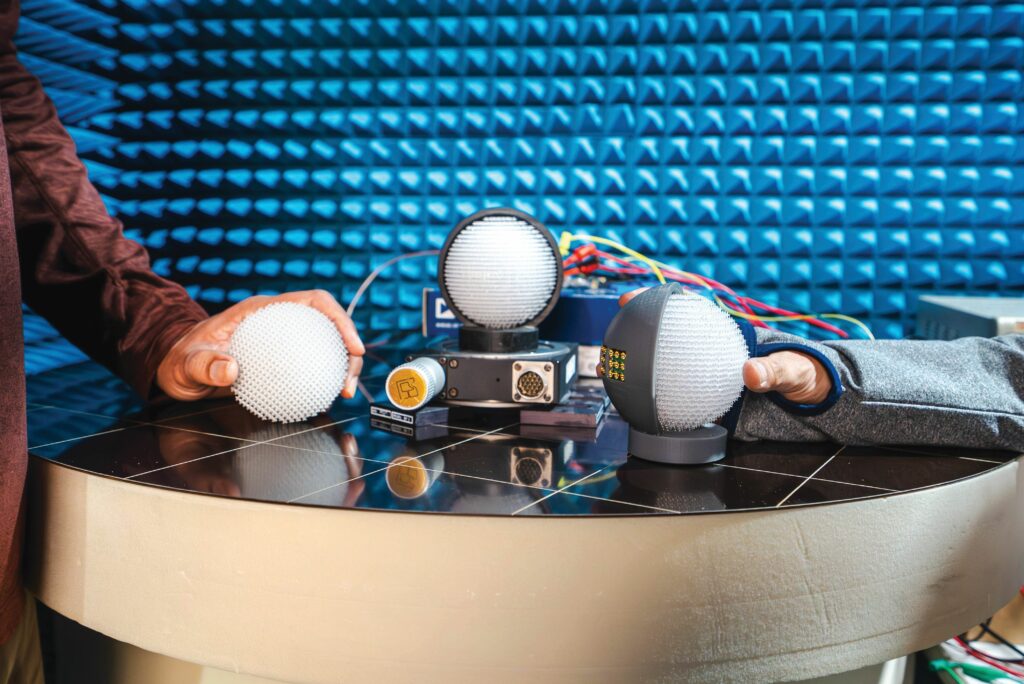
The EyeDAR sensor consists of a 3D-printed lens made from resin, which functions similarly to the lens of the eye, focusing incoming signals in the 21 to 29 GHz band from any direction onto a focal point on the opposite surface. This is coupled with an antenna array surrounding the lens on the back end that functions like a retina, detecting the signal and determining its direction.
The spherical lens is formed as a metamaterial comprising layers of material with varying refractive indexes built out of 8000 uniquely shaped, extremely small elements.
The design of the distribution of these elements allows the lens structure to interact with incoming radar signals, routing them to the right spot on the antenna array. This physical design does most of the computational work typically required for direction finding with an analogue, rather than digital, approach, handling the most power- and data-intensive tasks in radar processing.
Placed on roadside infrastructure such as traffic lights, stop signs or streetlights, EyeDAR can capture radar reflections that would otherwise be lost. The device’s unique structure allows it to determine the direction of reflected signals and report that information back to self-driving vehicles. In tests, EyeDAR was able to resolve target directions more than 200 times faster than traditional radar designs.
“It is like adding another set of eyes for automotive radar systems,” said Cho, who specialises in metamaterial antenna design.
A key innovation is that EyeDAR communicates what it sees without transmitting new signals. Instead, the sensor alternates between absorbing incoming radar waves and reflecting them back to the source radar in a form it can interpret as a sequence of zeros and ones.
“EyeDAR is a talking sensor,” said Cho. “It is a first instance of integrating radar sensing and communication functionality in a single design.”
This combination of sensing and communication in a compact, inexpensive and low-power architecture makes it feasible to deploy large numbers of sensors across roadways. In the case of self-driving cars, the system promises to be especially useful in dense, high-traffic urban settings. However, the potential application space is much wider: EyeDAR could be integrated into robots and UAVs, while networks of these sensors could also share information with one another, allowing each device to see well beyond its own range of sight.
UPCOMING EVENTS