




Lemvos LM450 USV & DockMaster
(All images: Lemvos)
Just gotta lock in
Rory Jackson investigates this company’s lean approach to autonomously mooring and securing USVs, which is enabling resident CONOPS across civilian and defence applications
As the collective uncrewed systems industry matures, from a predominant focus on technical development to increased capacity for manufacturing reliable and maintainable vehicles at scale, competition inevitably breeds increasingly workable means for resident drone applications on land, air and sea – with sea (and riverine environments) posing significant challenges over the other two, as Lemvos knows well.
The German company was founded four years ago by a trio of engineers from the space industry who saw the growing potential of offshore robotic vessels with advancements in edge processing and precision navigation. From their location in Augsburg, Bavaria, significant portions of their development testing were carried out at a lake roughly 30 minutes’ drive away.
“But we wanted to do continuous USV operations, and driving that far every day meant we really needed some options for docking and launching the USV without needing to be on site to physically tie it up with a rope or release it,” says Daniel Severinsen, co-founder of Lemvos.
“Without a solution of that sort, it hardly even makes sense to have a USV over a crewed survey boat because all the time and effort you save through autonomy gets paid back in the extra logistics and travel time you spend before and after each survey.”
However, the group encountered a severe dearth of options for automated launch or docking of small vessels; instead, finding only vastly oversized magnetic or suction equipment meant for ferries and other crewed boats.
Some of our readers will also be familiar with automated slipway systems functioning via powered roller-drives, which, while effective, are large and unwieldy infrastructure that must be constructed either into harboursides or as part of OEM vessel hulls, and then connected to a permanent power source (making them cost- and time-prohibitive for many).
Hence, Lemvos surmised that developing its own solution was the best way forwards. “Our initial solution was based on simple magnets, setting the magnet strength to the maximum thruster strength of our boat – at the time, a 250 cm long LM250 – but at best, it half-worked in a not-very-robust way,” Severinsen muses.
A second concept was later attempted using electromagnets combined with permanent magnets, but still the robustness was lacking. After some further research, however, the group came together around a two-part electromechanical locking system, today known as the DockMaster product.
On top of being used seamlessly with Lemvos’ own USV designs, DockMaster has been supplied to multiple companies around Europe.
With DockMaster enabling an increasing number of successful USVs and fleets, along with their capacity for highly automated and efficient work, we reached out to Lemvos to learn about the design and functioning behind this unique solution, illustrated specifically through its interactions with the German company’s LM450 USV.
Docking with DockMaster
One part of DockMaster installs dockside, while the other is meant for integration on the USV; the former is a static and passive component, while the latter functions as DockMaster’s active component.
The outermost and most operative part of the dockside system is composed largely of a vertically disposed rectangular pole or rail, while the USV-side part is designed as a U-shaped receptacle that is wide and deep enough to accommodate said rail as the USV comes in to moor.
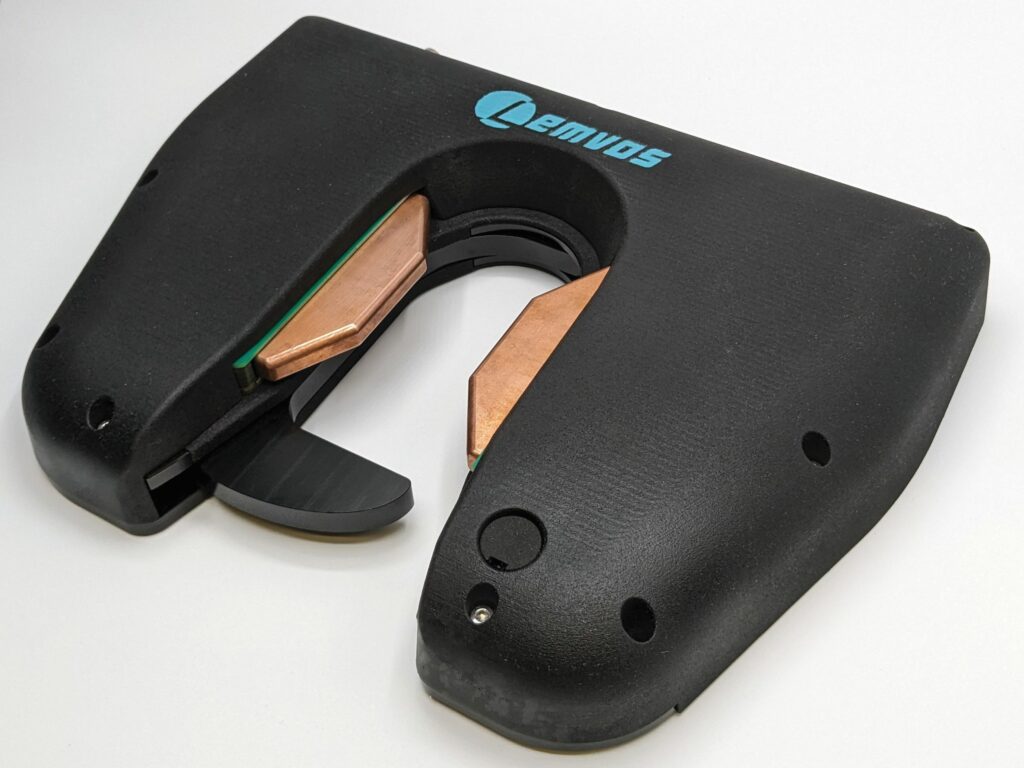
The receptacle housing is 293 mm wide, 217 mm long and 50 mm high. It additionally integrates a claw-like hook, which is concealed within the inner part of the housing until the USV berths. Right after the receptacle surrounds the dockside rail, the hook is electromechanically actuated to protrude, forming a loop with the receptacle around the rail, latching the USV more or less in place.
“But it’s not an incredibly tight latching; the receptacle and USV have room to ebb up and down, and tilt or swing left and right relative to the pole as waves push the boat about, rather than locking it too tightly and risking breakage if enough wave force is imparted,” Severinsen explains.
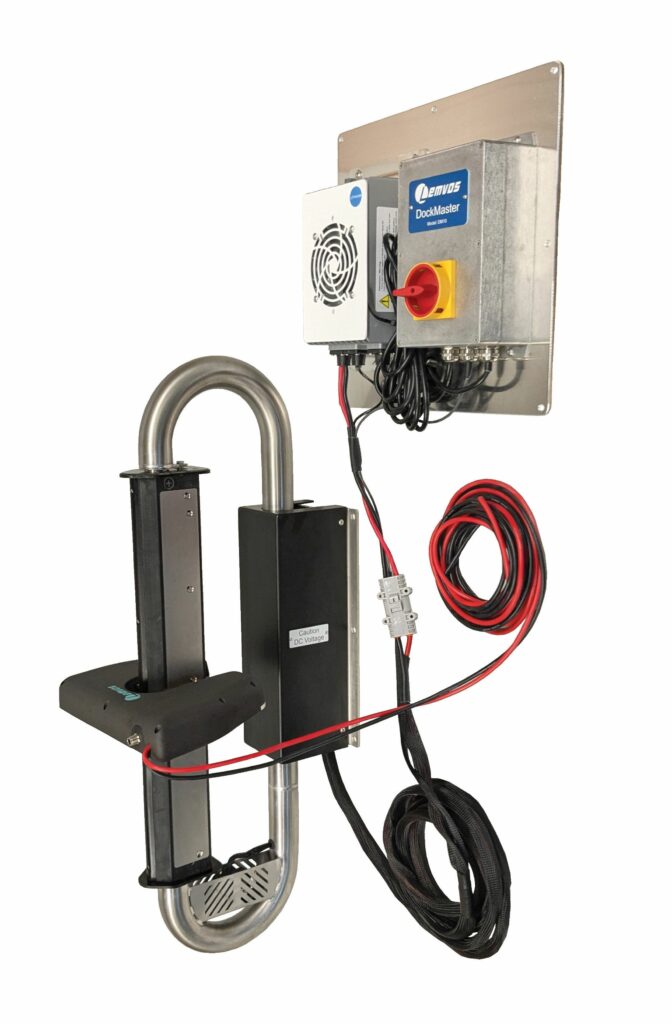
“It also facilitates charging. One side of the rail features a positive contact, the other the negative contact, with corresponding copper plates sitting on springs inside the left and right faces in the receptacle. So, electric or hybrid USVs can replenish battery energy while docked.
“The charger device is housed in the dockside part of DockMaster, and customised to the end-user’s battery voltage. We set up the charging curve to match the vessel accordingly, with our LM450 using a 48 V network, its peak charge being about 3 kW at 57 V, although we’ve had customers go as low as 24 V and it worked as normal,” Severinsen notes.
“We’ve also put in a resetting circuit, so that every few hours the charger resets itself to make sure the USV is staying continuously charged, even if it’s still using power – for instance, transmitting payload data to the cloud, or even just battery health and system telemetry back to the operator. And the LM450 vessel has a charging and monitoring circuit, with most USV OEM customers also having something similar in their vessels.”

The receptacle’s standard mounting configuration enables it to fasten onto any USV’s front with four M6 bolts. A flying lead is provided for connection to the USV’s battery bus, while a 5-pin M12 connector enables signal interfacing for the latching system, both connectors and their cable harnesses running from the housing’s rear-right.
“And the latch is passive in that it doesn’t need any power to close. When the system isn’t engaged, the latch is forced to close via a spring, whereas it’s essentially pulled open by an electrical actuator inside,” Severinsen adds.
The actuator is a linear servo sitting in the back of the receptacle housing, which has been selected by Lemvos following careful scrutiny of suppliers’ capacity for reliably delivering high-end devices.
In addition to being IP67-rated (which ensures that any amount of water splashing or salt getting into the receptacle housing cannot affect the servo’s continued functioning), the actuator is a proven model in marine applications, used for shutters in a variety of vessels.
“Moreover, while the servo and receptacle aren’t particularly lightweight – since weight optimisation isn’t a big problem for boats – we do care about reliability, so we’ve chosen a very oversized servo,” Severinsen muses. “It exerts around 12 times the force that’s actually needed in typical operation, so it’s got a huge margin for ensuring reliable unlatching.”
The LM450 USV
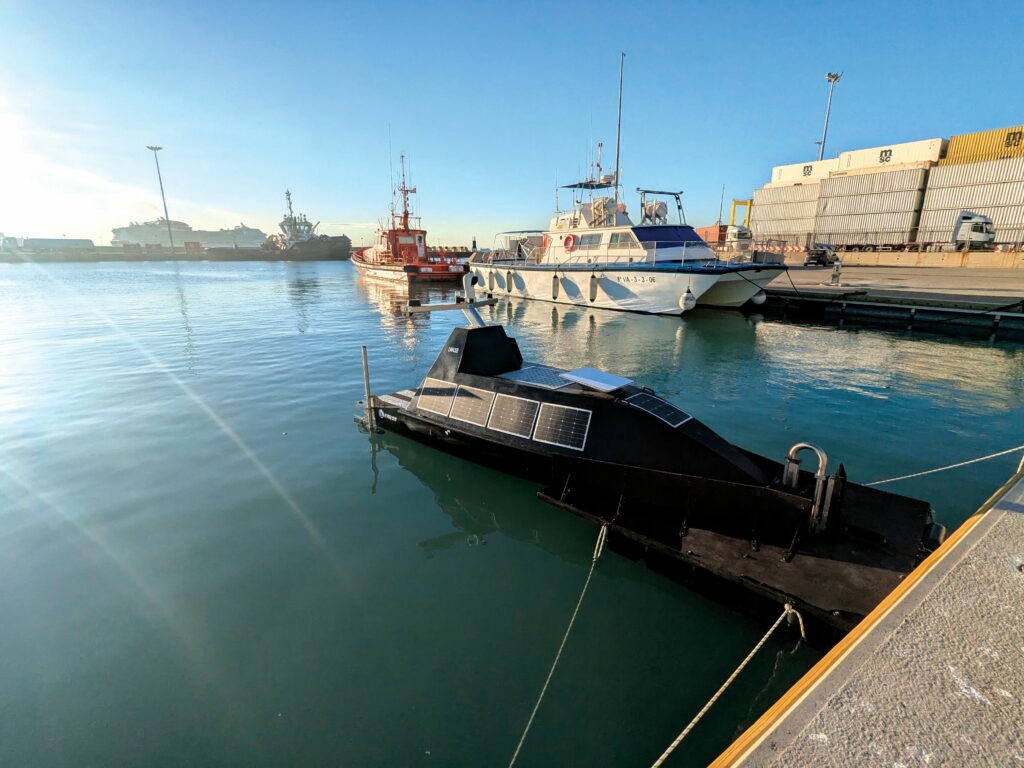
The DockMaster receptacle is visible on the bow of the LM450, which is a 4800 mm length, 1800 mm width USV displacing 630 kg, with its maximum height being 2400 mm when its mounting mast is raised and its draft running to 440 mm, although that latter figure can change depending on exact configuration.
“We went to the LM450’s longer, self-righting monohull design as our LM250 was limited in its ability to operate year-round in rough seas, being a smaller catamaran-type craft,” Severinsen recounts.
“It was also fully electric, whereas the LM450 comes hybrid-powered as standard, so we can do a lot more with it – either by using fuel to extend the range, or just operating more confidently by knowing that we have the fuel as a backup if the battery and the craft’s solar panels fall short of a mission’s needs.”
The USV functions through a series hybrid powertrain, with a 3.5 kW Yanmar diesel engine chosen as its auxiliary power unit out of the brand’s established reliability. The engine is fed by a 170 L fuel tank as standard, although additional tanks (and space to integrate them) for further range extension are available, and its power recharges a 12.8 kWh battery pack – however, a larger battery is available for customers who prefer an all-electric LM450.
“The battery then powers a pair of ducted, omnidirectional 5 kW electric thrusters, with this overall series hybrid configuration allowing for really fuel-efficient operation,” Severinsen says.
“A direct-drive combustion engine set-up has to work at the lowest end of its efficiency curve when powering a USV during the slow speeds needed for surveying – for large-area surveys, you might have the engine idling for days, which is just awful for fuel efficiency.
“But in our configuration, we just run the diesel generator at its peak efficiency point for a short period, which replenishes the batteries comfortably, and then we can discharge the batteries slowly over a longer period.”
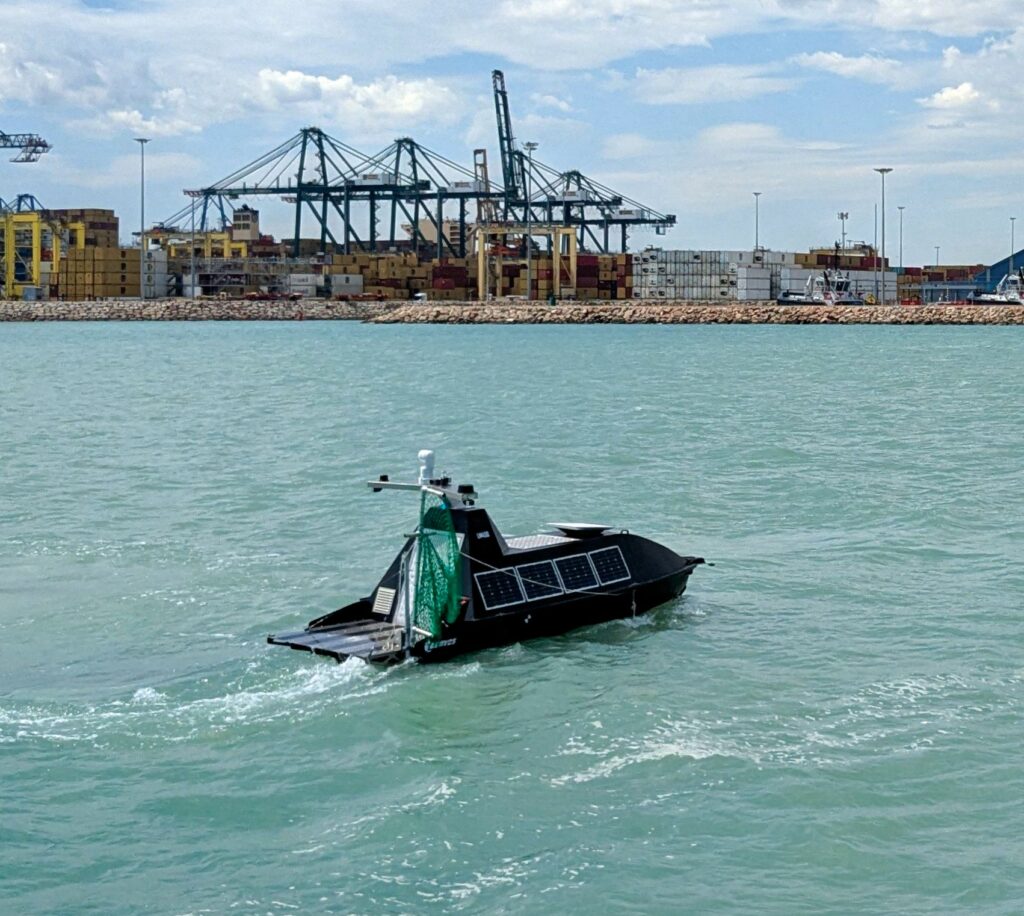
Integrating two freely azimuthing thrusters enables not only a zero-degree turning radius, but also dual redundancy, with the USV retaining full movement capacity should one be lost.
The LM450’s design notably features a large trapezoidal structure atop its deck, which provides both height for its comms mast and a similar-enough shape to a roll cage to enable self-righting if the vessel were to roll over.
Rearwards, a small platform enables either winching, lowering and retrieval of a small ROV, or (when the winching mechanism is removed) launch and recovery of small UAVs, to cater for particular mission needs in addition to the payload capacity of up to 330 kg and considerable internal and external mounting space.
“We’ve really focused on designing this USV as a multi-tool for many different scenarios and data-gathering applications; we’ve got a project in May this year to serve as mothership to an ROV, and we’ve done multiple successful UAV teamings too,” Severinsen notes.
Stable at port
As mentioned, the USV once docked has significant flexibility to heave, bank and turn about the secure lynchpin that DockMaster provides. However, to prevent the craft rotating too wildly, and to make it easier for the USV to come in for docking with a precise approach for mating the two halves of DockMaster, Lemvos recommends the construction or installation of a V- or U-shaped alcove (conformal with the approximate outline of the user’s chosen USV when observing it from above) about the dockside-half.
“We use a V-shaped dock with our LM450s, and a U-shaped dock with our LM250s, matching the shape of each of those two platforms – but if customers don’t want to do that, they can mount two DockMasters next to each other,” Severinsen says.
“That restricts the vessel’s rotation while still allowing a safe measure of flexibility; one customer in Sweden has done that with a ferry, essentially putting two DockMasters on its stern, and reversing it to come into dock and latch there.”
Naturally, a precise docking approach may also be achieved through well-engineered perception architecture, use of RF beacons, QR codes or other means – and, ultimately, Lemvos opts to leave the choice of such additional layers to the end user because different CONOPS and industries will have varying levels of functional safety requirements and budgetary freedom to consider.
Lemvos does recommend, however, that the pole-half of DockMaster is mounted on a floating dock or jetty, so that the USV and pole heave up and down together amid tidal differences.
The charging rail is designed tall enough that it features a degree of height to allow a range of vertical movement, but that remains limited to approximately 600 mm, and – as readers with nautical experience or general knowledge will understand – tides can shift significantly more than that.
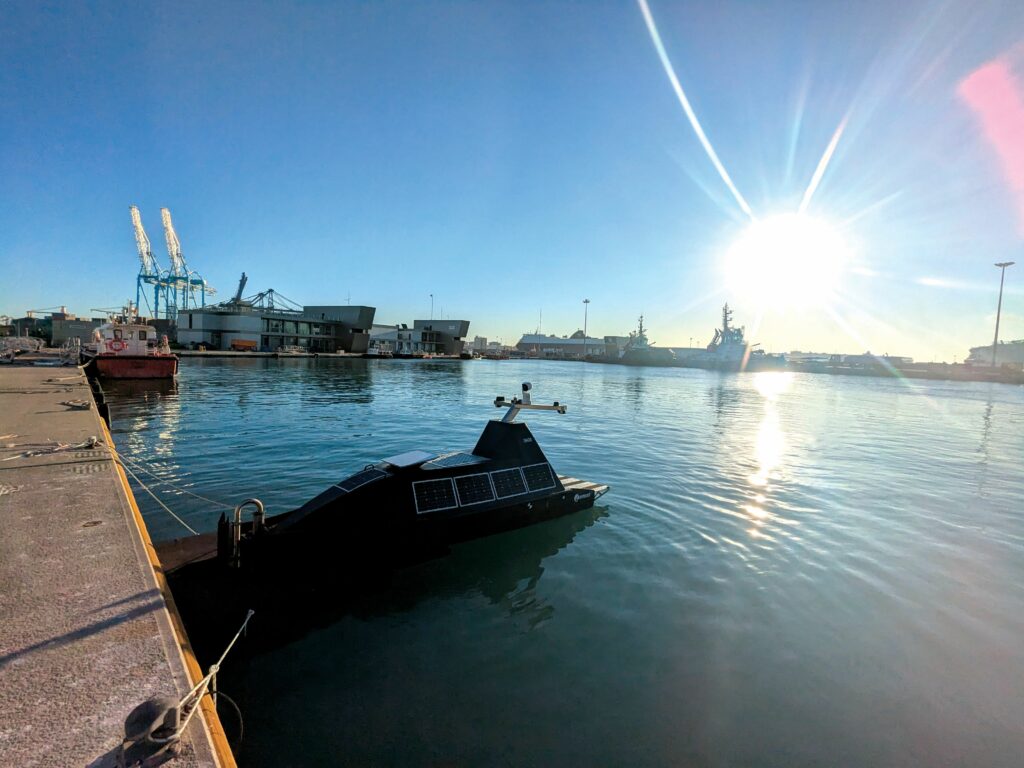
Lemvos is also open to building taller, bespoke versions of DockMaster upon customer requests, but floating docks remain a reasonably standard and widespread infrastructure, and are thus the first, most cost-efficient port of call it suggests to users or interested parties.
The LM450 USV is also largely constructed out of high-density polyethylene (HDPE), with sheets of the HDPE welded together in most sections. This build enables mechanical robustness while also allowing some flexing to dissipate impacts from waves or other sources.
“We’ve also designed the air inlets for the diesel generator such that, if the craft rolls over, it should only take on a few mils of water, which should then get bilge-pumped out after a few seconds,” Severinsen notes.
Setting sail
Once relaunched from DockMaster – or launched via any other means, for that matter – the LM450 USV is capable of operating for up to 30 days at a time, thanks in no small part to the combined fuel and electrical efficiency of its diesel series-hybrid powertrain.
The fully electric version of the LM450 is capable of running for just 34 hours per mission, while endurances for the kind of direct-drive, combustion-only version of the USV previously alluded to, remain theoretical.
Naturally, at some point, humans will be needed on-hand to refuel the USV (assuming, of course, that the end user does not engineer or adopt some means of automated refuelling). However, one may recall here that the LM450 is built with solar panels across its bow, port and starboard faces – with up to 350 W of power available through them in ideal sunny conditions.
If the USV moors using DockMaster, while its operators ensure general use of the diesel generator is kept smart and sparing, and missions are programmed such that the USV periodically stays in an all-stop mode to replenish its batteries using solar power, along with DockMaster, Lemvos estimates that the vessel may be left to function alone for up to six months at a time, without needing human intervention or direct maintenance inspections after making berth or setting sail.
Relaunching the USV from the DockMaster pole is naturally straightforward because the USV controls whether the latch is engaged or not; its control system simply transmits a signal to the linear servo to hold open the latch, and then allows it to return to its closed position once the vessel is well clear of the dock.
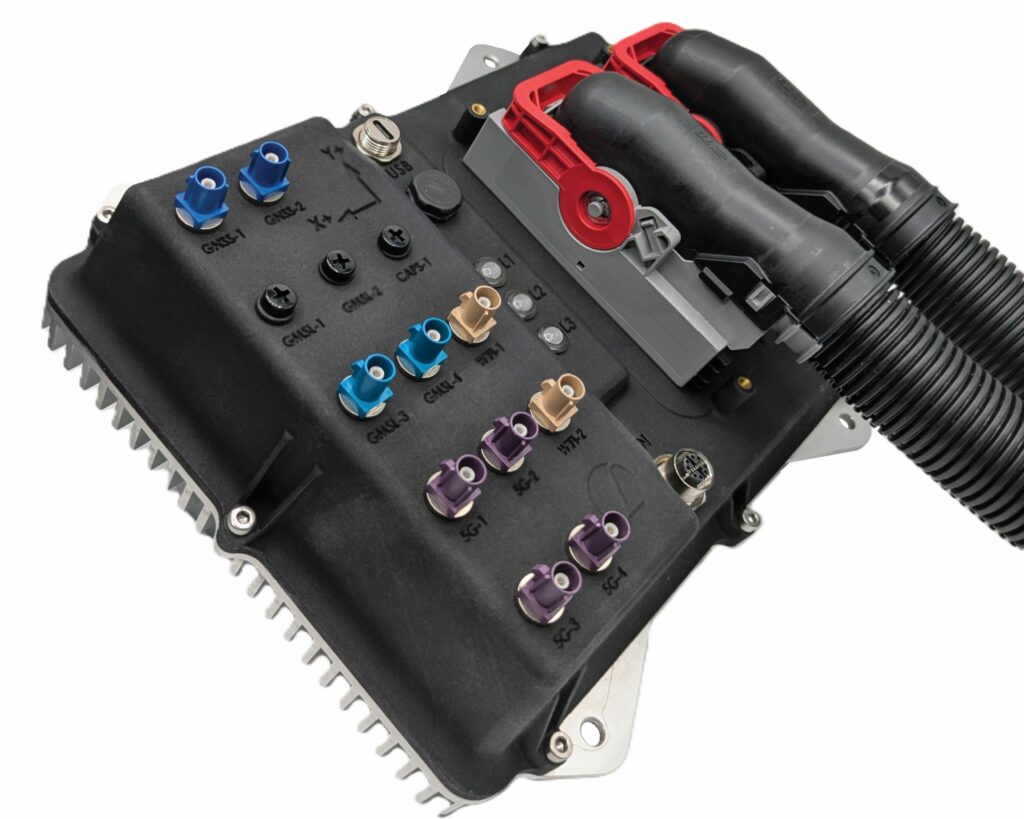
In the case of the LM450, that control system is the AutomatePro, which is designed and manufactured internally (and has been sold externally for autonomous control and navigation in other USVs).
“With our LM250, we’d started out with a control system that combined a lot of different components,” Severinsen recounts.
“We had modules for the analogue and digital I/Os, for the processor, for the cellular connectivity and for a few other things, all connected together in kind of a messy way.
“We wanted all these subsystems to be integrated into a single unit; plus, IP ratings are pretty important to us, and if you’re trying to connect together five different devices that largely aren’t IP-rated to begin with, you stand to create just so many potential failure points.”
Readers may recall that Callboats in Finland (featured in Issue 65) took a similar approach with its CAT-10 autonomous ferry, integrating the bulk of its electronics for control, navigation and communications onto a single large-sized PCB, to minimise the size, weight and complexities of cable lengths that had previously been routed throughout the ferry’s innards.
However, the added step of bringing these under a single housing achieves (as mentioned) the ability to have all electronics and I/Os protected to IP67 levels against water ingress.
On top of bringing all of these subsystems together into one tidy and waterproofed system, Lemvos was determined to regulate system-wide power consumption, and this too was made easier by combining autonomy, cellular comms, navigation, camera inputs and edge processing under one centrally integrated and monitored architecture.
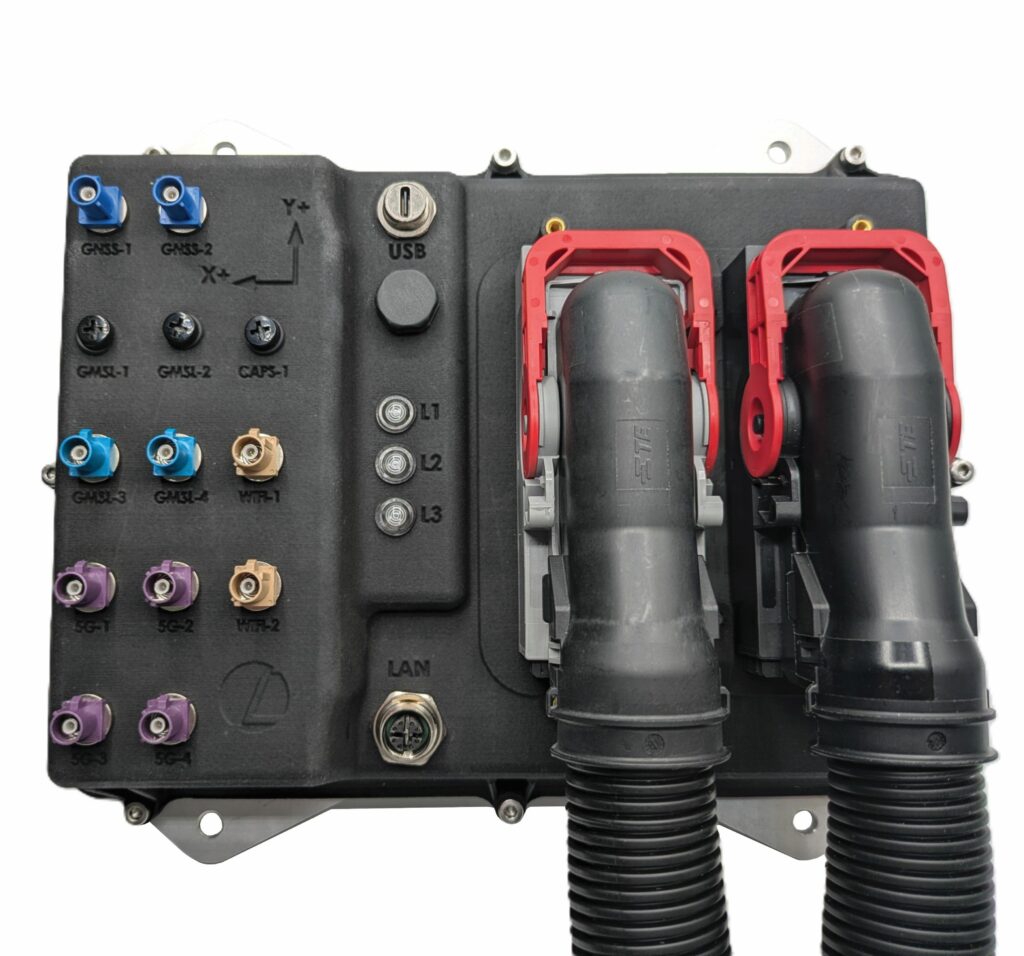
Hence, the LM450’s autonomous operations, from main navigation and 4G/5G live streams to obstacle avoidance analytics, can be managed almost entirely by AutomatePro. The solution also interfaces via CAN for monitoring and controlling the different powertrain subsystems, CAN also enabling interfacing with those marine-grade devices running NMEA 2000 onboard, and analogue devices also, preventing the need to add an extra module every time some new functionality is installed.
Additional interfaces including Gigabit Ethernet, RS485 serial, and either six H-bridges or 12 solid state relays are also provided for integration of external devices, including Lidars, directional antennas and radars.
For edge computing, Lemvos offers AutomatePro with four levels of graphics processing, based on the NVIDIA Jetson Orin Series and ranging from the 4 GB Orin Nano up to the 16 GB Orin NX; the solution also comes preloaded with JetPack 6.0 and ROS 2 drivers for seamless interfacing with onboard hardware, as well as Linux Ubuntu 22.04 as its OS.
The unit integrates all data link transceivers, including a cellular sim card for either 4G or 5G, which then runs to an antenna (with Taoglas in Ireland providing antennas for both comms and GNSS as standard), the system’s 5G being typically powered by a Quectel RM520N-GL and GNSS coming via a u-blox F9P or F9R depending on mission requirements.
Future
On top of having sold DockMasters and USVs to multiple users already, Lemvos is continuing to engage with a number of ports and coastguard agencies, disclosing to us that it has a notable operation coming up in June later this year in the port of Valencia, Spain.
“So, come the summer of 2026, we’ll be using our LM450 vessel to carry out security patrols, including scanning underneath the water with a sonar device attached via the rear platform and the payload electronics bay near the stern,” Severinsen says.
“We’re also looking to trial and deploy in more defence and security applications, so we’re set to take part in the next REPMUS crewed–uncrewed set of naval exercises in Portuguese waters, with its specific kinds of NATO tests on autonomous intelligence and interoperability.
“And as you can imagine, we’re also actively looking to see what interesting kinds of new technologies we could integrate into the USV itself to provide further value to defence-minded users. We’re actually having talks with quite a few companies who are keen to show off what their sensors can do onboard a platform like ours during the REPMUS26 exercises.”
Lastly, as our application-savvy readers will have surmised, the mothership capabilities enabled through the LM450’s stern platform and the resident capabilities empowered by DockMaster make the two combined systems a suitable fit for monitoring offshore infrastructure, including having them permanently integrated and anchored at wind farm fields to maintain close eyes on the performance, health and integrity of far-remote wind power installations.
“We’re also investigating how the combined systems could take to monitoring critical subsea infrastructure, including missions where we’re autonomously following and assessing underwater pipelines and data cables,” Severinsen adds.
“Maybe it’s a little late for Nordstream-2, but there are still millions of kilometres’ worth of remote submarine infrastructure like that – and more every year – that can go from being really expensive to monitor, to really quite cost-effective and repeatable with solutions like these that we’re delivering.”
Key specifications
LM450
Monohull USV with self-righting
Series hybrid with solar; all-electric version optional
Length: 4800 mm
Width: 1800 mm
Draft: 440 mm (depending on configuration)
Height: 2400 mm (mast up)
Displacement: 630 kg (dry mass excluding payload)
Maximum endurance: 30 days (34 hours if all-electric; six months for resident version with DockMaster)
Maximum speed: 5.5 kts (10 kph)
Maximum thrust: 10 kW
Maximum sea state: 6 (Beaufort scale)
Maximum payload weight: 350 kg
Maximum payload power: 2.5 kW
Internal payload bay dimensions: 1056 x 350 x 500 mm
External payload dimensions: 1500 x 1200 x 1000 mm
DockMaster
Maximum recommended vessel length: 6 m
Maximum roll while docked: +/- 20°
Maximum pitch while docked: +/- 10°
Peak charging power: 3 kW (60 V DC)
Charging voltages: 12, 24 or 48 V, or custom up to 75 V DC
Charging current: Up to 50 A
Shore power voltage: 110 or 230 V AC
Release actuator voltage: 12–30 V DC
Some key suppliers
Main computer: In-house
5G: Quectel
GNSS: u-blox
IMU: CEVA Inc
Antennas: Taoglas
Cameras: Sony
Camera cables: Leoni
UPCOMING EVENTS