



UMEX 2026
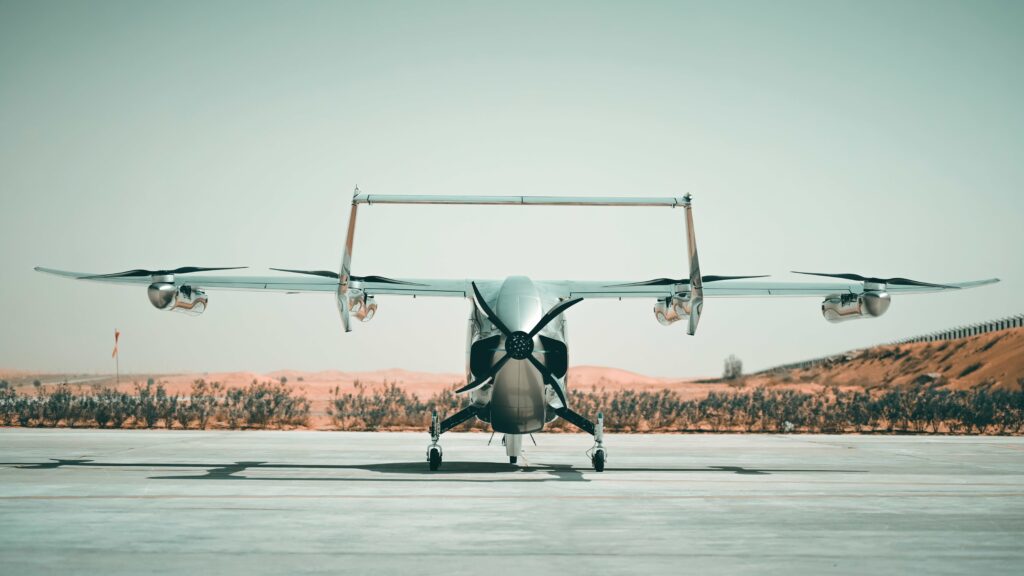
(Image: LODD Autonomous)
Frontline innovations
Rory Jackson reports on the latest products and solutions for defence-oriented uncrewed systems at this premiere Middle East expo
With the Arabian Gulf now (at time of writing) faced with active conflict, it can be regarded as apt prescience on the part of the Gulf States that they have long been enthusiastic adopters of uncrewed systems for strengthening their defence capabilities in the absence of large populations to bolster their forces.
So it was that the 2026 Unmanned Systems Exhibition (UMEX) was the event’s largest edition yet, bringing together record numbers of exhibitors, innovations and interested customers into what has become cemented as the region’s leading platform for defence autonomy technologies. Aircraft, avionics, power systems, connectivity solutions and more were on display for delegations from around the world seeking to stay one step ahead of their nation’s threats and adversaries – with a selection of the latest product launches presented here.
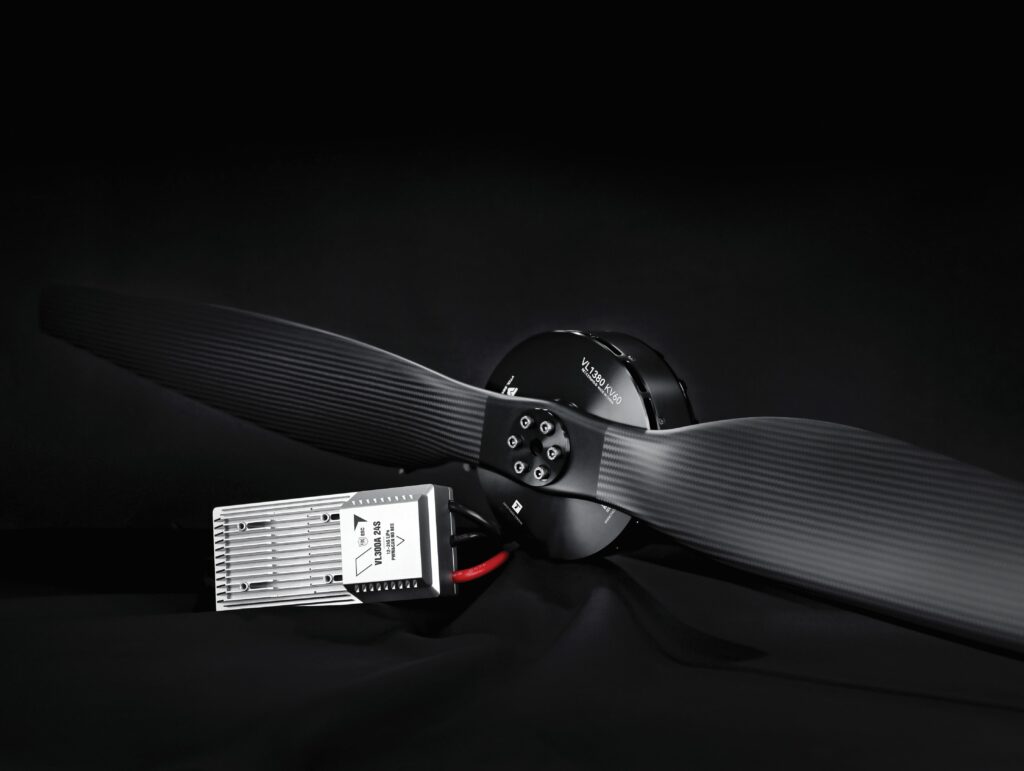
T-Motor displayed a range of new solutions, including its new electronic propeller locking feature, which comes integrated within its VL Motor product series.
“The VL Motors are especially designed for VTOL-capable UAVs, and with the propeller locking, the props will be fixed in a specific position as the UAV transitions into forward flight,” said Brian Zhou from T-Motor.
“That particularly means locking them so the blades run parallel with the direction of flight, so they don’t create as much drag as in any other position. The UAV’s aero efficiency then improves and flight times get longer. But end users can interface with the motors to fix the propellers in whatever angle they like. So, they could also lock them perpendicularly against the flight direction, if the blades were designed to generate lift like wings.”
The VL Motors’ ESCs are programmable via CAN to facilitate such locking configurations and, as indicated by their name, the locking is achieved electronically via electromagnetism rather than a mechanical device. While mechanical locking is often a reliable solution, particularly for small- to medium-sized motors, electronic propeller locking offers increased stability for the kinds of larger motors increasingly used in heavy-lift applications.
The electric motors themselves come in a range of sizes and power levels to suit VTOL-transitioning UAVs of different weight categories, from 15 kg UAVs up to 150 kg aircraft.
Holybro is preparing to launch a new industrial Pixhawk autopilot designed to interface with all onboard UAV sensors through a single industrial-grade waterproof connector.
“The system uses a rugged industrial connector that is sealed and waterproof, providing a much more reliable interface than multiple standard cables,” said Vince Poon of Holybro.
“It also includes two internal GPS receivers and an airspeed sensor, making it an all-in-one flight controller for OEMs to integrate directly into their vehicles as a turnkey system ready to run their autonomous flight software stack.
“By consolidating everything into one system with a single connector, the autopilot installation becomes much cleaner and reduces internal wiring. As fleets scale and drones become larger, reducing loose wiring helps improve reliability and lowers the risk of hardware issues.”
The company also previewed an upcoming integrated autopilot design featuring a compact metal enclosure that houses both a Pixhawk flight controller and an NVIDIA Jetson Orin companion computer. The enclosure includes a wide range of interfaces, including dual camera inputs and dual wi-fi interfaces, providing a robust and compact solution for advanced autonomous UAV systems.
PowerBox Systems Industrial is a German manufacturer of electronics for UAV powertrains and flight systems, which attended UMEX to exhibit solutions such as its Engine Manager Pro for monitoring and controlling gasoline engines.
“Its foremost functions include controlling ignition processes and feeding back telemetry on crank rpm, while also connecting up to four temperature sensors and up to three servo outputs,” said Richard Deutsch.
“The power supply for ignition can also be taken through the system because we have a filter inside to prevent electrical interference. We’d previously been producing a similar device to this for RC applications, but when we found there’s nothing really on the market like this with CAN functionality, we made the Engine Manager Pro available and controllable with CAN bus, including variations such as DroneCAN, so it’s plug-and-play with most flight controllers.”
The Engine Manager Pro is a 40 g device capable of handling up to 2.5 A of ignition current continuously and delivering output voltages of 6, 8 or 12 V.
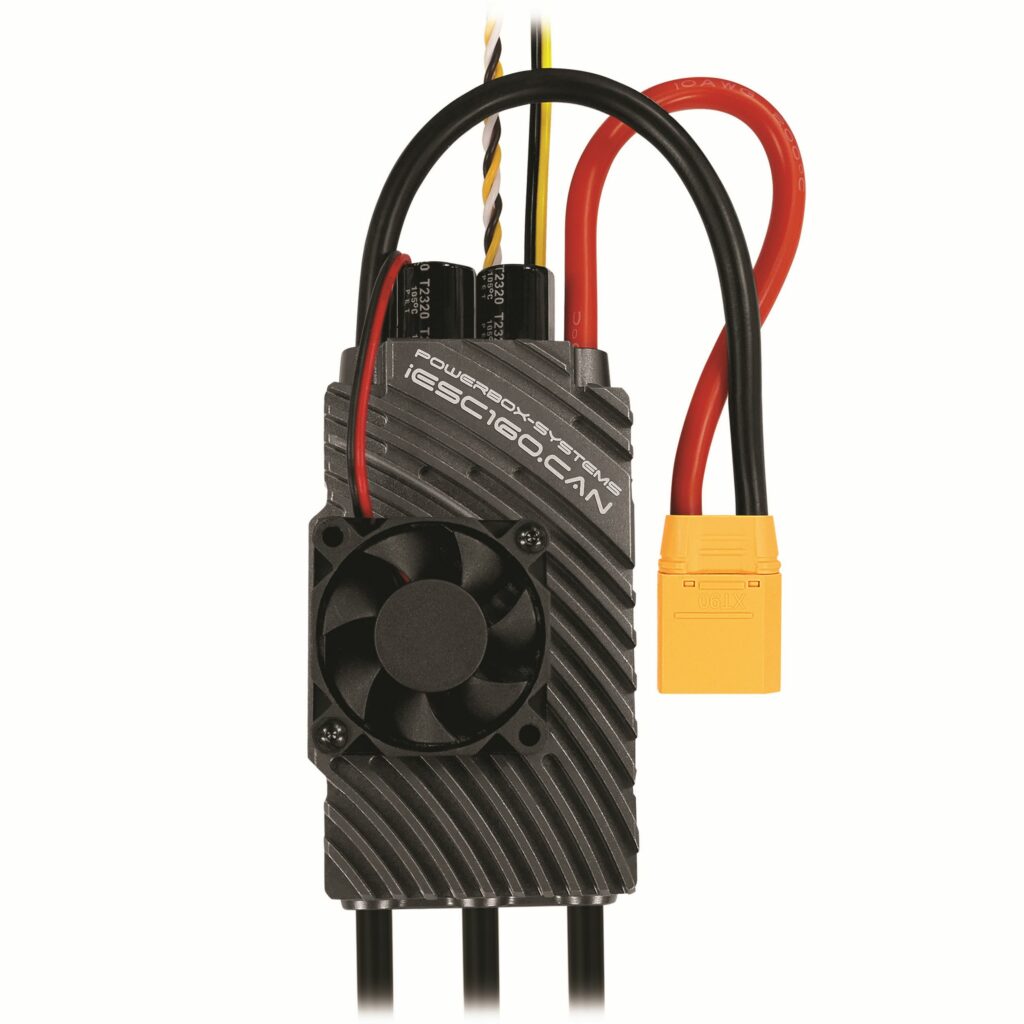
The company also showed us its iESC 160.CAN, a motor controller designed for 180 A peak power (160 A maximum continuous current) or 6S-14S batteries. The system is configured for BLDC motors and DroneCAN for easy integration into existing mission planners and telemetry analysis.
Avior Labs is a South African developer and manufacturer of drones, specialising in small- to medium-sized VTOL-transitioning UAVs. Its products are designed to be particularly well suited to operations in Southern and sub-Saharan Africa, and are optimised for missions such as wildlife surveys for nature reserves and hunting lodges, surveys in support of precision agriculture, and security operations such as countering infrastructure theft and wildlife poaching.
“Our flagship Elevation UAV comes in two versions: Elevation-S, which integrates various fixed high-resolution RGB, thermal or multispectral cameras for survey work, and Elevation-G, which has a gimballed EO/IR payload linked to an onboard stabilisation, tracking and AI computer for surveillance operations,” explained Avior Labs’ Dr Bennie Broughton.
“An example of the end-to-end solutions that we provide at Avior Labs is the utilisation of our Elevation-S survey platform along with in-house developed game counting technology. Private reserves and hunting lodges typically need to count their animals at least once a year. The results are used to plan habitat management, evaluate animal numbers ahead of the hunting season or to determine the land value when wildlife farms are sold or purchased.
“Traditional helicopter-based surveys are both expensive and inaccurate. Drones provide the ability to survey and photograph the entire farm. The data not only provide accurate animal numbers but can also be used to provide orthomosaic photographs that can be used for other land management applications, such as monitoring erosion, vegetation density, the presence of invasive plant species or the state of waterholes and other farm infrastructure.
“One Elevation-S can fly for almost 90 minutes and survey up to 400 hectares in one flight. We use a combination of high-resolution RGB and thermal images along with our own AI-based software to find the animals and classify them by species. By utilising the dual payload set-up, we can even find animals standing under vegetation, providing a much more accurate count than traditional methods.”
The Avior Labs Elevation UAV is a 4.6 kg MTOW, fully electric fixed-wing VTOL aircraft, with a 2.54 m wingspan. It utilises a patented configuration with three fixed VTOL motors (two mounted on wing booms and one mounted on the tail) along with a single tiltrotor on its nose.
The configuration forms one element of the UAV’s SilentFly technology, which allows exceptionally quiet operations to avoid distressing animals, disturbing guests or alerting criminals.
The company is also currently developing its upcoming Callisto VTOL UAV, which will have a 15 kg MTOW, flight endurance of up to 8 hours, and 2 kg payload capacity. It is designed from the ground up as an intelligent, autonomous agent that combines extreme endurance for its class with onboard ‘AI-at-the-Edge’ computing. Avior Labs anticipates flight tests to commence before the end of 2026, and by applying the lessons learned on earlier products, start series production as early as mid-2027.
We also met and spoke with Jiangsu Sunpower Co., Ltd. about its SunPower (or Sainpower) line of battery cell products, which are used in packs and modules across UAVs, UGVs, and a variety of other types of vehicles and devices.
As Jack Yang at Sunpower told us, “Our NCA [nickel cobalt aluminium oxide] cells are especially popular in uncrewed applications for their high power density. For instance, our 50SE and 55P solutions are 21700-type NCA products, which store up to 5000 mAh and 5500 mAh per cell, respectively, weigh 72 and 70 g, respectively, and can discharge up to 30 A of current continuously or be recharged at up to 10 A.”
In addition to offering several other 21700-type NCA cells, the company also manufactures its NCA, nickel manganese cobalt and lithium iron phosphate [LFP] cells to the older 18650 standard, as well as 26700-type LFP cells.
More recently, the company has begun series manufacturing of sodium-ion cells also, in 18650 and 26700 formats. The 26700-type 33E SunPower cell weighs 89.5 g, contains up to 3300 mAh, and both charges and discharges at currents up to 16.5 A.
“In truth, right now, there aren’t a lot of advantages to using sodium-ion cells, but as their production scales and technology improves, their prices per unit will lower by quite a lot and we expect them to gradually become a lower-cost alternative to lithium cathode technologies,” Yang added.
Suter Industries (Aviation) showed us several new engine and auxiliary power unit (APU) products it has unveiled in its growing portfolio for UAV and light aircraft propulsion.
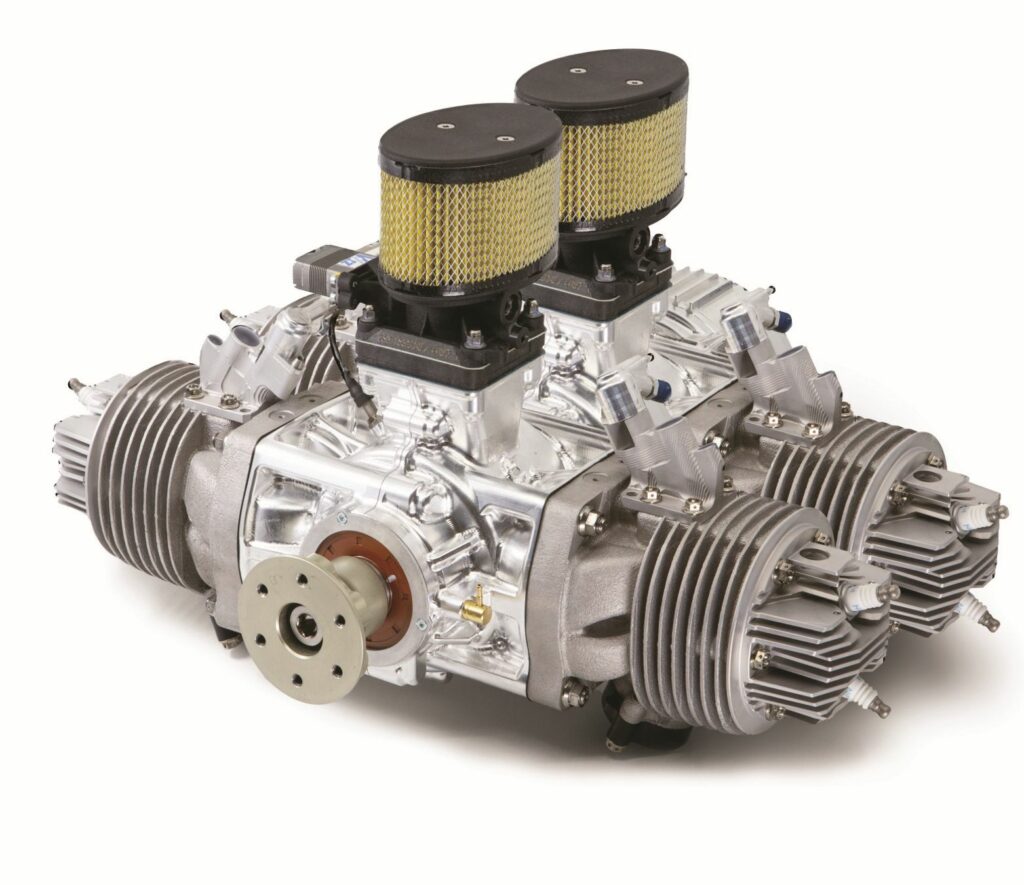
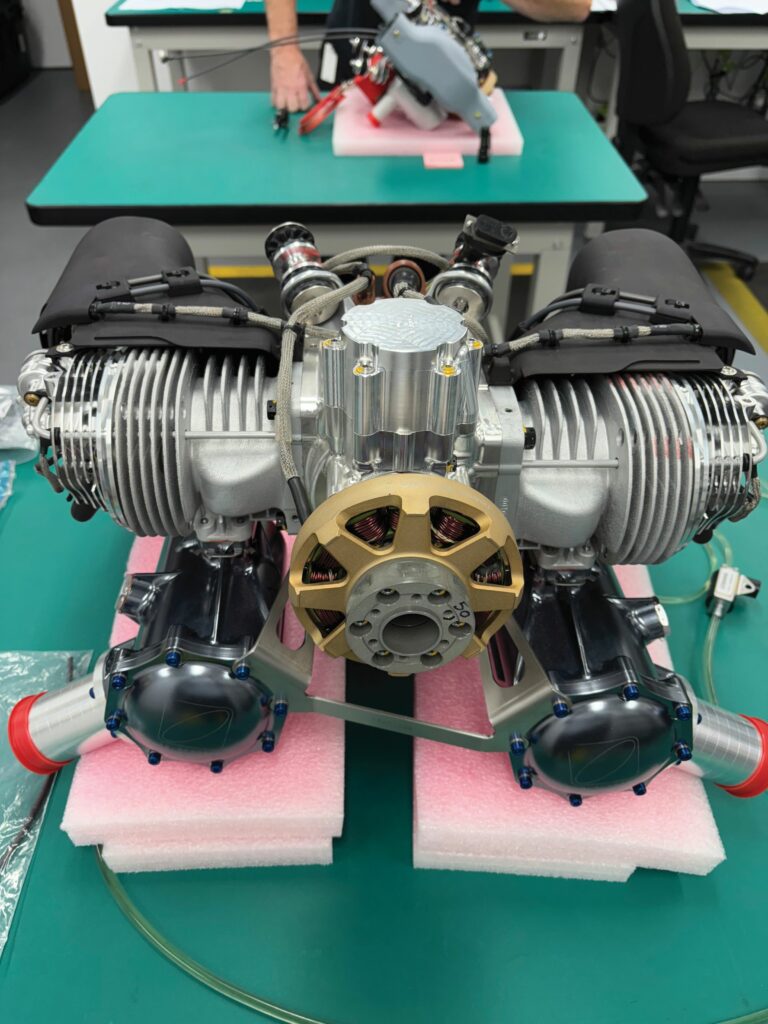
First among these is an upcoming HF-FOA-660-SDI, a 660 cc four-cylinder variation on the air-cooled, 330 cc TOA-330 boxer twin detailed in Issue 60. This new engine will enable significantly increased power output over its smaller sibling, while companies seeking to run differently sized aircraft on either engine will derive inventory and maintenance advantages through their use of common cylinders, connecting rods, pistons and other components.
“We’ve been receiving greater demand for a 30 kW APU, and a higher horsepower engine for larger UAVs. So, the 660 cc engine will be in the 50 hp range, possibly up to 60 hp depending on the fuel type, and as with the 288 and 330 cc engines, we’ll configure it to run on heavy fuel and gasoline, depending on what each customer wants,” said Bob Schmidt.
“The growth of hybrid-electric VTOL-capable UAVs, across both defence and commercial, is really what’s motivated a lot of these new engine designs. Such aircraft need APUs for range extending, or a source of battery replenishment for prolonged hover, ascent and descent with their lift motors. It’s also why we’ll continue scaling our water-cooling capabilities, as you’ve seen in our TOW-288, for engines in multi-rotor or hovering applications that can’t be sustained on air cooling alone.”
Beyond these systems, Suter is also planning an 1800 cc engine, in pursuit of 175–200 hp outputs, and a potential 144 cc single-cylinder version of its TOA-288, the latter following demand for propulsion and APU systems suited to very small UAVs.
Until then, the Swiss company anticipates first availability of the FH-FOA-660-SDI’s test units later in 2026, potentially by the middle of the year.
Micro-Magic is a Hangzhou-based producer of MEMS- and FOG-based inertial systems, which attended UMEX to showcase some of its newest solutions, including its tactical-grade U16488-D MEMS IMU.
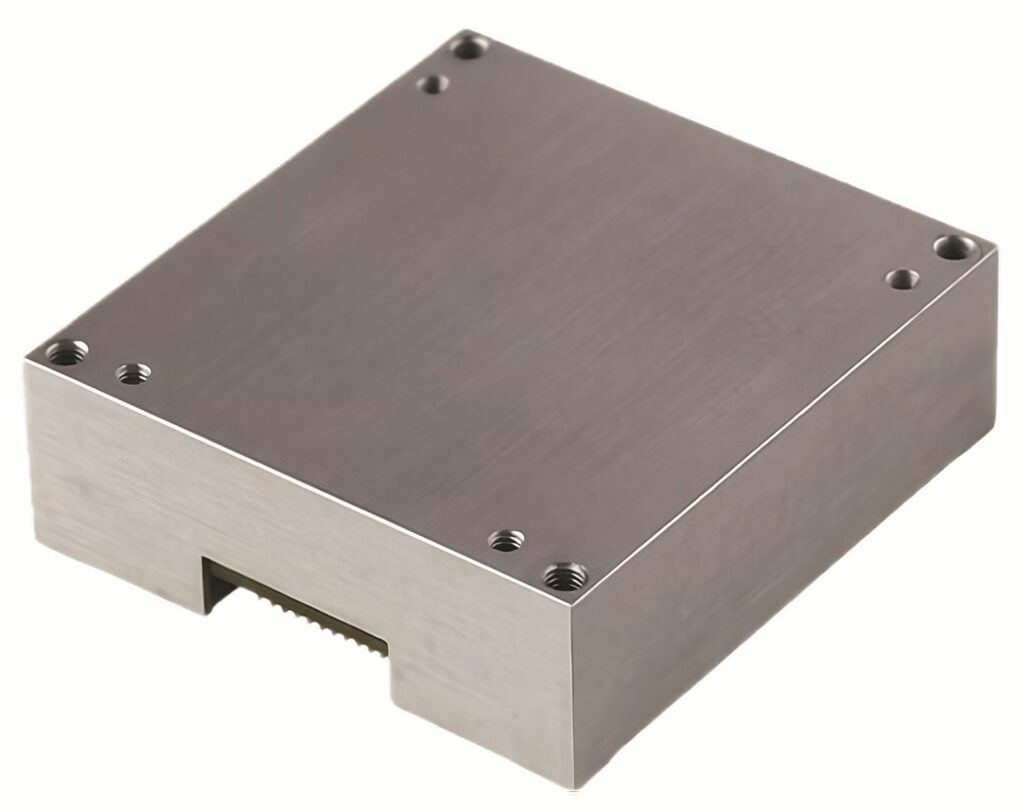
“It’s designed as a lightweight solution – at 50 g unit weight – and also for high precision and stability in its performance, particularly for small UAVs. We’ve sold a lot of U16488-D units to high-speed drones with very dynamic mission applications,” said Manot Xu of Micro-Magic.
The U16488-D’s accelerometers have a maximum dynamic range of +/-16 to 40 g, and function with a bias in-run stability of 0.02 mg, a bias in-run repeatability of also 0.02 mg and 0.01 m/s/√hr of random walk. Its gyroscopes meanwhile have a bias in-run stability of 3°/hr, a bias in-run repeatability of 1.5°/hr and 0.08°/√hr random walk, with +/-500°/s maximum dynamic range. The IMU additionally integrates a +/-8 gauss magnetometer and a 300–1100 mbar barometer.
“It also comes with both SPI and UART protocols for easy plugging-in, interfacing and configuration, especially with the high-speed nature of SPI,” Xu added.
XDynavia displayed its range of turnkey motor-propeller pods for multi-rotor UAV assemblies, including its newest, the MS-15.

The MS-15 pod has an all-up weight (including cabling and propellers) of 5765 g, and produces up to 74 kg of thrust, as well as 3.6–5.1 kW of power in its optimal efficiency range, up to peaks of 15.8 kW. It is recommended by the Guangdong-based company for quadrotors of 30–38 kg MTOW and for pairings with 24S Li-po batteries.
“Product lifespan is important to us as a propulsion systems manufacturer, so the MS-15 is qualified for 2000 hours of operation per unit as its MTBF,” said Kevin Liu of XDynavia.
“Safety is also very important to us. So, before we released this or our other products to the market, our engineers performed exhaustive testing across all industrial-grade environmental and vibration tests, including subjecting units to accelerated ageing, water ingress, dust ingress and other tests to inform the designs of their housing and protection systems.
“This and our other products also use, we feel, the most efficient electric motors on the market, capable of 95% power efficiency on air cooling alone; compare that with, say, Tesla’s electric motors which hit 98% highs by using aids like oil cooling, and you can see we’re hitting the limit of what’s possible in drone motors.”
Although XDynavia does not directly manufacture the propellers that come with the MS-15 or its other products, it keeps closely involved with their design, and individually validates each supplied propeller through testing because its motor controllers function using some of the newest field-oriented control algorithms, and such testing is key to both characterising and guaranteeing the performance of each complete supplied propulsion pod.
visionair spoke with us about its new 2 kW power distribution unit (PDU), which is its most powerful PDU yet following its 1.8 kW predecessor. The system forms part of an intended modularity approach, whereby end users can use the smaller 1 kW units for smaller UAVs, or string differently specified units together across a large UAV’s electrical architecture to address (for example) ad hoc upgrades of avionics or payloads.
“The new system is actually capable of handling peaks of 2.25 kW, but OEMs and integrators tend to exceed the electrical limits you recommend, and we care about safety a lot, so 2 kW is the rated power capacity,” mused Ben Tschida from visionair.
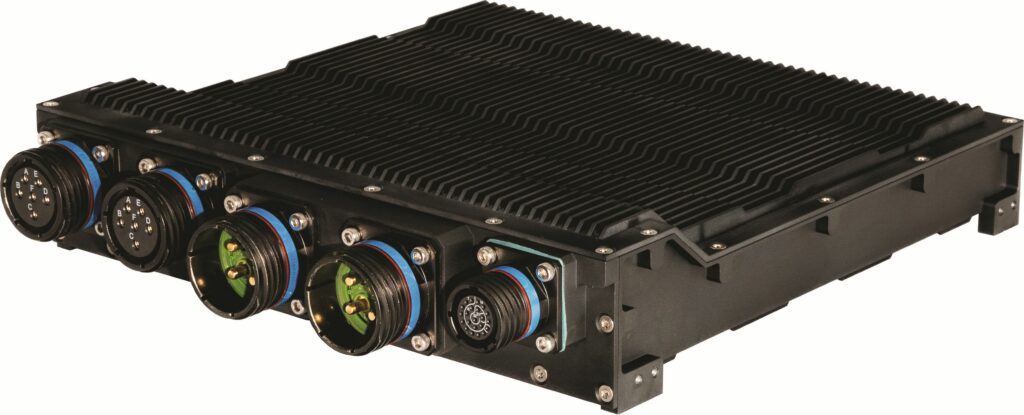
The PDU is designed with a plethora of electrical inputs, each of which functions independently and with insulation from the others, minimising interference or interruptions among them – for instance, if one port should suffer a short or other failure mode.
“Internally, it has six configurable outputs that are programmable via our UI, and four of those are fully redundant systems, as in duplicated internally,” Tschida added. “Hence, if one of them fails, you still have 100% power delivery and conversion for your critical onboard systems.”
Voltage inputs from 24 to 60 V can be run in the PDU, although visionair recommends users try to stay within the 45–60 V range to avoid limitations from the current and wiring run-up caused by lower voltages. Voltage outputs can run from 6 to 28 V, the lower end being particular to two of the six outputs, specifically for servos and similarly power-hungry equipment.
“We also build-in classical safety features like short-circuit protections and duty cycle switching, and we’ve updated our UI software on top of that,” Tschida said.
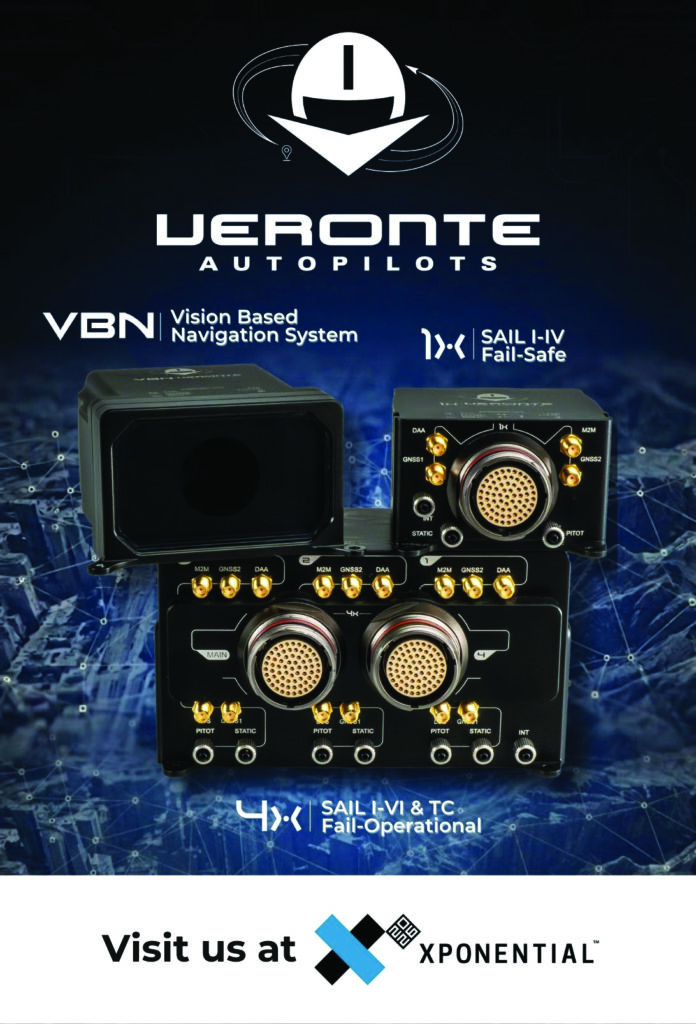
“And on a separate note, we’ve updated our engine starter product with improvements to its starting algorithms for increased reliability, including fault tolerances for things like mistakes in customer integrations where incorrect wiring could cause surges.”
We caught up with Orbital UAV walking the aisles, and learned about its new 350 cc direct injection heavy fuel engine, the 350HFE.
“We introduced this powertrain to the market around the end of 2025, and it’s very well suited to aircraft integrations of around 150 kg MTOW,” said Dan Evangelisti of Orbital UAV.
“Right now, it produces roughly up to 30 hp, but we’re still in pre-production, prototype development; we anticipate that, when we get to full-scale production in around Q3 2026, we’ll be solidly outputting a continuous 30 hp with about 325 g/kWh specific fuel consumption.”
As a small two-stroke boxer twin optimised for UAVs, the system’s developers are targeting an all-up unit weight of around 18 kg, including its engine management system, pumps, mounts and so on. It will also come with a fitted starter–generator rated to 2 kW for powering onboard subsystems, and Orbital UAV’s FlexECU will enable features such as remote starting, anti-stall, fault monitoring and black box logging along with other electrical and electronic features.
We met with CYS Precision Power Technology, who displayed a range of actuator systems for applications from RC to industrial aircraft, including a new steel gear servo.
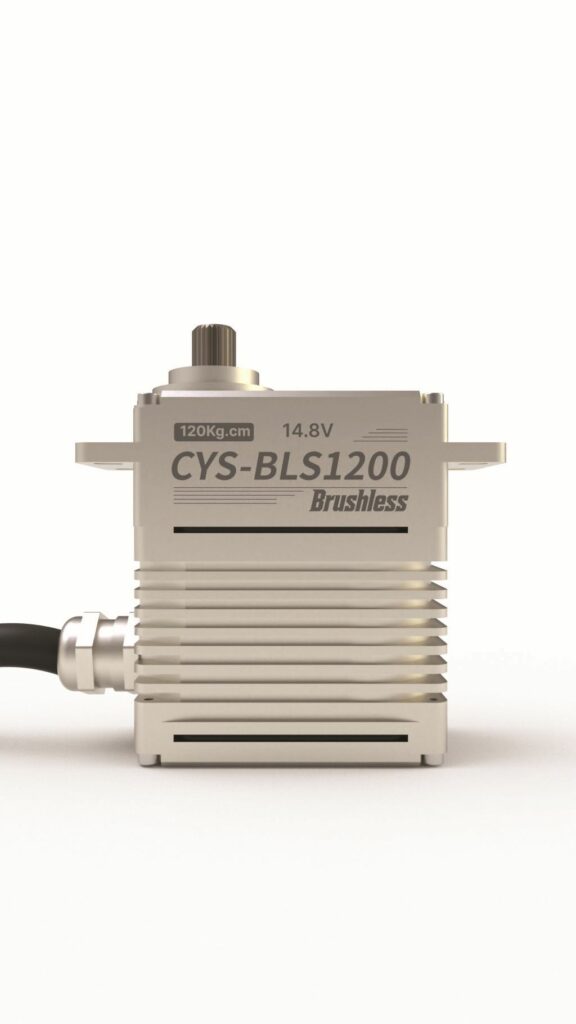
“Our CYS-BLS1200 is a waterproof brushless servo designed for high torque outputs of up to 120 kg of force in professional integrations,” said Cherry Guan at CYS. “It comes with dual CAN bus interfaces, as well as traditional PWM control for those who use it.”
The company’s range of high-torque, CAN-interfaceable brushless servos range from 200 to 25 kg rated force outputs (with 65 kg peak torque from its smallest unit), and come in IP65 metal casings for added protection against ingress of precipitation as well as wear and impacts.
SensWhere showed us its latest MEMS product for inertial measurements, the INT300, which is a 53 g system measuring 44.8 x 38.6 x 21.5 mm and consuming 1.6 W of power in normal operations.
“We’ve designed the INT300 as a high-performance MEMS sensor for use in medium- to large-sized UAVs,” said Bruce Hu at SensWhere. “It integrates triple-axis gyroscopes and accelerometers, with its gyroscopes having a bias instability of about 0.3°/hr and its accelerometers’ bias instability is about 30 μg.”
The system also outputs data at up to 1000 Hz, its gyroscopes being capable of 200 Hz bandwidths and its accelerometers of 100 Hz, with communications from the system running over an RS422 interface and a J30J-15ZK connector, as well as a 5 V supply voltage.
Hirth exhibited its range of UAV powertrains, including the 4103, its newest and smallest two-stroke engine yet.
“It’s a spark-ignited boxer twin running on standard gasoline, fuel-injected and throttle-controlled via the DA 15T servo from Volz,” said Sebastian Glueck from Hirth.
“We’ve kept it as compact as possible for small UAV pusher-propeller integrations, and one of the ways we’ve achieved that is by putting a fairly large single muffler underneath it, although you can also put the exhaust on the back and have two mufflers depending on the application. It can also optionally run a 500 W generator off the back of the crankshaft to power other aircraft systems.”
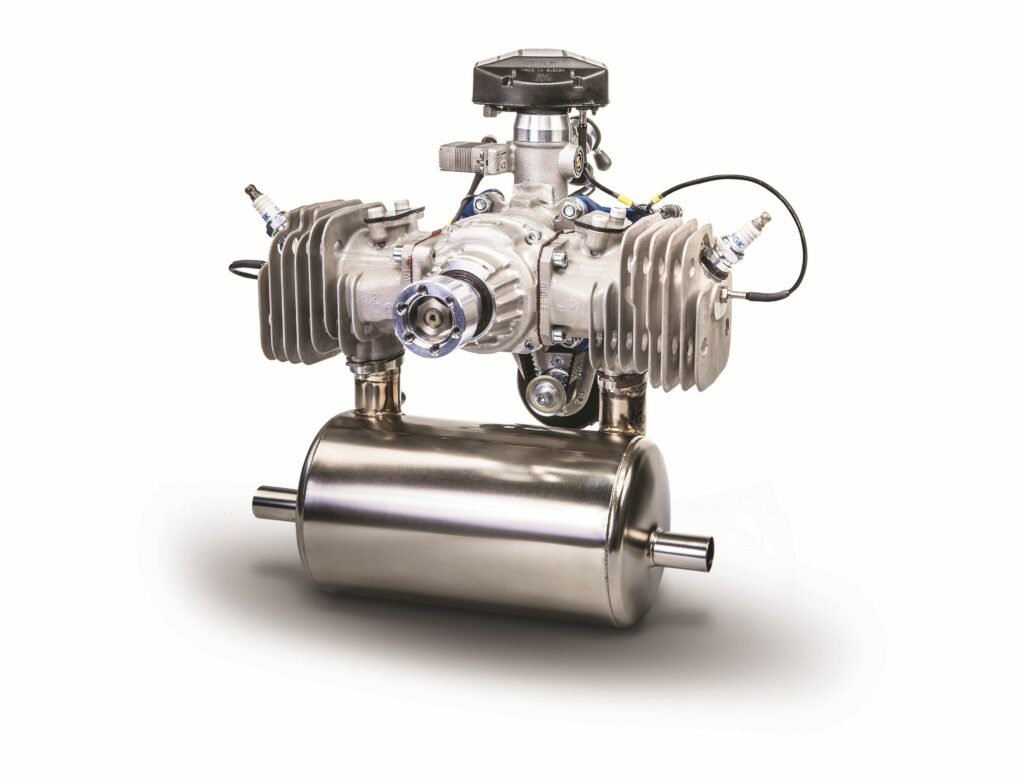
The product is air-cooled, displaces 103.4 cc (44 mm bore x 34 mm stroke) and it produces up to 6.7 hp with an optimal SFC of 440 g/kWh.
Additionally, the 4103’s TBO as of writing is 150 hours, with 300 hours being the next target pending further testing and qualification (the company emphasising that it would be just a top-end overhaul rather than a full, complete overhaul), with further upward revisions expected to follow as the technology is proven and matured.

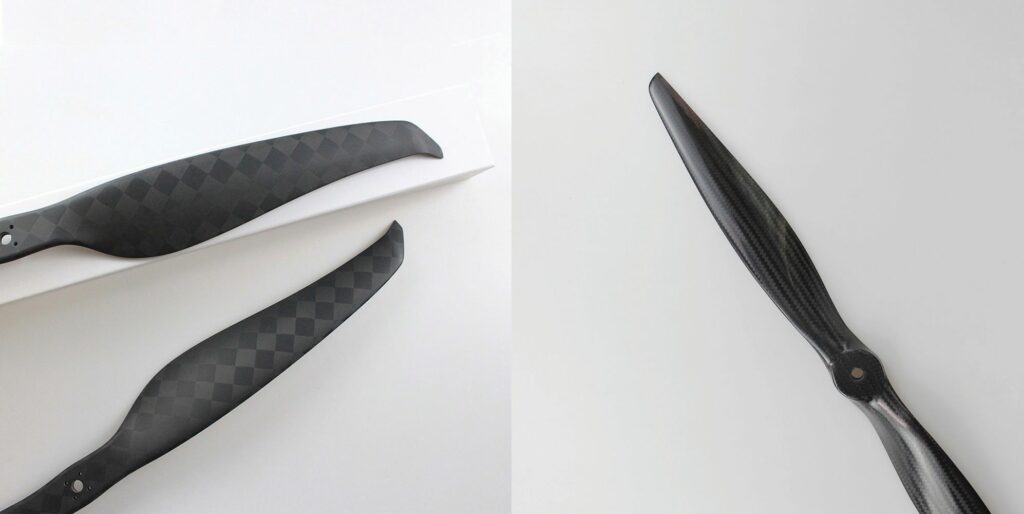
Lighter Propeller exhibited the full range of its propeller products, all of which are manufactured from carbon composite, and the solutions therein are categorised across fixed-wing and multi-rotor airframes, as well as electric and gasoline propulsion.
The Malaysian manufacturer also caters to varying sizes of UAVs, its standard-issue propeller diameters running from 14 to 80 in.
“For electric fixed-wing drones, we offer our EFD, EFB and EFC series of propellers,” explained Vicky Lee at Lighter Propeller.
“While EFB is a balanced, all-around design, EFD is designed for long-endurance cruising with heavy payloads, and EFC is for high-speed flight including attritable drones. Our EFFA propellers are also manufactured with foldable blades for multi-rotors that need to be transported easily.”
The company provides its GFB propellers as a long-endurance gasoline propulsion driver, while the GFA range is a more balanced design for integrators looking to trade some endurance for speed.
Its MD multi-rotor props have been optimised through CFD to target significant noise reductions and aero efficiency improvements over other, more mass-produced propellers in the UAV market, while its MDU multi-rotor propellers are a specialised ultra-lightweight design, which the company claims is 15–55% lighter than comparable products. And, again, foldable propellers are offered in the MDF range.
On top of these, Lighter manufactures an FB series of small, rigid, three-bladed propellers as a stronger alternative to the plastic props used by FPV drones, as well as a VB series for VTOL-transitioning drones.
All manufacturing processes are retained either in-house or locally (Lighter being the source manufacturer for numerous other propulsion product brands); hence, Lighter can also provide varying finishes – including glossy, matte, polished or with painted winglets – for specific aesthetic needs, or produce larger, more cost-optimised batches of propellers upon request.
UPCOMING EVENTS